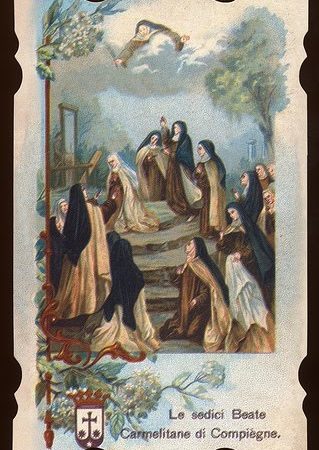
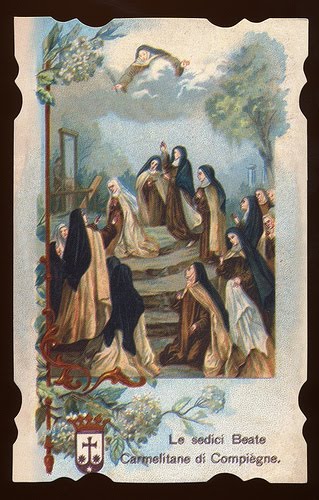
The Feast Day of Bl. Rose Chretien is celebrated on July 17. It is also the Feast of the Carmelite Martyrs of Compiegne. She was born near Eureaux, France in 1741.
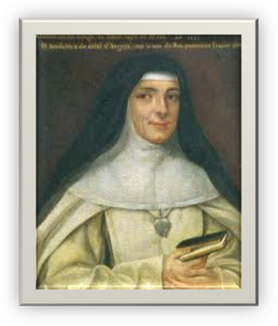
Bl. Rose married at a young age and soon became a widow. She decided to join the Discalced Carmelite Order and became a choir nun. At her profession in 1777 she took the religious name of Sister Julia Louise of Jesus.
Bl. Rose is considered one of the Carmelite Martyrs of Compiegne. The sixteen Carmelites were imprisoned along with English Benedictine nuns. The Carmelites were condemned as traitors and sentenced to death by guillotine. As they were martyred, one by one, they renewed their vows and chanted the hymn Veni Creato Spiritus which was the hymn sung at their ceremony professing their vows.
Several days after their deaths, the persecution called the Reign of Terror led by Robespierre came to an end. The English Benedictine Nuns credited the Carmelites with ending the bloodbath and saving their community.
The Carmelite Sisters were buried in a common grave at Picpus Cemetery with a single cross where 1306 other victims of the guillotine were buried.
Those who do something for the glory of God are not troubled by failure, because they have already achieved their pupose of pleasing God, by acting with a pure intention.
Quote of St. Alphonsus Liguori, Feast day August 1
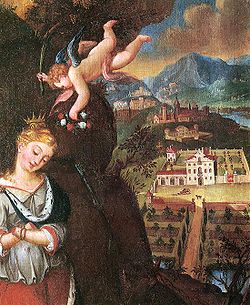
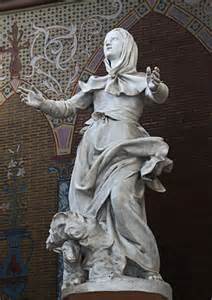
The Feast Day of St. Eurosia is celebrated on June 25. St. Eurosia is considered the patron saint against bad weather.
St. Eurosia was a French martyr. She was born in Bayonne, France into a noble family. Betrothed against her will to a Moore, she escaped through the mountains and hid in a cave. Eurosia was pursued and captured. Her captures dragged her out of the cave by her hair. She was then martyred. Her limbs were amputated and then she was beheaded. At the moment of her death a violent storm came which terrorized her captures.
St. Eurosia’s remains were discovered by a shepherd. Her head remained at the original shrine, but her body was taken to Jaca for burial. Miracles were reported at the original shrine which became a site of pilgrimage.
St. Eurosia was canonized by Pope Leo XIII.
Where the sign of the cross is erected,
the wickedness of the devil is immediately repelled.
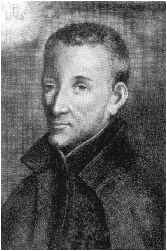
The Feast Day of St. John Francis Regis is celebrated on June 16. He was a Jesuit priest from France.
St. John Francis Regis was born into a wealthy family in southern France. He entered the Society of Jesus at age 19. After his ordination as a Jesuit priest he became a missionary working in various French towns. He would walk from town to town preaching from the heart. His speaking style was simple but poetic. He was easy to understand and his zeal attracted many people. He usually heard confessions in the morning and visited prisons and hospitals in the afternoon. His preaching missions successfully converted many people and brought others back to the faith.
St. John Francis Regis was well known for his work with at-risk women and orphans. He established safe houses and helped the unemployed find work. He led many to be trained as lace makers, giving them a stable income.
While serving on a mission in 1640, St. John Francis Regis died. He spent his last day meditating on the crucifix. His last works were:
“Into thy hand I commend my spirit”.
St. John Francis Regis was canonized in 1737. Regis Societies were formed throughout France to provide services for the poor and marginalized.
The incomparable heart of the Mother of the Redeemer is a glorious heaven,
The Feast Day of St. Germaine Cousins is celebrated on June 15. St. Gemaine was born in the small village of Pebrac, France in 1579. Her mother died soon after her birth. Germaine was born with a paralyzed right arm and a disease which caused abscesses around the neck.
Her father soon remarried. The step-mother treated her harshly, refusing to let her sleep in the house. Germaine slept on a mattress of hay in the stable or in the cupboard under the stairs. She was underfed being given only scraps of food and forbidden to play with her step-siblings.
At an early age, Germaine was given the chore of caring for the family sheep. While caring for the sheep, Germaine developed a relationship with God, attending Mass whenever possible. When she heard the nearby church bells ring, she entrusted the sheep to her guardian angel so that she could receive communion. The sheep were always found safe on her return.
One day in the winter the village people saw the stepmother pursuing Germaine and accusing her of stealing bread and concealing it in her apron. She threatened to hit her with a stick and Germaine opened her apron. Summer flowers fell to the ground. After this incident the parents decided she had been touched by God and invited her to live in the house. Germaine, however, refused. She preferred to go on living as she had been.
One morning in 1601 she was found dead in the cupboard under the stairs at the age of 21. After her death her body became very beautiful. Word spread and many people came to see the change. She was buried in the church of Pibrac. Forty three years later when a relative had died and was to be buried, her body was exhumed and found to be incorruptand flexible.
St. Germaine was canonized on June 29 1867 by Pope Pius IX.
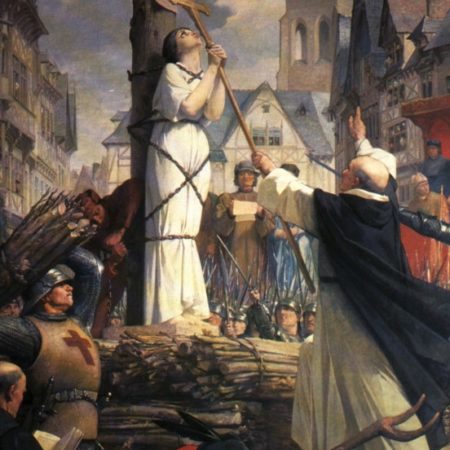
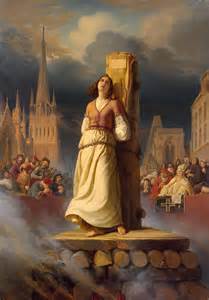
St. Joan of Arc Burning at Stake Public Domain Image
St. Joan of Arc was born in Domremy, Francs in 1412 on the Feast of the Epiphany on Jan. 6. Her parents, Jacques and Isabelle were peasants. She was the youngest of four children, having three older brothers. She helped her mother with spinning and helped shepherd the animals. She was very devout as a child enjoying her religious faith and spending her free time in church.
St. Joan grew up during the “Hundred Years War”, which never seemed to end. The French were losing the war while she was young. England was invading the country of France causing much suffering. Joan prayed with great devotion and fervor for the suffering people.
At the age of thirteen, Joan began to have visions and hear voices which counseled her. She claimed to hear the Voice of God, Michael the Archangel,St. Catherine of Alexandria and St. Margaret of Antioch. In 1428, the voices told her to go tho the King of France and help him reconquer his kingdom. She was told to accompany Prince Charles to his coronation. St. Joan went to the town of Vaucouleurs seeking help from the military commander. After three trips he decided to listen to her.
She was given an escort of six which included two knights. They left on Feb. 23, 1429. The journey was 400 miles, taking eleven days in the winter to travel. She was given permission to meet with Prince Charles VII. However, he concealed himself in the crowd to test Joan. Joan, however, recognized him. St. Joan spoke to him, saying:
“I am Joan the Maid and to you is sent word by me from the King of Heaven that you will be anointed and crowned in Reims and you will be Lieutenant to the King of Heaven who is King of France.”
After being questioned by clerics who asked for a sign Joan was eventually given a sword, armor and a banner with the names of Jesus and Maria to lead the French Army to Tours in 1429. She was only 17 years old.
St. Joan led French troops against the English and recaptured the cities of Orleans and Troyes. Prince Charles was then anointed King with St. Joan at his side holding the banner in 1429.
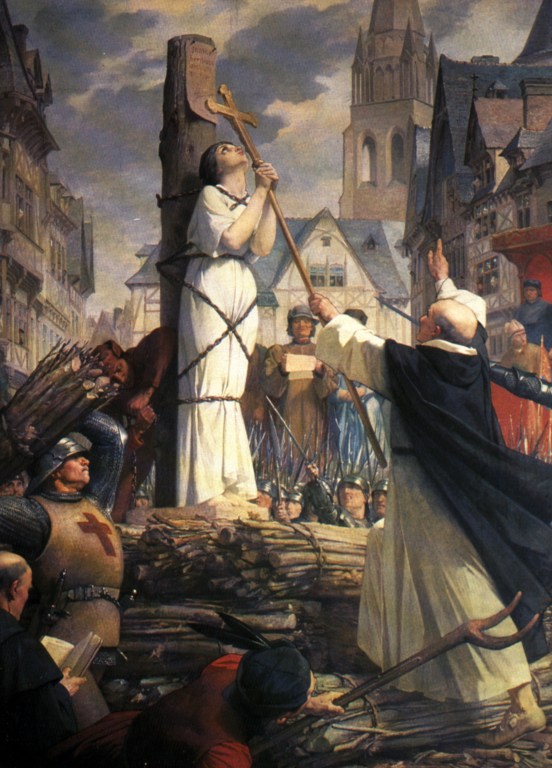
St. Joan of Arc Burning at Stake Public Domain Image
St. Joan was later captured and then sold to the English. Joan spent six months in prison before she was put on trial for heresy and witchcraft. After being found guilty she was burned at the stake in 1431. Her ashes were scattered in the Seine River. A second trial was held 25 years later which overturned the first verdict because it was politically motivated. Joan was declared a martyr.
St. Joan was beatified by Pope Pius X and canonize by Pope Benedict XV in 1920 who said that she is a “most brilliantly shining light of God.”
I know this now,
Every man gives his life for what he believes.
Every woman gives her life for what she believes.
Sometimes people believe in little or nothing.
One life is all we have and we live it as we believe in living it and then it’s gone.
But to surrender what you are and to live without belief
is more terrible than dying…even more terrible than dying young.
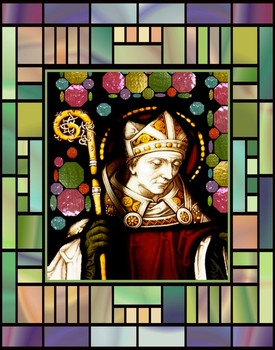
The Feast Day of St. Germanus of Auxerre is celebrated on May 28. He served as the Bishop of Paris.
St. Germanus of Auxerre was born in 496 near Autun, France. He was ordained by St. Agippinus the Bishop of his diocese. He became the Abbot and administrator of St. Symphorianus, a suburb of Autun. Although at first he declined the position, he was named Bishop of Paris in 566. He was known as an eloquent preacher who brought conversion and the Christian faith to many people. Under his influence the lifestyle in the city became less worldly and vain. He tried to end civil strife and the licentiousness of the kings and nobles.
St. Germanus was known to have received the gift of miracles and prophecy. After his death on May 28, 576, King Chilperic wrote his epitaph praising his virtues, miracles and the zeal he displayed in working for the salvation of souls.
For the Christian there is no such thing as a “stranger.” There is only the neighbor…..the person near us and needing us.
The Feast Day of St. Eugene de Mazenod is celebrated on May 21.
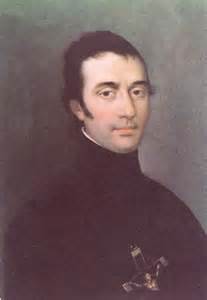
St. Eugene Mazenod was born in Aixen Provence, France in 1782 on August 1. He was born into a wealthy family during the French Revolution. Because of the Revolution his family fled France and lived in exile for eleven years. His family life was filled with turmoil and fighting. Although Eugene tried to keep his family together, his parents eventually divorced. At the age of 20, Eugene returned to France. After having a mystical experience at the foot of the cross on Good Friday in 1807 Eugene was led to enter the seminary of Saint Sulpice in Paris in 1808. He was ordained a priest on Dec. 21, 1811 at Amiens, France.
As a priest, Eugene began by serving those in prison and the youth. He founded the Missionaries of Provence, asking the Pope directly that his group be recognized. It was approved by Pope Leo XII in 1826 under the name “Oblates of Mary Immaculate”. As Superior General St. Eugene led and inspired his missionaries for 35 years until his death. They worked with the youth, cared for shrines, worked in the prisons and heard confessions. Because of his zeal he earned the nickname, “the second Paul”.
In 1832, St. Eugene was named Auxiliary Bishop of the Diocese of Marseilles. Five years later he became the Bishop. As Bishop, he sent his missionaries to Canada the United States, Africa, Asia, Australia and Latin America. They would preach and baptize.
St. Eugene died at age 79. He was canonized by Pope John Paul II in 1955. There are over 4000 Missionary Oblates in 67 countries today. St. Eugene de Mazenod is the patron saint of dysfunctional families.
In spiritual life, when you cease to climb, you begin to descend.
The Feast Day of St. Ivo of Kermartin is celebrated on May 19. St. Ivo is the patron saint of lawyers, judges, orphans and widows.
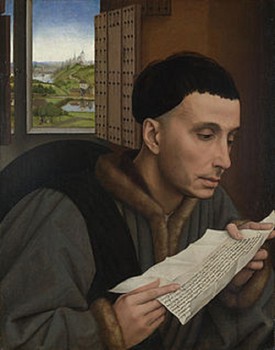
St. Ivo was born in Kermarton, Brittany, France on Oct. 17, 1253. He studied at the University of Paris, becoming a lawyer. He quickly became well known for his knowledge of philosophy, theology and canon law. He was appointed a judge of the Ecclesiastical Court and received minor orders. It is believed he entered the Third Order of Franciscans. He was ordained a priest in 1284.
St. Ivo’s defense of the downtrodden earned him the title “Advocate of the Poor.” He often visited the poor in prison and payed their expenses. He refused to take bribes which was a common corruption of that time.
Eventually, St. Ivo was elected as an official for the Bishop of Treguier. In this position he resisted the taxation imposed upon the church. St. Ivo also built a hospital. St. Ivo served as a parish priest for 18 years. He died on May 19, 1303 at the age of 50. He was canonized by Pope Clement VI in 1347.
The truth that many people never understand, until it is too late, is that the more you try to avert suffering the more you suffer, because smaller and more insignificant things begin to torture you in proportion to your fear of being hurt.
The Feast Day of St. Simon Stock is celebrated on May 16.
Little is known about the early life of St. Simon Stock. Legend has told us that from the age of twelve he lived as a hermit in a hollow tree trunk. As a young man he went on a pilgrimage to the Holy Land. There, he joined a group of Carmelites. They returned together to Europe.
St. Simon was elected Superior General of his Order in London in 1254. St. Simon founded many Carmelite Communities in Cambridge, Oxford, Paris and Bologna. He was instrumental in the transition from a hermit Order to an Order of mendicant friars.
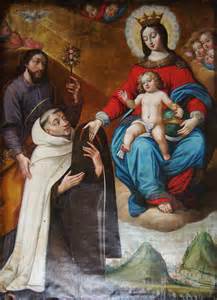
In 1251 he experienced an apparition during a time when the order was being oppressed. The Virgin Mary appeared to him holding the brown scapular in one hand. She told him,
“Receive, my beloved son, this scapular of thy Order; it is a special sign of my favor which I have obtained for thee and thy children of Mt. Carmel. He who dies clothed with this habit shall be preserved from eternal fire. It is the badge of salvation, a shield in time of danger and a pledge of special peace and protection.”
The scapular is made of two squares of cloth connected by strings. It is worn over the shoulders, one on the chest, one on the back.
The promise from the Virgin Mary is believed to mean that Carmelites who live their vocation well, with love and sincerity will be saved. It is a reminder that Mary is their role model in love. The Carmelite Order is a contemplative Order which focuses on contemplative prayer. Mary leads those in the Carmelite Order to a deeper love of Jesus Christ, the Eucharist and the Beatitudes. The role models for the Carmelite Order are the Virgin Mary and the prophet Elijah. It was Elijah who heard the voice of God in the whisper of the gentle breeze.
St. Simon Stock was known to have a special gift of miracles and prophecy. St. Simon Stock. died on July 16, 1265 in Bordeaux, France.
God whispers to us in our pleasures, speaks in our conscience,
The Feast Day of St. Marie de l’Incarnation is celebrated on April 30.
St. Marie de l’Incarnation was born in Tours, France. She was the daughter of a baker. Against her will she married Claude Martin, a silk manufacturer at the age of 17. She had one son. Two years later she became a widow and worked as an embroiderer.
St. Marie experienced a vision in which she saw all of her faults and human frailties. Then she was immersed in the Blood of Christ. This transformed her and led her to become an Ursuline Nun at Tours, France. Her son became a Benedictine priest. She experienced another vision which led her to become a missionary to Canada. She came to New France (Quebec) on July 4, 1634. She worked as a missionary with the Jesuits in Canada. She taught the children of both the natives and the settlers.
St. Marie de l’Incarnation died on April 30, 1762 from hepatitis.
St. Marie de l’Incarnation was both a mystic and writer. She experienced many visions. St. Marie de l’Incarnation was canonized on April 3, 2014 by Pope Francis.
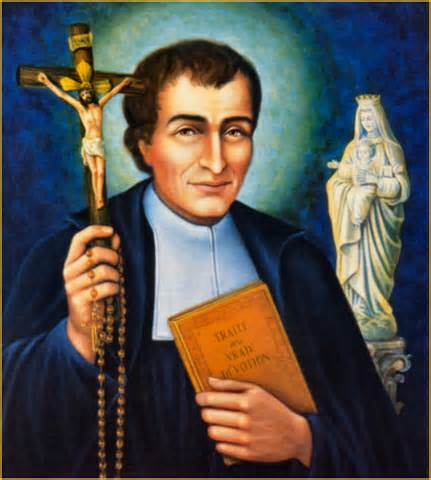
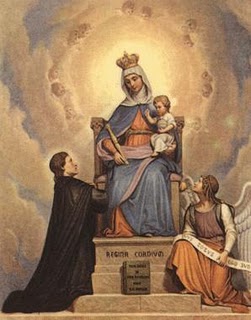
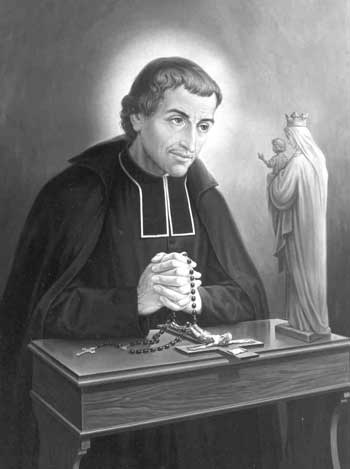
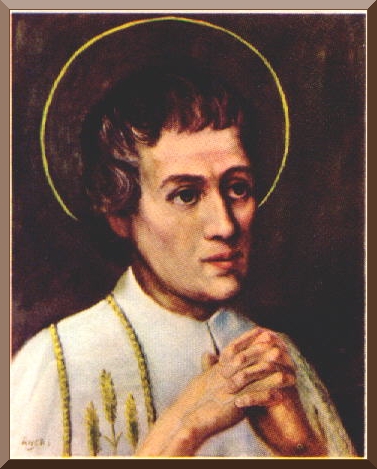
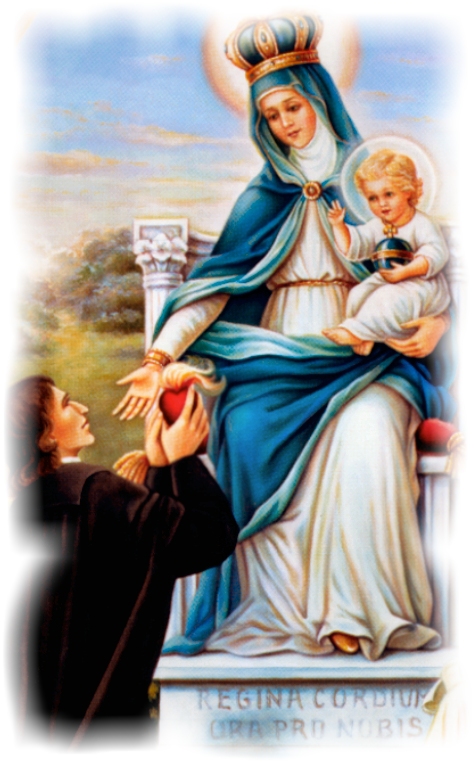
The Feast Day of St. Louis Marie de Montfort is celebrated on April 28.
St. Louis de Montfort was born on Jan 31, 1673 at Montfort, France. As a child he had a profound devotion to praying before the Blessed Sacrament. At the age of 12 he entered a Jesuit College in Rennes. While at college he visited church before and after class. He joined a society of men who ministered to the poor and the sick. He would read to those in the hospital during their meals. He studied theology in Paris. At the age of 27 he was ordained in 1700 and assigned as a hospital chaplain at Poitiers. He reorganized the staff which resulted in great resentment and his resignation.
Pope Clement XI appointed him to be a missionary and he went to Brittany to preach. He was an emotional preacher and was successful in spreading the devotion to the Blessed Virgin through the Rosary. He wrote “True Devotion to the Blessed Virgin” and “The Secret of the Rosary” which were very popular books. He was also known for his devotion to the angels; especially guardian angels.
For 17 years he preached the gospel in towns and villages. His preaching was known to move men to cry and beg for forgiveness. St. Louis preached against Jansenism. He founded the Daughters of Wisdom who worked in the hospitals and teaching girls and the Company of Mary which was for missionaries. St. Louis organized several priests into the Company of Mary in 1715. The Company of Mary was led for 39 years by Father Mulot who at first refused to join the Company due to being paralyzed on one side. He was however cured of his disability when he began to preach.’
St. Louis de Montfort fell ill and died on April 28, 1716.
Imitate the virtues of the Blessed Virgin, particularly her profound humility, her lively faith, her blind obedience, her continual prayer.
The Feast Day of St. Mary Pelletier is celebrated on April 24.
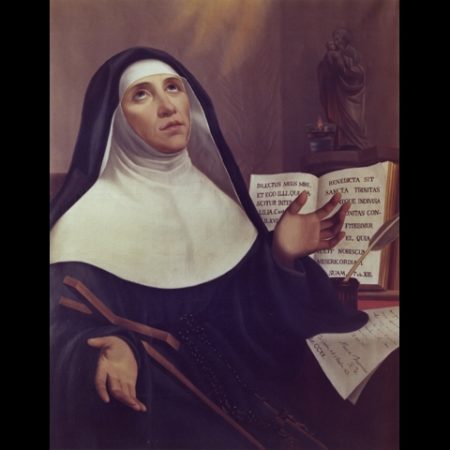
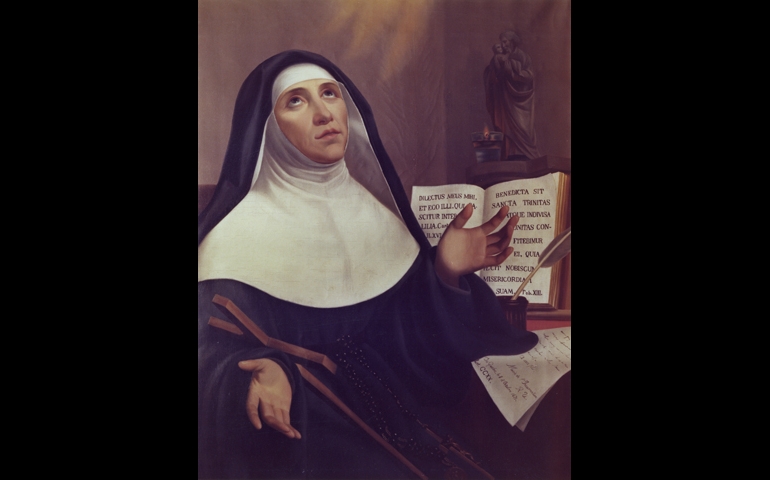
Rose Virginie Pelletier was born on July 3l, 1796 on the island of Noirmoutier, Vendée, off the west coast of France. She was the eighth child of Dr. Julian and Anne Pelletier.
It was wartime in France during her childhood. Her family became isolated because her father had treated an enemy soldier. As a child she was very independent but quite compassionate. Her father died when she was only ten years old. Rose was not able to attend school until the Ursuline Sisters opened a school in 1808 in Noirmoutier. While she enjoyed school she also clashed with authority. She was sent to a boarding school in 1810 where she experienced not only the loss of her freedom but loneliness. The boarding school was very strict. When her mother died in 1815 she was not told until after the funeral had taken place. She experienced profound grief.
Near the school was the convent of the Sisters of Our Lady of Charity of the Refuge which had been founded by St. John Eudes. It provided care for women and girls who were homeless. Rose was attracted to their mission and wanted to join the convent. Both her guardian and the boarding school disapproved. Rose, however, persisted and eventually she was allowed to join on the condition she would not make her vows until she was 21. When she made her vows she took the name Sister Mary of St. Euphrasia. She carried out her mission with great enthusiasm.
The mission grew rapidly and Mary saw the need to change the governmental structure in order to deploy sisters to other countries. After much struggle her plans were approved by the Pope. She then founded the Congregation of Our Lady of Charity of the Good Shepherd of Angers. They became known as the Good Shepherd Sisters.
The following quote is attributed to St. Mary Pelletier:
It is well known that I had neither riches nor talent, nor external charm, but I always loved, and I loved with all the strength of my soul.
St. Mary Pelletier eventually established 110 new convents in six continents before her death on April 24, 1868. She was known for her fortitude, cheerfulness and her trust in God.
St. Mary Pelletier was canonized by Pope Pius XII in 1910.