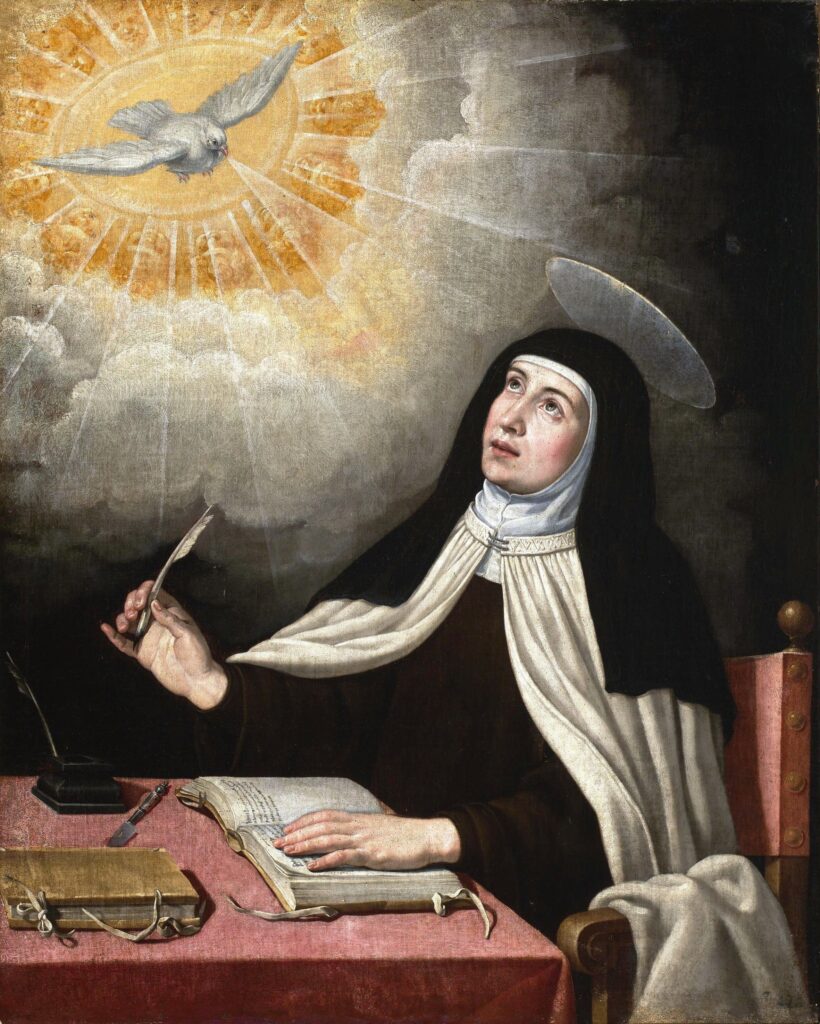
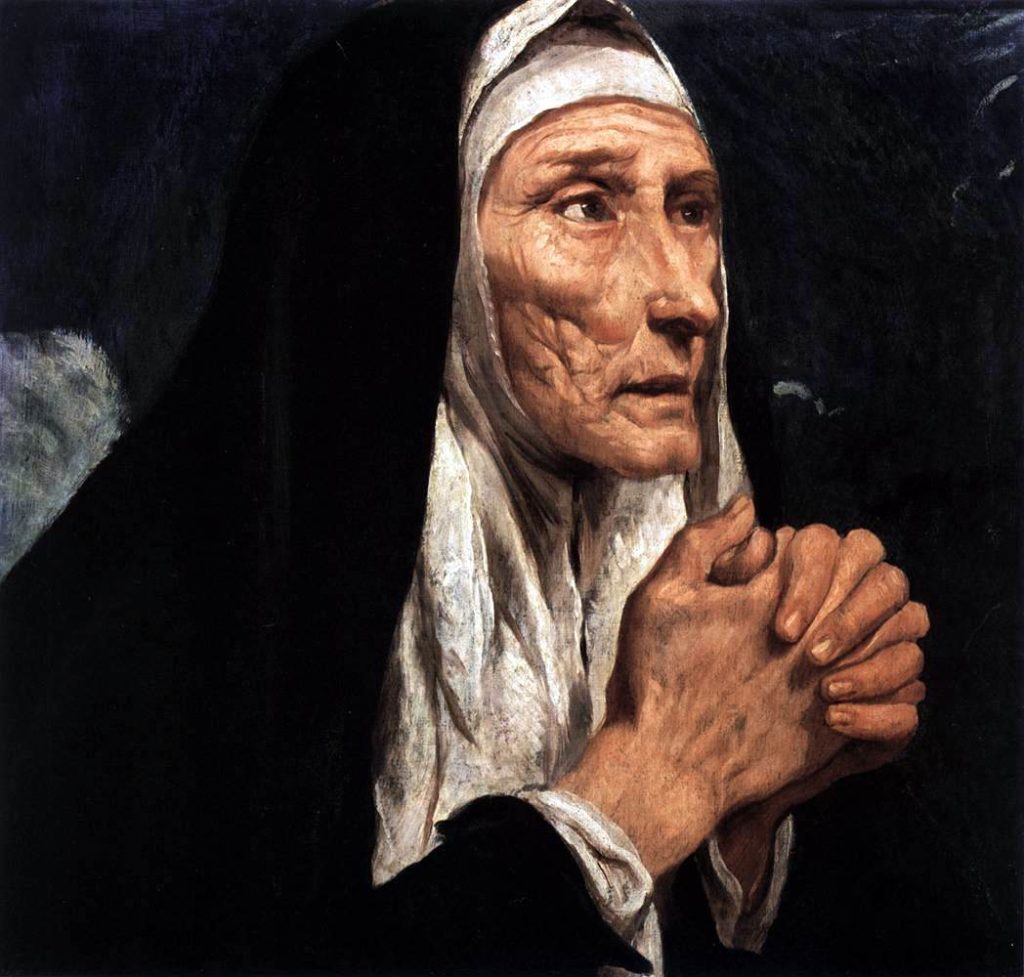
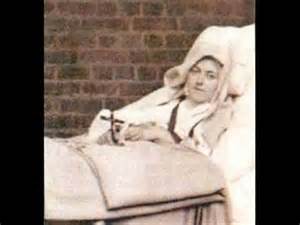
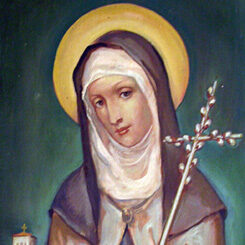
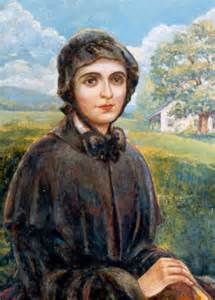
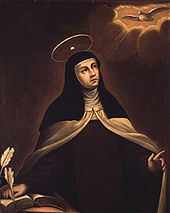
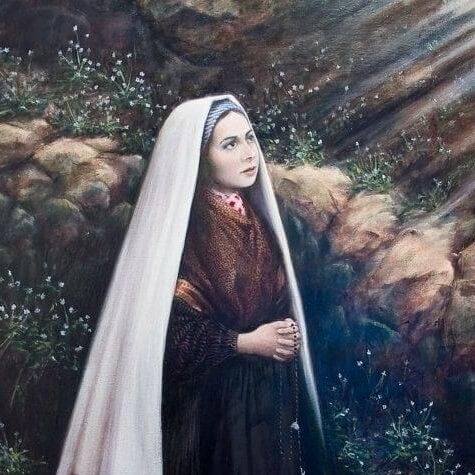
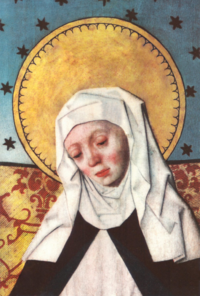
St. Teresa of Avila was a Spanish Carmelite nun and mystic. She was born in Avila Spain on March 28, 1515, one of ten children. Her mother died when Teresa was 15.
Invoked against bodily ills, headaches, and sickness, St. Teresa was canonized a Saint by Pope Gregory XV on March 12, 1622. The Feast Day of St. Teresa of Avila is celebrated on October 15.
Saint Teresa of Ávila was proclaimed Doctor of the Church by Pope Paul VI on 27 September 1970.
St. Teresa has written many books. These include: The Interior Castle, The Life of Teresa of Jesus, and The Way of Perfection. Her spirituality has led many to a much deeper prayer life.
Reflecting on the life of this Carmelite nun, let’s ponder her many quotes which reveal her spirituality.
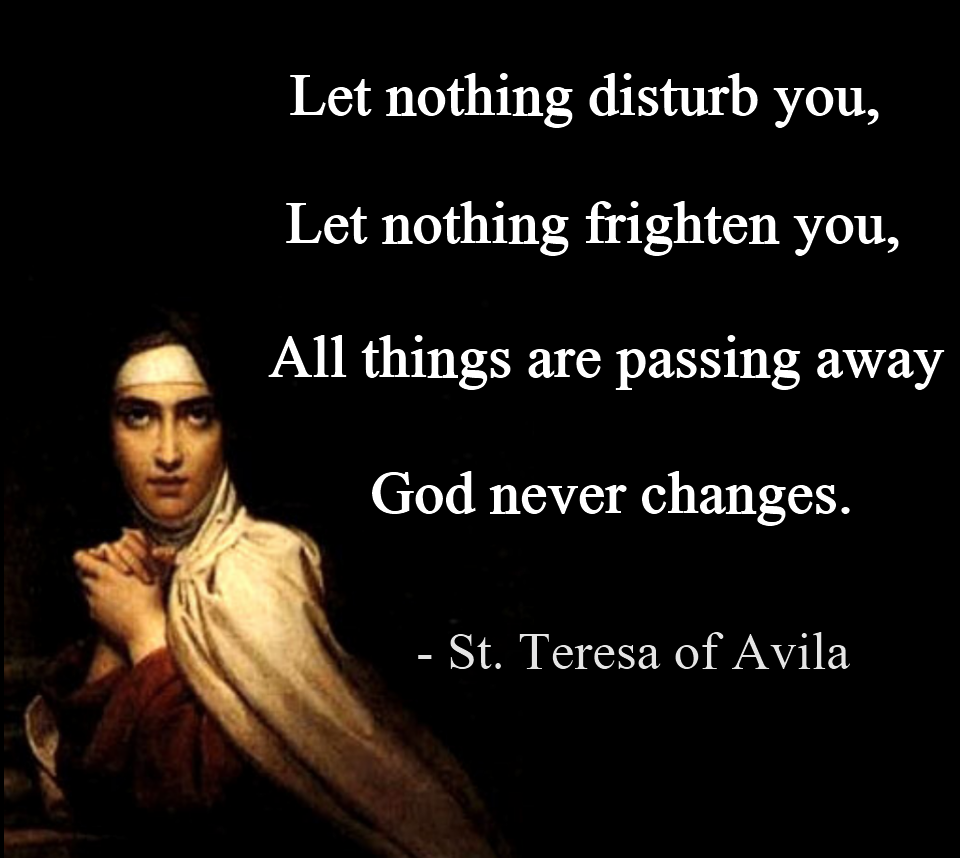
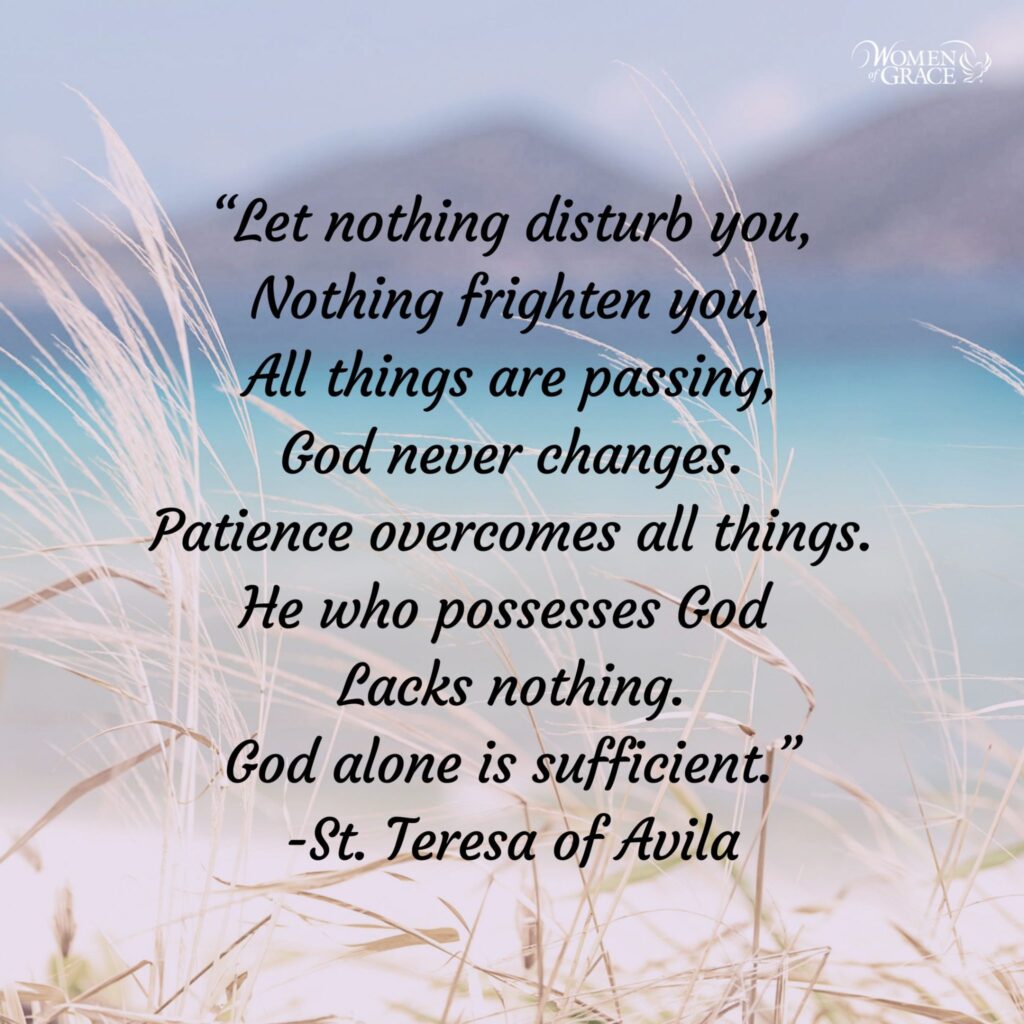
1. Let nothing disturb you. Let nothing frighten you. All things pass away. God never changes. Patience obtains all things. He who has God, finds he lacks nothing. God alone suffices.
St. Teresa of Avila
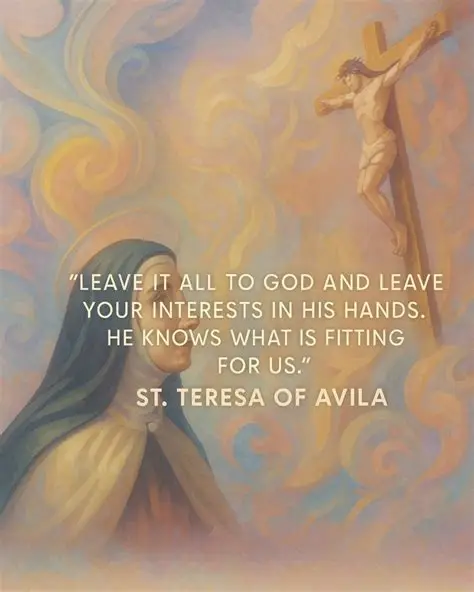
2. Leave it all to God and leave your interests in His hands. He knows what is fitting for us.
St. Teresa of Avila
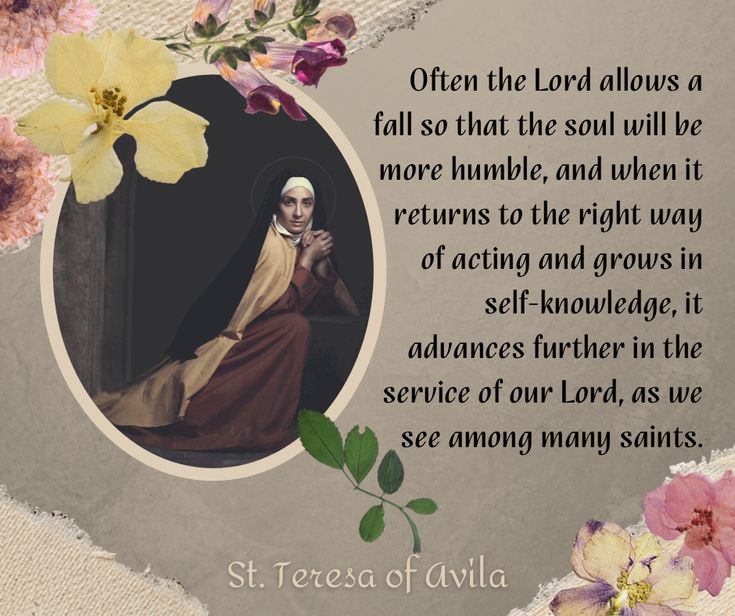
3. Often, the Lord allows a fall so that the soul will be more humble, and when it returns to the right way of acting and grows in self-knowledge, it advances further in the service of our Lord, as we see among many saints.
St. Teresa of Avila
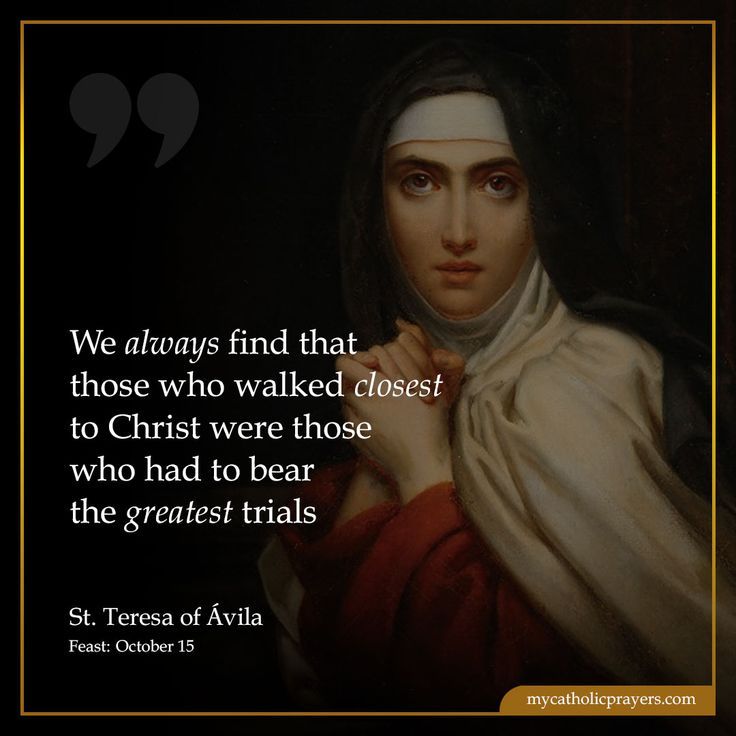
4. We always find that those who walked closest to Christ were those who had to bear the greatest trials.
St. Teresa of Avila
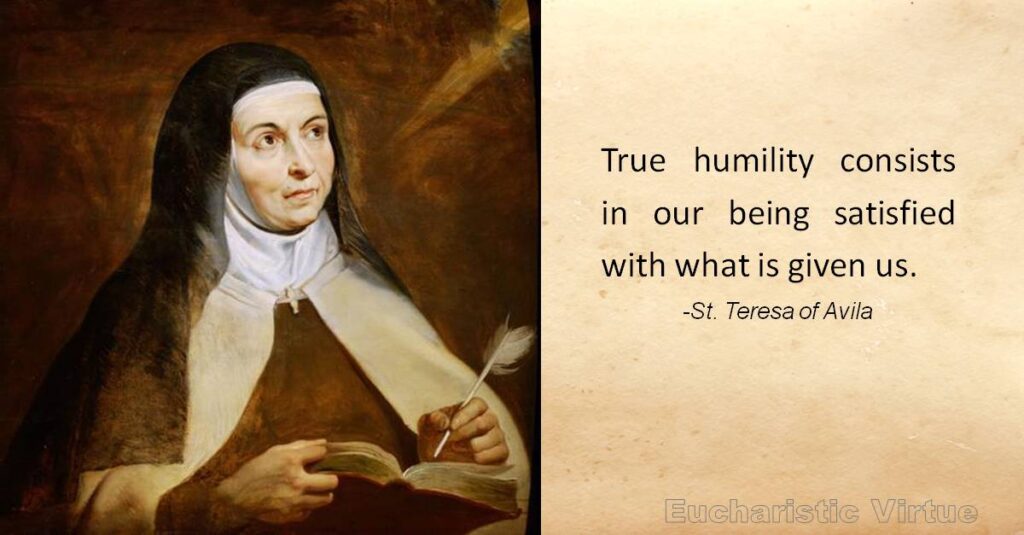
5. True humility consists in our being satisfied with what is given us.
St. Teresa of Avila
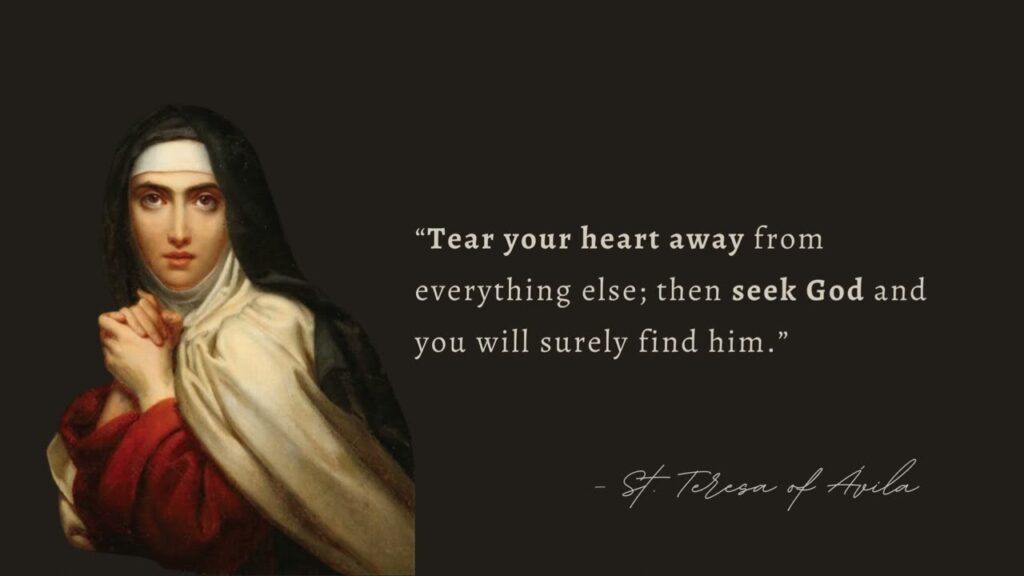
6. Tear your heart away from everything else, then seek God and you will surely find him.
St. Teresa of Avila
7. There are more tears shed over answered prayers than over unanswered prayers.
St. Teresa of Avila
8. Hope, O my soul, Hope! You know neither the day, nor the hour. Watch carefully, for everything passes quickly, even though your impatience turns a very short time into a long one.
St. Teresa of Avila
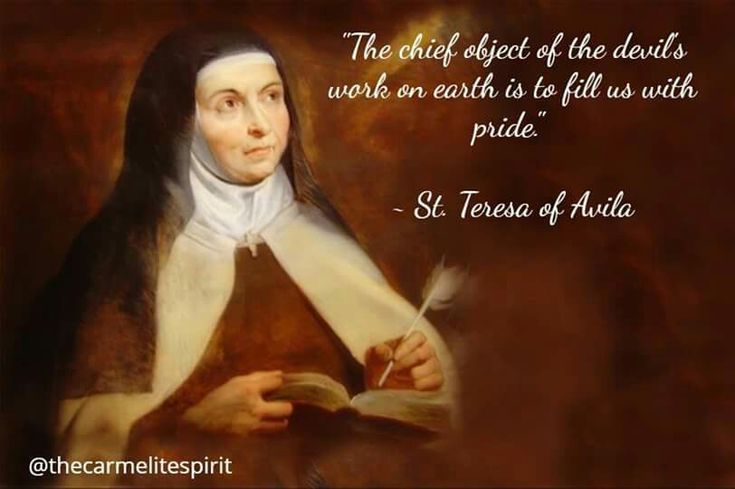
9. The chief object of the devil’s work on earth is to fill us with pride.
St. Teresa of Avila
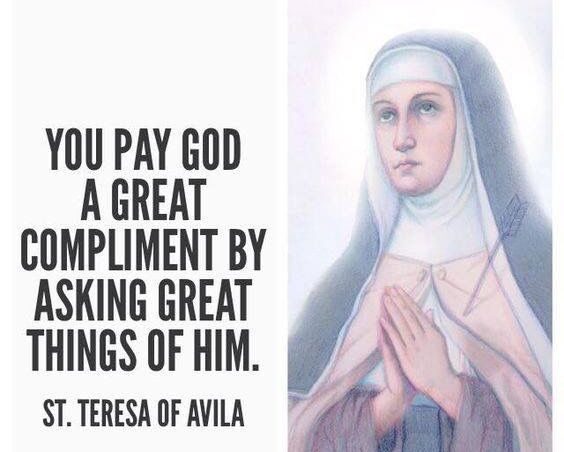
10. You pay God a great complement by asking great things of Him.
St. Teresa of Avila
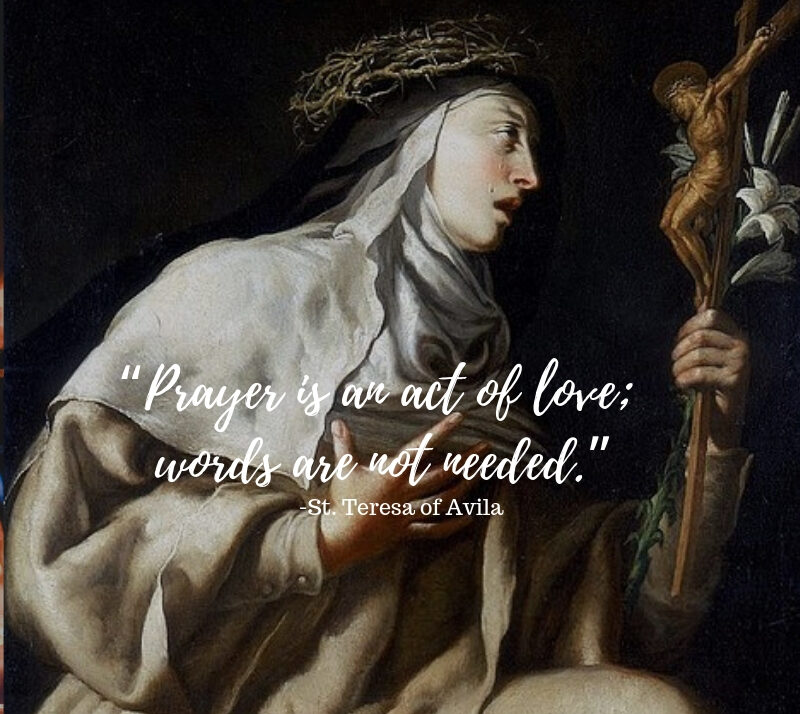
11. Prayer is an act of Love, words are not needed.
St. Teresa of Avila
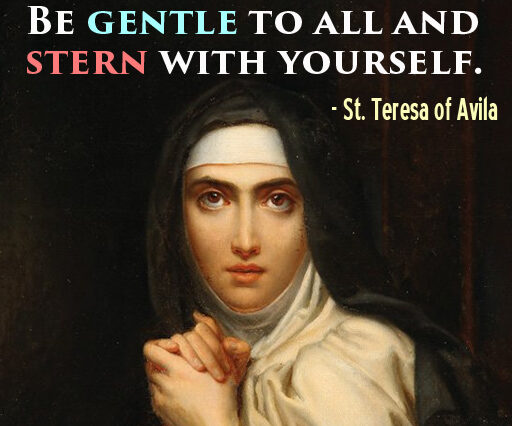
12. Be gentle to all and stern with yourself.
St. Teresa of Avila
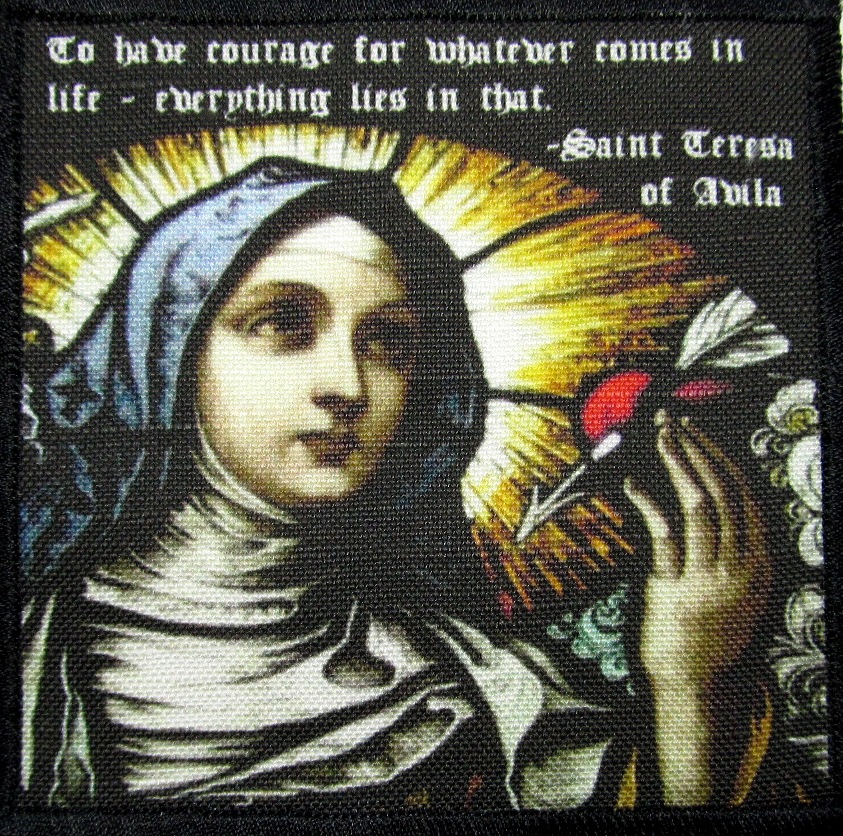
13. To have courage for whatever comes in life…everything lies in that.
St. Teresa of Avila
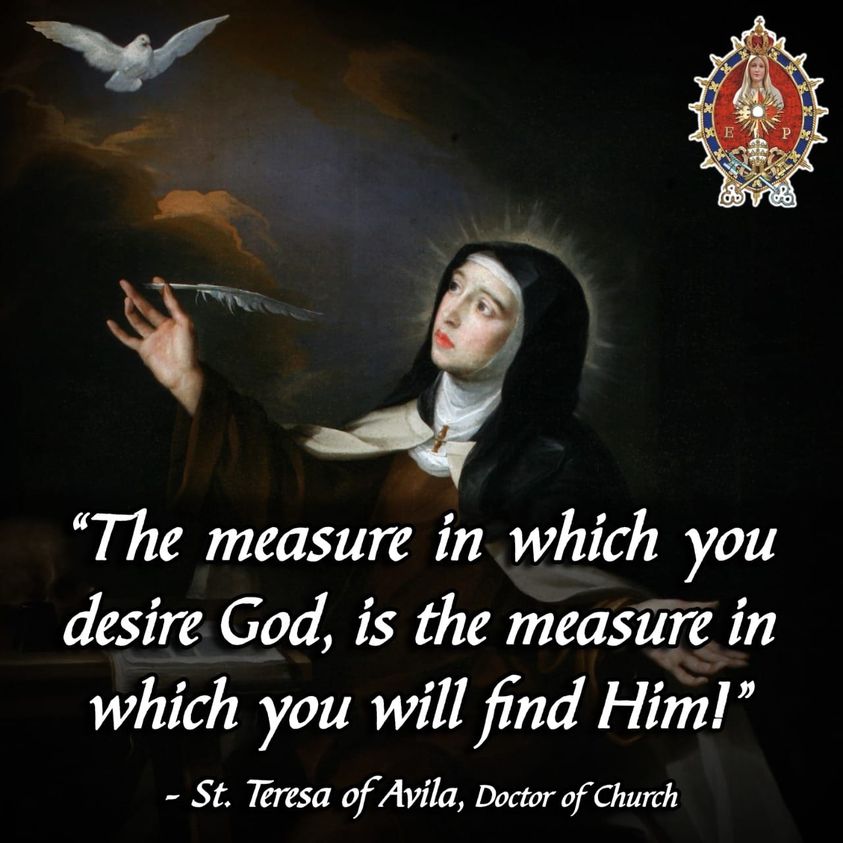
14. The measure in which you desire God, is the measure in which you will find Him!
St. Teresa of Avila
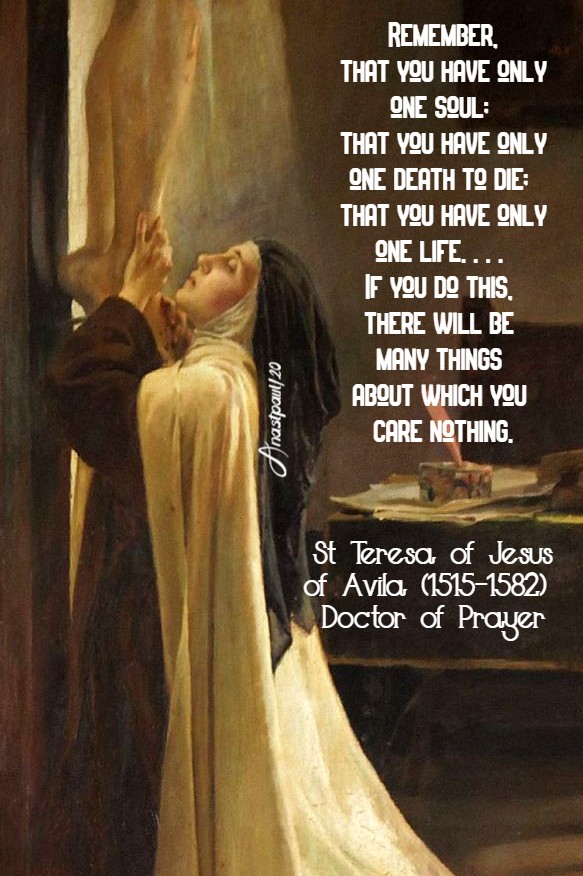
15. Remember, that you have only one soul: that you have only one death to die: that you have only one life…if you do this, there will be many things about which you care nothing.
St. Teresa of Avila
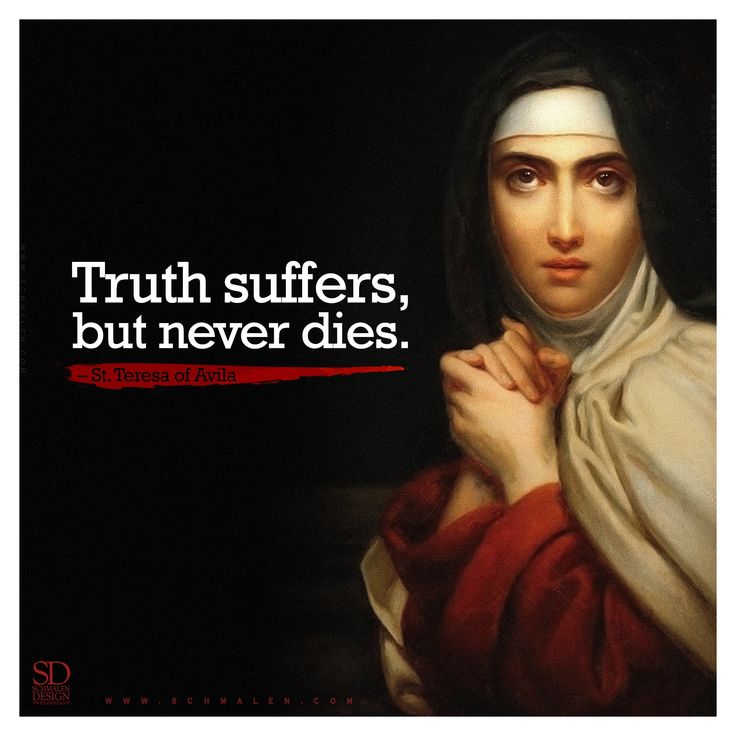
16. Truth suffers, but never dies.
17. It is love alone that gives worth to all things.
St. Teresa of Avila
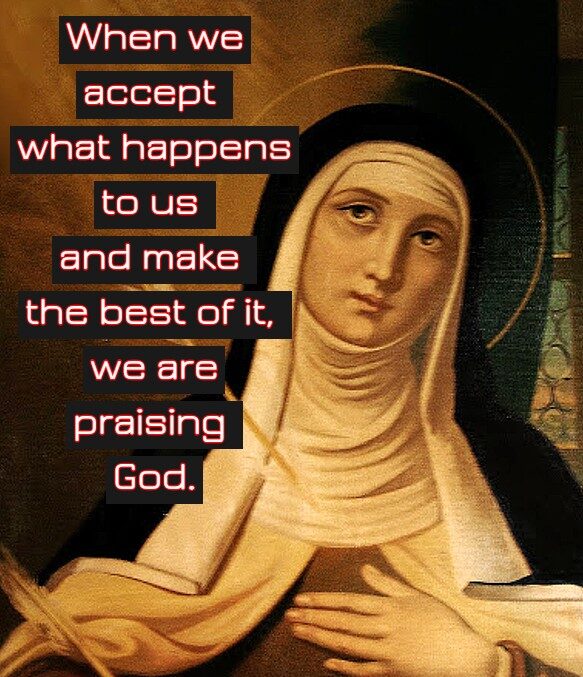
18. When we accept what happens to us and make the best of it, we are praising God.
St. Teresa of Avila
19. In this life our lot is not to enjoy God, but to do His Holy Will.
St. Teresa of Avila
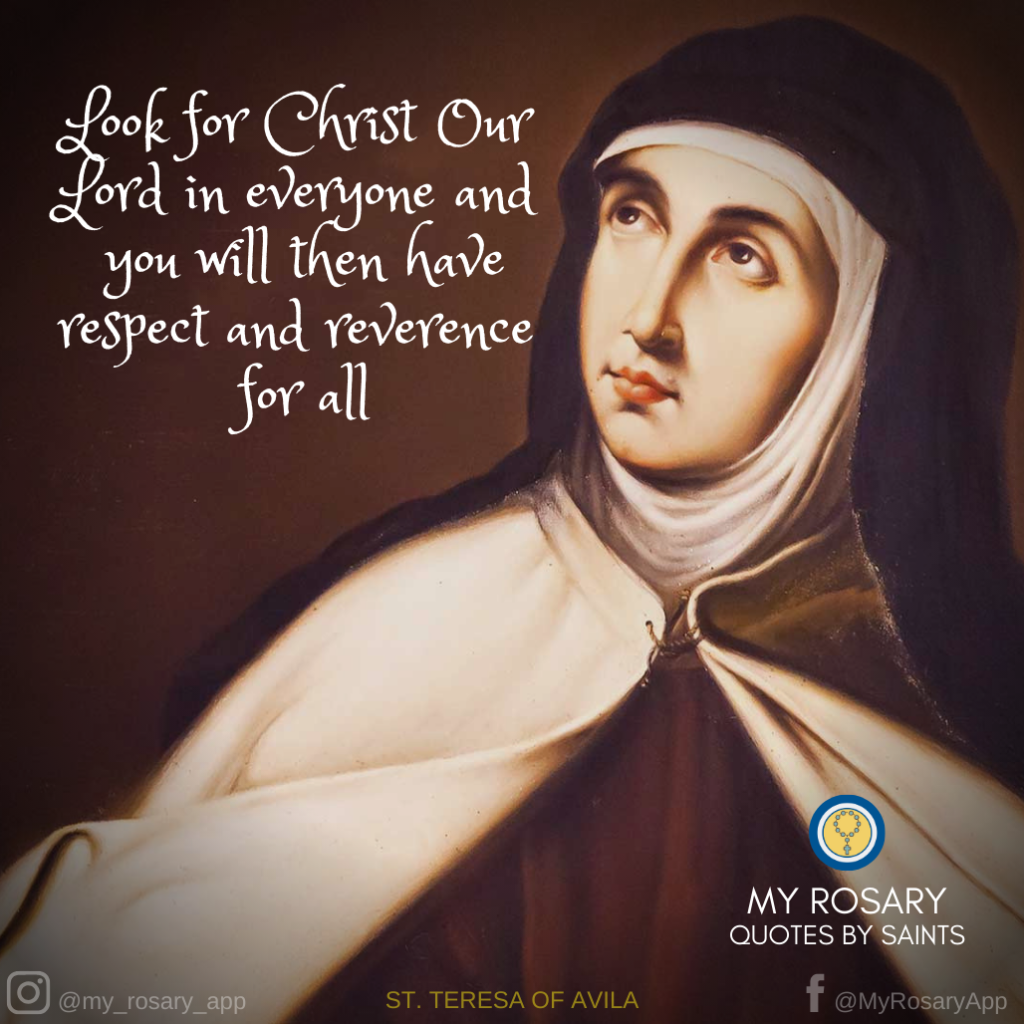
20. Look for Christ Our Lord in everyone and you will then have respect and reverence for all.
St. Teresa of Avila
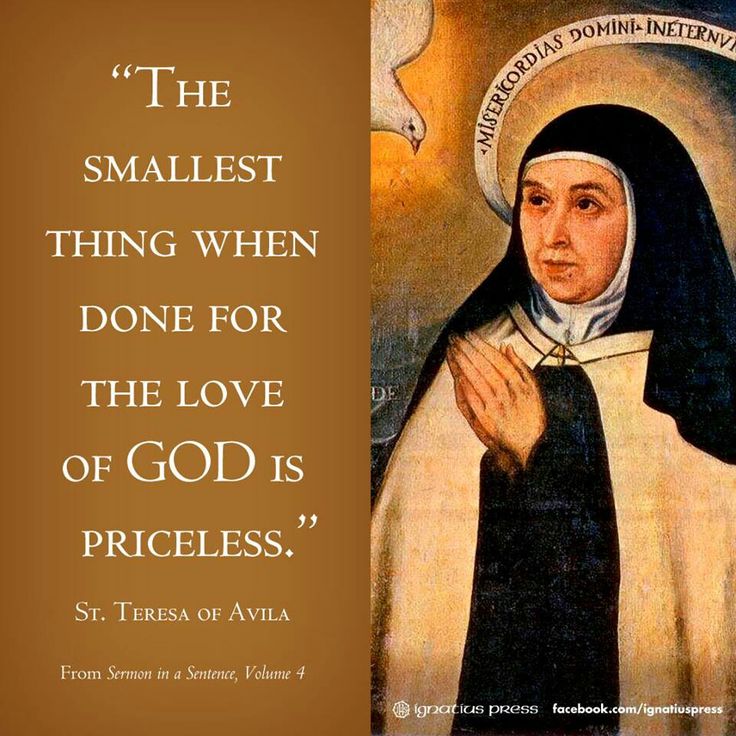
21. The smallest thing when done for the love of God is priceless.
St. Teresa of Avila
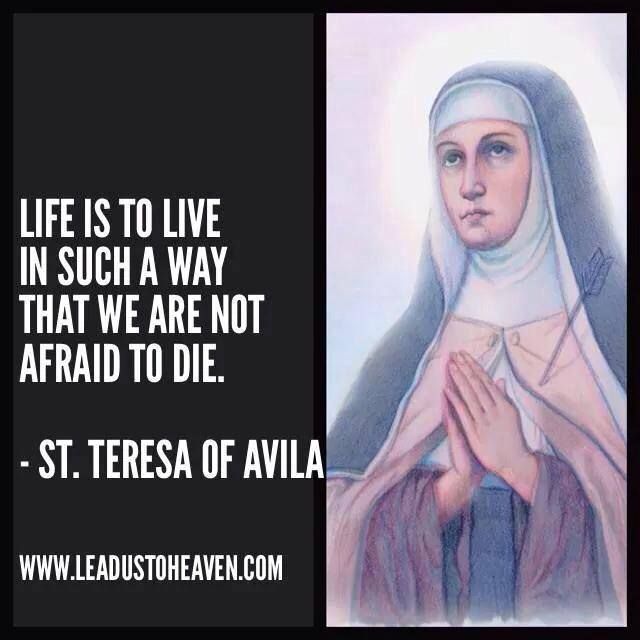
22. Life is to live in such a way that we arenot afraid to die.
St. Teresa of Avila
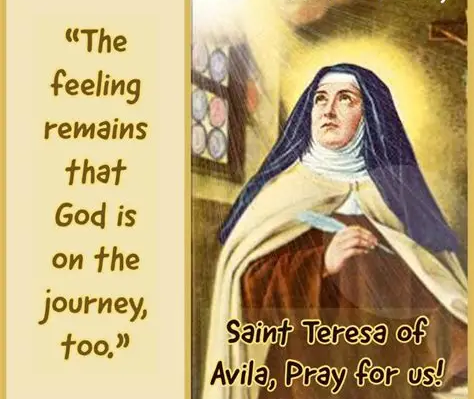
23. The feeling remains that God is on the journey too.
St. Teresa of Avila
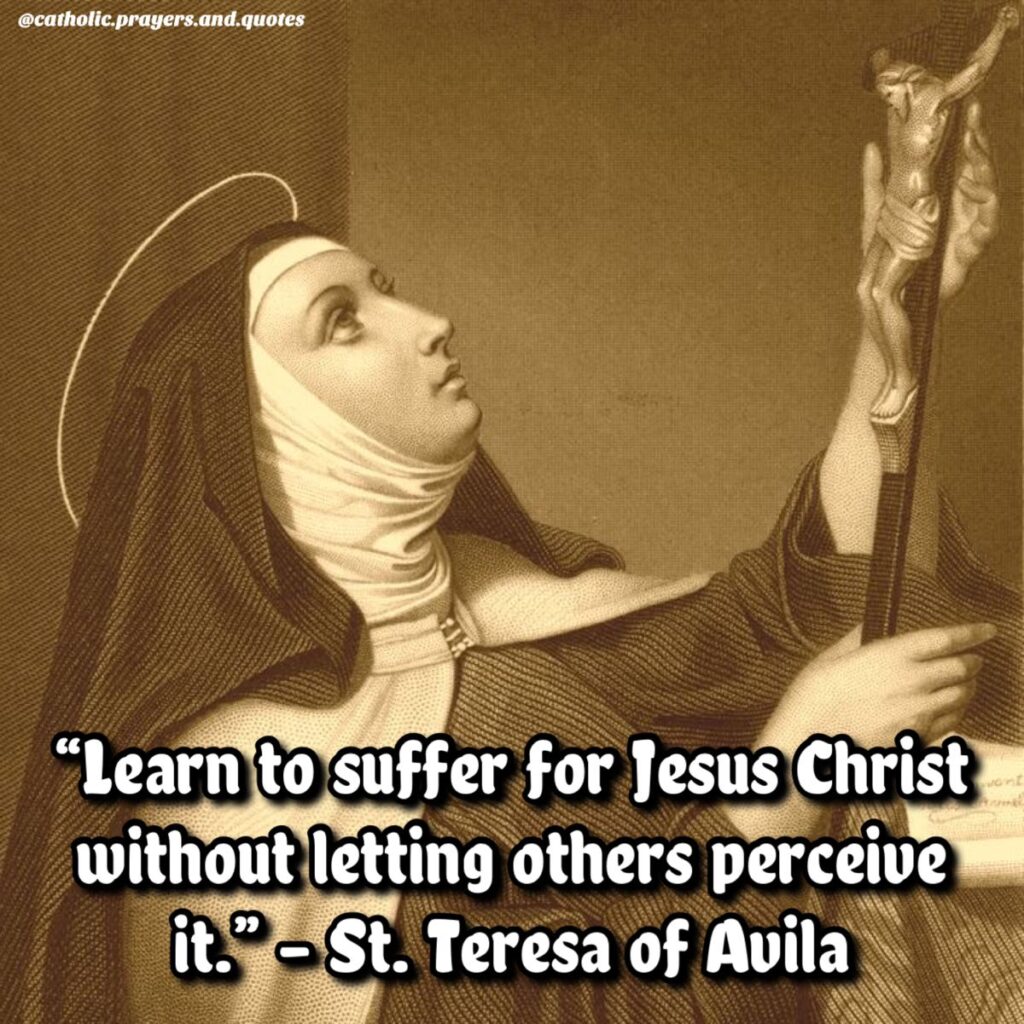
24. Learn to suffer for Jesus Christ without letting others perceive it.
St. Teresa of Avila
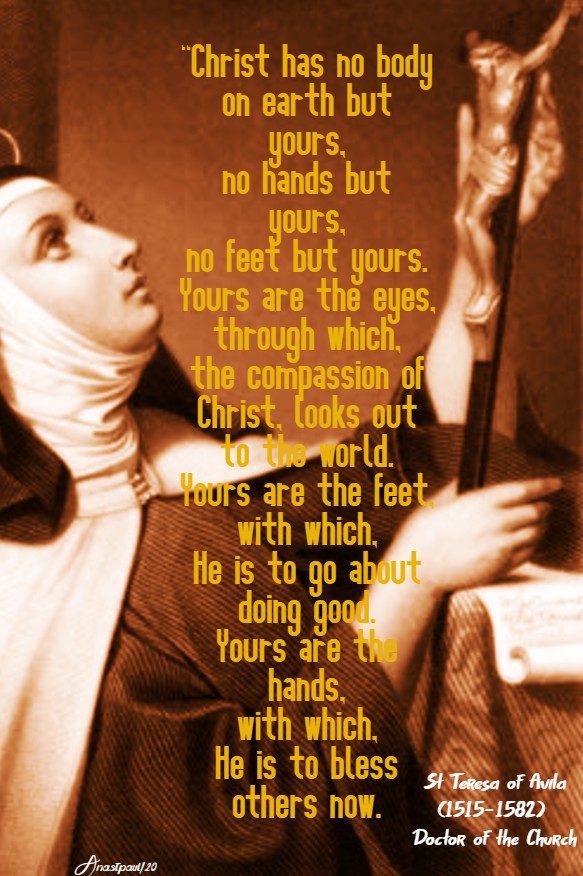
25. Christ has no body on earth but yours. no hands but yours, no feet but yours. Yours are the eyes through which the compassion of Christ looks out to the world. Yours are the feet with which He is to go about doing good. Yours are the hands with which He is to bless others.
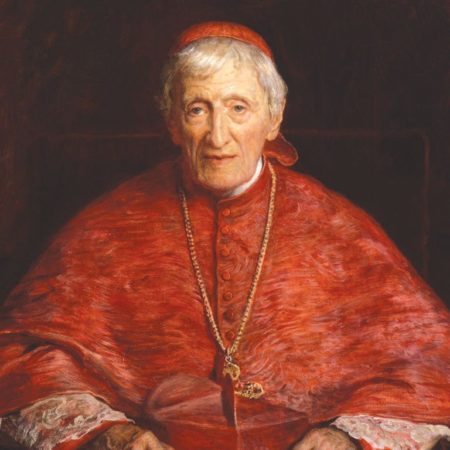
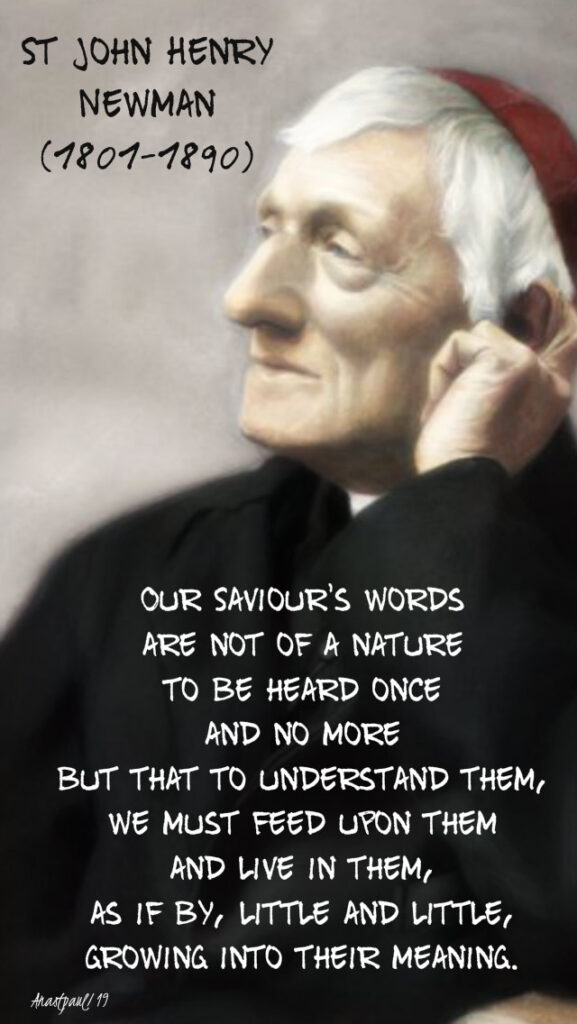
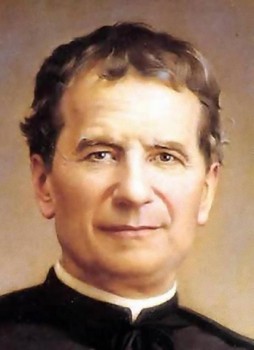
St. John Henry Newman was born in London in 1801. He was raised in the Anglican faith. He first studied law and then decided to become a priest. He was ordained in the Anglican Church after studying at Trinity College in Oxford. As an Anglican priest, John Henry was influential in the Oxford Movement. Eventually, he converted to the Roman Catholic faith and was ordained a priest in Rome in 1848. Pope Leo XIII named him a cardinal.
St. John Henry Newman is the patron saint of catholic education and poets and writers.
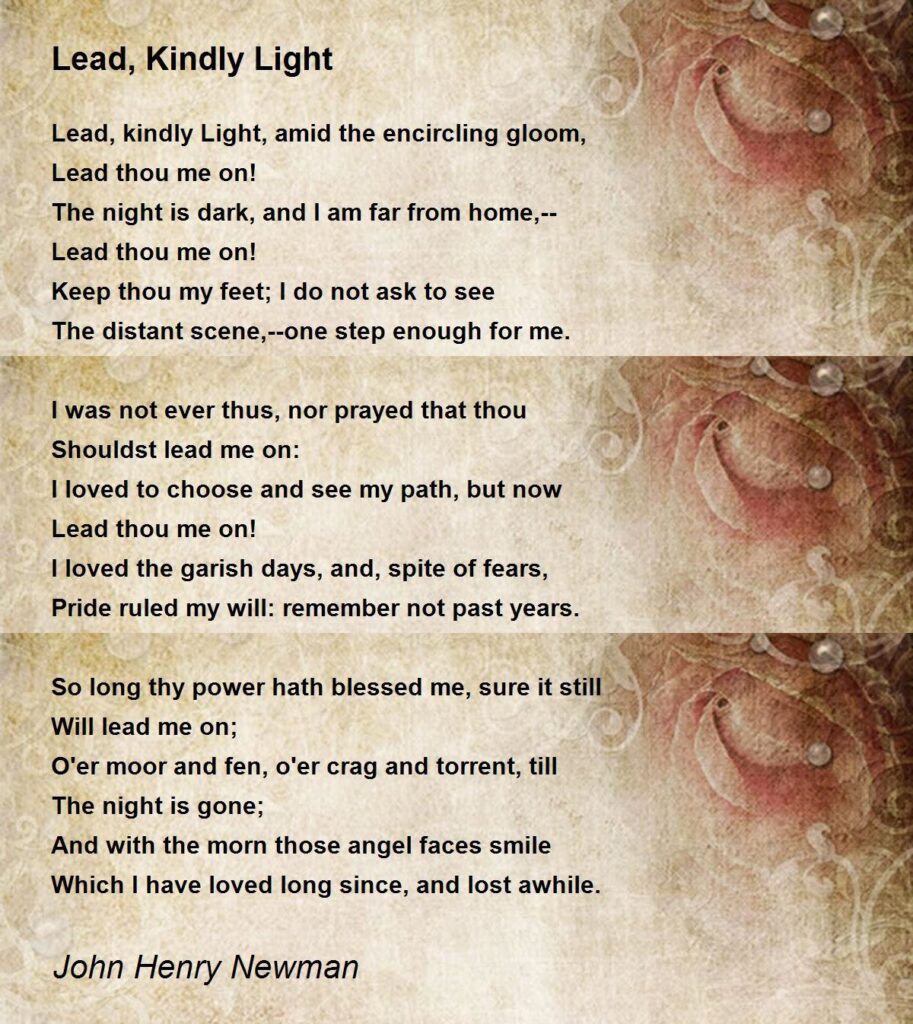
St. John Henry Newman was known for writing 40 books and poetry including the poem Lead kindly light.
When Saint John Henry Newman was named a cardinal, he took as his motto “Cor ad cor loquitur”—“Heart speaks to heart.”
He pondered and preached about many theological questions which included the Significance of Our Lady, the Authority in the church and Spirituality during difficult times.
St. John Henry Newman died in Birmingham in 1890. He was beatified by Pope Benedict XVI in 2010. He was canonized by Pope Francis on October 13, 2019.
Lead Kindly Light
Poem by St. John Henry Newman
Lead, kindly Light, amid th’ encircling gloom, Lead Thou me on; The night is dark, and I am far from home, Lead Thou me on; Keep Thou my feet; I do not ask to see The distant scene; one step enough for me.
I was not ever thus, nor prayed that Thou Shouldst lead me on; I loved to choose and see my path, but now Lead Thou me on; I loved the garish day, and spite of fears, Pride ruled my will; remember not past years.
So long Thy pow’r has blest me, sure it still Wilt lead me on, O’er moor and fen, o’er crag and torrent, till The night is gone, And with the morn those angel faces smile, Which I have loved long since, and lost awhile
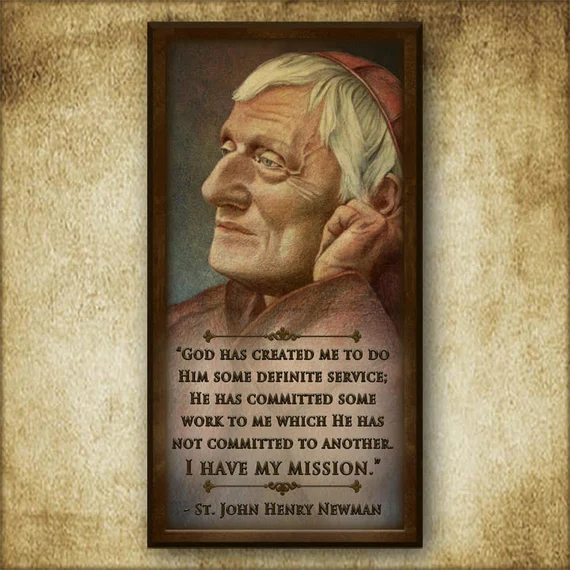
Learn to do thy part and leave the rest to Heaven.
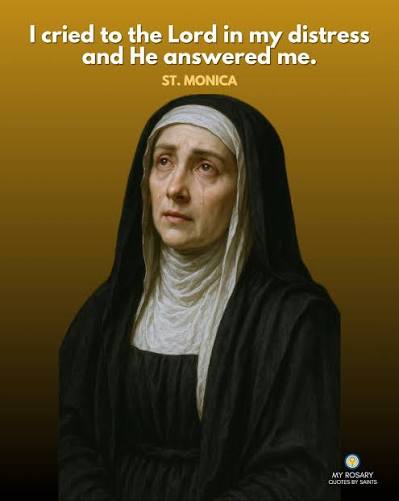
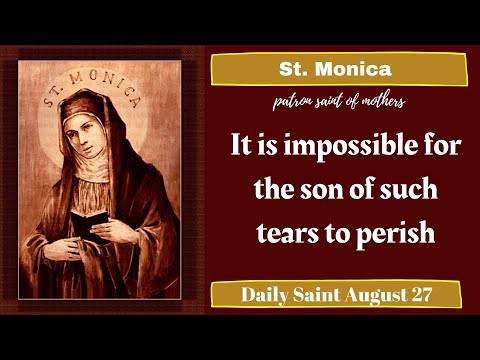
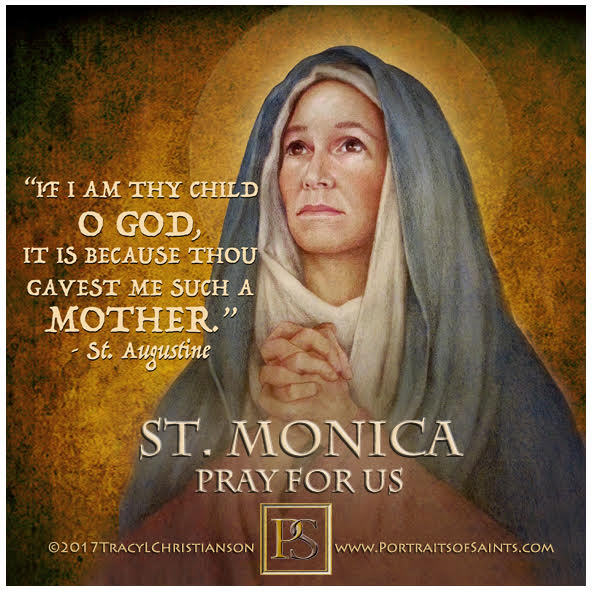
The Feast Day of St. Monica is celebrated on August 27. She is the patron saint of mothers, alcoholism and difficult marriages.
St. Monica was born of a Christian family in Tagaste in Africa in 331. She was given in marriage by her parents to a non-Christian named Patricius. He was known to have a a bad temper and alcoholism. They had three children who survived infancy. One of them was Augustine.
Monica was known for her pious nature. She prayed without ceasing for her family. A year before his death Patricius converted to Catholicism and was baptized. Augustine was 17 at the time of his father’s death. He left the faith and led an immoral life. By eighteen he had a mistress and a son. He joined a group called the Manichees. Manicheeism teaches that the material world is part of the realm of evil. There are two gods one good and one evil.
Monica never ceased praying for the return of her son to the Catholic faith. After more than 15 years of prayer, Augustine heard St. Ambrose, the bishop of Milan, preach. He decided to study the faith, and eventually returned, being baptized in 387. Eventually Augustine became a priest and then a bishop. St. Augustine is now considered a Doctor of the Church.
Monica is the patron of mothers due to her persistence in prayer.
“Nothing is far from God.”
Quote of St. Monica
August is the Month of the Immaculate Heart of Mary
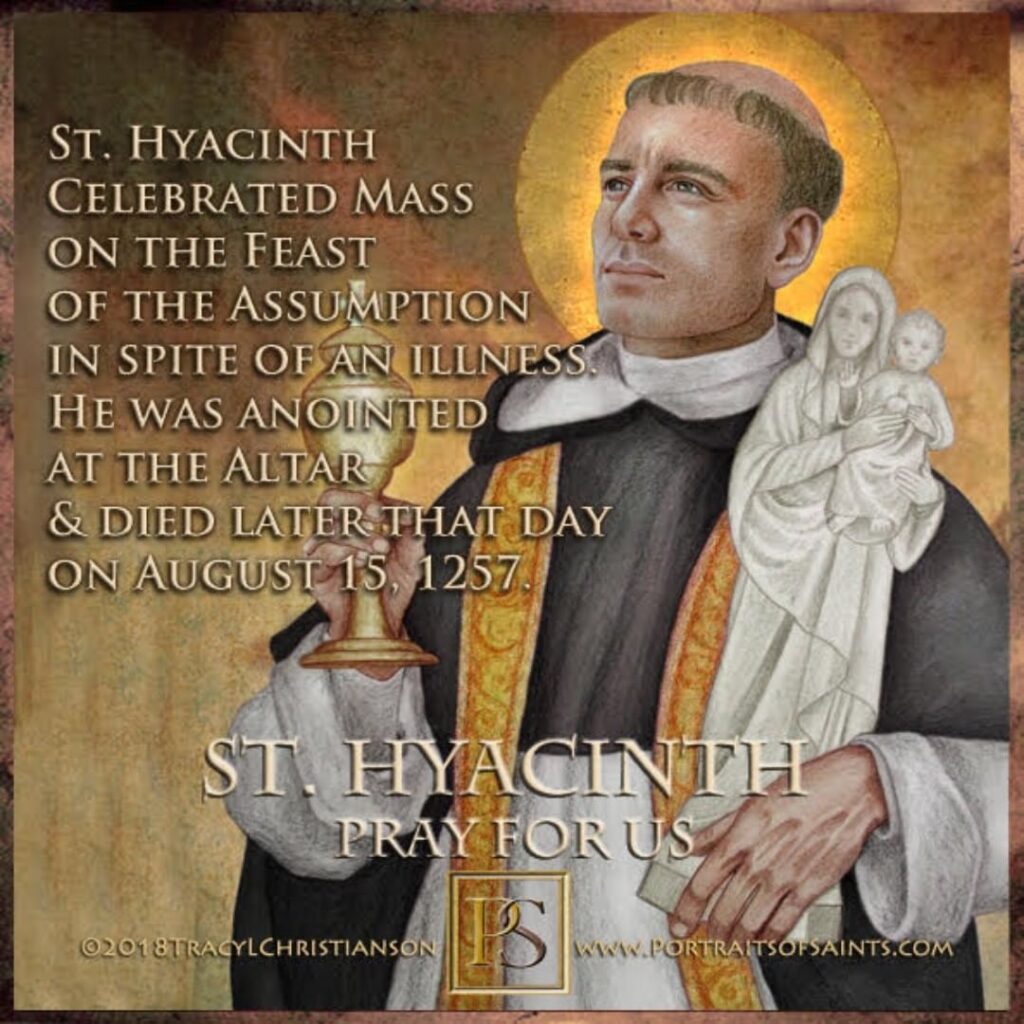
The Feast Day of St. Hyacinth of Poland is celebrated on August 17.
St. Hyacinth was born in 1185 to noble parents in Odrowacz, Poland. He was educated by his uncle who was a pious priest who eventually became the Bishop of Cracow. He was a very happy and pious child with an early calling to the religious life. He studied at Bologna earning the degree of Doctor of Canon Law and Divinity.
St. Hyacinth returned to Poland. On a trip to Rome with his uncle he met St. Dominic. He was one of the first to join the Order of Preachers, becoming a Dominican. He returned to Poland to establish the Dominican Order.
St. Hyacinth was a wonderful preacher. He converted many people and was able to build churches and convents. He visited the sick and was a friend to the poor. He became known for the many miracles which occurred. The most famous happened during the Tartars siege of the city of Kiev. Hyacinth had a tender devotion to the Mother of God. After celebrating Mass unaware of the siege occurring, he retrieved the Blessed Sacrament and a statue of Mary and fled with the community to the river Dnieper. Although the river was deep he led them across the river walking on the water. His footprints could be seen on the water for centuries.
The last years of St. Hyacinth’s life were lived in a convent at Cracow. On the feast of St. Dominic, he fell ill with a fever. He celebrated Mass on the Feast of the Assumption in spite of his illness. He was anointed at the Altar and died later that day on August 15, 1257.
St. Hyacinth was canonized by Pope Clement VIII in 1594.
“The greater danger for most of us is not that our aim is too high and we miss it, but that it is too low and we reach it.”
Quote of Michelangelo
August is the Month of the Immaculate Heart of Mary
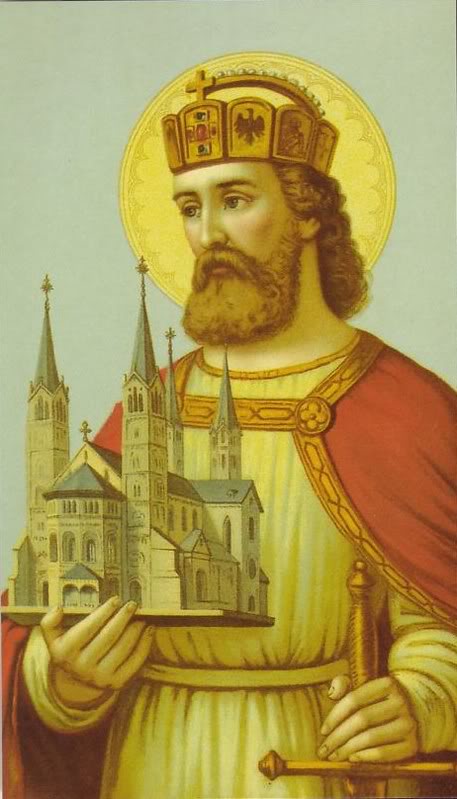
The Feast Day of St. Stephen of Hungary is celebrated on August 16.
St. Stephen was born in the year 973. His mother was the Duchess Sarolt. She had had a vision in which the first St. Stephen, the first martyr of the church had appeared to her. She was told she would bear a son who would evangelize the land.
St. Stephen’s father was the Duke Geza. Both his mother and father were converted to Christianity by Bishop St. Adalbert of Prague. The Bishop baptized St. Stephen at the age of ten. St. Stephen married Gesela who was a sister to the Duke of Bavaria in 995. Sadly, he survived all his children. Only one child lived to be an adult. This son, Emeric, died in a hunting accident in 1031.
St. Stephen use their wealth to build a monastery and encouraged the people of the land to convert to Christianity. The laws of the land which St. Stephen enacted favored Christianity over paganism. He sent a request to Pope Sylvester II to proclaim him as King of Hungary. Pope Sylvester II was happy to oblige. He sent Stephen a crown and gold processional cross.
As King, St. Stephen was generous to the poor and sick. He was devoted to the Virgin Mary, building several churches in her honor. Mary is credited with preventing both a war and the assassination of King Stephen. While he was king, St. Stephen also established a monastery in Jerusalem.
St. Stephen died on August 15, 1038, the Feast of the Assumption of Mary after suffering an illness. He was buried next to his son Emerick. They were both canonized saints in 1083.
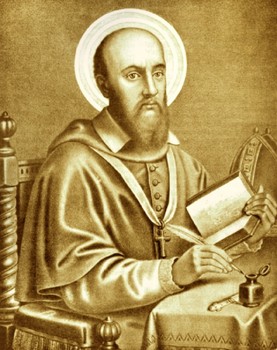
Suffering comes in many forms. Pain, illness, loss, and death of a loved one all cause grief and sorrow. Turning to God during troubled times can be very difficult. Let the words of the Saints help you as you travel on your spiritual journey.
1. I’m suffering very much, but am I suffering very well?
5. O my Jesus, give me Your strength, when my weak nature rebels against the distress and sufferings of this life of exile, and enable me to accept everything with prosperity and peace.
With my whole strength, I cling to Your merits Your sufferings, Your atonement, and Your tears so that I may be able to cooperate with you in the work of Salvation.
6. The Passion of Jesus is a sea of sorrows, but it is also an ocean of love. Ask the Lord to teach you to fish in this ocean. Dive into its depth. No matter how deep you go, you will never reach the bottom
11. Sorrow for sin is indeed necessary, but it should not be an endless preoccupation. You must dwell also on the glad remembrance of God’s loving kindness; otherwise, sadness will harden the heart and lead it more deeply into despair.
12. In every disappointment, great or small, let your heart fly directly to your dear Savior, throwing yourself against every pain and sorrow, Jesus will never leave you or forsake you.
16. He will either shield you from suffering or give you unfailing strength to bear it. Be at peace and put aside all anxious thoughts and imaginations.
17. In suffering God gives strength, but in action and in joy the soul does but show its own weakness and imperfection. And in suffering the soul practices and acquires virtue and becomes pure, wiser and more cautious.
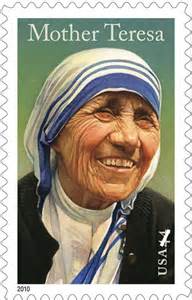
Bl. Teresa of Calcutta U.S. Stamp Public Domain Image
20. All the science of the saints is included in these two things: To do, and to suffer. And whoever had done these two things best, has made himself most saintly.
21. We should strive to keep our hearts open to the suffering and wretchedness of other people, pray continually that God may grant us that spirit of compassion which is truly the Spirit of God.
22. To suffer and be happy through suffering, to have ones feet on the earth, to walk on the dirty and rough path of this earth and yet to be enthroned with Christ at the Father’s right hand, to laugh and cry with the children of this world and ceaselessly sing the praises of God with the choirs of angels–this is the life of the Christian until the morning of eternity breaks forth.
23. Those who pray and suffer, leaving action for others, will not shine here on earth; but what a radiant crown they will wear in the Kingdom of Life! Blessed be the “apostolic of suffering!”
24. Suffering is transformed and elevated when in these moments we become aware of God’s closeness and solidarity. This is the certainty that gives inner peace and spiritual joy to the person who suffers generously and offers his pain as a “living sacrifice, holy and acceptable to God” (Romans 12.)
25.My Lord Jesus Christ, two graces I beg of you before I die. The first is that in my lifetime I may feel in my soul and in my body, as far as possible, that sorrow which you, sweet Jesus, endured in the hour of your bitter passion. The second is that I may feel in my heart, as far as possible, that abundance of love with which you, Son of God, were inflamed, so as willing to endure so great a passion for us sinners.
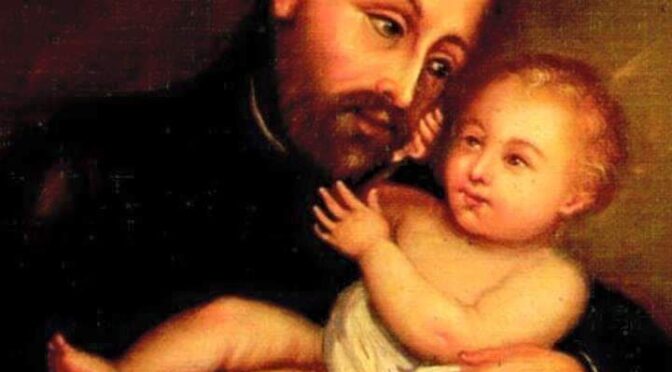
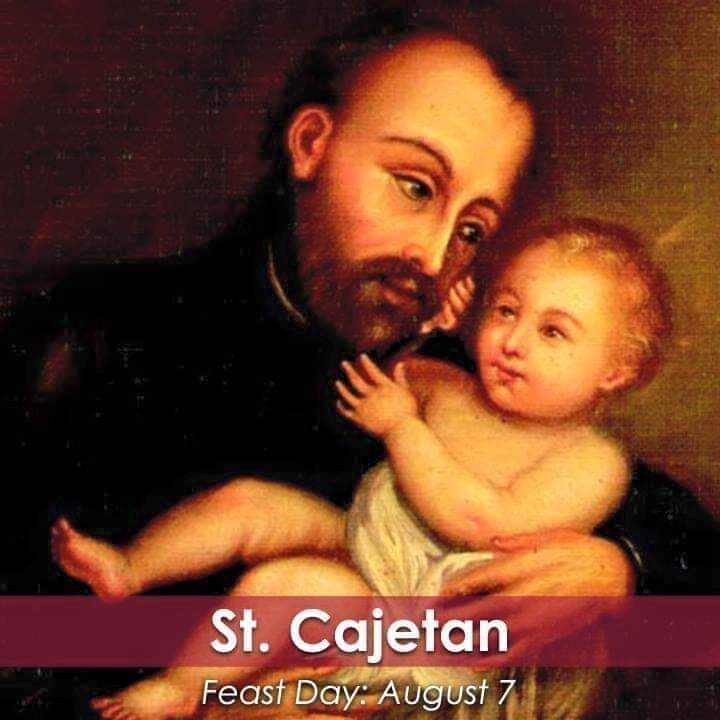
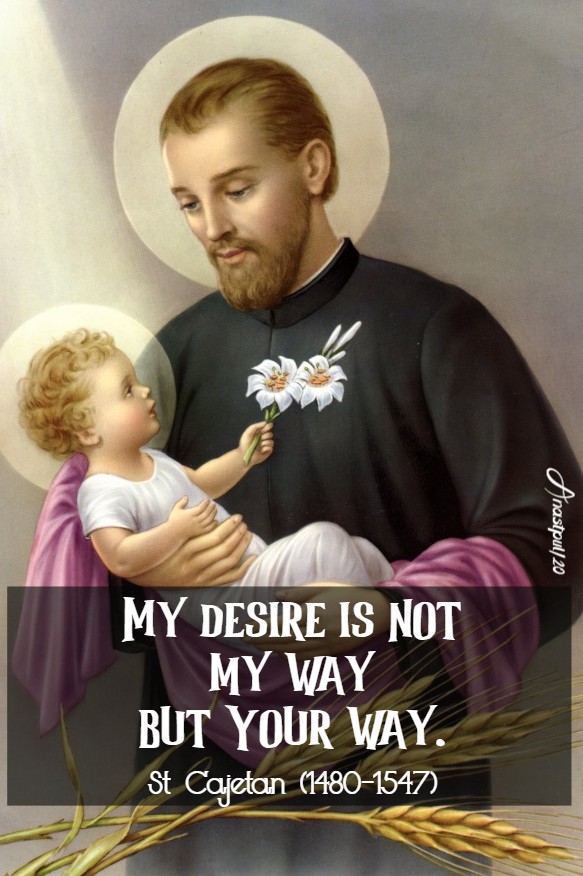
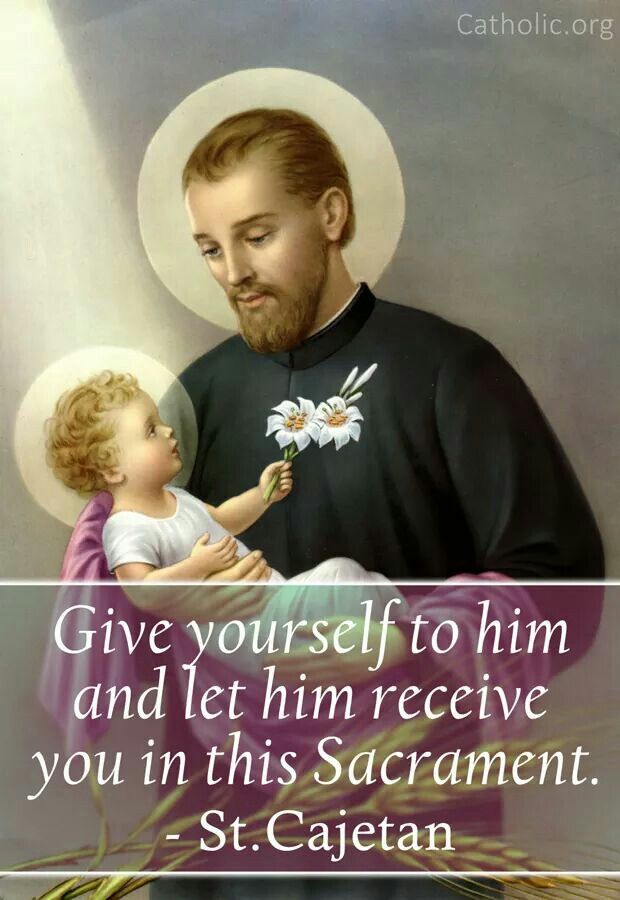
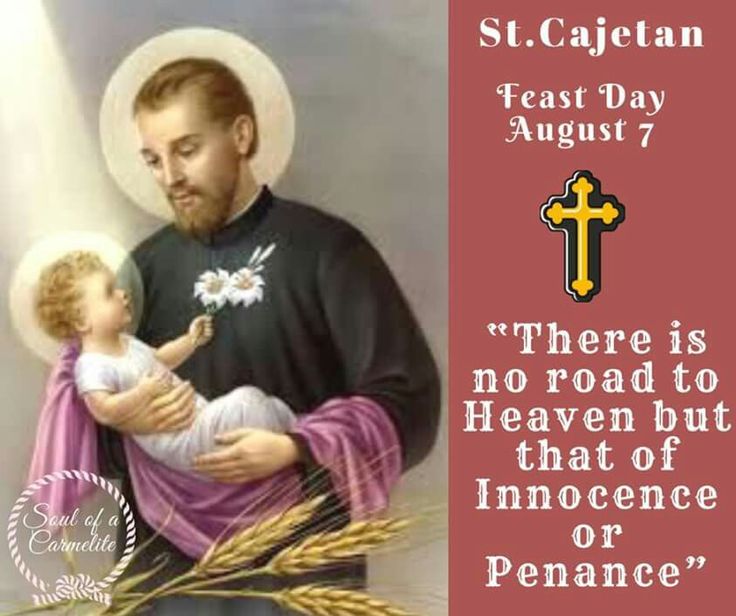
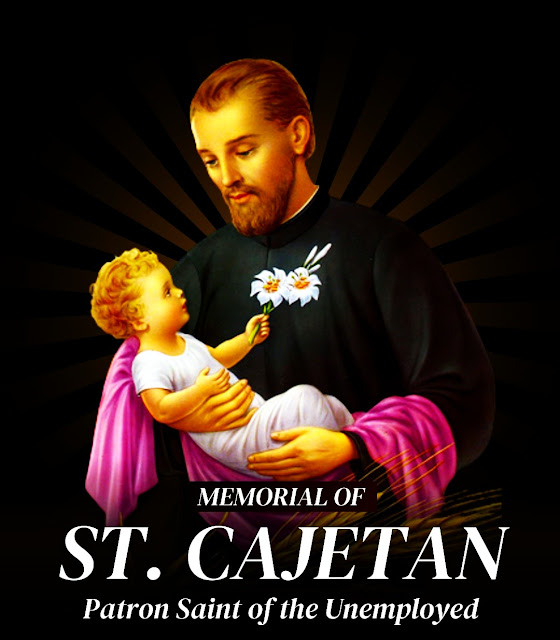
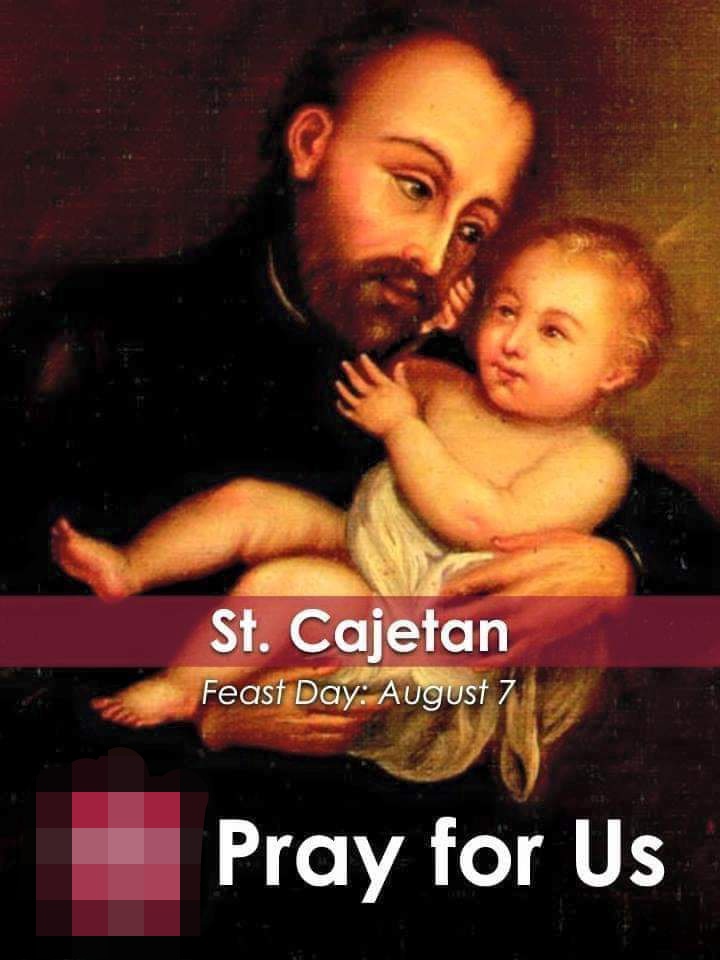
The Feast Day of St. Cajetan is celebrated on August 7. He was born in Vicenza, Italy, in 1480. St. Cajetan is the patron saint of the unemployed.
Even as a child Cajetan was very devout. He studied at Padua becoming a lawyer. He then was ordained a priest in Rome working for the Roman Curia. He joined the Oratory of Divine Love in Rome, which was devoted to charity and piety.
At the age of 42, he founded a hospital for incurables in Venice. He served the sick and the poor. St. Cajetan along with three friends decided to bring zeal back to the clergy. They founded an order known as the Theatines. They focused on reforming the clergy. After the sack of Rome, they escaped to Venice when their house was ruined in 1527. Members of his order took a strict vow of poverty, depending entirely on Divine Providence rather than on income.
One Christmas Eve when Cajetan was passing the Church of St. Mary Major, the Holy Child appeared to him, and the Blessed Virgin laid the child in the Saints arms filling his soul with joy. He had many visions in his life and was known for being in a state of ecstasy during prayer. He miraculously cured many who were sick including a man whose foot was to be amputated due to gangrene. After telling the man to trust in God and ask for the intercession of St. Francis, he kissed the foot, rebandaged it and made the sign of the cross over it. The following day the foot was healed.
St. Cajetan died in 1547 after receiving the last sacraments. Many miracles were attributed to him after his death. St. Cajetan was canonized by Clement X in 1671.
“There is no road to Heaven
but that of Innocence or Penance.”
Quote of St. Cajetan August is the Month of the Immaculate Heart of Mary
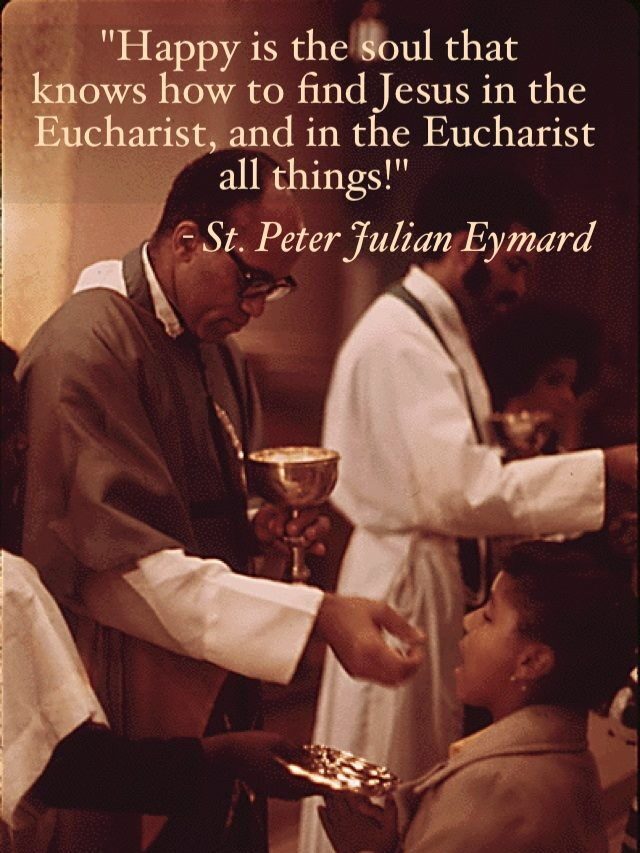
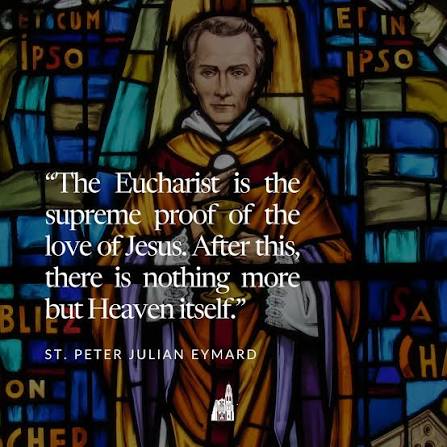
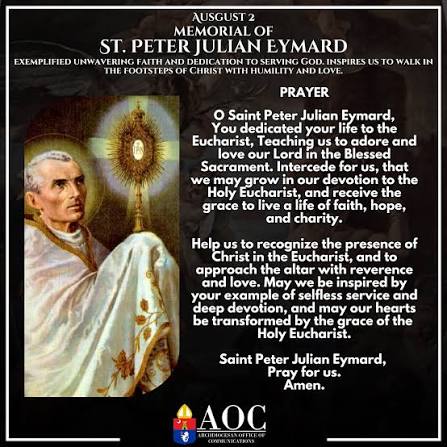
The Feast Day of St. Peter Julian Eymard is celebrated on August 2. Peter was born in 1811 in La Mure, France. He worked with his father as a cutler until he was 18.
While he was still a teenager, St. Peter told his father of his desire to become a priest. His father was adamantly against it, wanting him to stay in the family business. Peter began to study Latin while continuing to work for his father. Two years later, Peter’s father refused his request to attend college, wanting him to continue to work with him. Peter managed to attend college by accepting a scholarship. He also worked for a priest at a hospital for the insane.
While at college, his mother died. A priest from the Oblates of Mary received permission at this time from Peter’s father for him to enter the Oblate novitiate. His father died two years later. Five months after entering the novitiate, Peter became very ill. he struggled with illness throughout his life. After his father’s death he entered the seminary at Grenoble. After his ordination he joined the community of Marists. His devotion to the Eucharist and perpetual adoration grew. He helped to spread the devotion of perpetual adoration. St. Peter became known as the Apostle of the Eucharist. He wrote many different books about the Eucharist including How to get more out of Holy Communion.
St. Peter Julian Eymard died in 1868 and was canonized in 1962. He is the patron saint of Eucharistic Devotion.
The Lord comes into us Sacramentally in order to live there spiritually.
Quote of St. Peter Julian Eymard
August is the Month of the Immaculate Heart of Mary
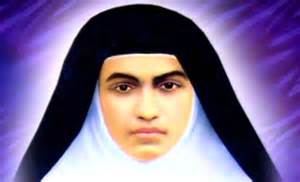
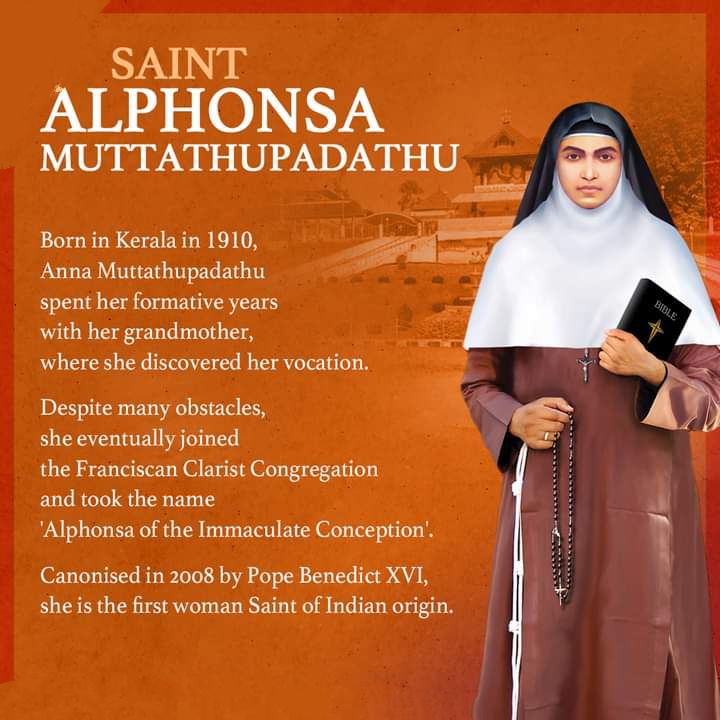
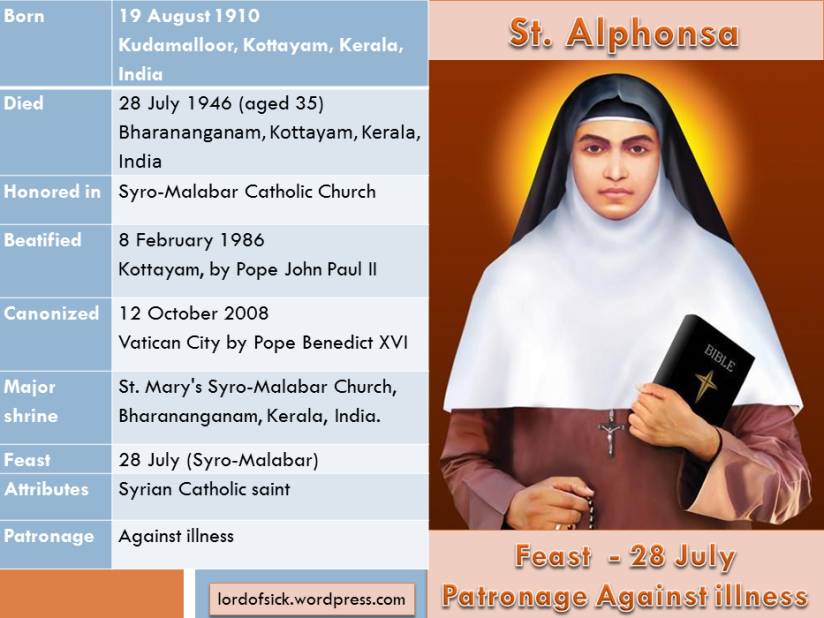
The Feast Day of St. Alphonsa is celebrated on July 28. She was born in Muttahupadathu, India in 1910. She is the second canonized saint of India.
Baptized with the name Anna, she had a difficult birth and childhood. Her mother died three months after she was born. She was raised by her maternal Aunt. After falling into a pit of burning chaff, her feet were badly burned leaving her disabled. At an early age, after reading the biography of St. Therese of Lisieux, she had a great desire to become a saint.
In 1927 at the age of 17 she joined the Poor Claresat Christ Convent at Bharananganam. She took the name Alphonsa. She completed her permanent vows in 1936. After completing her own education. Alphonsa taught school but she was plaqued by illness.She became known for her willingness to accept suffering. After enduring several different types of illnesses over many years St. Alphonsa died at the age of 35. Her tomb is a site for pilgrims due to the many reported miracles at the site. The miracle which was approved by the Vatican for her canonization was the curing of a child with a club foot. St. Alphonsa was canonized by Pope Benedict XVI in 2008.
Since only grief and suffering have fallen to the lot of my Spouse, I too lovingly embrace them and my soul is at peace, though the body continues to be tormented. For the last seven years I have ceased to be my own, being given over entirely to my Divine Spouse. You know all that and now let the Lord do as He will with me. It is not a cure I am anxious for but only that His Holy Will be fulfilled in me.
The Feast day of St. Bridget of Sweden is celebrated on July 23. St. Bridget of Sweden was born on June 14, 1303. She was the daughter of Berger Persson and wife, Ingeborg. Her family was wealthy, pious, and went on long pilgrimages to the Holy Land. St. Bridget of Sweden is the patron of Sweden, Europe, and widows.
At the age of ten her mother died. Her sister Kathleen, infant brother Israel, and Bridget were sent to her maternal aunt for education and care. As a young child Bridget had a vivid dream vision of The Man of Sorrows. When she asked who had done this to him He responded,
“All those who despise my love.”
This dream vision left an indelible mark on her. She married early, as was the custom, at 13 years old to Ulf Gudransson. They had eight children, four sons and four daughter. The newly married King of Sweden asked her to be a Lady in waiting and teach the young queen the language and customs of her new country.
St. Bridget became a widow when she was 41 years old when her husband died of severe illness. She prayed for guidance, after which she founded a new religious order (The Brigitta’s), mainly for women. She reported many visions and revelations, some which can be found in the “Fifteen Prayers of St. Bridget”.
In August, 1370, Pope Urban V confirmed the Rule of her congregation. Bridget made earnest representations to Pope Urban, urging the removal of the Holy See from Avignon back to Rome.
In 1349 she journeyed to Rome where she stayed until she died in 1373.
My Lord Jesus Christ, Your blessed, royal, and magnificent heart could never, by torments or terrors or blandishments, be swayed, from the defense of Your kingdom of truth and justice.
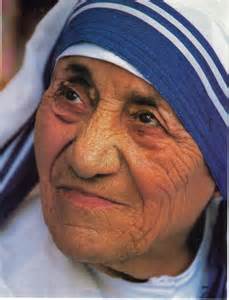
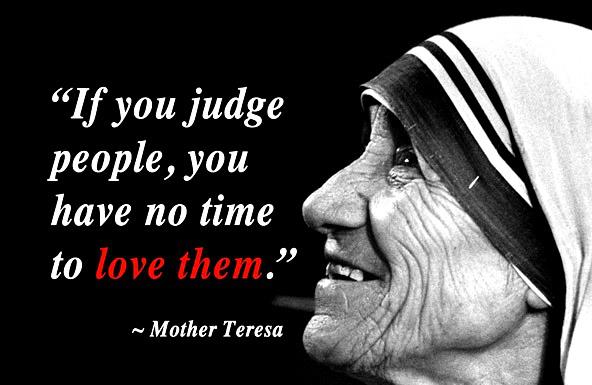
Mother Teresa will soon be officially declared a saint!
The day before the feast day of Bl. Mother Theresa Pope Francis will proclaim that she is a saint. Her feast day is celebrated on Sept. 5. The world remembers her as a “living saint”.
Bl. Teresa of Calcutta was born to parents Nikola and Drana Bojaxhiu on August 26, 1916 in Skopje of Macedonia and named Agnes Gonxha Bojaxhiu. She was baptized on August 17, 1910 in Macedonia. She was the third child in her family, following sister Aga and a brother, Lazar. Her father, Nikola died, when she was eight years old. Her father was a traveler, an extrovert, and a businessman who spoke five languages. Her mother, Drana, was extremely pious, adopting several orphans. She was known as Gonxha (pronounced gon’KHA) which means “flower bud”.
Gonxha desired early to become a missionary. At the age of eighteen, she joined the Sisters of Loreto. Here she took the name of Sister Mary Teresa after St. Therese of Lisieux. She was sent to Calcutta, India to teach at St. Mary’s High School for Girls, which was run by the Sisters of Loreto. On May 24, 1937, she took her final Profession of Vows to a life of poverty, chastity, and obedience. She then became known as Mother Teresa. In 1944, she became principal of the school.
Mother Teresa received a second calling while on a train. Christ spoke to her, asking her to work in the slums of Calcutta, caring for the sickest and poorest of the people.Pursuing this calling changed her life forever. In one year, she received approval to do the work she was being called to do. After six months of basic medical training she went to the slums to aid the needy and dying. Mother Teresa founded the Missionaries of Charitywith 12 members, most of them students from St. Mary’s. She established a leper colony, an orphanage, a mission house, and several health clinics.
In 1971, Mother Teresa visited New York City, where she opened a soup kitchen and a home to care for HIV/AIDS sufferers. In 1979, she received the Nobel Peace Prize.
In 1983, Mother Teresa suffered her first heart attack. After suffering from lung, kidney and heart problems for several years, she died on Sept. 5, 1997, which is now her feast day. At the time of her death her Missionaries of Charity numbered over 4,000. She had 610 foundations in 123 countries.
Mother Teresa was beatified on October 19, 2003, after confirmation of her first miracle. The miracle was reported that a woman who had a large and very visible tumor, had stayed with the Missionaries of Charity. After she and the Sisters had prayed for Mother Teresa’s intercession, the growth, six to seven inches in length, had disappeared within several hours. Finding no other medical explanation for the sudden cure it was declared her first miracle. Over 3500 other reports are being investigated as possible miracles.
After accepting a second miracle, Pope Francis cleared the way for Mother Teresa to be declared a saint. Pope Francis signed a decree declaring that the inexplicable 2008 recovery of a Brazilian man who suddenly woke from a coma caused by a viral brain infection was due to the intercession of the Albanian nun, who died in 1997.
The Rev. Brian Kolodiejchuk, the postulator spearheading Mother Teresa’s canonization case, stated that the man fully recovered following his wife’s prayers and he has since returned to work as a mechanical engineer. The couple also have had two children.
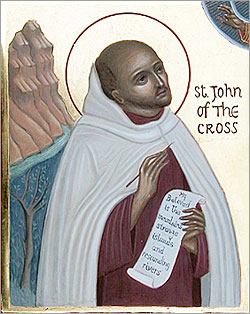
In 2003, Mother Teresa’s private correspondence revealed she had experienced a “dark night of the soul”… feeling abandoned by God and lacking in faith. This lasted unusually long; for fifty years. Many saints have experienced such feelings, described by John of the Cross, in his book Dark Night of the Soul. She was filled with loneliness, and torture, due to this lack of consolation from God.
Each image in the following list is accompanied by a quote or prayer of Mother Teresa. The images are all public domain images.
As we celebrate the sainthood and feast day of St.Teresa of Calcutta on Sept. 5, let’s remember the remarkable things she did and said.
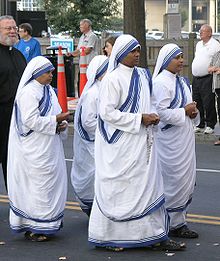
Sisters of Charity
Prayer of Mother Teresa of Calcutta
Dear Jesus, help us to spread your fragrance everywhere we go. Flood our souls with your spirit and life. Penetrate and possess our whole being so utterly that our lives may only be a radiance of yours. Shine through us and be so in us that every soul we come in contact with may feel your presence in our soul. Let them look up and see no longer us, but only Jesus. Stay with us and then we shall begin to shine as you shine, so to shine as to be light to others. The light, O Jesus, will be all from you. None of it will be ours. It will be you shining on others through us. Let us thus praise you in the way you love best by shining on those around us. Let us preach you without preaching, not by words, but by our example; by the catching force – the sympathetic influence of what we do, the evident fullness of the love our hearts bear to you.
Amen
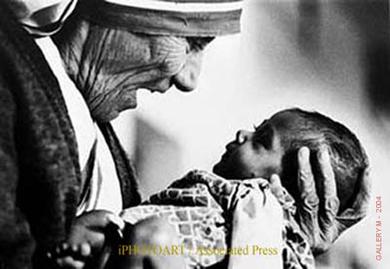
Mother Teresa with Child/Associated Press
Mother Teresa: Smile
“Let us always meet each other with a smile for the smile is the beginning of love.”
“Peace begins with a smile.”
“Every time you smile at someone it is an action of love, a gift to that person, a beautiful thing.”
Mother Teresa
Mother Teresa
Mother Teresa: God and Faith
“We are nothing without God, but if we put our lives in God’s hands miracles happen.”
“Be faithful in small things because it is in them that your strength lies.”
“Faith in action is love, and love in action is service. Byt transforming that faith into living acts of love, we put ourselves in contact with God Himself, with Jesus our Lord.”
“I know God will not give me anything I can’t handle. I just wish He didn’t trust me so much.”
Mother Teresa
Mother Teresa with Pope John Paul II
Mother Teresa: Prayer
The fruit of silence is prayer.
The fruit of prayer is faith.
The fruit of faith is love.
The fruit of love is service.
The fruit of service is peace.”
Mother Teresa
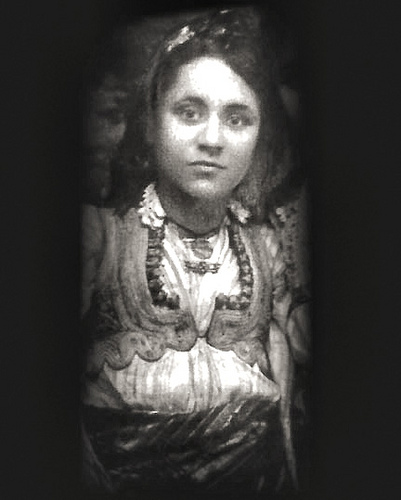
Young Mother Teresa
Agnes Gonxha Bojaxhju (Mother Teresa)
Life is an opportunity, benefit from it.
Life is beauty, admire it.
Life is a dream, realize it.
Life is a challenge, meet it.
Life is a duty, complete it.
Life is a game, play it.
Life is a promise, fulfill it.
Life is sorrow, overcome it.
Life is a song, sing it.
Life is a struggle, accept it.
Life is a tragedy, confront it.
Life is an adventure, dare it.
Life is life, fight for it.
Mother Teresa
Mother Teresa
Mother Teresa: Abortion
“Any country that accepts abortion, is not teaching its people to love but to use any violence to get what it wants.”
“It is a poverty to decide that a child must die so that you may live as you wish.”
“There are two victims in every abortion: a dead baby and a dead conscience.”
Mother Teresa
Mother Teresa
Mother Teresa: Love and Forgiveness
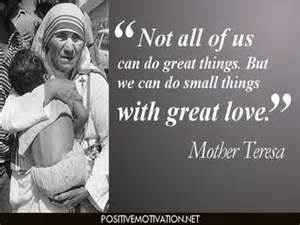
“It is not how much we do, but how much love we put into the doing.It is not how how much we give, but how much love we put in the giving.”
“I have found the paradox that if you love until it hurts, there can be no more hurt, only more love.”
“If we really want to love we must learn to forgive.”
Mother Teresa
Mother Teresa
Mother Teresa: Helping the Sick
“Let us touch the dying, the poor, the lonely, and the unwanted according to the graces we have received and let us not be ashamed or slow to do the humble work.”
“Yesterday is gone, tomorrow has not come, we have only today. Let us begin.”
Mother Teresa
Mother Teresa in service
Mother Teresa: Service
“If you are kind, people may accuse you of selfish ulterior motives; be kind anyway.
If you are successful, you will win some false friends and true enemies; succeed anyway.
If you are honest and frank people may cheat you; be honest and frank anyway.
If you find serenity and happiness, they may be jealous, be happy anyway.
You see, in the final analysis, it is between you and God, it was never between you and them anyway.”
Mother Teresa
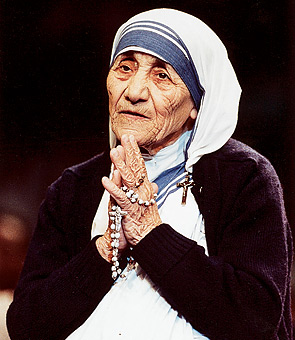
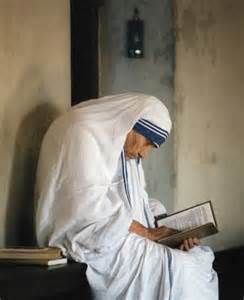
Mother Teresa Praying
Mother Teresa: Prayer
“Love to pray. Feel often during the day the need for prayer and take trouble to pray Prayer enlarges the heart until it is capable of containing God’s gift of Himself. Ask and seek, and your heart will grow big enough to receive Him and keep Him as your own.”
“Prayer is not asking. Prayer is putting oneself in the hands of God, at His disposition and listening to His voice in the depth of our hearts.”
Mother Teresa
Mother Teresa
Mother Teresa: Silence
“We need to find God and he cannot be found in noise and restlessness. God is the friend of silence. See how nature; trees, flowers, grass, grows in silence. See the stars, the moon and the sun, how they move in silence. We need silence to be able to touch souls.”