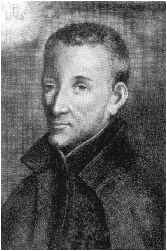
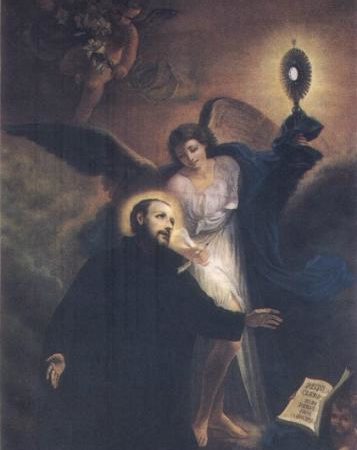
The Feast Day of St. John Francis Regis is celebrated on June 16. He was a Jesuit priest from France.
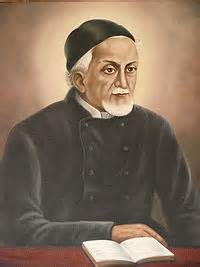
St. John Francis Regis was born into a wealthy family in southern France. He entered the Society of Jesus at age 19. After his ordination as a Jesuit priest he became a missionary working in various French towns. He would walk from town to town preaching from the heart. His speaking style was simple but poetic. He was easy to understand and his zeal attracted many people. He usually heard confessions in the morning and visited prisons and hospitals in the afternoon. His preaching missions successfully converted many people and brought others back to the faith.
St. John Francis Regis was well known for his work with at-risk women and orphans. He established safe houses and helped the unemployed find work. He led many to be trained as lace makers, giving them a stable income.
While serving on a mission in 1640, St. John Francis Regis died. He spent his last day meditating on the crucifix. His last works were:
“Into thy hand I commend my spirit”.
St. John Francis Regis was canonized in 1737. Regis Societies were formed throughout France to provide services for the poor and marginalized.
The incomparable heart of the Mother of the Redeemer is a glorious heaven,
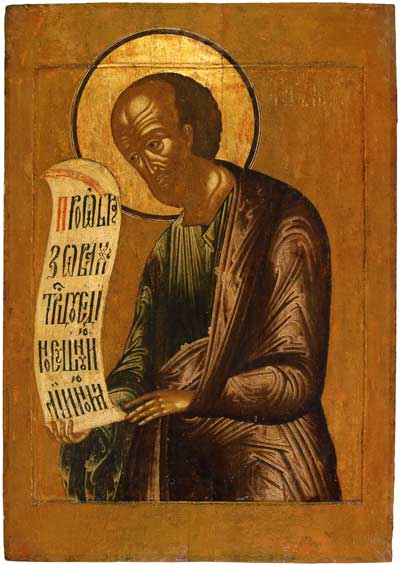
The Feast day of St. Elisha is celebrated on June 14. St. Elisha was a prophet in the ninth century. His Hebrew name means “God is Salvation”.
St. Elisha was called to follow the prophet Elijah, his mentor, when Elijah cast his mantle on him indicating that he was to be his successor. As Elijah ascended into heaven in a fiery chariot, Elisha asked for a double portion of St. Elijah’s spirit. The spirit he received enabled him to protect the faith.
St. Elisha was known for many miracles. He divided the waters of Jordan. He made the water from the Jericho Spring fit to drink. He saved a poor widow from death by increasing the oil in her vessel. He raised a child back to life after death. He healed a Syrian officer from leprosy by having him bathe in the Jordan seven times.
St. Elisha continued the devotion begun by Elijah to Our Lady of Mt. Carmel. He is considered a patron saint of the Carmelite Order. According to tradition, Elijah had a vision of the Blessed Virgin Mary. The title of Mary “Star of the Sea” is believed go have originated with this vision.
St. Elisha died from old age at Samaria.
What does it profit a man to gain the whole world and lose his soul?
How do we come to know and love God? The first commandment is:
“Love the Lord thy God with your whole heart, mind, and soul.”
How is it possible to love someone we don’t know? When we truly love someone we don’t fear them, we want to spend time with them; we enjoy their company.
Prayer is the way we come to know God. It is not enough to pray just on Sunday. If we love God, we will pray without ceasing…always, … in our thoughts and in our actions.
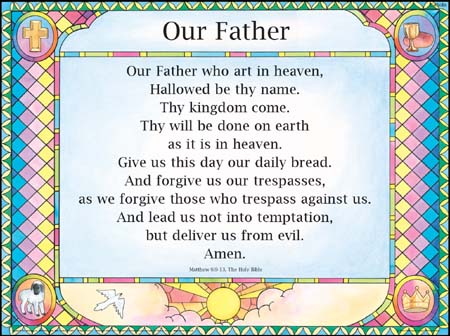
Knowing the different forms of prayer can help us explore getting to know God better. When Jesus was asked by his disciples how to pray he responded by giving us the well known “Lord’s Prayer”.
The following are different types of prayer: 1. Prayer of petition: When we ask for specific things we are making a petition. Hopefully we also say “Thy will be done.” Our will is not always God’s will. This is why God’s answer is sometimes “No, I have a better solution.”
Prayer of intercession: When we pray for the welfare of someone else, this is the prayer of intercession. When the saints pray for us they are interceding for us.
Prayer of Glory, Praise and Thanksgiving. Saying thank you to God is an important part of our spiritual journey. Remember the story of Jesus healing the ten lepers? Only one returned and thanked Jesus. Let me be grateful for all the gifts God gives me.
Prayer of Adoration: This prayer is acknowledging God as our creator; all good and all powerful.
Prayer of Quiet: This prayer is the prayer of LISTENING to God. We sit quietly in the presence of God, quiet our mind, and ask God to lead us. We find God in the silence. Actually, God finds us.
6. Scripture: Reading Holy Scripture is a form of prayer. We read and meditate on both the Old and the New Testament.
Music: Music is a powerful way to pray. “When we sing we pray twice.” St. Augustine. Music is prayer which comes from the heart. Some people find it easier to connect with God with this type of prayer.
Meditation: Reflection on nature, art, humanity and scripture are all forms of meditation. Take the time to reflect on what is happening in your life. Ask God to lead you in your meditative prayer.
The Catholic Mass: It incorporates all of these types of prayer. During the Mass we pray for others, give glory and thanks, ask for mercy and guidance, listen to scripture, adore Christ in the Eucharist, and pray through silence and singing.
10. Praying can be either spontaneous or memorized. When we are in a crisis it is sometimes hard to know what to say to God. This is when memorized prayer is very powerful. The Catholic Church has many formal prayers for every occasion and need. They guide us when we are at a loss for words. Spontaneous prayer is also a very meaningful way to pray to God.
When Jesus is our closest friend, we can tell him anything. Praying on a regular basis in all these different ways helps us to come closer to God. Letting ourselves be led by God in prayer is how we put into action the first commandment.
Loving God means spending time with him. Each of us has a different prayer style. If we are too busy to pray, we are too busy for God. God does not force himself on anyone. If you are having difficulty praying start by meditating on the Our Father, the prayer Jesus himself gave us. Ponder each word in the prayer. Your relationship with God will begin to grow.
The Lord’s Prayer
Their is a different prayer style for each person. Each of the saints also prays in a way that is special to that saint If you are searching for the type of prayer that works for you a wonderful book to read is Six Ways to Pray from Six Great Saints by Gloria Hutchinson.
This book introduces you to six different saints: St. Francis of Assisi (Franciscan), St. Clare ( Poor Clares), St. Teresa of Lisieux (Carmelite), St. Therese of Avila (Carmelite), St. John of the Cross (Carmelite ) and St. Ignatius of Loyola (Jesuit). You will learn not only their story but also their prayer style. Each chapter contains exercises to help you discover what type of prayer works best for you. When I read this book, I learned about the “Prayer of Detachment” taught by St. John of the Cross. The exercises helped me to practice and meditate in a way I had never tried before. I encourage everyone to read it and discover their own prayer type.
The Feast Day of St. Gaspar Bertoni is celebrated on June 12.
St. Gaspar was born in Verona in the Republic of Venice on Oct. 9, 1777 into a wealthy family. His baby sister died leaving him an only child. After his 1st communion at age 11, St. Gaspar was called into a mystical union with Christ. He entered the seminary at 18. During his first year as a seminarian the French army invaded his country. He dedicated himself to caring for the sick and wounded, becoming a member of a Gospel Fraternity for the Hospitals.
St. Gaspar was ordained a priest on Sept. 20, 1800. He was put in charge of youth formation. He also became the spiritual director of the religious community of St. Joseph’s convent. Here he met Leapoldina Naudet and was her spiritual guide. He helped her found the Sisters of the Holy Family. St. Gaspar also directed Servant of God Teodora Compostrini who founded the Community “Sorelle Minime” of the Charity of the Sorrowful Mother. By 1810, he became the spiritual director of the diocesan seminary.
St. Gaspar kept a spiritual diary in which he tells of his mystical gifts and his call to form a religious family. With the help of two companions he began the order in a church named “The Stigmata of St. Francis.” They began a tuition free school. They lived together in common, living a life of penance and contemplation.
St. Gaspar almost died from military fever. While he was sick he continued to counsel many people. The Congregation of the Sacred Stigmata of Our Lord Jesus Christ was also known as the Stigmatines. It gradually spread from Verona to the United States, Brazil, Chile, The Philippines, south Africa, Tanzania, and Thailand.
St. Gaspar died in 1836 after the cholera outbreak of 1836. During his lifetime he was attributed with many miracles. He was canonized in 1954.
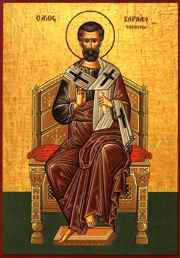
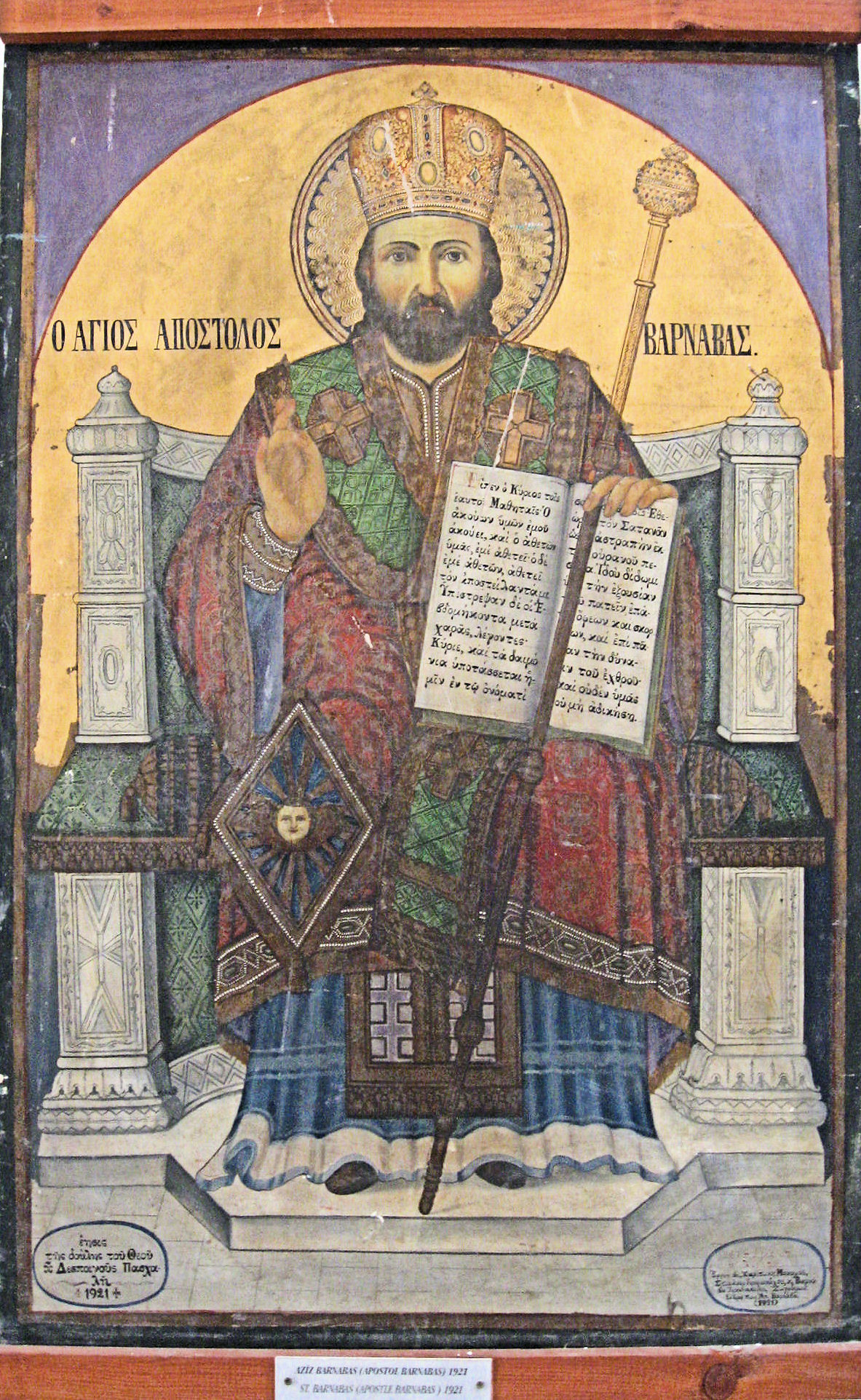
The Feast Day of St. Barnabas is celebrated on June 11.
St. Barnabas was Jewish. He was given the name of Joseph at birth. He sold his property and gave the proceeds to the Apostles who named him Barnabas. Barnabas means ‘son of consolation’ or ‘man of encouragement’. The bible tells us he was a good man, filled with the Holy Spirit and faith. He lived in common with the earliest Christian converts. While he was not one of the original apostles, he is believed to be one of the 72 commissioned by Jesus to preach. He is given the honorary title of Apostle.
St. Barnabas
St. Barnabas was one of the first to welcome St. Paul as a disciple of Jesus. He persuaded the community to accept Paul. Barnabas was sent to Antioch, Syria to investigate a community of non-Jewish believers there and brought Paul there from Tarsus. The followers of The Way were first called Christians at Antioch. Barnabas, his cousin John Mark and the Apostle Paul traveled together on their first missionary journey. They went to Cyprus, Perga, Antioch, and Iconium, and Lystra in Lycaomia. After being stoned they returned to Antioch.
Paul and Barnabas attended the counsel of Jerusalem which was discussing whether Christians needed to be circumcised before baptism.
St. Barnabas preached in Alexandria and Rome before being stoned to death at Salamis in the year 61. He is considered the founder of the Cypriot Church.
Let us be about God’s business and He will look after ours.
The Feast Day of Bl. John Dominic is celebrated on June 10.
Bl. John Dominic is also known as Giovanni Dominici. He was born in Florence, Italy in 1350 to a family with a humble background. He suffered a speech impediment which caused him to stammer and stutter. While young, Bl. John spent much time in prayer at the Dominican Church of Santa Maria Navella.
At the age of 17 he was accepted into the Dominican Orderin spite of his speech impediment and lack of education. He studied in Pisa, Florence and the University of Paris where he received his degree in theology.
As a priest he served as a preacher in Venice, Italy for twelve years. He was appointed vicar-provincial of the Roman Province. He labored to help those affected by the Black Plague. He also successfully renewed the Dominican Order. In 1407 he was made cardinaland confessor of the Pope. He attempted to heal the Western Schism and convinced Pope Gregory XII to call the Council of Constance.
In 1420 Bl. John Dominic died from a fever on June 10.
In the light of faith, we can regard the altar as the heavenly Father does.
What does he see upon the altar?
He sees the Son of His love…the Son in whom He is well pleased.
The Feast Day of St. Ephrem of Syria is celebrated on June 9. He was born in Nisibis, Mesopotamia in the 4th century. At the age of 18 he was baptized. Along with other Christians, he became a refugee in Edessa during the persecutions by the Persians. He was ordained a deacon and served under four bishops.
St. Ephrem is most known for his prolific writing. He wrote both hymns and poetic homilies. Over 400 hymns still exist, earning him the title of “Harp of the Holy Spirit”. The hymns he wrote were used to instruct the people against the heresies of the time. He often used popular melodies, putting his own words to the music. Because of his music he is credited with a spiritual awakening during that time period. St. Ephrem was also a poet, writing many of his homilies as poetry. His description of heaven and hell is said to have inspired Dante. St. Ephrem had a special devotion to the humanity of Jesus.
St. Ephrem lived a very simple life, living in a cave with a view of Edessa. During the great famine which occurred, he influenced those with money to help him establish a poor house for the sick and poor. St. Ephrem died in June in 373.
O Giver of light! Fulfill my supplications and grant me Your gifts according to my prayer; impart to my heart just one drop of Your grace, that the flame of Your love may begin to burn in my heart; and like a fire, may it consume evil thoughts like thorns and thistles!
St. William was born into a powerful family in England during the 12th century. He was the son of Count Herbert.
In 1142 he was elected Archbishop of York, however his election was disputed on charges of simony and unchastity. After proving his innocence he was finally consecrated Bishop in 1143. Because of his charity and gentleness he was very popular.
When Eugenius II was elected Pope complaints again surfaced and he was suspended. St. William went to Sicily where he lived as a monk devoting himself to a life of prayer. After the death of Pope Eugene III Pope Anastastius IV restored William as Archbishop of York. However just one month after he resumed office he died. Many believed he was poisoned. Many miracles took place at his tomb. Pope Honorius III canonized William of York in 1227.
I have not even begun to think of unity when the Trinity bathes me in its splendor.
I have not even begun to think of the Trinity when unity grasps me.
Quote of St. Gregory of Nazianzus; Feast Day Jan. 2
The feast day of St. Paul of Constantinople is celebrated on June 7. St. Paul was elected the Bishop of Constantinople to succeed Alexander of Constantinople. The Arian controversy was causing a great deal of turmoil at this time. Arianism denied the divinity of Christ and the Trinity.
Emperor Constantus II was an Arian and did not approve of the election of St. Paul. Because St. Paul defended the belief that Christ is divine as well as human, he was exiled several times by the emperor. The first time he was exiled but allowed to return in the year 338. The second time he returned in the year 340. The third time he was exiled to Mesopotamia, returning in the year 344. His last time of exile was in the year 350 when he was exiled to Armenia. Here, he died a martyr’s death. He was starved and then strangled.
The man who has the mission of saying great things
(and all of us Christians have this sweet obligation)
The Feast Day of St. Norbet is celebrated on June 6.
St. Norbet was born at Xanten in the Rhineland around 1080. He was born into a noble family and enjoyed luxury. While a young man he pursued worldly pleasures. He accepted orders as a sub deaconate to ensure his success at court, but he hesitated at becoming a priest.
This all ended after a near fatal accident during a thunderstorm. While riding in the rain, the thunder and lightning spooked his horse and he was thrown to the ground. He lay unconscious for about an hour. When he awoke he asked the Lord, “Lord, What do you want me to do?” These were the same words of Saul before his conversion. God’s response to Norbet was:
“turn from evil and do good. Seek peace and pursue it.”
St. Norbet embraced a life of prayer and penance. He now wanted to become a priest. he was ordained in 1115 at the age of 35. He gave everything he owned to the poor. After receiving permission from the pope he traveled throughout Europe preaching the gospel. He was known for his intense devotion to the Real Presence in the Blessed Sacrament. The bishop of Laon requested his aid in reforming the canons, which he willingly did.
At the request of Pope Calictus II Norbet founded a religious order in France, called Canons Regular of Premontre. They followed the Rule of St. Augustine. He continued to preach in France, Belgium and Germany.
St. Norbet eventually became the archbishop of Magdebury however he died on June 6, 1134 soon after his election.
Oh, how good and pleasant a thing it is to dwell in the Heart of Jesus!
Who is there that does not love a heart so wounded?
Who can refuse a return of love to a heart so loving?
The Feast Day of St. Francis Caracciolo is celebrated on June 4.
St. Francis Caracciolo was born at Villa Santa Maria, Italy in 673. He was born into a noble family. While still young he came down with a skin disease that resembled leprosy. Already a very pious child, he vowed to devote his life to God if he was cured. After making the vow the skin disease was cured. At the age of 22, he began studying for the priesthood at Naples. He had a great devotion to the Blessed Sacrament spending many hours in prayer before Our Lord. He also visited those in prisons and hospitals.
St. Francis was ordained in 1587. He soon joined a confraternity known as “The White Robes of Justice”. They visited the criminals sentenced to die. Together with two other devout men he started a religious order called the Minor Clerks Regular. They were very strict. They fasted and did penitential acts. Two years later Francis became the Superior of the Order.
St. Francis spent many hours in the confession. He was known for his gift of discerning hearts and prophecy, foretelling the date of his own death. St. Francis died surrounded by his community on the Vigil of Corpus Christi, June 4, 1608 after coming down with a fever.
The Sacred Heart of Jesus is not only the temple and the altar,
but also the censer of divine love….In that precious censer
all the worship, praise, prayers, desires, and affections
of all the saints are placed, like so many grains of incense
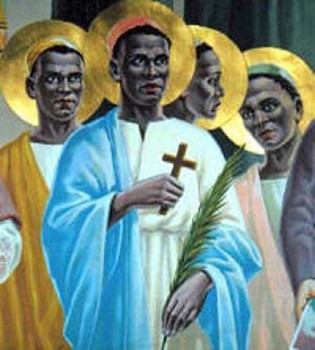
The Feast Day of St. Charles Lwanga is celebrated on June 3.
The Society of Missionaries attracted many converts in Uganda. The converts soon became teachers of the faith also. Uganda was ruled by King Mwanga who was violent and a pedophile. The Christians who lived and taught at King Mwanga’s court tried to protect the pages from the King. The leader of the 200 Christians was Joseph Mkassa. He confronted the King after a Protestant missionary and his companions were killed. Mwanga ordered his execution. Before he was beheaded and burned on Nov. 15, 1885 Joseph forgave Mwanga, but asked for repentance.
St. Charles, who was 18 when he converted, became the new leader of the Christian group. For six months the persecution lessened. Then, however, King Mwanga became angry and killed another student of Christianity with a spear. He ordered the royal compound sealed so no one could escape. Charles baptized four catecheumens (students) that night. The next day the king ordered the 15 boys and men to be executed because they refused to give up being Christians. They were ordered to walk 37 miles to be executed in Namugongo. Three died on the journey. After seven days in prison, they were burned to death. Thirteen Catholics and eleven Protestant’s died.
The Catholic faith was practiced in secret without clergy. After the death of King Mwanga, there were 500 Christians and 1000 catecheumans waiting to receive the sacraments again.
The 22 Catholic Martyrs of Uganda were canonized.
Do not be ashamed to confess the cross, for angels glory in it.