Prayers, Quips and Quotes: Our Lady of Sorrows, Feast Day September 15

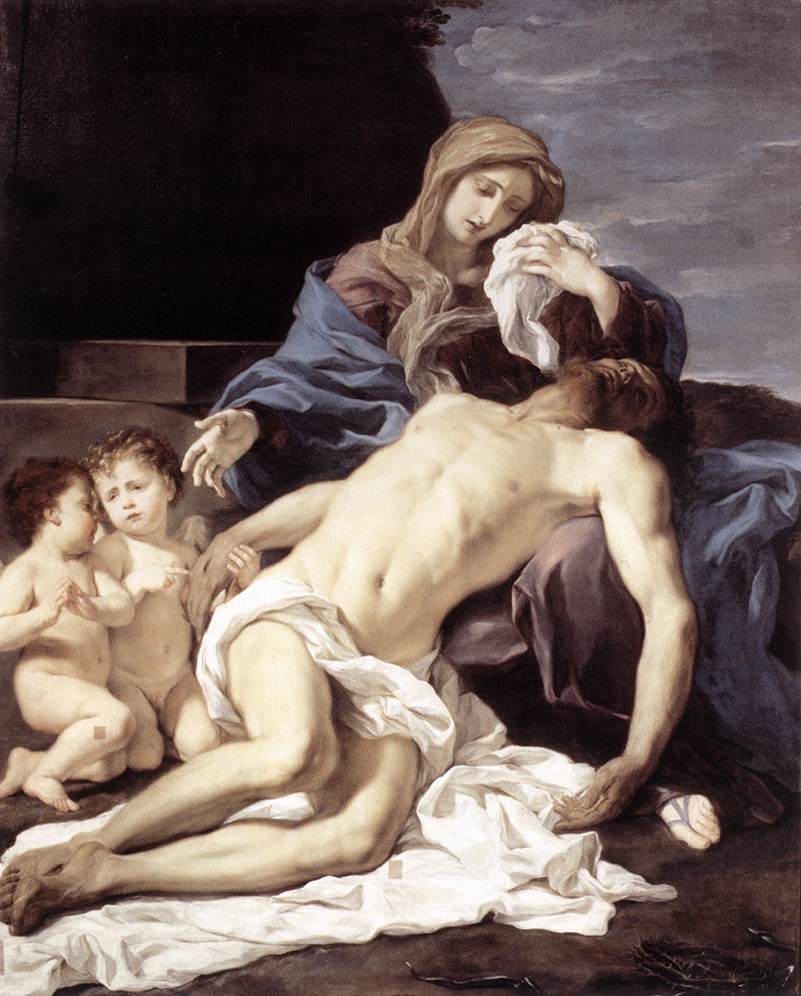
Baciccio Pieta 1667 Public Domain Image
Baciccio Pieta 1667

The Feast Day of Our Lady of Sorrows is celebrated on September 15. It dates back to the 12th century when it was promoted by the Cistercians and the Servites.

The focus of the devotion to Our Lady of Sorrows is the grief Mary felt during the suffering of her Son, Jesus. As His mother, her heart felt intense pain and sorrow.

Below are the seven sorrows of Mary:

  1. The prophecy of Simeon (Luke 2:25-35)
  2. The flight into Egypt (Matthew 2:13-15)
  3. Loss of the Child Jesus for three days (Luke 2:41-50)
  4. Mary meets Jesus on his way to Calvary (Luke 23:27-31; John 19:17)
  5. Crucifixion and Death of Jesus (John 19:25-30)
  6. The body of Jesus being taken from the Cross (Psalm 130; Luke 23:50-54; John 19:31-37)
  7. The burial of Jesus (Isaiah 53:8; Luke 23:50-56; John 19:38-42; Mark 15:40-47)

As we reflect on the sorrows and suffering Mary experienced as the Mother of God, we can remind ourselves of the human nature of both Jesus and Mary. They felt pain. They felt grief. They felt loss. They wept.

Jesus has two natures: Human and Divine. Mary is not Divine. She is human like you and me. We can only wonder at her strength and holiness as she drank from the bitter cup of suffering.

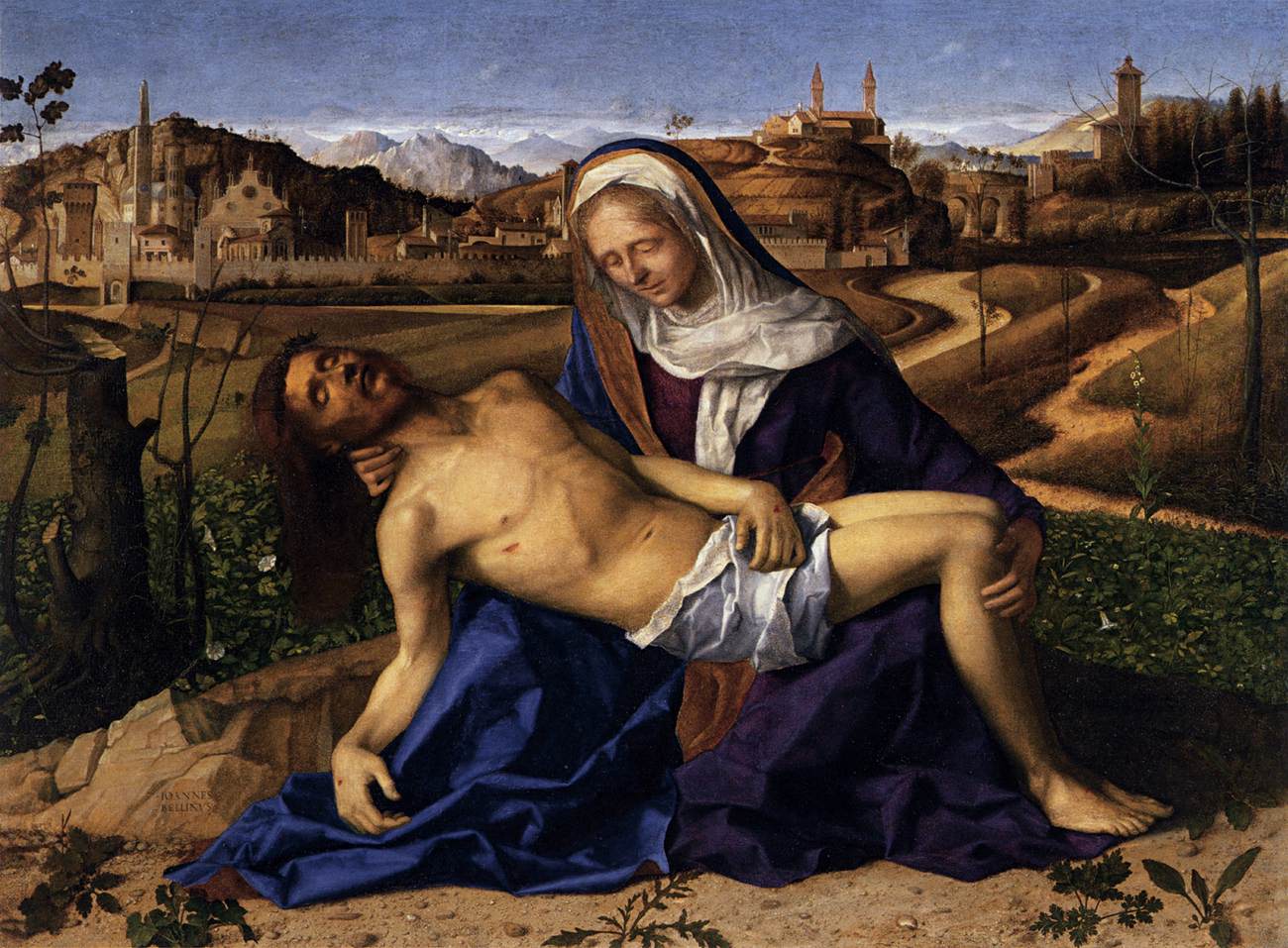
Giovanni bellini pieta martinengo Public Domain Image
Giovanni bellini pieta martinengo
Public Domain Image
Whoever you are who love the Mother of God, take note and reflect with all your innermost feelings upon her who wept for the Only Begotten as He died…The grief she felt in the Passion of her son goes beyond all understanding.
Quote of St. Amadeus of Lausanne; Feast Day January 28

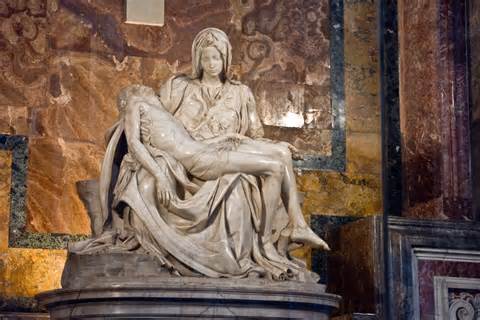
La Pieta Michelangelo Public Domain Image
La Pieta Michelangelo

September is the Month of Our Lady of Sorrows

Save

Prayers, Quips and Quotes: Our Lady of Sorrows, Feast Day September 15


Baciccio Pieta 1667 Public Domain Image
Baciccio Pieta 1667
Public Domain Image

The Feast Day of Our Lady of Sorrows is celebrated on September 15.  It dates back to the 12th century when it was promoted by the Cistercians and the Servites.

The focus of the devotion to Our Lady of Sorrows is the grief Mary felt during the suffering of her Son, Jesus.  As His mother, her heart felt intense pain and sorrow.

Below are the seven sorrows of Mary:

  1. The prophecy of Simeon (Luke 2:25-35)
  2. The flight into Egypt (Matthew 2:13-15)
  3. Loss of the Child Jesus for three days (Luke 2:41-50)
  4. Mary meets Jesus on his way to Calvary (Luke 23:27-31; John 19:17)
  5. Crucifixion and Death of Jesus (John 19:25-30)
  6. The body of Jesus being taken from the Cross (Psalm 130; Luke 23:50-54; John 19:31-37)
  7. The burial of Jesus (Isaiah 53:8; Luke 23:50-56; John 19:38-42; Mark 15:40-47)

As we reflect on the sorrows and suffering Mary experienced as the Mother of God, we can remind ourselves of the human nature of both Jesus and Mary.  They felt pain.  They felt grief.  They felt loss.  They wept.

Jesus has two natures:  Human and Divine.  Mary is not Divine.  She is human like you and me.  We can only wonder at her strength and holiness as she drank from the bitter cup of suffering.

Giovanni bellini pieta martinengo Public Domain Image
Giovanni bellini pieta martinengo
Public Domain Image
Whoever you are who love the Mother of God, take note and reflect with all your innermost feelings upon her who wept for the Only Begotten as He died…The grief she felt in the Passion of her son goes beyond all understanding.
Quote of St. Amadeus of Lausanne;  Feast Day January 28
La Pieta Michelangelo Public Domain Image
La Pieta Michelangelo
Public Domain Image
September is the Month of Our Lady of Sorrows

Save

Save

Save

Prayers, Quips and Quotes: Feast Day of the Most Holy Name of the Blessed Virgin Mary

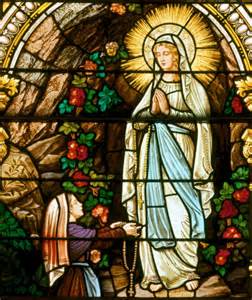
Our Lady of Lourdes Public Domain Image
Our Lady of Lourdes

The Feast Day of the Most Holy Name of the Blessed Virgin Mary is celebrated on September 12.

On this day we reflect on the titles given to Mary.  Why has she become known by so many names?  Which name touches you the most when you think about the Blessed Virgin Mary?  Mary, Mother of God?  Mary, Queen of Saints?  The Immaculate Heart of Mary?

Each name tells us something about Mary, who loved and gave birth to Jesus.  Our Sorrowful Mother helps us to reflect on the suffering Mary experienced.    Some of her titles refer to the place in which she appeared to someone:  Our Lady of Lourdes, Our Lady of Mt. Carmel, and Our Lady of Guadalupe.

Other titles refer to her spirituality:  Our Lady of the Rosary,  Our Lady of Grace,  Mystical Rose, Star of the Sea.

The name we are given at birth is important.  We are called by that name throughout our life.  Each of us has been called to do something specific for God.  Perhaps it is prayer.  Perhaps it is raising a family with love.  Perhaps it is a profession like teaching or medicine, or farming.

Mary was called by God  for a very special purpose.  She was asked to love and raise Jesus, the Son of God.  She became the Mother of God and loved him in a way none of us can.

Today is a day to reflect on the role of Mary in the life of Jesus.  We can also reflect on our role in the world.  If we honor and imitate the mother of Jesus, we can be certain that we will come to know Jesus better.

Mary  is called Queen of Martyrs, for her martyrdom was the lengthiest, most intense, and most loving.
Quote of Bl. James Alberione

September is the Month of Our Lady of Sorrows

Save

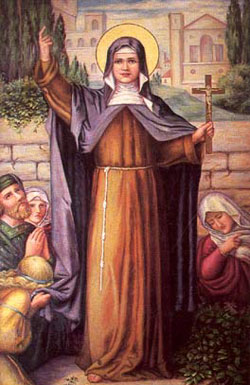
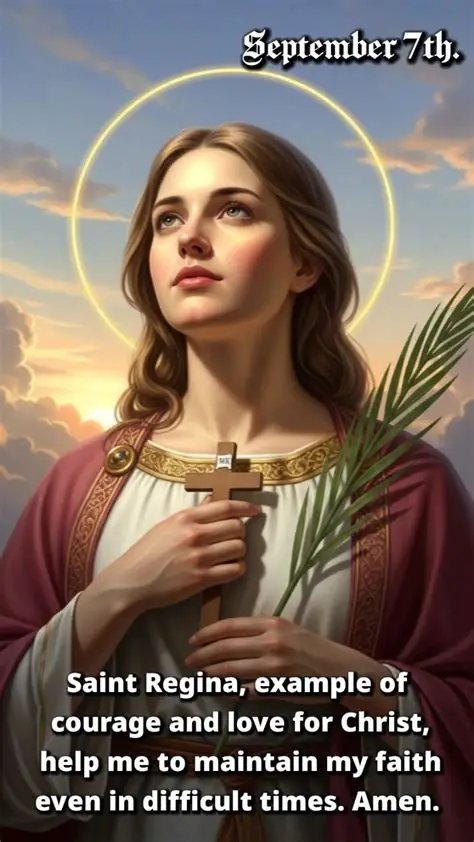
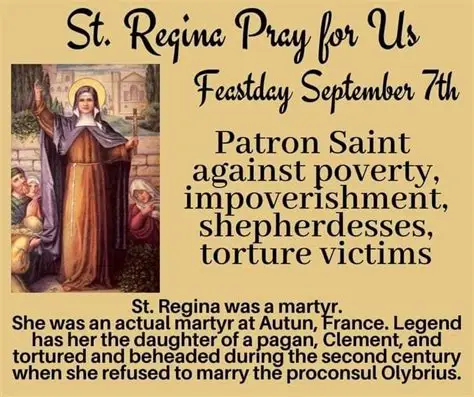
Prayers, Quips and Quotes: St. Regina, Feast Day September 7


St. Regina
St. Regina

The Feast Day of St. Regina is celebrated on September 7.  She was born in Alise, France.  Her mother died at childbirth.  Regina’s father was a prominent man who was a pagan.  He hired a Christian nurse to raise Regina.  While Regina was quite young the nurse secretly baptized Regina.

St. Regina became more and more religious as she grew older.  When her father learned that she had been baptized, he disowned her.  She lived with her nurse and worked in the fields to earn money.  She also tended sheep.  While working, she meditated on the love and mercy of God.

When Regina was 15 years old, the prefect of Gaul named Olybrius noticed Regina and became determined to marry her.  He was unhappy that she was a Christian.  Olybrius tried to convince her to deny her faith but she not only refused but proclaimed her faith even louder.   Olybrius then had her imprisoned.  She was chained to the walls of the cell with an iron belt.  After she still refused to deny her faith, she was whipped and scourged.  Finally she was beheaded.  She died in the year 286.   Many were converted after seeing a solitary dove hover over her during the torture.

The relics of St. Regina are enshrined in Flavigini Abbey where many miracles have since occurred.

St. Regina is honored as a martyr for the faith.  She is the patron saint against poverty and for victims of abuse.

If the moon is beautiful as it reflects the light of the sun at so great a distance, what will be the beauty of the saints, who for all eternity and not at a distance, will reflect the divine image of God!

Quote of Ven. Solanus Casey

September is the Month of Our Lady of Sorrows

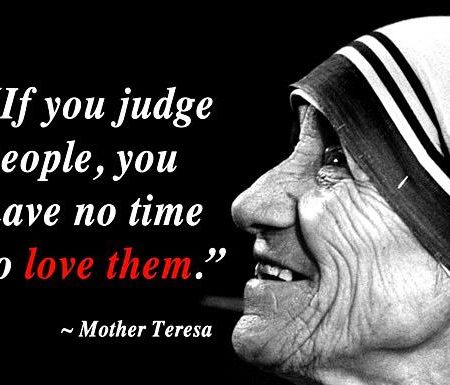
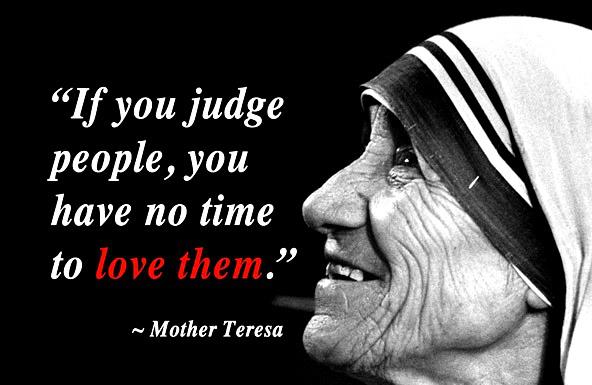
Prayers, Quips and Quotes: St. Teresa of Calcutta, Feast Day September 5


Mother Teresa Public Domain Image
Mother Teresa

The Feast Day of St. Teresa of Calcutta is celebrated on September 5.  On September 4, 2016 Pope Francis canonized Mother Teresa, proclaiming her a saint.

Mother Teresa was beatified on October 19, 2003, after confirmation of her first miracle. The miracle was reported that a woman who had a large and very visible tumor, had stayed with the Missionaries of Charity. After she and the Sisters had prayed for Mother Teresa’s intercession, the growth, six to seven inches in length, had disappeared within several hours. Finding no other medical explanation for the sudden cure it was declared her first miracle. Over 3500 other reports are being investigated as possible miracles.

After accepting a second miracle, Pope Francis cleared the way for Mother Teresa to be declared a saint.  Pope Francis signed a decree declaring that the inexplicable 2008 recovery of a Brazilian man who suddenly woke from a coma caused by a viral brain infection was due to the intercession of the Albanian nun, who died in 1997.

The Rev. Brian Kolodiejchuk, the postulator spearheading Mother Teresa’s canonization case, stated that the man fully recovered following his wife’s prayers and he has since returned to work as a mechanical engineer. The couple also have had two children.

Mother Teresa, as the world knows her, was born to parents Nikola and Drana Bojaxhiu on August 26, 1916 in Skopje of Macedonia and named Agnes Gonxha  Bojaxhiu. She was baptized on August 17, 1910 in Macedonia. She was the third child in her family, following sister Aga and a brother, Lazar. Her father, Nikola died, when she was eight years old. Her father was a traveler, an extrovert, and a businessman who spoke five languages. Her mother, Drana, was extremely pious, adopting several orphans. She was known as Gonxha (pronounced gon’KHA) which means “flower bud”.

Gonxha desired early to become a missionary. At the age of eighteen, she joined the Sisters of Loreto. Here she took the name of Sister Mary Teresa after St. Therese of Lisieux. She was sent to Calcutta, India to teach at St. Mary’s High School for Girls, which was run by the Sisters of Loreto. On May 24, 1937, she took her final Profession of Vows to a life of poverty, chastity, and obedience. She then became known as Mother Teresa. In 1944, she became principal of the school.

While on a train, she received a second calling. Christ spoke to her, asking her to work in the slums of Calcutta, caring for the sickest and poorest of the people. Pursuing this calling changed her life forever. In one year, she received approval to do the work she was being called to do. After six months of basic medical training she went to the slums to aid the needy and dying. Mother Teresa founded the Missionaries of Charity with 12 members, most of them students from St. Mary’s. She established a leper colony, an orphanage, a mission house, and several health clinics. In 1971, Mother Teresa visited New York City, where she opened a soup kitchen and a home to care for HIV/AIDS sufferers. In 1979, she received the Nobel Peace Prize.

In 1983, Mother Teresa suffered her first heart attack. After suffering from lung, kidney and heart problems for several years, she died on Sept. 5, 1997 at the age or 87. At the time of her death her Missionaries of Charity numbered over 4,000. She had 610 foundations in 123 countries.

In 2003, Mother Teresa’s private correspondence revealed she had experienced a “dark night of the soul”… feeling abandoned by God and lacking in faith. This lasted unusually long; for fifty years. Many saints have experienced such feelings, described by John of the Cross, in his book Dark Night of the Soul. She was filled with loneliness, and torture, due to this lack of consolation from God.

Mother Teresa is known for saying,

“The greatest poverty in the world, among the affluent, as well as the poorest of the poor, is to be unloved, unwanted, and uncared for.”

The world did not know that she spoke from her own experience.
There are many books written about Mother Teresa and her great love and service to the world. The following is one of my favorite quotes.

Suffering is a sign that we have come so close to Jesus on the cross that He can kiss us; that He can show that He is in love with us by giving us an opportunity to share in His Passion.


Quote of St. Teresa of Calcutta
September is the Month of Our Lady of Sorrows
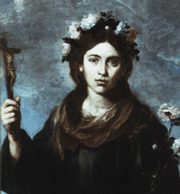
Prayers, Quips and Quotes: St. Rose of Viterbo, Feast Day September 4


St. Rose of Viterbo Public Domain Image
St. Rose of Viterbo

The Feast Day of St. Rose of Viterbo is celebrated on September 4.  Rose was born in Viterbo, Italy in 1234.  The city was in revolt against the pope.  Her family was exiled for supporting the Pope.  After the Pope won the dispute, Rose returned to the city.

St. Rose was pious from a very young age.  She practiced contemplative prayer by age 7.  She had the gift of miracles and visions.   While still a child she is credited with the healing of her Aunt who was believed to be dead.  At the age of ten, Mary instructed her to join the 3rd Order of St. Francis.  Shortly after, Our Lord appeared to her on a cross wearing a crown of thorns.  When Rose asked him why this had happened he told her his deep love for men was the reason.  Rose persisted asking him who had pierced him.  He told her:

The sins of men have done it.

This vision inspired young Rose to take to the streets preaching penance.  St. Rose tried and failed to join the Order of Poor Clare’s due to lack of a dowry.  She tried to  found a religious community of her own but it was not approved.    She lived a life of prayer and penance in her father’s home.  She died in 1251 at the age of 18.

The body of St. Rose was discovered to be incorrupt and lies in the monastery of St. Mary of the Roses which refused her entry.  St. Rose was canonized in 1457.

Rose’s dying words to her parents were:

“I die with joy, for I desire to be united to my God. Live so as not to fear death. For those who live well in the world, death is not frightening, but sweet and precious.
Quote of St. Rose of Viterbo
September is the Month of Our Sorrowful Mother

Save

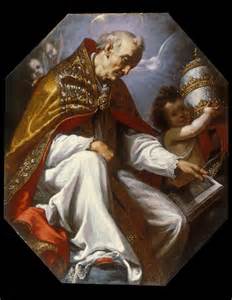
Prayers, Quips and Quotes: St. Gregory the Great, Feast Day Sept. 3


St. Gregory the Great Public Domain Image
St. Gregory the Great

The Feast Day of St. Gregory the Great is celebrated on September 3.

St. Gregory the Great was born in Rome, Italy around the year 550. He was born into a wealthy family. By the age of 23, he had become the prefect of Rome.  The following year his father died.  He decided to leave office and to become a monk.   St. Gregory is the patron saint of musicians, students, singer and teachers.

St. Gregory turned his family home into a monastery which he dedicated to St. Andrew.  He built six other monasteries on family land in Sicily and gave the remainder of his inheritance to the poor.  As a monk he devoted time to prayer, study and meditation.  He studied the writings of the Latin fathers.

After four years of prayer as a monk, Pope Pelagius II ordained Gregory a deacon and sent him to Constantinople.  He returned to Rome in 586 to serve Pope Pelagius until his death four years later.

Although Gregory was only a deacon he was elected Pope by popular acclaim.  His first act was to organize a three day penitential procession asking God to end the plague.  The plague ended after the procession reached the church of St. Mary Major.

As pope, Gregory negotiated for peace when the Lombards threatened Rome.

Over sixty of Pope Gregory’s sermons have survived, as well as over 80 letters he wrote.  He organized the liturgy and is given credit for the Gregorian Chant becoming popular.

Pope Gregory was well known for his compassion.  During a famine Pope Gregory ordered the church to use its assets to feed the poor.  He also ordered the clergy to go into the streets to help the poor.  If they did not they were replaced.

While Pope Gregory considered the Bishop of Rome to be the first among the bishops he also considered bishops to be equal.  Pope Gregory considered the Bishop of Rome to be likened to a final court of appeal.  He referred to himself as “the servant of the servants of God.”

Pope Gregory suffered from arthritis in his later years.   Pope Gregory was acclaimed a saint by popular decree.  St. Gregory the Great died on March 12, 604.

For it was not poverty that led Lazarus to heaven, but humility;  nor was it wealth that prevented the rich man from attaining eternal rest, but rather his egoism and his infidelity.
Quote of St. Gregory the Great
September is the Month of Our Lady of Sorrows
Save

Save

Prayers, Quips and Quotes: St. Giles the Abbot, Feast Day September 1


St. Giles, Abbot Public Domain Image
St. Giles, Abbot

The Feast Day of St. Giles the Abbot is celebrated on September 1.   St. Giles is the patron saint of the mentally ill, the disabled, epileptics, childhood fears, and depression.

St. Giles was born into a noble family in Athens, Greece in the seventh century.  After the death of his parents, he distributed his inheritance to the poor.    He also became known for the gift of miracles and healing he had received.  Giles longed to live a life of solitude, serving God as a recluse, away from all the praise and fame of the world.

He left Greece, sailing for France.  Everywhere he lived he became known for his gift of miracles and healing.  He would have to flee once again to find a place to live in peace and solitude.  He first lived near the mouth of the Rhone River.  Later he lived near the river Gard and finally he lived in the diocese of Nimes.  His final dwelling place was deep in the forest in a cavern in  a rock.  He occupied his time in prayer, praising God and meditating.  He was a vegetarian, living on herbs and roots.  His only companion was a red deer, which provided him with milk to drink.

After several years of living in complete solitude, the King of France instituted  a great hunt near where Giles lived.  The hunters chased the deer which led them to the cave where Giles lived.  They shot an arrow into the cave, wounding the holy hermit.  They found him covered with blood with the deer lying at his feet.  When the king was told what had happened, he ordered him taken care of.  He came to see him offering him gifts.  St. Giles refused the gifts and the King’s request to leave his solitude. Before leaving the king asked if there was anything he could do for him, St. Giles said he would like a monastery built where they were standing.

St. Giles became the Abbot of the monastery which was soon built.  Several disciples joined him.  His fame continued to spread because of his gift of miracles.  The conversion of the King was one of these miracles.

St. Giles made a pilgrimage to Rome to see the Pope.  He requested a blessing for his community which embraced the Rule of St. Benedict. Not only did he receive a blessing but he received the gift of two beautifully carved doors of cedar wood for his church.

Many sinners were converted because of the prayers and miracles of St. Giles.  St. Giles died on September 1, 725.  The miracles which took place near his tomb were so many that soon after his death a town began to grown and was named Giles.

I praise
Your humility that consoles me
Your patience that shelters me
Your eternity that preserves me
and……Your truth that rewards me.
Quote of St. Thomas Aquinas;  Feast day January 28
September is the Month of Our Lady of Sorrows