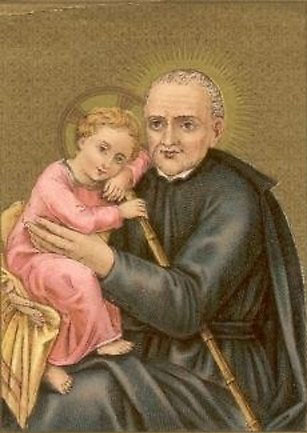
The Feast Day of St. Bernadino Realino is celebrated on July 2. St. Bernadino is the patron saint of advertising and communication.
St. Bernadino was born to a noble family of Capri, Italy in 1530. He studied medicine and law at the University of Bologna. He received his doctorate in 1563. After attending a retreat giving by the Jesuits, Bernadino realized he had a religious calling. He joined the Society of Jesus and was ordained a Jesuit priest in 1567. After ministering to the poor and the youth of Naples for several years he was sent to Lecce where he served for 42 years.
St. Bernadino was a powerful preacher and confessor. He was known for his acts of kindness and serving the poor. He died in 1616. His fame occurred after his death when his body was found to be partially incorrupt when his tomb was opened in 1711.
St. Bernadino Realino was canonized by Pope Pius XII in 1947.
It has hands to help others.
It has feet to hasten to the poor and the needy.
It has eyes to see misery and want.
It has ears to hear the sighs and sorrows of women and men.
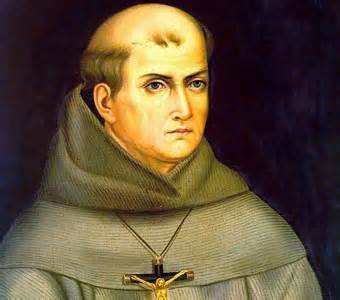
The Feast Day of St. Junipero Serra is celebrated on July 1.
St. Junipero Serra was born Miguel Jose Serra on the Island of Mallorca, Spain in 1713. At a young age Miguel joined the Order of St. Francis of Assisi taking the name Junipero which was the name of St. Francis’ original companion friar. Until he was 35, he was a student and them a professor. He was well known for his preaching ability.
Suddenly he gave up his life as a professor. He volunteered to serve in the Franciscan missions in the new world. He traveled by ship to Vera Cruz, Mexico and then walked with a companion the 250 miles to Mexico City. The Franciscans of Mexico were asked to take over the missions in Baja, California. It became Father Serra’s responsibility. St. Serra established nine of the missions in California. He baptized over 6,000 people and confirmed over 5,000. He died at the age of 70 and is buried at Mission San Carlos Borromeo.
St. Junipero Serra was beatified in 1988. Pope Francis canonized St. Junipero Serra on Sept. 23, 2015 while visiting the United States. He is the first saint to be canonized on U. S. soil.
We found on our journey, as well as in the place where we stopped,
that they treated us with as much confidence and goodwill
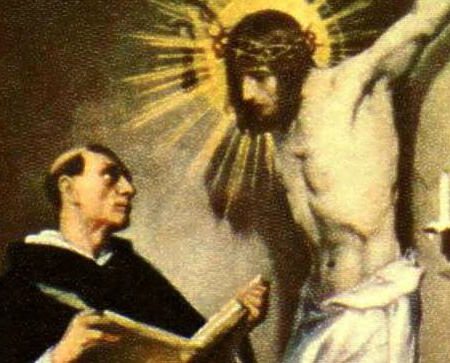
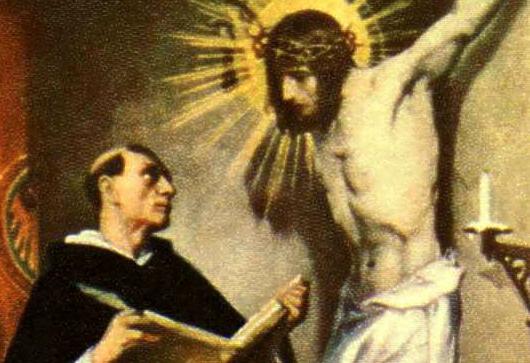
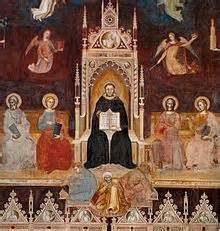
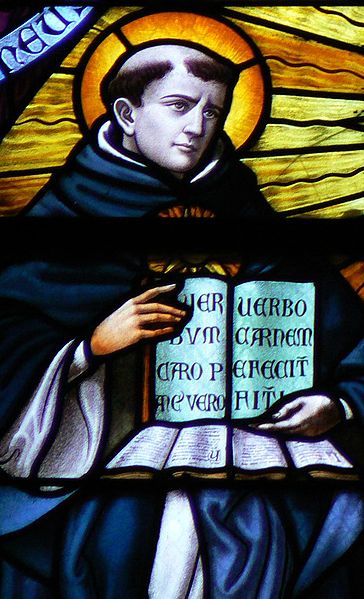
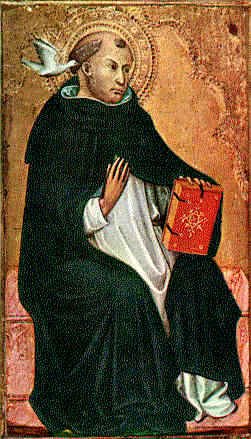
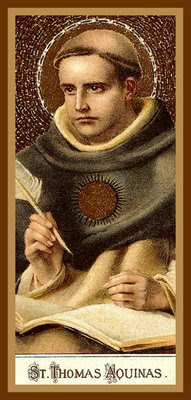
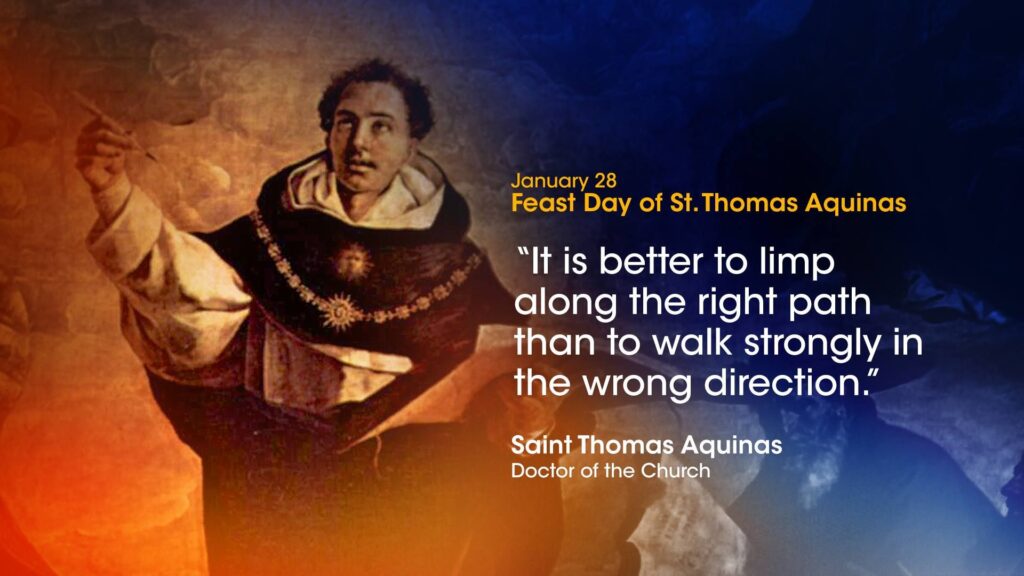
St. Thomas was was born in Sicily in the year 1225. He died in 1274. The Feast Day of St. Thomas Aquinas is celebrated on Jan. 28. He is considered the patron saint of students and universities.
At the age of five he was placed in the care of the Benedictines of Monte Casino.
He became a Dominican priest against his families wishes. His brothers followed careers in the military. In an attempt to end his desires to become a Dominican, his brothers hired a prostitute to seduce him. According to legend, two angels appeared to Thomas to strengthen him and increase his determination to remain celibate. He thus became known as the “Angelic Doctor”.
St. Thomas studied at Cologne under St. Albert the Great. He was called “the dumb-ox” because he was so shy and quiet. He was also of a very large stature. Actually, he was quite brilliant, eventually being declared a Doctor of the Church.
After becoming a priest he was sent to Paris. In Paris he became a friend of the King, St. Louis, dining with him frequently. He was asked to teach at the age of 22. He has published many writings. The most well known are Summa Theologica and Summa Contra Gentiles. He also wrote Hymns of Adoration which are well known today. The belief in the Real Presence of Christ in the Eucharist is very evident in his hymns of praise and adoration.
His well known hymns are the following:
1. Panis Angelicus (Bread of Angels) sung by Andre Bocelli
All now on earth can see what we are called to be:
Hope for a world in need, signs that love can succeed
Where true justice and peace endure.
St. Thomas Aquinas
O Salutaris Hostia ( O Saving Victim)
O saving Victim, open wide
The gate of heav’n to us below,
Our foes press on from ev’ry side;
Your aid supply your strength bestow.
To your great name be endless praise,
Immortal Godhead, One in Three;
O grant us endless length of days
In our true native land with thee.
Amen
St. Thomas Aquinas
Zion, to thy Savior; singing
Zion, To Thy Savior Singing Zion, to Thy Savior singing,
To thy Prince and Shepherd bringing, Sweetest hymns of love and praise, Thou wilt never reach the measure Of His worth, by all the treasure Of thy most ecstatic lays.
Of all wonders that can thrill thee, And, with adoration fill thee, What than this can greater be, That Himself to thee He giveth? He that eateth ever liveth, For the Bread of Life is He.
Fill thy lips to overflowing With sweet praise, His mercy showing Who this heav’nly table spread: On this day so glad and holy, To each longing spirit lowly Giveth He the living Bread.
Here the King hath spread His table, Whereon eyes of faith are able Christ our Passover to trace: Shadows of the law are going, Light and life and truth inflowing, Night to day is giving place.
Lo, this angels’ food descending Heavenly love is hither sending, Hungry lips on earth to feed: So the paschal lamb was given, So the manna came from Heaven, Isaac was His type indeed.
O Good Shepherd, Bread life giving, Us, Thy grace and life receiving, Feed and shelter evermore; Thou on earth our weakness guiding, We in Heaven with Thee abiding, With all saints will Thee adore.
St. Thomas Aquinas
Adore te Devote (Humbly I adore thee)
Humbly I adore thee, Verity unseen, who thy glory hiddest ‘neath these shadows mean; low, to thee surrendered, my whole heart is bowed, tranced as it beholds thee, shrined within the cloud.
Taste and touch and vision to discern thee fail; faith, that comes by hearing, pierces through the veil. I believe whate’re the Son of God hath told; what the Truth hath spoken, that for truth I hold.
O memorial wondrous of the Lord’s own death; living Bread that givest all thy creatures breath, grant my spirit ever by thy life may live, to my taste thy sweetness never failing give.
Jesus, whom now hidden, I by faith behold, what my soul doth long for, that thy word foretold: face to face thy splendor, I at last shall see, in the glorious vision, blessed Lord, of thee.
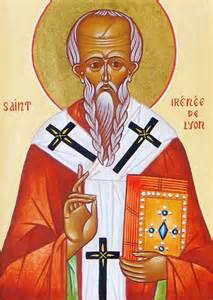
The Feast Day of St. Irenaeus of Lyons is celebrated on June 28.
St. Irenaeus of Lyons is considered a martyr and Church Father. St. Irenaeus was born around 125 in Asia Minor. He was raised in a Christian family, becoming a student of St. Polycarp of Smyrna.
St. Irenaeus was ordained a priest in 177 and became the Bishop of Lyons after the martyrdom of St. Pothinus. He is considered one of the first great Christian theologians. The most well known of his books is titled “Against Heresies”. He defended the holiness of the body and preached to the Gnostics.
St. Irenaeus was martyred in 202 in Lyons, France under the Emperor Septimus Severus.
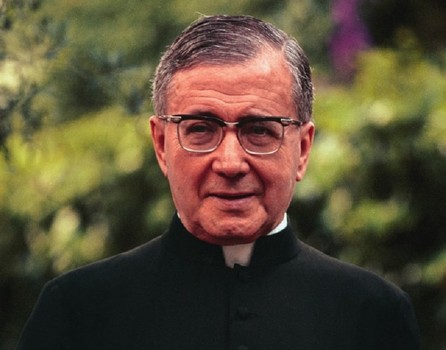
The Feast Day of St. Josemaria Escriva is celebrated on June 26.
St. Josemaria Escriva was born in Barbastro, Spain on Jan. 9, 1902. He was the second of six children and attended Catholic schools. At an early age he learned the meaning of suffering when three of his younger sisters died.
After reflecting on footprints in the snow from a discalced Carmelite, he became aware that he had a religious calling. He decided to study for the priesthood and was ordained a priest in 1925. Within three years in 1928, he was inspired to found Opus Dei which was dedicated to all people following Christ. Married people and non Catholics were allowed to join. Their ministry included working among the poor in schools and hospitals. He also founded the Priestly Society of the Holy Cross. Opus Dei spread to many countries throughout the world.
St. Josemaria is also an author of three popular books: The Way, Furrow and The Forge.
On June 26, 1975, St. Josemaria died in his office suddenly at the age of 73. He was canonized by Pope John Paul II in 2002.
It’s not enough to be good, you need to show it.
What would you say of a rose bush which produced only thorns?
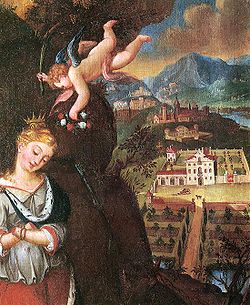
The Feast Day of St. Eurosia is celebrated on June 25. St. Eurosia is considered the patron saint against bad weather.
St. Eurosia was a French martyr. She was born in Bayonne, France into a noble family. Betrothed against her will to a Moore, she escaped through the mountains and hid in a cave. Eurosia was pursued and captured. Her captures dragged her out of the cave by her hair. She was then martyred. Her limbs were amputated and then she was beheaded. At the moment of her death a violent storm came which terrorized her captures.
St. Eurosia’s remains were discovered by a shepherd. Her head remained at the original shrine, but her body was taken to Jaca for burial. Miracles were reported at the original shrine which became a site of pilgrimage.
St. Eurosia was canonized by Pope Leo XIII.
Where the sign of the cross is erected,
the wickedness of the devil is immediately repelled.
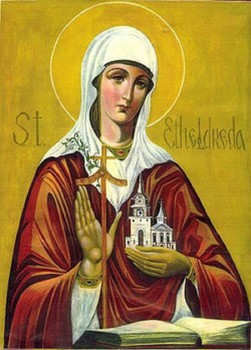
The Feast Day of St. Audrey is celebrated on June 23.
St. Audrey was also known as Etheldreda. She was born an English princess. At her parents insistence, she married a prince named Tonbert. He permitted her to keep the vow of virginity which she had earlier made. However, after three years she was a widow.
She was later forced to marry a king from Northumberland, named Egfrid. After twelve years he tried to change her mind about living as brother and sister. When she refused he tried to bribe the bishop St. Wilfred of York, asking him to release her from her vows. St. Wilfrid refused.
With the permission of her husband St. Audrey became a nun and founded the Abbey of Ely. She died from an enormous growth on her neck in 679. She was not yet 50 years old.
Sixteen years later her body was found to be incorrupt.
Charity is the sweet holy bond that binds the soul with the Creator.
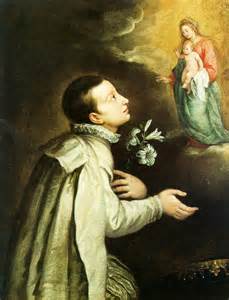
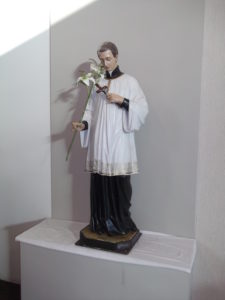
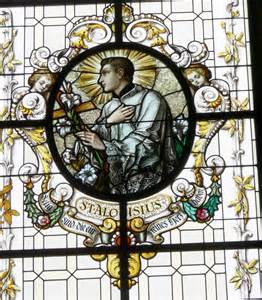
The Feast Day of St. Aloysius Gonzaga is celebrated on June 21. He was a Jesuit Deacon who lived in Italy and Rome from 1568-1591. He is the patron saint of youth and plague victims.
St. Aloysius was born in Castiglione, Italy in 1568. He was one of seven children and lived in a castle. He was expected to follow his father into the military, but by the early age of nine Aloysius had decided he had a religious calling. He received his 1st communion from St. Charles Borromeo, who was a Cardinal.
St. Aloysius’ family was living in Florence when Aloysius came down with kidney disease. He spent his time while he was ill reading the lives of the saints. After reading about Jesuit missionaries in India he became determined to join the Society of Jesus. Against the will of his father he joined the Jesuits at the age of 18. He gave up his right to an inheritance.
In 1590 Aloysius returned to Rome. While he was in Rome he had a vision of Archangel Gabriel who told him he would die within a year. In 1591, a plague broke out in Rome. Aloysius volunteered to serve in the hospital. It was not long before he came down with the plague himself. After receiving another vision, St. Aloysius told several people he would die on the Feast of Corpus Christi, (Body of Christ). The Feast of Corpus Christi fell on June 21 that year. In the morning he seemed fine but he grew weaker quickly. St. Bellarmine gave him the last rites and he died just before midnight at the age of 23.
St. Aloysius was known for his purity. He had taken a vow of perpetual virginity while very young, safeguarding himself from temptation by always looking downward when in the presence of women. His prayers included the Office of Mary and the Psalms. St. Aloysius had been ordained a deacon but was never ordained a priest.
A Carmelite mystic, St. Maria Magdalena de Pezzi claimed to have had a vision of St. Aloysius on April 4, 1600. She described him as radiant in glory because of his interior works and said he was a hidden martyr for his great love of God.
Pious legend tells us his first words were the Holy Names of Jesus and Mary. Before his death, his final words were “Into Thy hands.”
St. Aloysius was canonized on Dec. 31, 1726 by Pope Benedict XIII.
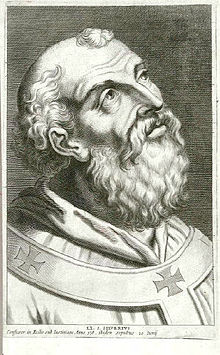
The Feast Day of St. Silverius is celebrated on June 20.
St. Silverius was the son of Pope Hermisdas who had been married before entering his ministry. St. Silverius was chosen as Pope while he was serving as a sub deacon. He was ordained on June 8, 536.
As Pope, St. Silverius refused to approve the doctrine of monophysitism which believed Christ had one nature not two (human and divine). Because of this ruling Pope Silverius was deposed and replaced by a deacon named Vigilus. St. Silverius was accused of treason and degraded to the rank of monk. After an appeal he was sent to Rome for an inquiry. Silverius however was forced to live on the island of Palmaria off Naples.
St. Silverius died from murder by starvation in the year 539. He was recognized a saint by popular acclamation.
Cast yourself into the furnace of the gentle heart of Jesus.
All your defects and imperfections will be consumed there.
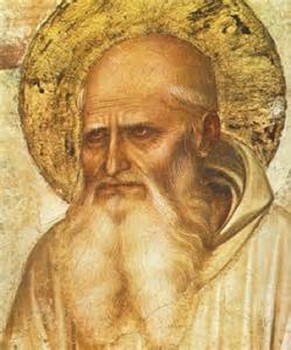
St. Romuald was born at Ravenna, Italy in 951. His feast day is celebrated on June 19.
As a young man he pursued the pleasures of the world. However, at the age of 20, he witnessed a duel between his father and a relative over property. His father killed the relative. St. Romuald fled to a Benedictine monastery to do penance as if he had committed the crime himself.
St. Romuald became a monk at the Basilica of Saint Apollinare in Classe. Wanting a stricter order he founded several monasteries of his own. When faced with temptation he always turned to prayer. His rule states,
“Sit in your cell as in paradise. Put the whole world behind you and forget it. Watch your thoughts like a good fisherman watching for fish. The path you must follow is in the Psalms – never leave it.”
St. Romuald spent 30 years founding monasteries. His father eventually followed him and became a monk. When he wavered he had the encouragement of his son.
St. Romuald died in the year 1027.
I arise today through God’s strength to pilot me.
God’s wisdom to guide me, God’s eye to see before me.
God’s ear to hear me, God’s word to speak for me,
God’s hand to guard me, God’s way to be before me,
God’s shield to protect me, God’s host to secure me.
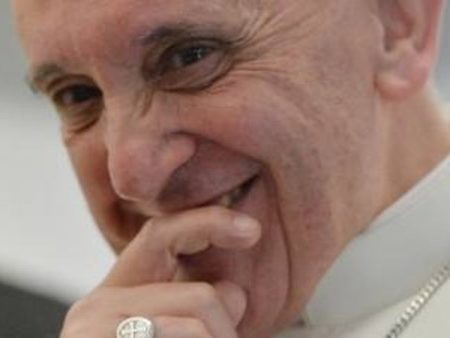
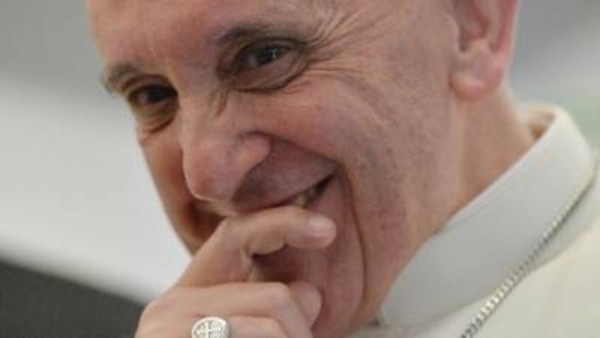
During his catechesis for the general audience on Wednesday, Pope Francis described the gift of piety received from the Holy Spirit, saying not to confuse it with pity. He described piety as a friendship with God, given us by Jesus; a friendship that changes our life and fills us with enthusiasm and joy. According to Zenit News Agency, Pope Francis said this gift is often misunderstood as pity.
Pope Francis told thousands gathered for his weekly general Audience that when the Holy Spirit pours love into our hearts we are led to perceive the Lord’s presence and love in our lives. This moves us to respond joyfully in prayer and adoration.
Pope Francis said,
“We experience ever anew, with joy and gratitude, the loving relationship with God our Father which has been granted us in Jesus his Son which grounds and perfects our authentic worship of God.”
Pope Francis clarified that piety is often misunderstood and confused as pity. “However,” he said ,
“piety is not having compassion for someone, having pity for one’s neighbor but indicates our belonging to God and our profound bond with Him. This bond gives meaning to the whole of our life and keeps us firm, in communion with Him, in the most difficult and trying moments.”
He stressed that there are two aspects of piety. First is a bond with the Lord which is not intended as a duty or an imposition. The bond comes from within. Pope Francis explained that it is a relation lived with the heart: it is our friendship with God, given to us by Jesus: a friendship that changes our life and fills us with enthusiasm and joy.
Pope Francis continued:
“When the Holy Spirit makes us perceive the presence of the Lord and all his love for us, He warms our heart and moves us almost naturally to prayer and to celebration,”
The pope stated that the second point of piety makes us grow in relationship and communion with God and leads us to live as his children, helping us to pass this love on to others, recognizing them as our brothers.
Distinguishing piety from pity, Pope Francis stressed that pity does not motivate the faithful in their relationships and encounters.
“Why do I say not to pity? Why do some people think that having compassion is close your eyes, make a face like a little picture, pretend to be a saint,” he said. “This is not the gift of piety.”
Rather, he said,
“piety means to be truly capable of rejoicing with those in joy, to weep with those who weep, to welcome and help those who are in need.”
Pope Francis noted the very close relation between the gift of piety and meekness, he said piety “makes us meek, it makes us tranquil, patient, in peace with God, and at the service of others with meekness.” Meekness is one of the beatitudes.
Recalling Paul’s Letter to the Romans: “All who are led by the Spirit of God ,these are sons of God, and ye have not received a spirit of slavery to fall back into fear, but you received the Spirit adopted as children, by whom we cry, ‘Abba, Father. ‘” The Apostle Paul’s words still apply to faithful today, he stressed.
The Pope concluded his homily with an invitation. He asked the faithful to ask the Lord that the gift of his Spirit conquer our fear, our uncertainties, also our restless, impatient spirit, rendering us joyful witnesses of God and of his love, adoring the Lord in truth and also in the service of our neighbor, with meekness and with the smile that the Holy Spirit always gives us in joy.
This article was originally posted on June 5, 2014
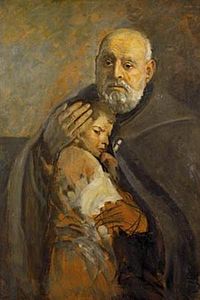
The Feast Day of St. Albert is celebrated on June 17.
St. Albert was born into a wealthy family on August 29, 1845 in Iglomia, Poland , which is near Krakow in 1945. He was the oldest of four children. He was active in politics as a young man. During the war against the Czar Alexander II Adam suffered from wounds which resulted in the amputation of his leg.
Adam had a great talent as an artist. He studied art in Warsaw, Munich and Paris. He was a very kind and compassionate man and decided to give up his life as an artist to join the Secular Franciscans when he returned to Krakow. He took the name Albert when he founded the Brothers of the Third Order of St. Francis, Servants of the Poor, also known as the Albertines. He also founded a community of Albertine Sisters. They organized food and shelter for the poor and homeless. St. Albert died in1916.
Pope John Paul II was inspired by St. Albert while he was serving as a priest. Pope John Paul was active in theater and wrote a play about St. Albert called Our God’s Brother. In 1983, Pope John Paul II beatified St. Albert. On November 12, 1989, Pope John Paul II canonized St. Albert.