On July 25, the Catholic Church will be celebrating the feast day of St. James the Greater. St. James was a fisherman and the brother of John. Peter was his partner. When they were called to become Apostles of Jesus, they left everything to do so. St. James the Greater is the patron saint of laborers and Spain.
There were two Apostles named James. James the Greater is the older of the two. He was also called “The Son of Thunder”. James, John and Peter were honored to be the only Apostles present at the Transfiguration. They were also present in the Garden of Gethsemane while Jesus prayed before His death.
Tradition tells us he evangelized in Spain after the crucifixion for nine years. St. James the Greater was the first Apostle to be martyred. In the year 44, King Herod Agrippa killed him with a sword during the early persecutions of the Church.
Truly, matters in the world are in a bad state,
but if you and I begin in earnest to reform ourselves,
a really good beginning will have been made.
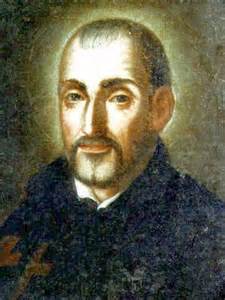
Quote of St. Peter Alcantara; Feast day October 19
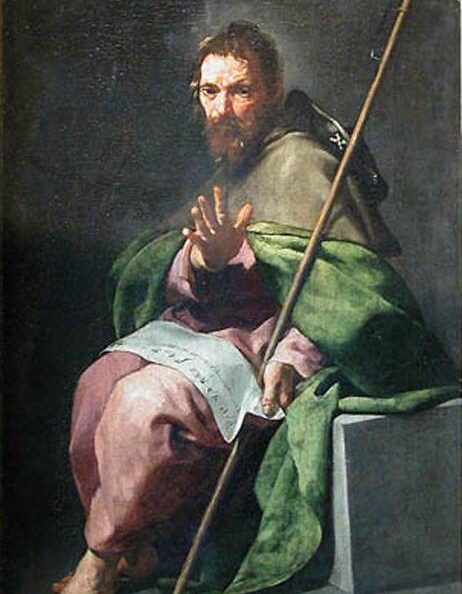
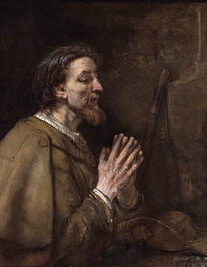
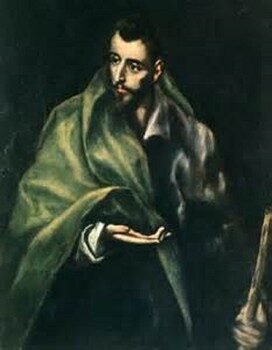
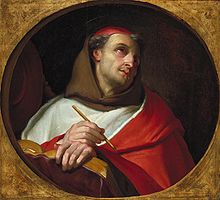
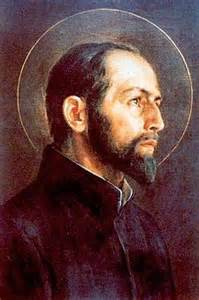
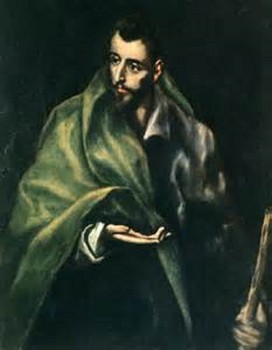
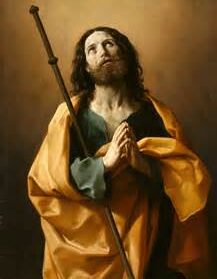
St. James the Greater in Art
St. James the Greater Public Domain Image
St. James the Greater by Alonso Cano
Public Domain Image
St. James the Greater by Rembrandt
Public Domain Image
St. John Boste is one of the Forty Martyrs of England and Wales. Their feast day is celebrated together on October 25. The Feast Day of St. John Boste is celebrated on July 24, the anniversary of his death.
St. John Boste was born in Dufton Westmoreland in 1544. He attended Queen’s College, Oxford. He became the first headmaster to serve under Queen Elizabeth l. He converted to Catholicism and was received into the Church in 1576. After leaving England he was ordained a priest in Rheims in 1581.
St. John Boste returned to England as a missionary priest. He evaded arrest for ten years. After a betrayal, he was finally arrested. He was found hiding behind a fireplace after celebrating a forbidden Mass. He was taken to the Tower of London and interrogated on the rack. He was then hung, drawn and quartered while reciting the Angelus prayer.
My function is to invade souls, not to meddle in temporal invasions.
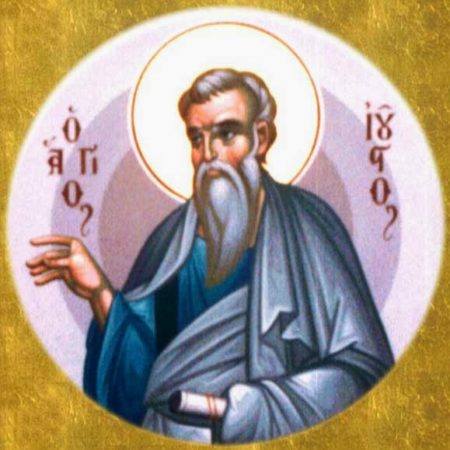
St. Joseph Barsabas was a follower and disciple of Christ. In the Acts of the Apostles St. Matthias was chosen over him to replace Judas after the crucifixion.
St. Joseph Barsabas, is also known as Barsabbas and Joseph the Just. He is considered one of the 72 disciples sent out by Our Lord. (Luke 10:1)
He spread the good news of the resurrection after the crucifixion.
Why climb the mountains or go down into the valleys of the world looking for Him who dwells within us.
The Feast Day of St. Camillus de Lellis is July18.
St. Camillus was born on May 25, 1550 in Bucchianico, Abruzzo, Italy. His mother died when he was a child and he received little attention.
As a teenager he was adventurous and a risk taker often losing his money and fighting. During one fight he was wounded in his leg. The wound did not heal but spread to his foot. It was during this time that his father also died.
Camillus continued to fight and gamble. He became so destitute that he stopped at a church to request help. Leaving the church, he met two monks. He soon began working for a Capuchinmonastery helping with construction projects. After talking to a priest, he had a burning desire to become a Benedictine priest. However, he was rejected due to lack of education.
At the age of 25, Camillus was admitted into a hospital for treatment of his leg. To pay for the treatment he cared for the sick and dying in the hospital. He was discharged form the hospital for gambling and fighting. He decided to study to become a Benedictine, however his wound again needed treatment. He returned to the hospital where he was hired to help reform the hospital.
At the age of 34 he became a priest and organized others to help. They called themselves “Servants of the Sick.”
The Order of St. Camillus serves the sick and dying in 35 countries. They care for both the physical and spiritual needs of the person in need.
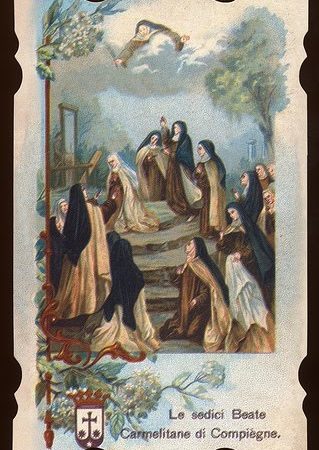
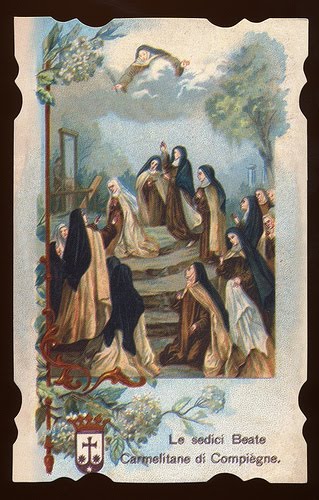
The Feast Day of Bl. Rose Chretien is celebrated on July 17. It is also the Feast of the Carmelite Martyrs of Compiegne. She was born near Eureaux, France in 1741.
Bl. Rose married at a young age and soon became a widow. She decided to join the Discalced Carmelite Order and became a choir nun. At her profession in 1777 she took the religious name of Sister Julia Louise of Jesus.
Bl. Rose is considered one of the Carmelite Martyrs of Compiegne. The sixteen Carmelites were imprisoned along with English Benedictine nuns. The Carmelites were condemned as traitors and sentenced to death by guillotine. As they were martyred, one by one, they renewed their vows and chanted the hymn Veni Creato Spiritus which was the hymn sung at their ceremony professing their vows.
Several days after their deaths, the persecution called the Reign of Terror led by Robespierre came to an end. The English Benedictine Nuns credited the Carmelites with ending the bloodbath and saving their community.
The Carmelite Sisters were buried in a common grave at Picpus Cemetery with a single cross where 1306 other victims of the guillotine were buried.
Those who do something for the glory of God are not troubled by failure, because they have already achieved their pupose of pleasing God, by acting with a pure intention.
Quote of St. Alphonsus Liguori, Feast day August 1
The Feast Day of St. Bonaventure is celebrated on July 15.
St. Bonaventure was born in 1218 in Bagnorgio, Latium. His name at birth was John of Fidanza. He was the son of a doctor. When he was young, he suffered from a serious intestinal illness. His distraught mother took him to St. Francis of Assisi to ask for healing prayers. When healed, St. Francis exclaimed “O-Buono ventura!” (Ogoodfortune!) From then on he was known as Bonaventure.
St. Bonaventure studied philosophy and theology in Paris. He entered the Franciscan order in 1243 at age 22. He later became a bishop. Pope Sixtus V inscribed him Doctor of the church in 1557.
St. Bonaventure was regarded as one of the greatest philosophers of the Middle Ages. St. Bonaventure wrote many books, including The Journey of the Mind to God. He is known as the Seraphic (Angelic) Doctor.
In 1257, St. Bonaventure was chosen as minister general of the Franciscan Order. He led the order into a deeper love of the Franciscan spirituality. At the request of his brothers he wrote a book describing St. Francis titled The life of St. Francis.
St. Bonaventure died while assisting the Second Council of Lyons on July 15, 1274.
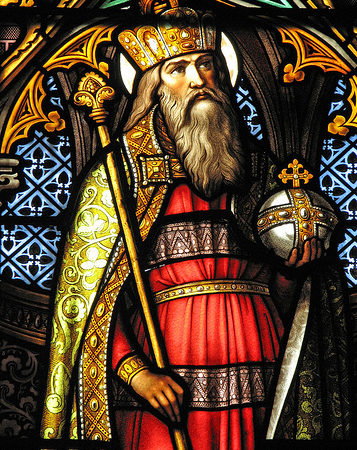
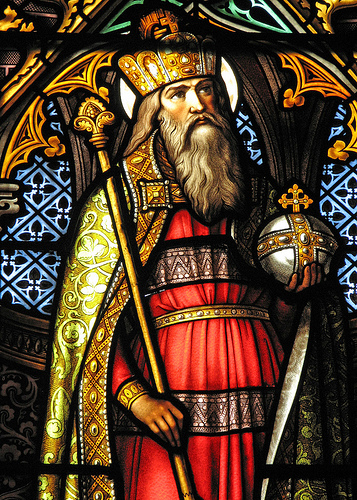
The Feast Day of St. Henry II is celebrated on July 13.
St. Henry was born to Duke Henry of Vavaria and Princess Gisela of Burgundy. As a youth he considered becoming a priest. He was educated at the Cathedral School in Hildesheim by St. Wolfgang of Regensburg who was a bishop.
In 995 Henry became the Duke of Bavaria. He became the king of Germany in 1002. In 1004 he was crowned King of Pavia, Italy. He married St. Cunegunga, however they had no children. In 1014 he was crowned the Emperor of the Roman Empire by Pope Benedict VIII. He worked to establish peace in Europe. He was also able to reform the church. He fostered missions and began the construction of the Cathedral at Basel, Switzerland, which took 400 years to complete.
Later in life he came down with an aliment which crippled his leg. He was cured by the touch of St. Benedictat Monte Cesino. After the death of his wife he considered becoming a monk however he was turned down. He was told he could no more good in the world as a public servant.
St. Henry II died on July 13, 1024 from natural causes at Pfalz Gvona, Saxony (modern Germany). He was canonized by Pope Bl. Eugene III.
From now on, regard this life as a desert
through which you pass until you come to the Promised Land,
the Jerusalem, which is above the land of the living.
The Feast Day of Bl. Emmanuel Ruiz and Companions is celebrated on July 10.
Emmanuel was born in Santander, Spain. He became a Franciscan priest serving as a missionary in Damascus during a time of great persecution.
During the massacre which occurred in 1860 thousands of victims were tortured and died. The villages of Lebanon were pillaged and burned. The massacre began with a quarrel between a Maronite and Druse. When a crowd came looking for them, Emmanuel and his companions refused to renounce their faith and become Muslims. Emmanuel, his supervisor and seven others were tortured and martyred.
Bl. Emmanuel was beatified in 1926 by Pope Pius XI.
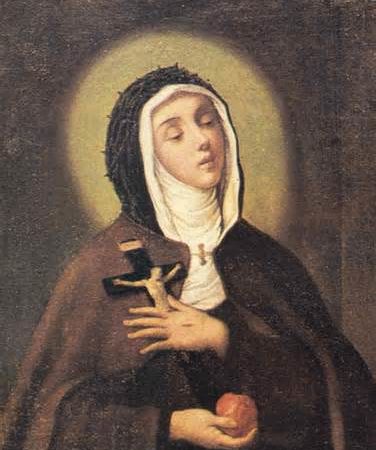
The Feast Day of St. Veronica Giuliani is celebrated on July 9.
St. Veronica was born in Mercatello, Italy in 1660. She was the youngest of seven children. Her mother died when she was seven. Even as a child she had a great compassion for the poor. She was known to give away food and her clothing. At the age of 17, she refused to marry. After pleading with her father, she joined the Poor Clares in 1677. She worked in the kitchen, infirmary and sacristy.
St. Veronica had a great devotion to the Sacred Heart and to the Eucharist. She offered her sufferings to the missions. She was known as a mystic. After a vision in which she saw her own heart as a ‘heart of steel’ she became much more compassionate and loving.
At the age of 34 St. Veronica became the novice mistress. She held the position for twenty two years. In 1697, at the age of 37, Veronica received the stigmata. She bore the marks of the crown of thorns and five wounds on her body. She underwent a humiliating investigation during which she was temporarily removed from her position. The investigation concluded the stigmata was real and she regained her position of novice mistress. She became the abbess at the age of 56. Eleven years later she died on July 9, 1727.
The body of St. Veronica was found to be incorrupt. She was canonized by Pope Gregory XVI on May 26, 1839.
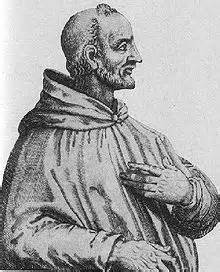
The Feast Day of Bl. Eugene III is celebrated on July 8. He served as the Bishop of Rome from 1145-1153. He was the first Cistercian Pope. Little is know about his early life. Bl. Eugene was ordained a priest by Pope Innocent II. St. Bernard of Clairvaux led him into the Cistercian Order in 1138. He became the abbot of the monastery of S. Anastasio aale Tre Fontance outside of Rome.
The election of Bl. Eugene III as the Bishop of Rome took place in 1145. Because of the turmoil of the times which was during the Crusades Bl. Eugene was unable to live in Rome. He lived in Viterbo, Siena, and France. He actively reformed the church. Three synods were held while he was Pope; Paris (1149), Tier (1147-1148) and Rheims (1148) The synods focused on reforming the clerical life.
Bl. Eugene III died on July 8, 1153 in Tivoli, Italy. He was recognized as a pious and meek man. Pope Pius X beatified him in 1872.
Time is a treasure of inestimable value,
because in every moment of time we may gain
an increase of grace and eternal glory.
Quote of St. Alphonsus Liguori; Feast day August 1
The Feast Day of St. Peter To Rot is celebrated on July 7. St. Peter To Rot is the patron saint of catechists, family, and marriage. Peter was born in 1912 in Rakunai which today is Papua, New Guinea. The Missionaries of the Sacred Heart of Jesus taught Peter while he was young. At the age of 18 Peter became a student at St. Paul’s College to become a catechist. His prayer life and devotion to the Blessed Sacrament grew. After three years he was asked to return to Rakunai to teach. He was the youngest catechist at the age of 21. He also visited the sick.
St. Peter To Rot married and had six children. In 1941 the war came to Rakunai and the Japanese invaded their country. The missionaries were sent to prison camp. When the priest, Father Laufer was taken he left Peter in charge asking him to look after the people and not to let them forget about God. Peter willingly accepted the challenge. He visited the sick and prayed with those who were dying. He taught both the children and the adults. He told the people,
“This is a very bad time for us, and we are all afraid. But God our Father is with us and looking after us. We must pray and ask him to stay with us always.”
When the bombing increased, they decided it would be safer to meet in small groups, they met in caves to pray. When the Japanese began to lose the war, they forbid the people from praying. They threatened them with imprisonment.
Peter continued to lead the people in prayer. The Japanese encouraged men to take a second wife. Peter objected to this and insisted that the people follow the Churches teaching on marriage. He protected several women from being forced to become a second wife. When the Japanese learned of all that Peter To Rot was doing, they arrested him. They searched the caves and his home. They took his books, Bible and crucifixes. His two brothers were also arrested. He was sentenced to two months in prison. He was not, however, released. He was murdered while he was in prison. It is believed he was poisoned with cyanide.
St. Peter To Rot was buried in the new cemetery next to the church he had served. He is considered a martyr for his faith.
St. Peter To Rot was beatified by Pope John Paul II in 1995.
St. Peter To Rot was canonized by Pope Leo XIV on October 19, 2025.
“The Japanese cannot stop us loving God and obeying laws! We must be strong and we must refuse to give in to them.”
Quote of Bl. Peter To Rot
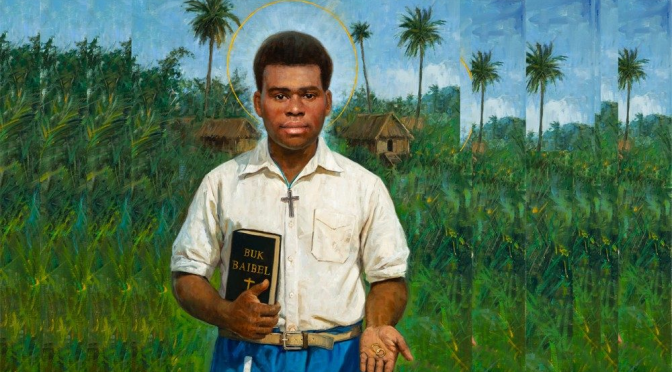
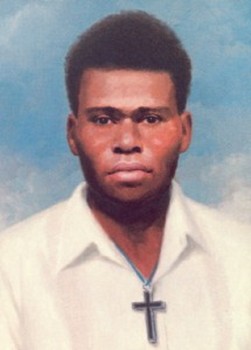
According to Vatican News, there is only one portrait of St. Peter Tu Rot.
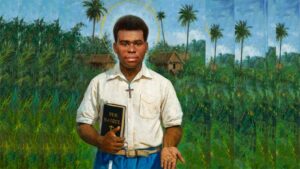
Fr. Tomas Ravaioli commented, “Some people don’t know the face of Peter To Rot, there is only one photograph, and it is not widely known. For the canonization, we wanted a new portrait of him. I commissioned the Spanish artist Raúl Berzosa; I love his art because it invites me to pray. He has this gift that his artworks are a way to unite yourself with God.”
In this portrait, he has the Holy Bible in his right hand, his wedding rings in his left, and on his neck, the catechist’s cross. The three symbols mark the new official portrait of Peter To Rot.
The wedding rings symbolize his commitment to protecting Catholic marriage, defending the sacramental union between man and woman.
The Bible he holds emphasizes To Rot’s devotion to the Word of God, nourished daily by Sacred Scripture and the Eucharist; he drew strength from these sources to face persecution.
The catechist’s cross, on his neck and is placed in the center of his chest, is the symbol of his unwavering faith. This image will be hung on the façade of St. Peter’s Basilica on the day of the canonization.
The Feast Day of St. Anthony Mary Zaccaria is celebrated on July 5.
St. Anthony of Zaccaria is known for beginning the devotion of Eucharistic adoration and founding the religious order of the Society of Clerics. He is the patron saint of physicians and medical doctors.
St. Anthony was born in Cremona, Italy in 1502 into a noble family. His father died when he was still an infant. His mother was 18 and chose to devote herself to charity and caring for her son. Anthony studied philosophy in Pavia and then medicine at the University of Padua. He returned to Cremona with a degree at the age of 23.
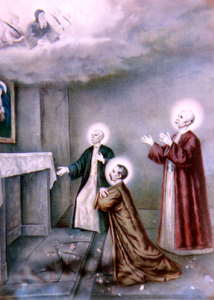
St. Anthony not only practiced medicine, he taught catechism and then began teaching adults. Eventually he decided to study for the priesthood. He was ordained at the age of 26. At his first Mass, he experienced the presence of angels around the altar and supernatural light during the consecration of the Eucharist. Many witnessed and testified about this event after his death.
St. Anthony was an eloquent preacher. It was the time of the counter-reformation which was begun after Martin Luther began the Reformation. He founded a priestly society the Clerics Regular of St. Paul to combat the corruption which surrounded him. They were inspired by the Apostle Paul and sought humility, poverty and preaching. Their society became known as the Barnabites named after the companion of St Paul…St. Barnabas. They were active at a well known church named St. Barnabas.
St. Anthony encouraged the “40 hours” devotion which involved continuous prayer before the Blessed Sacrament.
St. Anthony died at his mother’s house in 1539 after he became seriously ill. He was only 36 years old. Thirty years after his death St. Anthony’s body was found to be incorrupt. He was canonized by Pope Leo XIII in 1897.
Jesus is happy to come with us… as truth is to be spoken, as life is to be lived, as light is to be lit, as love is to be loved, as joy is to be given, as peace is to be spread.
 St. James the Greater Public Domain Image