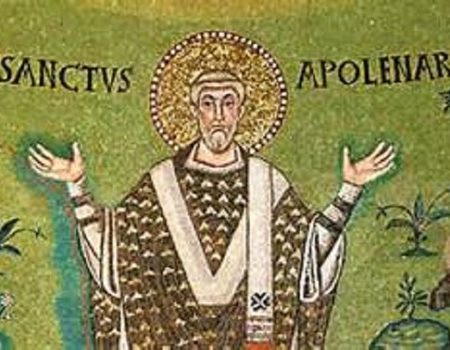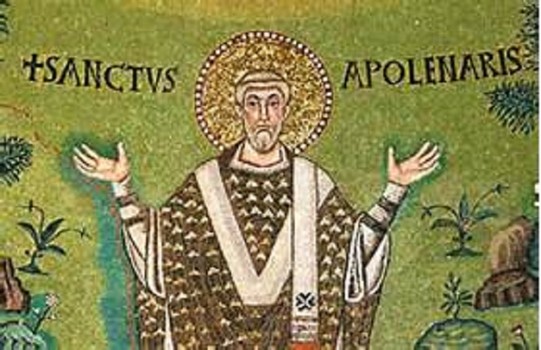
The Feast Day of St. Sylvester I is celebrated on December 31.
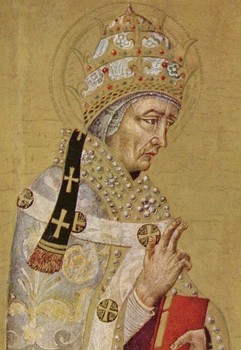
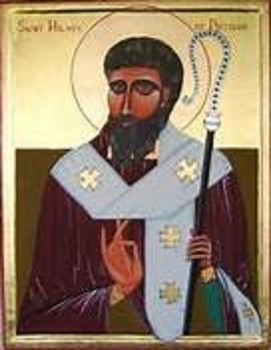
St. Sylvester I was the 33 pope, succeeding Pope Militades on Jan 31, 314. Although he became pope during peaceful times, his reign occurred during the persecutions of Diocletian. These persecutions came to an end when Emperor Constantine converted to Christianity.
A popular legend states that Constantine was cured of leprosy by Pope Sylvester, after which he converted to the faith. Constantine built several churches during his reign with the help of Pope Sylvester. These included the original St. Peter’s Basilica and the Basilica of St. John Lateran.
Pope Sylvester served as the Bishop of Rome for 21 years. He was involved in the debate about Arianism at the Council of Nicea. The Arians believed that Jesus Christ was not fully divine but a created being. It was at this council that the Nicean Creed was proclaimed by the Catholic Church. Pope Sylvester died in the year 335.
Nicean Creed
We believe in one God, the Father, the Almighty, maker of heaven and earth, and of all that is, seen and unseen. We believe in one Lord, Jesus Christ, the only Son of God, eternally begotten of the Father, God from God, Light from Light, true God from true God, begotten, not made, one in Being with the Father.
Through him all things were made. For us men and for our salvation, he came down from heaven: by the power of the Holy Spirit he was born of the Virgin Mary, and became man.
For our sake he was crucified under Pontius Pilate; he suffered, died, and was buried. On the third day he rose again in fulfillment of the Scriptures; he ascended into heaven and is seated at the right hand of the Father. He will come again in glory to judge the living and the dead, and his kingdom will have no end.
We believe in the Holy Spirit, the Lord, the giver of life, who proceeds from the Father and the Son. With the Father and the Son he is worshiped and glorified. He has spoken through the Prophets.
We believe in one holy catholic and apostolic Church.
We acknowledge one baptism for the forgiveness of sins.
We look for the resurrection of the dead, and the life of the world to come. Amen.
Jesus calls Peter
Do not be afraid; from now on, you will be catching people.
The feast day of St. Thomas Becket is celebrated on December 29. He was the Archbishop of Canterbury and a martyr.
St. Thomas Becket was born in 1118 in Normandy. He was the son of a wealthy merchant. He went to Paris to study law. After working in the field of law he decided to become a priest. He continued studying towards this goal. Thomas accepted the position of Bishop of Canterbury in 1162. After becoming Archbishop of Canterbury, Thomas gave up his worldly lifestyle. He lived an austere life and was generous with his time and money.
Many disputes arose between St. Thomas and King Henry II. Refusing to cooperate with the King, Thomas proceeded to resign as Archbishop, saying his election had been irregular. The Pope reinstated him as archbishop ordering him not to abandon his office. He then recommended Thomas to the Cistercian Abbot at Pontigny. Thomas followed the rules of the monastery after putting on the habit of a monk.
Troops soon appeared. The Cistercians were warned that they were harboring an enemy. No longer welcome there, the Archbishop turned to King Louis for refuge.
After three years of quarreling, Thomas was named the legate for the Pope for England except York.
St. Thomas was murdered with swords at his cathedral in Canterbury by knights of King Henry.
Many miracles were reported at his tomb. He is considered a martyr for the faith.
“I feel as though I am with Mary and Joseph beside the Crib.
It is good to be there. Outside are the cold and the snow,
images of the world, but in the little cave,
lit by the light of Jesus, it is sweet and warm and light.”
The Feast Day of The Holy Innocents is celebrated on December 28.
According to the Gospel of St. Matthew 2:16-18, Herod ordered the execution of all young male children near Bethlehem out of fear of a newborn King of the Jews after the announcement of His birth by the Magi.
It is not known how many children died, however, they are considered Martyrs and are honored by the Catholic Church.
An angel appeared to Joseph in a dream saying;
“take the child and his mother and escape to Egypt. Stay there until I tell you, for Herod is going to search for the child and kill kill Him.”
Joseph took Mary and Jesus to Egypt keeping them safe from harm.
December 27 is the Feast Day of St. John the Evangelist. He is the patron of writers, editors, and publishers. This honor is due to his writing of the fourth gospel, three epistles and the Book of Revelations.
John was the son of Zebedee. He and his brother James the Greater were called by Jesus to follow him as his Apostles. James and John were known as the “sons of thunder”.
John is referred to as the “beloved disciple”. At the Last Supper, it is John who sat next to Jesus. He is the only apostle not to die a martyr’s death.
In the gospels, John with Peter and James were the only witnesses to Jesus raising of the daughter of Jairus. (Luke 8.40) They were also at the transfiguration and the Agony in the Garden. Jesus sent only John and Peter into the city for the preparation of the final Passover meat. ( Last Supper).
The writings of John have been very important in the life of the church. It was the last gospel written. John did not focus on the parables of Jesus. He focused on the divinity of Jesus and the major themes of Jesus teaching. The first chapter of John especially focuses on the divinity of Jesus.
“In the beginning was the Word and the Word was with God and the Word was God. He was in the beginning with God. All things came into being through him and without him not one thing came into being. What has come into being in him was life, and the life was the light of all people. The light shines in the darkness and the darkness did not overcome it.”(John 1.1)
The gospel of John contains the “I am” sayings of Jesus. These sayings teach us a a great deal about Jesus. They are:
I am the bread of life (6.35)
I am the light of the world (8.12)
I am the gate for the sheep (10.7)
I am the good shepherd (10.11)
I am the way, and the truth, and the life (14.6)
I am the vine, you are the branches (15.5)
Reflecting on these gospel readings can help us to know Jesus in a much deeper way. John also shares with us his vision of the “end times” in the Book of Revelation. This book is probably the most misunderstood book in the bible. One of the things it teaches is the Christian belief that good will be victorious over evil. The book of Revelation also gives us the image of Jesus as “The Lamb of God”.
St. John was the only apostle who did not flee during the death of Jesus. He stood courageously at the foot of the cross with Mary and the other women. It is during the crucifixion that Jesus says,
“Woman, here is your son.” Then he said to the disciple. “Here is your mother.“ And from that hour the disciple took her into his own home. (John 19.26)
This is why Catholics consider Mary to be their spiritual mother.
The home John and Mary lived in is believed to be in Ephesus. After its discovery, it became a shrine for pilgrims. Tradition states that Joseph had died earlier in the life of Jesus. John lived primarily in Jerusalem and Ephesus after the crucifixion. He founded churches in Asia Minor.
Popular legend tells us Roman officers attempted to poison him. However, when John blessed the chalice the poison was turned into a snake. He was then ordered cast into boiling oil but because he was uninjured he was banished to the island of Patnos for a year. He lived to an old age, dying around the year 100.
Prayer to St. John the Evangelist
Shed upon your Church, O Lord, the brightness of your light, that we, being illuminated by the teaching of your apostle and evangelist John, may walk in the light of your truth, that at length we may attain to the fullness of eternal life, through Jesus Christ Our Lord, who lives and reigns with your and the Holy Spirit one God for ever and ever. Amen
The Feast Day of St. Stephen is celebrated on December 26. He was a disciple of Jesus.
St. Stephen is believed to be one of the 72 original disciples of Our Lord. After the ascension of Jesus he became one of the first seven deacons of the Catholic Church. He is considered the first to be martyred for the faith. In the book of Acts:6 we learn the story of the plot against St. Stephen. He was accused of blasphemy against the Jewish temple. This resulted in him being condemned and then stoned to death. Before his death he cried out to the Lord to forgive those persecuting him.
Look! I see an opening in the sky, and the Son of Man standing
at God’s right hand…Lord Jesus, receive my spirit.
The Feast Day of St. Emiliana and Trasila is celebrated on December 24. They were both Aunts of St. Gregory the Great.
St. Gregory the Great’s father had three sisters, Emiliana, Trasila and Gordiana. Gordiana eventually married. Trasila and Emilana lived in their father’s house living a life of prayer. They lived as if in a convent, praying many hours with joy and peace. They both made great spiritual progress.
Tarsilla had a vision of her great grandfather inviting her to join him in heaven. She died on Dec. 24th. This left her sister in grief on Christmas day. However, Tarsilla appeared to Emiliana several days after her death, asking her to celebrate Epiphany with her in heaven. Emiliana died on the eve of Epiphany, Jan. 5.
The feast day for both St. Emiliana and St. Tarsilla is celebrated on Dec. 24.
“Since I began to love, love has never forsaken me. It has grown to its own fullness within my innermost heart.”
Quote of St. Catherine of Genoa; Feast Day September 15
The Feast Day of St. John Cantius is celebrated on December 23. He was a priest in Poland.
St. John Cantius was born in 1397 in the Polish town of Kanty. He is also known as St. John of Kanty. He studied at a university in Krakow, Poland. After being ordained a priest, he was offered a position as rector of a school in Miechow. During this time he studied the writings and spirituality of St. Augustine. In 1429, he returned to Krakow, accepting a position in the Philosophy Department at Jagiellonian University. Eventually, he became the head of the Philosophy Dept. then the directorship of the University’s Theology Department.
St. John led a very austere life. He kept only what he absolutely needed, sleeping little and on the floor. He ate very little, consuming no meat. He was known for his kindness and generosity and was taken advantage of because of it. St. John had an affinity to the less fortunate and to the students.
At the time of his death in 1472, he was beloved and considered a holy man. Veneration began immediately after his death.
Pope John Paul II had a devotion to this saint from Poland.
Fight all error, but do it with good humor, patience, kindness, and love. Harshness will damage your own soul and spoil the best cause.
The Feast Day of St. Flavian is celebrated on December 22.
St. Flavian became the Patriarch of Constantinople after the death of Patriarch Proclus. It was a time of great turmoil in the church. St. Flavian convened a Local Council at Constantinople to discuss the heresy of Eutyches, which believed Jesus was Divine but not human.
When Eutyches persisted in his belief, he was excommunicated from the Church. Chrysathius, a friend of Eutyches, defended him and won his equital and the condemnation of Patrizrch Flavian.
Flavian suffered sever beatings and then he was chained and sentenced to banishment.
The Catholic Church celebrates Christmas for twelve days.
While the Nativity of Our Lord is celebrated Dec. 25, the Twelve days of Christmas begins on Christmas Day, Dec. 25(beginning at sundown), and ends at sunrise on Jan. 6, the Feast of the Epiphany. During the Christmas season the priest’s vestments are gold to symbolize the sacredness of the Christmas season. The change in the color of vestments indicates that Advent is over. During Advent, the priest’s vestments are purple to symbolize the holy season of waiting and prayer.
According to legend, the song The Twelve Days of Christmas was actually written by Jesuit priests in England during the sixteenth century. It was a time of persecution and the song was used to secretly teach basic facts regarding the Catholic faith. If someone studied all the items represented in the song they knew the basics of the catholic faith.
Each number had a secret meaning:
Twelve represented the twelve teachings mentioned in the Apostles Creed;
Five represented the first books of the Old Testament;
Four represented the four gospels;
Three represented the Trinity;
Two represented the two natures of Christ…human and divine;
and One represented Jesus himself, our Lord and our God.
The Pear Tree represented the cross we must carry when we follow Christ.
The Apostles’ Creed is a summary of the faith taught by the Apostles. When we pray the Apostles Creed we are professing our faith in the church begun by the Apostles.
The Apostles’ Creed
We believe in God, the Father Almighty, Creator of heaven and earth.
We believe in Jesus Christ, his only Son, our Lord.
He suffered under Pontius Pilate was crucified, died and was buried.
He descended into hell.
On the third day he rose again.
He ascended into heaven and is seated at the right hand of the Father.
He will come again to judge the living and the dead.
We believe in the Holy Spirit,
The holy catholic Church,
The communion of saints,
The resurrection of the body
and life everlasting. Amen
The Catholic Church has feast days throughout the year. Many of its feast days are in honor of the saints. The feast day given to a saint is usually the day he or she died and entered heaven.
Take a small amount of time each day during the twelve days of Christmas to meditate on the actual feast day we are celebrating.
The Holy Innocents are the innocent children murdered by King Herod after the Magi told him about birth of the new King of the Jews, called the Christ child. The little children were murdered in an attempt to find and murder Christ, “The King of the Jews”.
St. Anysia was a martyr in Greece. She lived from 284-309. She was killed with a sword after being accosted by a soldier. She used her wealth to help the poor.
The prayer of a good innocent,and obedient child is like dew from heaven falling upon his whole family.
St. Sylvester I was the Bishop of Rome. He died in the year 335 after helping to define doctrine at the Council of Nicea which proclaimed the Nicean Creed.
St. Elizabeth Ann Seton is the first native born American to be canonized. She lived in New York, dying in 1821. She is the Founder and first Superior of the Sister of Charity in the U.S.
“Be attentive to the voice of Grace.”
Quote of St. Elizabeth Ann Seton
St. John N. Neumann
St. John N. Neumann; Feast Day January 5
St. John N. Neumann was born in Bohemia. He emigrated to the U.S. becoming a Redemptorist priest and the fourth Bishop of Philadelphia. He is the first American bishop to be canonized.
The Feast of the Epiphany celebrates the Three Kings following the star to visit Jesus. They brought the King of the Jews gifts of gold, frankincense and myrrh.
The Feast Day of St. Peter Canisius is celebrated on December 21. He is the patron saint of the Catholic Press, a Jesuit priest and a Doctor of the Church.
St. Peter Canistius was born in Holland in 1521. He received his masters degree at the age of 19 from the University of Cologne. He studied art, law, and theology. He met Peter Faber, the first disciple of Ignatius, at a retreat. Soon after, he decided to become a member of the Society of Jesus, (the Jesuits). He was ordained in 1546. During the Council of Trent he was a delegate. St. Peter taught at several universities and established colleges and seminaries. He also wrote a catechism for lay people which was easy to understand. It was translated into twelve languages. He was an eloquent preacher, leading the counter reformation and renewing the faith in southern Germany. He also led reform in Austria, Bavaria and Bohemia.
After Mass one day, he received a vision of the Sacred Heart. Afterward, he offered his work to the Sacred Heart of Jesus.
Prior to his death he suffered from a paralytic seizure. He continued preaching and writing until his death on Dec. 21, 1597.
“Anyone who wishes to frolic with the devil cannot rejoice with Christ.”
The Feast Day of St. Dominic of Silos is celebrated on December 20. He is the patron saint of pregnant women, shepherds and prisoners. He was a Benedictine monk and priest.
St. Dominic of Silos was born in Navarre, Spain. around the year 1000. He was a peasant, shepherding his father’s flock. His love of solitude led him to become a Benedictine monk. He was ordained a priest becoming the Master of novices and prior. Because of his opposition to the annexation of the monastery land he was driven into exile.
St. Dominic turned to King Ferdinand I of Leon for aid. King Ferdinand found him refuge in the town of Silos in a decaying Abbey occupied by six monks. Dominic became the abbot of the community. He rebuilt the monastery both physically and spiritually. The monastery became a center of book design and scholarship Its proceeds were used for charity. St. Dominic raised funds to ransom Christians taken prisoner by the Moors. The membership in the monastery increased to 40 monks.
St. Dominic died on Dec. 20. Many healings were reported at the monastery, especially regarding pregnancy. Almost one hundred hears after his death, Blessed Joan de Aza de Guzmán prayed at his shrine to conceive the child she named Dominic.
“Is it not reward enough to know that one is doing the will of God?”
Quote of St. Just Bretenie’res; Feast day September 20
The Feast Day of St. Thomas De and Companions is celebrated on December 19.
St. Thomas was a tailor in Vietnam who entered the Dominican Orderas a tertiary. He was arrested and charged with giving aid and shelter to foreign missionaries. He was strangled at the age of 26.
The companions of St. Thomas De were Dominic Uy, Augustine Moi, Xavier May and Francis Man.
Augustine was also a Dominican tertiary. He was a day laborer. He refused to trample a crucifix when he was ordered to do so. He was strangled.
Francis Xavier was a native catechist and was also strangled.
Francis Man was a Dominican Tertiary working as a catechist when arrested.
St. Thomas De and Companions were among the 117 Vietnamese martyrs canonized by Pope John Paul II in 1988.