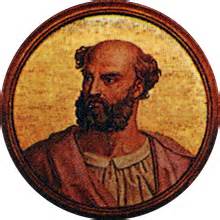
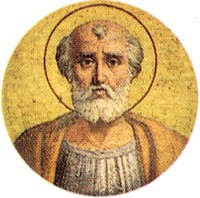
The Feast Day of St. Damasus is celebrated on December 11. He was the Bishop of Rome.
Damasus was born in 306. His father was a Roman priest. Following his father’s footsteps, he began as a deacon. He served in the Basilica of San Lorenzo. He also served Pope Liberius following him into exile. When Pope Liberius died he was elected Pope. At the same time a minority elected Ursinus as the Pope. Ursinus was considered the anti-pope. Unrest and discord were constant during the reign of Pope Damasus.
Pope Damasus commissioned his secretary St.Jerome to translate the scripture into Latin, the Vulgate version of the Bible. He also changed the liturgical language of the Church from Greek to Latin. He worked to preserve the catacombs and the graves of the martyrs, and relics. During his reign, Christianity was declared the official religion of the Roman state.
Pope Damasus I died of natural causes in Rome on Dec. 11, 384.
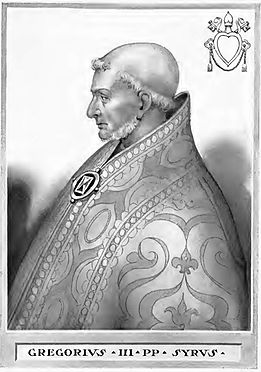
The Feast day of St. Gregory III is celebrated on December 10. He was the Bishop of Rome.
St. Gregory III was born in Syria. His father’s name was John. Little is known about his childhood. He became a Syrian priest. He was proclaimed pope immediately after the death of Pope Gregory II. The most pressing problem was defending the veneration of holy images. Emperor Leo III considered it idolatry.
Pope Gregory called a synod during which he approved measures against anyone who destroyed images of Jesus, Mary or the saints. He taught that icons and images promote worship rather than being the object of worship themselves. He repaired many beautiful churches and promoted monasticism. Pope Gregory was known for his virtue and knowledge.
Pope Gregory III died of natural causes on November 28, 741.
The Feast Day of Our Lady of the Miraculous Medal is celebrated on November 27.
The Miraculous Medal was the result of visions which occurred to St. Catherine Laboure’. She was born in 1806 in Paris, France. After having a dream about St. Vincent de Paul, she joined the Daughters of Charity which was founded by him. She is known as a Marian visionary because of the apparitions which she reported appearing to her.
On July 18, the first apparition occurred. Catherine saw a lady seated in the sanctuary. She approached her and was instructed how she was to act during times of trial, pointing to the altar for consolation. Mary told her,
“Sorrows will come upon France; the throne will be overthrown.”
A week later the French revolution began in Paris.
On Nov. 27, the lady showed St. Catherine the Medal of the Immaculate Conception, now known as the “Miraculous Medal” . She gave Catherine the mission of having the medal made and to spread devotion to it.
Catherine reported the visions to her spiritual director, Father Aladal. Forty five years later, she spoke fully to her supervisors about the apparitions.
The miraculous medal which Mary showed to Catherine was oval showing Mary standing on a globe crushing the head of the serpent. (the devil). Around the image of Mary were the words
“O Mary, conceived without sin, pray for us who have recourse to thee.”
Mary’s hands were showering a cascade of brilliant rays upon the world.
On the reverse side of the medal was a cross, the symbol of Christ’s redeeming Sacrifice on Mount Calvary for the salvation of the world. The cross was intertwined with the letter “M”.
The “M” stands for both Mary and for Mother and was to be surrounded by twelve stars. The two hearts are the Sacred Heart of Jesus encircled by a crown of thorns and the Immaculate Heart of Mary, pierced by a sword. The Flames symbolize the burning love of Jesus and Mother Mary.
Mary told Catherine,
“All who wear them will receive great graces.”
After two years of investigation Father Aladal went to the archbishop with the request. The request was approved.
At Catherine’s death, on December 31, 1876, at the age of 70, few people knew of her visions. She preferred a silent life, spending her time caring for the aged and sick.
The first two-thousand medals were delivered on June 30, 1832. The spread of the Medal was almost like a miracle in itself. The first supply disappeared quickly. Pope Gregory XVI put one of them at the foot of the crucifix on his desk. By 1836 several million medals had been made. The stories of the cures and wonders of the medal helped to spread its use far and wide.
The Miraculous Medal is considered a sacramental. Sacramentals lead a person to prayer which opens the person to the gifts of the Holy Spirit. Sacramentals can be material things such as blessed objects, such as scapulars, rosaries, crucifixes, medals, or Holy Water. It can also be actions such as the Sign of the Cross, genuflection, and prayer.
The following explanation of sacramentals is from the Catholic Catechism.
1667 “Holy Mother Church has, moreover, instituted sacramentals. These are sacred signs which bear a resemblance to the sacraments. They signify effects, particularly of a spiritual nature, which are obtained through the intercession of the Church. By them men are disposed to receive the chief effect of the sacraments, and various occasions in life are rendered holy.”17
1670 Sacramentals do not confer the grace of the Holy Spirit in the way that the sacraments do, but by the Church’s prayer, they prepare us to receive grace and dispose us to cooperate with it. “For well-disposed members of the faithful, the liturgy of the sacraments and sacramentals sanctifies almost every event of their lives with the divine grace which flows from the Paschal mystery of the Passion, Death, and Resurrection of Christ. From this source all sacraments and sacramentals draw their power. There is scarcely any proper use of material things which cannot be thus directed toward the sanctification of men and the praise of God.”176
Most Holy Virgin Mary…
Sanctuary of the Holy Spirit,
Lily of purity, Rose of patience,
Paradise of delight, Mirror of chastity,
Model of innocence…intercede
for this poor banished pilgrim.
Quote of St. Peter of Alcantara; Feast Day October 19
The Feast Day of the Presentation of Mary is celebrated on November 21.
The Feast Day of the Presentation of Mary originated in Jerusalem in 543. The story appears in the Protoevangelium of James which is an extra biblical document. St. Joachim and St. Anne, the parents of Mary, in gratitude for having a child after many years of infertility, presented Mary to God at the temple in Jerusalem when she was three years old.
The feast day emphasizes the purity of Mary from the moment her life began. Mary is considered a temple in which God dwells in a special way.
The feast day also remembers all the people who have dedicated themselves to God in a contemplative order.
Through Thee…the faithful have received baptism;
churches have been erected in all parts of the earth.
By Thine assistance the Gentiles have been brought to repentance.
And finally, through Thee, the only Son of God, source of light,
I try to make the serenity prayer a daily prayer. Often, it helps me to get through the most difficult moments of my life. When life is out of control, this prayer reminds me that I am not supposed to be in control of everything, only God is! I am a very visual person. When I say a prayer I often have pictures to meditate on in my mind. One day as I was praying the serenity prayer I realized my definition of serenity was wrong!
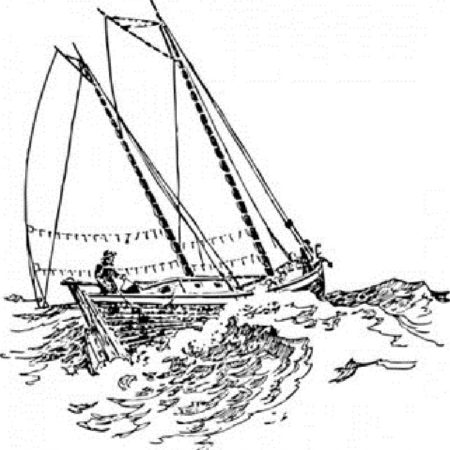
I have always considered serenity as complete calm. While praying this prayer I was picturing a calm lake on a sunny day. It was so calm there were no whitecaps on the water. It was so calm if I was on a sailboat, I would not be able to sail due to lack of wind. I was stuck! This is not serenity! We need movement in our lives! Without progress we stagnate and then we seem to go backwards or become lost.
When I am the opposite of serene, I am frantic and in a panic. This frame of mind makes it impossible to make rational decisions. I finally realized that serenity is being able to make decisions while we are in the eye of a storm! While I prefer a sunny day on the lake, I always want there to be a breeze so the sailboat I am in will actually go where I direct it.
Serenity is being calm enough during the storm to know which ropes to pull to keep the boat from turning over!
Serenity Prayer
God, grant me the serenity To accept the things I cannot change Courage to change the things I can, And the wisdom to know the difference.
Living one day at a time, Accepting hardships as the pathway to peace Taking, as He did, this world as it is, Not as I would have it.
Trusting that He will make all things right If I surrender to His will. That I may be reasonably happy in this life, And supremely happy with Him, Forever in the next.
The Feast Day of St. Albert the Great is celebrated on November 15. He is the patron saint of scientists and philosophers.
St. Albert the Great was born in Germany. After experiencing an encounter with the Virgin Mary he was inspired to join the Dominican Order also known as the Order of Preachers.
St. Albert was well educated and respected for his knowledge of science and theology, He received his doctorate from the University of Paris in 1245. He studied and commented on the works of Aristotle. Eventually, he became a professor of theology the the University of Paris. He became bishop of Regenburg in 1260. Because he refused to ride a horse and traveled entirely by foot he became known as “boots the bishop”). St. Thomas Aquinas was one of his students, later becoming a good friend.
St. Albert was a prolific writer. His writings are compiled in 38 volumes. He wrote about many subjects including philosophy, geography, astronomy, law and love.
St. Albert became well known as a mediator of disputes. He became ill and died on November 15, 1280.
St. Albert was canonized by Pope Pius XI in 1931 and declared a Doctor of the Church.
Three years after his death his body was discovered to be incorrupt. However, when his grave was opened centuries later, only a skeleton was found. His relics are found in St. Andreas Church in Cologne.
St. Elizabeth is mentioned in the Gospel of Luke. She is a relative of the Virgin Mary and the wife of Zachariah. Elizabeth was considered barren due to old age. However, the Archangel Gabrielappeared to Zachariah while he was at the temple. He told him not to be afraid, that he was to have a son and was to name him John. Zachariah questioned the angel and the angel said he would be mute because of his doubt.
Elizabeth was six months pregnant when Mary, who was pregnant with Jesus, came to visit her. It is Elizabeth you greeted Mary by saying,
“Blessed are you among women and blessed is the fruit of thy womb.”
When her son was born Zachariah asked for a tablet and wrote
“His name is John”.
Immediately, he was able to speak again. Their son was John the Baptist. St. John the Baptist and Jesus are considered cousins.
“When a nation lacks saints,
darkness invades people’s minds.”
Quote of Bl. Bronislaw Markiewiez; Poland, (1842-1912)
The feast day of All Souls’ Day is celebrated on November 2. It is always celebrated the day after All Saint’s Day which is celebrated November 1.
The Church devotes the month of November to praying for the Holy Souls in Purgatory.
To understand the doctrine of purgatory, it is necessary to understand several beliefs of the catholic church.
It is good to pray for the dead
We believe in tradition
Nothing unclean may enter heaven
Praying for the dead is a tradition which precedes the New Testament. In 2 Maccabees 23:45-46 it says:
“But if he was looking to the splendid reward that was laid up for those who fall asleep in godliness, it was a holy and pious thought. Therefore he made atonement for the dead, so that they might be delivered from their sin.“
Before we can enter into the presence of God in heaven we must be cleansed and purified. This process is known as purgatory. The bible teaches us that it is good to pray for the dead. Praying for those souls who are in the purification process in purgatory relieves the suffering of both the soul in purgatory and my own soul.
Many of the Saints had devotions of praying for the holy souls in purgatory. St. Gertrude the Great, St. Padre Pio and St. Margaret Mary are well known for their devotion to helping the souls in purgatory through prayer.
The Catholic Church believes in the power of prayer. When we pray for some one else this is called intercessory prayer. We ask the saints in heaven to pray for us on our journey. (The saints are interceding for us.) We also pray to Our Lord to guide those we love and hasten the journey of those who have died and are entering heaven. (We are interceding for the souls in purgatory.)
We believe that the more souls who are praying the better! The following prayer is a popular prayer asking for mercy for those who have died.
“Eternal Father, I offer thee the most precious Blood of thy divine son, Jesus, in union with the masses said throughout the world today, for all the holy souls in purgatory, for sinners everywhere, for sinners in the universal Church, those in my own home and within my family. Amen.”
On Halloween, we see many representations of good and evil: angels, witches, devils, monsters, princesses, gangsters, rock stars, politicians, super heroes.
While we are made in the image of God, each of us has a temptation to do evil. Society glamorizes evil.
If we take the Bible seriously, we should not doubt the existence of Satan and evil spirits. Jesus refers to Satan and angels multiple times.
Satan is actually an angel. He fell from grace when he turned from God. He has been at war with God ever since.
It is only in modern times, that people have denied the existence of evil spirits. Halloween is a time when we should reflect on the good and evil evident around us.
Halloween (All Hallows Eve) comes on the night before All Saint’s Day. Halloween is a display of both good and evil. All Saint’s Day (November 1st) is a display of people who have overcome evil for the glory of God.
Angels have existed since the beginning of creation. They are servants and messengers of God. Unlike human beings they are pure spirits. During the life of Jesus they are always present. Archangel Gabriel announces his birth, they protect Jesus in his infancy, (Mat 4) serve him in the desert, and they strengthen him in his agony in the garden,
The Church teaches that Satan, in the beginning, was a good angel, but became evil by choice. We learn in the bible that Jesus came to conquer evil.
“Everyone who commits sin is a child of the devil; for the devil has been sinning from the beginning. The Son of God was revealed for this purpose, to destroy the works of the devil.“ 1 John 8
When Jesus is praying in the Garden before his crucifixion, he prayed for unity among Christians. He also prayed for protection against satan.
“I do not ask You to take them out of the world, but to keep them from the evil one.” (John 17:15)
The fallen angels have never repented for their fall from grace. Their hatred of God leads them to seduce men into choosing their evil ways.
We have free will. God did not create evil. On Halloween, we should reflect on which path we wish to follow…the path of God…or the path of evil.
Being neutral is not an option, it is evil; the sin of omission, laziness, and being lukewarm.
The devil is always trying to tempt us to do evil. We need to turn to God with the Lord’s prayer when we need to be strengthened.
‘And do not lead us into temptation, but deliver us from evil. (Matthew 6:13)
We need to be aware of the evil around us and the temptations which may cause us to go astray. How else can we choose to do good rather than evil? Pray! Pray! Pray!
The Feast day of St. Callistus I is celebrated on October I. He is honored as a Pope and martyr of the faith.
St. Callistus was a slave for a Roman who worked for Caesar. He was put in charge of the bank by his master. He manged to lose the money deposited and in fear he fled. He was caught and sent to prison. He was released and told to try to recover the money. This time, he was arrested after getting into a brawl in a Jewish synagogue. He was then sent to Sardenia to work in the mines. The mistress of the emperor was able to influence his release.
Callistus became superintendent of the cemetery of St. Callistus. He was ordained a deacon by the Pope and became the friend and adviser of the Pope. When the pope died, Callistus was elected to be Bishop of Rome with a majority vote. This led to a schism with his rival St. Hippolytus who became the first anti-pope. Hippolytus accused Pope Callistus of sympathizing with heretics. He also disagreed with Pope Callistus’ teaching about the power of Divine Mercy in the sacrament of confession.
In the year 236, both Pope Callistus and Hyppolytus were martyred during an uprising in Rome. They were both canonized as saints. It is believed that Hyppolytus made peace with the church before his death.
St. Callistus is the first pope after St. Peter to be honored as a martyr.
“God loves each one of us as if there were only one of us.”
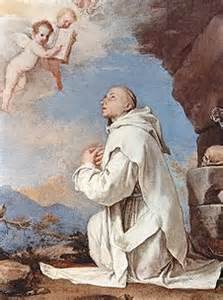
The Feast Day of St. Bruno is celebrated on October 6. He is the founder of the Carthusian Order.
St. Bruno was born at Cologne, Germany in 1030. He studied in France and was ordained a priest. For 18 years he was a professor of theology. He then became the Chancellor of the archdiocese. He supported the reform of clergy by Pope Gregory VII and removed his own archbishop because of scandal.
St. Bruno had a great love of silence and solitude. He received a vision from God showing him a hermitage where he should spend his life growing closer to God. Along with friends, St. Bruno opened a hermitage in Chartreuse. Their order became known as the Carthusians. The hermitage was in a mountainous, desert region which was very isolated. The hermits lived in private cells, coming together for Matins and Vespers each day. The rest of their day was spent in solitude. They ate together only on great feast days. Their time was spent copying manuscripts.
Pope Urban II requested St. Bruno to come to Rome as an advisor. When the pope fled Rome Bruno moved to Calabria after turning down an offer to become a bishop.
St. Bruno died of natural causes on October 6, 1101.
Although he was not formally canonized, Pope Clement X extended his feast day to the whole church in 1674.
The feast day of St. Francis of Assisi will be celebrated on October 4th. He is the patron saint of the environment, peacemakers, and animals.
St. Francis was born in 1181 in Assisi, Italy. His father was Pietro di Bernardone, a wealthy cloth salesman. Francis was indifferent to school. He enjoyed good times with his friends. He was attracted to the military and was a prisoner of war for two years. He returned home, probably ransomed by his family, returning to his old life, however he became very ill. When he recovered, he returned to the military, however, in a dream he was told to return home. He was told to “serve the Master rather that the man.” His dream changed him. He turned from his wild ways and began to serve God. While praying in a neglected chapel in San Damiano, Christ spoke to him from the crucifix, saying;
“Francis, go out and build up My house, for it is nearly falling down.”
Francis took this quite literally, and began to repair the old chapel. In need of money, he took some of his father’s cloth and sold it. His father accused Francis of theft. At the hearing before the bishop, he was told to return the money. Francis obeyed; however, he also removed his clothes returning them to Pietro and declaring:
“I have called you father on earth, but now I say, “Our Father, who art in heaven.”
St. Francis embraced poverty. “Love of Lady Poverty” was how he described his belief that possessions were a detriment to his spirituality. After two years of living as a hermit and begging for money to repair the church, he began to attract followers to his way of living. He owned nothing, wanting to live a life of complete poverty. He lived his life caring for the poor and preaching the gospel, primarily through example. He once said;
“Preach always, and when necessary, use words.”
The heart of St. Francis message was joy, based on the love of Christ. He served primarily the poor, including the lepers of the time. He had a strong devotion to the Eucharist and the Cross.
By 1210 his group had grown to a dozen men. He received permission to form an order from Pope Innocent III. Originally it was called the Humbler Brethren, or Friars Minor. They became known for the brown robes they wore. By 1219 they numbered 5,000.
Clare Sciffo was sixteen years old when she heard Francis preach. Against her parents will she became a nun under St. Francis care. Her order became known as the Poor Clares.
St. Francis became friends with St. Dominic, whom he met while begging. St. Dominic recognized him from a dream in which he had seen Francis. When Dominic met him he embraced him saying;
“You are my companion and must walk with me.
If we hold together, no earthly power can withstand us.”
The Franciscans and Dominicans had different spiritualities, but Francis and Dominic were lifelong friends.
Some of the Franciscans wanted to change the rule of poverty. They wanted to own books so they could study scripture like the other monasteries of the time. This was contrary to Francis’ love of Lady Poverty. He went to see St. Dominic, who came up with a solution. The Franciscans were allowed to have a library, loaned to them by the Dominicans!
The Franciscans today have several different orders. There rule of poverty is not as strict as the original order.
Later, in his life, St. Francis received the stigmata (the wounds of Christ). These wounds were real and painful, a sign of how close he had come to the cross. He also suffered from a painful eye disease.
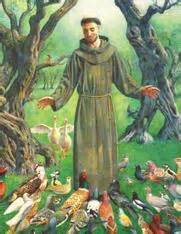
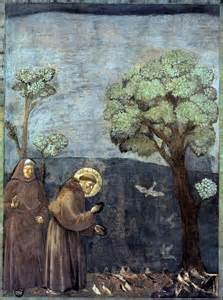
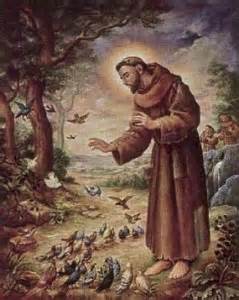
St. Francis composed several hymns, includingCanticle of the Sun. He is also known for his love of nature. Animals and birds had no fear of him and he was known for his friendships with traditionally wild creatures. It is St. Francis who started the tradition of a Christmas Crèche which honored the animals present in the stable when Christ was born.
St. Francis died in the year 1226 at the age of 45, praying the 141st Psalm and his Canticle of the Sun. His final prayer was:
“O Lord, I thank You for the pains which I suffer.”
Two years after his death, St. Francis was canonized on July 16, 1228 by Pope Gregory IX.
“My Lord, I am all yours. You know I have nothing besides my tunic, cord and underpants. And even these three things are yours.
So what can I give You?”
Quote of St. Francis of Assisi
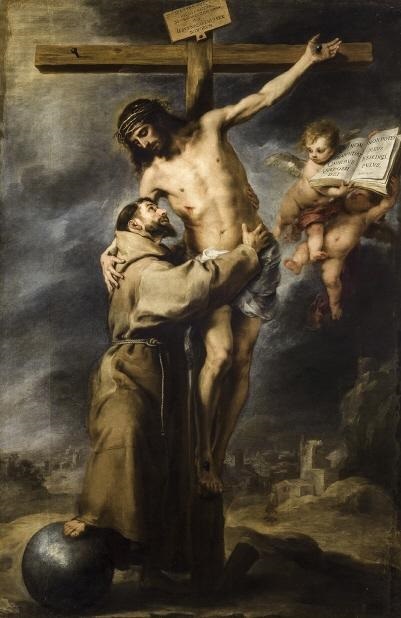
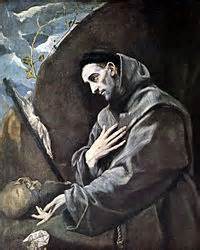
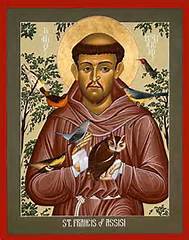
St. Francis of Assisi in Art
St. Francis with Birds
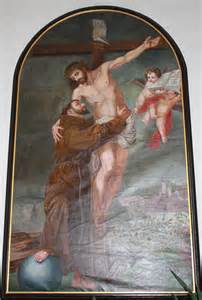
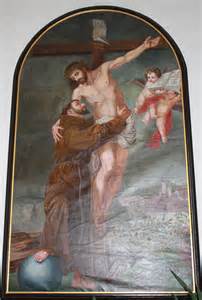
St. Francis Embracing Crucifix
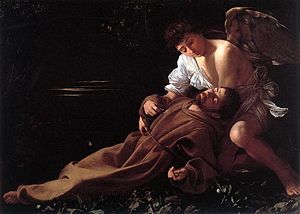
St. Francis in Ectasy by Caravaggio
St. Francis Christ on the Cross by Murillo
St Francis of Assisi Stigmata
St. Francis in Meditation
St. Francis of Assisi
St. Francis Preaching to the Birds
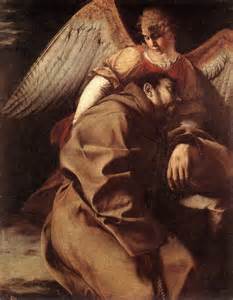
St. Francis Supported by an Angel by Orazio
Public Domain Image