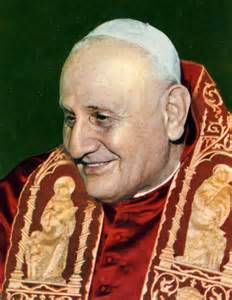
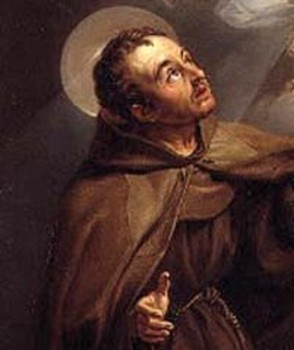
The Feast day of St. John XXIII is celebrated on October 11. He was known also known as “Good Pope John”.
Angelo Giuseppe Roncalli was born in 1881 near Borgano, Italy. He was the oldest of 13 children. Angelo joined the Secular Franciscan Order. After he was ordained a priest in 1904, he returned to Rome to study canon law. He became the bishop’s secretary, Church history teacher in the seminary and publisher of the diocesan paper.
During World War I, he served as a stretcher bearer for the Italian army. During World War II he was a papal diplomat, serving in Bulgaria, Turkey and France. With the help of Germany’s ambassador in Turkey, Archbishop Roncalli, he helped save approximately 24,000 Jewish people from death.
In 1953 he was named a cardinal and Bishop. He was elected Pope at the age of 77, taking the name of John. He soon called an ecumenical council and presided over the first session of the Second Vatican Council. The purpose of the Council was to bring the church into the modern world. It also was an effort to end hostilities between religions. Eastern Orthodox, Anglican and Protestant religious leaders were invited to attend.
One quote he is remembered for is:
“The Church has always opposed errors. Nowadays, however, the Spouse of Christ prefers to make use of the medicine of mercy rather than that of severity.”
Pope John XXIII earned the title Good Pope John because of his kind and cheerful demeanor.
He died on June 3, 1963. He was beatified November 15, 1881 by Pope John Paul II. He was canonized on the same day as Pope John Paul II by Pope Benedict on April 27, 2014.
In the Blessed Sacrament a heavenly school is open to me, with the best teacher one can possibly imagine…Jesus Christ himself.
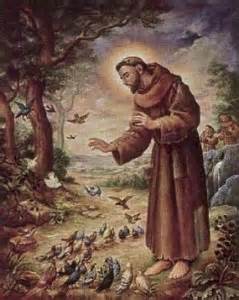
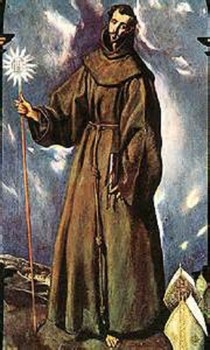
The feast day of St. Francis of Assisi will be celebrated on October 4th. He is the patron saint of the environment, peacemakers, and animals.
St. Francis was born in 1181 in Assisi, Italy. His father was Pietro di Bernardone, a wealthy cloth salesman. Francis was indifferent to school. He enjoyed good times with his friends. He was attracted to the military and was a prisoner of war for two years. He returned home, probably ransomed by his family, returning to his old life, however he became very ill. When he recovered, he returned to the military, however, in a dream he was told to return home. He was told to “serve the Master rather that the man.” His dream changed him. He turned from his wild ways and began to serve God. While praying in a neglected chapel in San Damiano, Christ spoke to him from the crucifix, saying;
“Francis, go out and build up My house, for it is nearly falling down.”
Francis took this quite literally, and began to repair the old chapel. In need of money, he took some of his father’s cloth and sold it. His father accused Francis of theft. At the hearing before the bishop, he was told to return the money. Francis obeyed; however, he also removed his clothes returning them to Pietro and declaring:
“I have called you father on earth, but now I say, “Our Father, who art in heaven.”
St. Francis embraced poverty. “Love of Lady Poverty” was how he described his belief that possessions were a detriment to his spirituality. After two years of living as a hermit and begging for money to repair the church, he began to attract followers to his way of living. He owned nothing, wanting to live a life of complete poverty. He lived his life caring for the poor and preaching the gospel, primarily through example. He once said;
“Preach always, and when necessary, use words.”
The heart of St. Francis message was joy, based on the love of Christ. He served primarily the poor, including the lepers of the time. He had a strong devotion to the Eucharist and the Cross.
By 1210 his group had grown to a dozen men. He received permission to form an order from Pope Innocent III. Originally it was called the Humbler Brethren, or Friars Minor. They became known for the brown robes they wore. By 1219 they numbered 5,000.
Clare Sciffo was sixteen years old when she heard Francis preach. Against her parents will she became a nun under St. Francis care. Her order became known as the Poor Clares.
St. Francis became friends with St. Dominic, whom he met while begging. St. Dominic recognized him from a dream in which he had seen Francis. When Dominic met him he embraced him saying;
“You are my companion and must walk with me.
If we hold together, no earthly power can withstand us.”
The Franciscans and Dominicans had different spiritualities, but Francis and Dominic were lifelong friends.
Some of the Franciscans wanted to change the rule of poverty. They wanted to own books so they could study scripture like the other monasteries of the time. This was contrary to Francis’ love of Lady Poverty. He went to see St. Dominic, who came up with a solution. The Franciscans were allowed to have a library, loaned to them by the Dominicans!
The Franciscans today have several different orders. There rule of poverty is not as strict as the original order.
Later, in his life, St. Francis received the stigmata (the wounds of Christ). These wounds were real and painful, a sign of how close he had come to the cross. He also suffered from a painful eye disease.
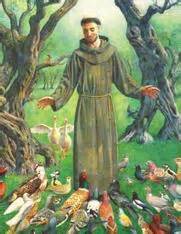
St. Francis composed several hymns, includingCanticle of the Sun. He is also known for his love of nature. Animals and birds had no fear of him and he was known for his friendships with traditionally wild creatures. It is St. Francis who started the tradition of a Christmas Crèche which honored the animals present in the stable when Christ was born.
St. Francis died in the year 1226 at the age of 45, praying the 141st Psalm and his Canticle of the Sun. His final prayer was:
“O Lord, I thank You for the pains which I suffer.”
Two years after his death, St. Francis was canonized on July 16, 1228 by Pope Gregory IX.
“My Lord, I am all yours. You know I have nothing besides my tunic, cord and underpants. And even these three things are yours.
So what can I give You?”
Quote of St. Francis of Assisi
St. Francis of Assisi in Art
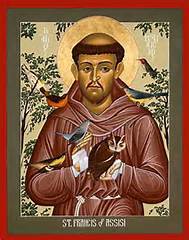
St. Francis with Birds
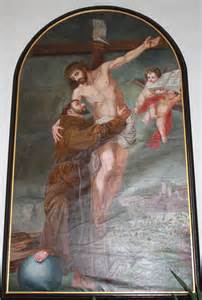
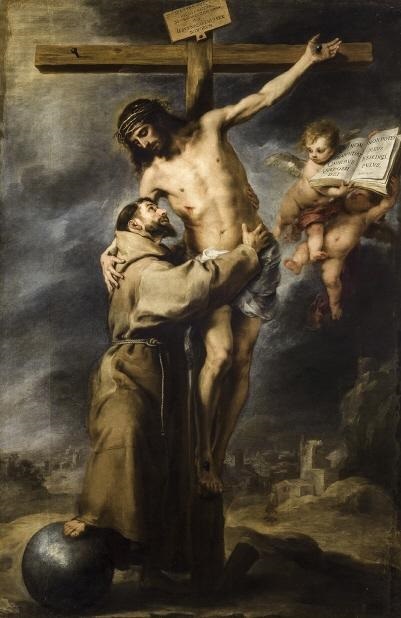
St. Francis Embracing Crucifix
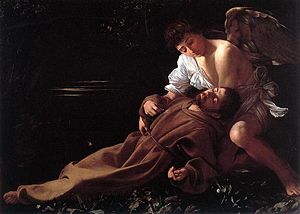
St. Francis in Ectasy by Caravaggio
St. Francis Christ on the Cross by Murillo
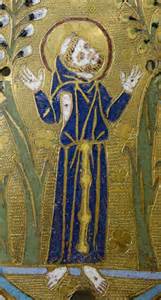
St Francis of Assisi Stigmata
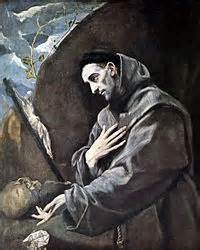
St. Francis in Meditation
St. Francis of Assisi
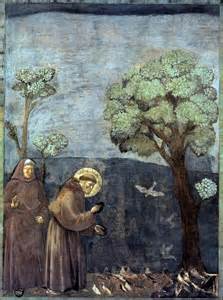
St. Francis Preaching to the Birds
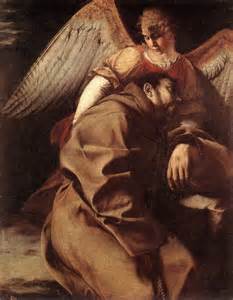
St. Francis Supported by an Angel by Orazio
Public Domain Image
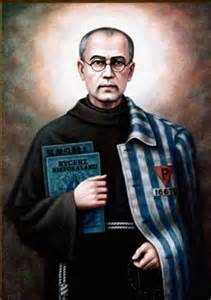
The Feast Day of St. Maximilian Mary Kolbe is celebrated on August 14. He was born in Poland in 1894. His father ran a religious book store before enlisting in the army. His mother later became a Benedictine Nun. St. Maximilian is the patron saint of drug addicts, prisoners, families, and the pro life movement.
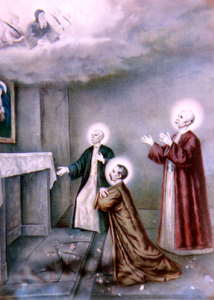
At the young age of 12, Maximilian experienced a vision from the Virgin Mary.
“That night I asked the Mother of God what was to become of me. Then she came to me holding two crowns, one white, the other red. She asked me if I was willing to accept either of these crowns. The white one meant that I should persevere in purity, and the red that I should become a martyr. I said that I would accept them both.”
Maximilian entered the minor seminary of the Conventual Franciscans in Lviv (formerly Poland, now the Ukraine) becoming a novice at 16. He studied science as well as philosophy and theology. He was ordained a priest at the age of 24. His mission was to fight against indifference towards God. He founded the Militia of the Immaculata which fought evil and promoted prayer, work and suffering. He became known as the Apostle of Consecration to Mary.
When the Nazis invaded Poland in 1939, Kolbe and his friars were arrested and then released after 3 months on the feast of the Immaculate Conception.
He was arrested a second time in 1941. After three months a prisoner escaped and ten men were ordered to be executed. St. Maximilian Kolbe offered to take the place of a man about to be executed. When asked who he was he replied, ” a priest”. The commandant allowed the exchange. He was stripped naked and given no food. The prisoners sang. On the eve of the Feast of the Assumption the jailer came to inject the remaining prisoners with a needle with carbolic acid. The bodies of the prisoners were burned.
Maximilian Kolbe was canonized in 1982.
No one in the world can alter the truth,
all we can do is seek it and live it.
Quote of St. Maximilian Kolbe
August is the Month of the Immaculate Heart of Mary
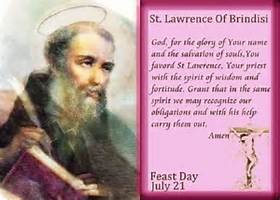
The Feast Day of St. Lawrence of Brindisi is celebrated on July 21. He was born on July 21, 1559 in Brindisi , Italy. His baptismal name was Julius Caesar. He was adventurous as a child but knew from an early age that he had a religious calling. When his father died at the age of twelve he went to Venice where he studied with the conventual Franciscans. He was accepted into the Capuchin Order and eventually became a priest. He worked as a diplomat and as a missionary. St. Lawrence is the Patron Saint of Cooks and Librarians.
St. Lawrence of Brindisi was fluent in five languages. He was Master General of his Order from 1602-1605. He was known for his eloquent preaching. He reformed the monasteries and taught theology. St. Lawrence was known for many miraculous healings. He healed a blind man and cured a paralyzed woman. His sermons have been compiled into 15 volumes.
On July 22, 1619 St. Lawrence died of natural causes. He was canonized by Pope Leo XIII on Dec. 8, 1881. St Lawrence of Brindisi is a Doctor of the Church.
The crucifix alone teaches one the worth of a single human soul.
Quote of St. Pierre Henri Dorie; Feast day September 20.
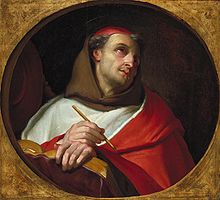
The Feast Day of St. Bonaventure is celebrated on July 15.
St. Bonaventure was born in 1218 in Bagnorgio, Latium. His name at birth was John of Fidanza. He was the son of a doctor. When he was young, he suffered from a serious intestinal illness. His distraught mother took him to St. Francis of Assisi to ask for healing prayers. When healed, St. Francis exclaimed “O-Buono ventura!” (Ogoodfortune!) From then on he was known as Bonaventure.
St. Bonaventure studied philosophy and theology in Paris. He entered the Franciscan order in 1243 at age 22. He later became a bishop. Pope Sixtus V inscribed him Doctor of the church in 1557.
St. Bonaventure was regarded as one of the greatest philosophers of the Middle Ages. St. Bonaventure wrote many books, including The Journey of the Mind to God. He is known as the Seraphic (Angelic) Doctor.
In 1257, St. Bonaventure was chosen as minister general of the Franciscan Order. He led the order into a deeper love of the Franciscan spirituality. At the request of his brothers he wrote a book describing St. Francis titled The life of St. Francis.
St. Bonaventure died while assisting the Second Council of Lyons on July 15, 1274.
The Feast Day of Bl. Emmanuel Ruiz and Companions is celebrated on July 10.
Emmanuel was born in Santander, Spain. He became a Franciscan priest serving as a missionary in Damascus during a time of great persecution.
During the massacre which occurred in 1860 thousands of victims were tortured and died. The villages of Lebanon were pillaged and burned. The massacre began with a quarrel between a Maronite and Druse. When a crowd came looking for them, Emmanuel and his companions refused to renounce their faith and become Muslims. Emmanuel, his supervisor and seven others were tortured and martyred.
Bl. Emmanuel was beatified in 1926 by Pope Pius XI.
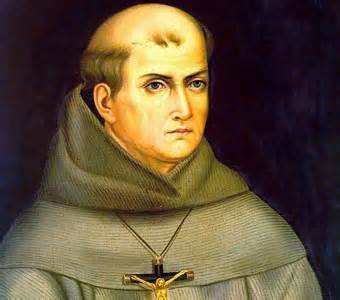
The Feast Day of St. Junipero Serra is celebrated on July 1.
St. Junipero Serra was born Miguel Jose Serra on the Island of Mallorca, Spain in 1713. At a young age Miguel joined the Order of St. Francis of Assisi taking the name Junipero which was the name of St. Francis’ original companion friar. Until he was 35, he was a student and them a professor. He was well known for his preaching ability.
Suddenly he gave up his life as a professor. He volunteered to serve in the Franciscan missions in the new world. He traveled by ship to Vera Cruz, Mexico and then walked with a companion the 250 miles to Mexico City. The Franciscans of Mexico were asked to take over the missions in Baja, California. It became Father Serra’s responsibility. St. Serra established nine of the missions in California. He baptized over 6,000 people and confirmed over 5,000. He died at the age of 70 and is buried at Mission San Carlos Borromeo.
St. Junipero Serra was beatified in 1988. Pope Francis canonized St. Junipero Serra on Sept. 23, 2015 while visiting the United States. He is the first saint to be canonized on U. S. soil.
We found on our journey, as well as in the place where we stopped,
that they treated us with as much confidence and goodwill
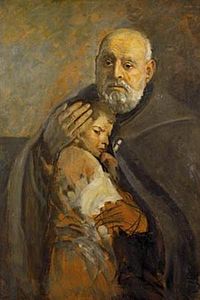
The Feast Day of St. Albert is celebrated on June 17.
St. Albert was born into a wealthy family on August 29, 1845 in Iglomia, Poland , which is near Krakow in 1945. He was the oldest of four children. He was active in politics as a young man. During the war against the Czar Alexander II Adam suffered from wounds which resulted in the amputation of his leg.
Adam had a great talent as an artist. He studied art in Warsaw, Munich and Paris. He was a very kind and compassionate man and decided to give up his life as an artist to join the Secular Franciscans when he returned to Krakow. He took the name Albert when he founded the Brothers of the Third Order of St. Francis, Servants of the Poor, also known as the Albertines. He also founded a community of Albertine Sisters. They organized food and shelter for the poor and homeless. St. Albert died in1916.
Pope John Paul II was inspired by St. Albert while he was serving as a priest. Pope John Paul was active in theater and wrote a play about St. Albert called Our God’s Brother. In 1983, Pope John Paul II beatified St. Albert. On November 12, 1989, Pope John Paul II canonized St. Albert.
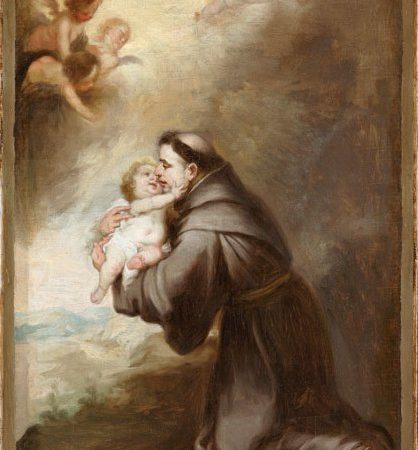
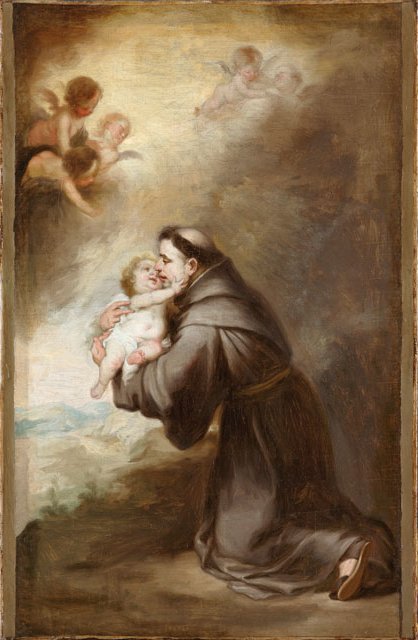
The Vision of Saint Anthony of Padua by Bartolome Esteban Murillo
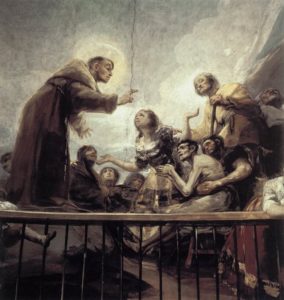
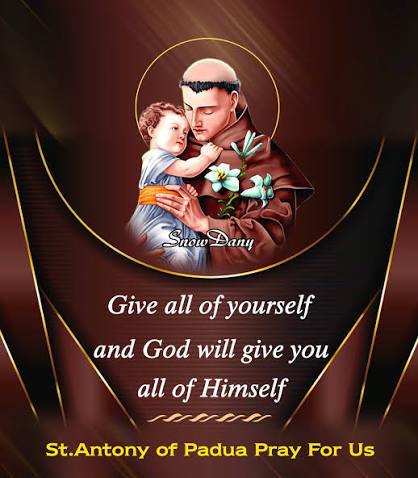
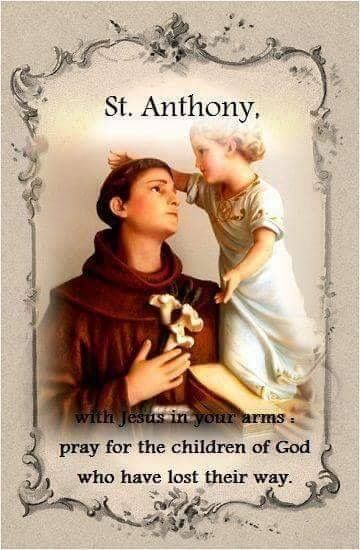
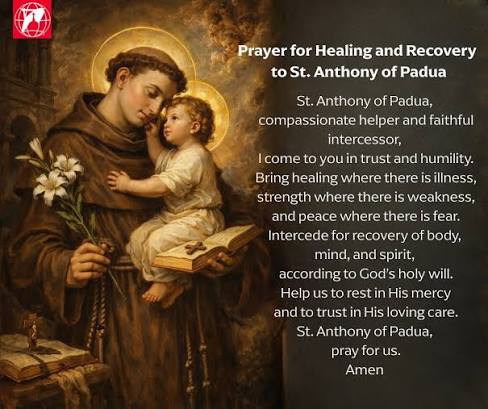
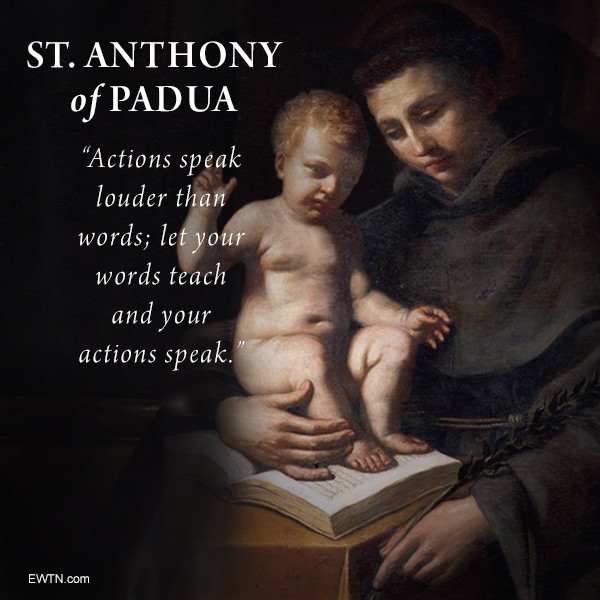
The Feast day of St. Anthony of Padua is celebrated on June 13. He is the patron saint of sailors, lost articles and fishermen.
St. Anthony was born in Lisbon, Portugal in 1195. His name at Baptism was Fernando. At the age of 15 Fernando entered the Augustinian Monastery. He did not focus on his studies and prayer, but spent time with friends and enjoyed political discussions. He was sent to Coimbra where he studied for nine years. He was ordained a priest during this time.
A turning point occurred in Fernando’s life after the massacre of five Franciscans. They had been tortured and beheaded. Their bodies were returned from Morocco and carried in a solemn procession to Fernando’s monastery. He was inspired to change orders and become a Franciscan, taking the name Anthony.
St. Anthony was sent to Morocco. but decided to return after becoming ill. He never arrived. His ship was hit by stormy weather and sent off course. He eventually landed on the East coast of Sicily. He was nursed back to health by the friars. While still ill, he attended the great Pentecost Chapter of Mats which was attended by 3000 Friars including St. Francis. Anthony was asked to give a short simple sermon. From then on he became a public preacher. The fire and knowledge with which he spoke inspired many to conversion.
St. Anthony made over 400 trips across Italy and France preaching against heresies. He presented the Christian faith in a positive light. Anthony became the teacher of sacred theology to the friars.
In 1226, St. Anthony was appointed provincial superior at the age of 31. It was in Padua that St. Anthony preached his last and most famous Lenten sermon. The crowds were near 30,000 so he preached in open fields. He was exhausted after the sermon. He knew death was near and received the last rites in the town of Arcilla singing with the friars there.
Shortly before he died he exclaimed,
“I see my Lord!”
He died in 1231 at the age of 36 after serving as a Franciscan for ten years.
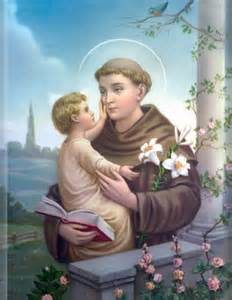
St. Anthony is often shown in art holding the child Jesus in his arms. Tradition tells us that one night as Anthony was praying the room was filled with brilliant light. Jesus appeared to St. Anthony as a little child.
St. Anthony was canonized in 1232 by Pope Gregory IX. In 1946 Pope Pius XII declared him a Doctor of the Church.
Poverty is an easy way to God…
Poverty is the mother of humility.
It is as difficult to preserve humility amid riches
The Feast Day of St. Bernadine of Siena is celebrated on May 20.
St. Bernadine was born in 1380 in a Sianese town. His father was the governor. He was orphaned at the age of six and raised by a pious aunt. When he was 20 years old the plague killed twenty people in one day in his town. He and ten companions offered to run the hospital. They nursed the patients for 4 months. Although he did not come down with the plague, he did become sick with fever and exhaustion afterwards. He was sick for several months. He then spent over a year caring for his aunt at her death.
At the age of 22 he joined the Franciscan Order. He was ordained at the age of 24. Bernadine lived in solitude and prayer for almost 12 years before God sent him to preach. He traveled on foot from town to town all over Italy. He was known to attract crowds of 30,000. He preached about vice and virtue, punishment and glory which were themes advised by St. Francis of Assisi.
St. Bernadine had a special devotion to the Holy Name of Jesus. He devised a symbol (IHS) which were the first three letters of the name of Jesus in Greek in Gothic letters on a blazing sun. He wanted the symbol to replace superstition. The devotion spread and began appearing in churches, homes and on buildings.
In 1427, Bernadine was called to Rome to stand trial for heresy for promoting the devotion to the Holy Name of Jesus. He was found innocent of heresy. After the trial St. Bernadine preached for 80 consecutive days. He was offered the office of bishop in the cities of Siena, Ferrar, and Urbino. He declined the office of bishop.
St. Bernadine preached for over 30 years, traveling all over Italy. While serving as Franciscan Vicar General the order grew from 140 friars to over 4000 friars before he died while traveling. Miracles were attributed to St. Bernadine after his death. He was canonized six years later in 1450 by Pope Nicholas V.
God must be the king of our minds, the Lord of our minds, so that the thought of Him never leaves us, and we speak, think, and act always either for Him or guided by love of Him. Let our souls be thus a house of prayer and not a den of thieves.
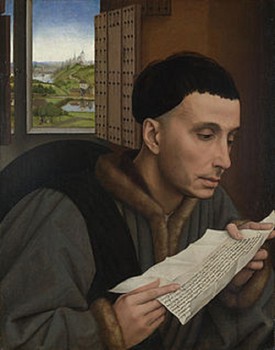
The Feast Day of St. Ivo of Kermartin is celebrated on May 19. St. Ivo is the patron saint of lawyers, judges, orphans and widows.
St. Ivo was born in Kermarton, Brittany, France on Oct. 17, 1253. He studied at the University of Paris, becoming a lawyer. He quickly became well known for his knowledge of philosophy, theology and canon law. He was appointed a judge of the Ecclesiastical Court and received minor orders. It is believed he entered the Third Order of Franciscans. He was ordained a priest in 1284.
St. Ivo’s defense of the downtrodden earned him the title “Advocate of the Poor.” He often visited the poor in prison and payed their expenses. He refused to take bribes which was a common corruption of that time.
Eventually, St. Ivo was elected as an official for the Bishop of Treguier. In this position he resisted the taxation imposed upon the church. St. Ivo also built a hospital. St. Ivo served as a parish priest for 18 years. He died on May 19, 1303 at the age of 50. He was canonized by Pope Clement VI in 1347.
The truth that many people never understand, until it is too late, is that the more you try to avert suffering the more you suffer, because smaller and more insignificant things begin to torture you in proportion to your fear of being hurt.
The Feast Day of St. Paschal Baylon is celebrated on May 17.
St. Paschal Baylon was born into a peasant family in Aragon, Spain. He worked as a shepherd while he was young. He taught himself to read while tending the sheep. He was known from an early age to have the gift of miracles. After having a mystical vision to enter a Franciscan Community nearby he joined the Reformed Franciscan Order as a lay Franciscan brother in 1564. He worked as a doorkeeper.
St. Paschal Baylon had a great devotion to the Blessed Sacrament. He spent many hours before the Blessed Sacrament in prayer. He is known to have defended the belief in the Real Presence to the Calvinists he knew. He lived a life of poverty and prayer.
St. Paschal died on May 17. Miracles were reported immediately after his burial. St. Paschal was canonized in 1690.
O Father Eternal God, Grant me faith and courage;
Son, wisdom of the Father, grant me light and make me wise;
Holy Spirit, beloved of Father and Son, inflame my heart and purify my soul,
that I may approach this majestic Sacrament with faith and love.