Category Archives: Faith

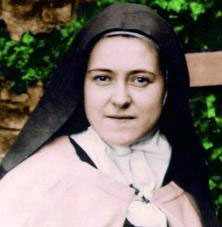
Prayers, Quips and Quotes: St Thérèse of Lisieux, Feast Day October 1


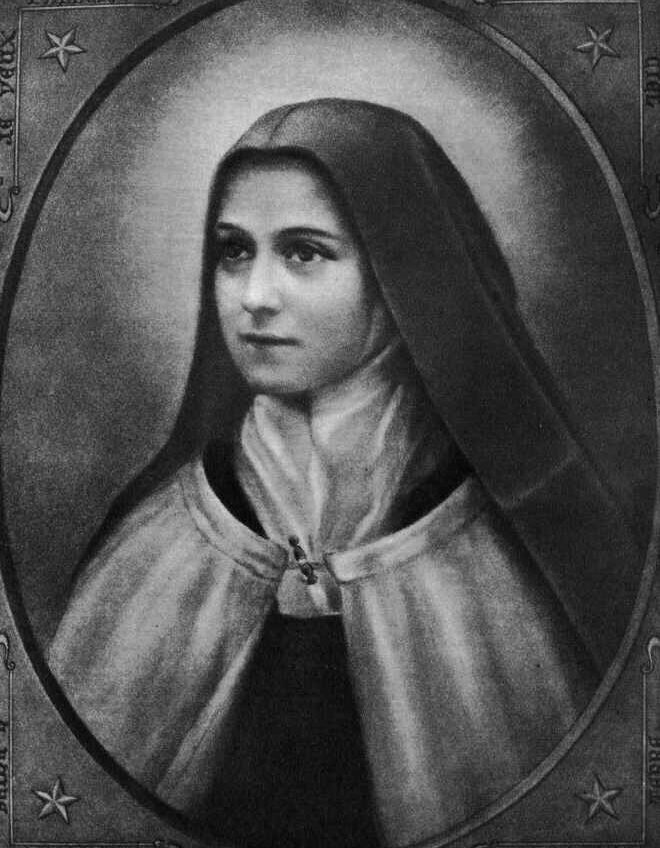
St. Therese the Little Flower Public Domain Image
St. Therese the Little Flower

Marie Therese Martin was born at Alencon, France on Jan. 2, 1873.   St Thérèse of Lisieux is the patron saint of florists, missionaries, pilots and against tuberculosis.

The father of St. Thérèse, Louis Martin, was a watchmaker.  Her Mother, Zelie was a lace maker.  She died when Thérèse was four year old.  Pope Francis canonized both Louise and Zelie as saints on Oct. 18, 2015.  All five of their daughters entered religious life.  The family attended daily Mass,  visited the elderly and the sick and helped the poor.

St. Thérèse  felt called into the religious life at the age of 15.  She asked permission to enter the Carmel of Lisieux a Carmelite convent.  She took the name of St. Thérèse  of the Child Jesus and the Holy Face.

St. Thérèse had a childlike  trust in the providence of God and in His merciful love.  Her life as contemplative Carmelite was short but it influenced many souls.  She was declared a Doctor of the Church by St. Pope St. John Paul II in 1997.

During her nine years living as a Carmelite Nun St. Thérèse  became known for her spirituality.  Her love of God was profound and she wanted to share that love with others.  She developed her “Little Way” which was her way of loving Jesus.  When asked to explain it, she replied:

“It is the way of spiritual childhood, the way of trust and absolute self-surrender.  I want to point out to souls the means that I have always found so completely successful…to tell them there is only one thing to do here below…to offer Our Lord the flowers of little sacrifices and win Him by our caresses.”

St. Thérèse’s spirituality began with scripture and the gospels.  She offered any suffering in her life to God and trusted in Him completely.  She found joy in suffering for it united her to the cross and the Passion of Our Lord.  She also had a devotion to the Sacred Heart of Jesus.

“How little known is the merciful love of the Heart of Jesus! It is true that to enjoy that treasure we must humble ourselves, must confess our nothingness . . . and here is where many a soul draws back.”

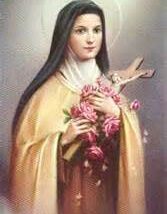
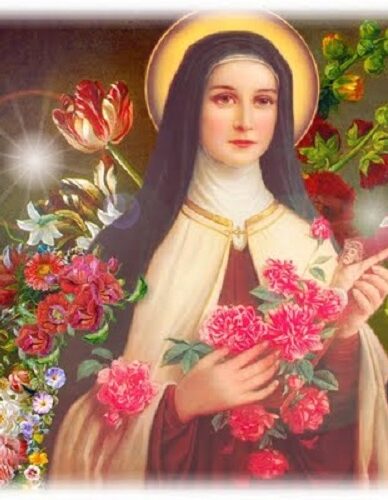
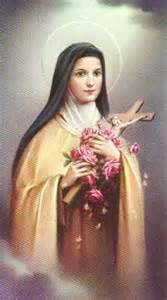
St. Thérèse liked to use the image of flowers, especially roses, in her prayers.  She considered each sacrifice a flower given to God.   She compared souls to flowers, each one unique.

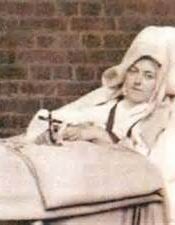
St. Thérèse came down with tuberculosis  and died after several years of suffering at the age of 24  on Sept. 30, 1897.  She was canonized in 1925.

The autobiography  St. Thérèse wrote, The Story of a Soul, was published the year after her death.

“I want to suffer and even rejoice for love, for this is my way of scattering flowers.  Never a flower shall I find but its petals shall be scattered for you, and all the while I will sing, yes sing, even when gathering my roses in the midst of thorns, and the longer and sharper the thorns may be, the sweeter shall be my song!”
Quote of St. Thérèse

St. Thérèse in Art
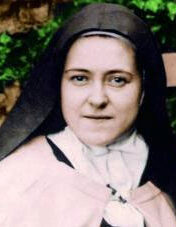
  • St. Therese of Lisieux Public Domain Image
October is the Month of the Most Holy Rosary

Save

Save

SaveSave

Save

Prayers, Quips and Quotes: Feast of the Archangels, Feast Day September 29


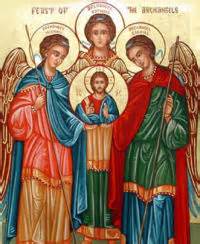
September 29th is the day the Catholic Church celebrates the Feast Day of the Archangels; St. Michael, St. Gabriel, and St. Raphael. The word “angel” means servant of God. Angels have no bodies. They are pure spirits. They have intellect and free will. Angels who turned against God are called “fallen angels”. Satan is the leader of the fallen angels.

St. Augustine tells us the following:

“Angel is the name of their office, not of their nature.”

The Choirs of angels include nine types of angels. In ascending order they are: 1. Angels 2. Archangels 3. Principalities 4. Powers 5. Virtues 6. Dominations 7. Thrones 8. Cherubim 9. Seraphim.

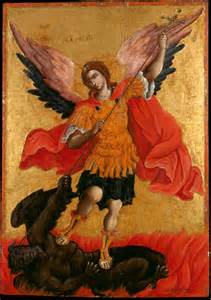
The archangels appear several times in scripture. St. Michael (which means “who is like God”) is considered a warrior angel. He appears three times in scripture; in the Book of Daniel, the Epistle of St. Jude, and the Book of Revelation. In the Book of Revelation, the final battle between good and evil at the end of time is described. St. Michael and his angels will battle against the dragon (also known as Satan) and good will triumph. (Revelation 12:7)

St. Gabriel (which means “Strength of God) is a messenger. He announces the birth of the prophet John the Baptist. He is also called the Angel of the Annunciation because he announces to Mary that she is to be the Mother of God. It is St. Gabriel  the messenger who says:

“Hail Mary, the Lord is with you.”(Luke 1:28)

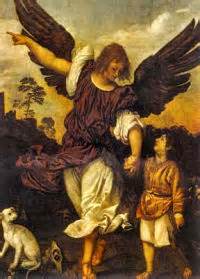
St. Raphael (which means “Divine Healer”) appears in the Book of Tobit. He is a guide for the young Tobias on his long journey. He introduces Tobias to his future wife Sarah, and after their return home, he gives Tobias instructions in how to heal his fathers’ blindness.

The following prayers of intercession are popular prayers to the Archangels.

St. Michael the Archangel Public Domain Image
St. Michael the Archangel

Prayer to St. Michael

St. Michael the Archangel, defend us in battle. Be our protection against the wickedness and snares of the devil. May God rebuke him, we humbly pray and do Thou, O Prince of the Heavenly Host, by the Divine Power of God, cast into hell Satan and all evil spirits, who roam throughout the world, seeking the ruin of souls. Amen

Archangel Gabriel Public Domain Image
Archangel Gabriel

Prayer to St. Gabriel
Blessed St. Gabriel, the Archangel, We beseech you to intercede for us as at the throne of divine mercy. As ;you announced the mystery of the Incarnation to Mary, so through your prayers, may we receive strength of faith, and courage of spirit, and thus find favor with God and redemption through Christ Our Lord. May we sing the praise of God our Savior with the angels and saints in heaven forever and ever. Amen

St. Raphael the Archangel Public Domain Image
St. Raphael the Archangel

Prayer to St. Raphael
Dear St. Raphael, your lovely name means “God heals”. The Lord sent you to young Tobias to guide him throughout a long journey. Upon his return you taught him how to cure his fathers’ blindness. How natural therefore for Christians to pray for your powerful help for safe travel and a happy return. This is what we ask for ourselves as well as for all who are far from home. Amen
“It is humility that makes men into angels.”
Quote of St. Augustine;  Feast day January 28
September is the Month of Our Lady of Sorrows

Save

Save

Save

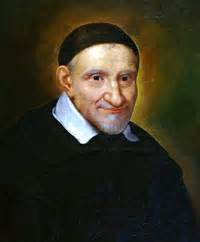
Prayers, Quips and Quotes: St. Vincent de Paul, Feast Day September 27


St. Vincent de Paul Public Domain Image
St. Vincent de Paul
Public Domain Image

The Feast Day of St. Vincent de Paul is celebrated on September 27.  He is the patron saint of charities, hospitals and volunteers.

St. Vincent was born at Pouy, Gascony in Southern France in 1581 into a large peasant family.  At the age of 15, he entered a Franciscan seminary.   He tutored children until he was ordained a priest in 1600.

In `1605, St. Vincent was traveling on a ship from Marseilles to Narborne when he was captured by Moorish pirates!  He was sold as a slave in Africa.  After two years as a slave, he escaped and returned to France.

At Avignon St. Vincent continued to study.  He became the chaplain to the Count of Goigny and was placed in charge of the charities for the poor.   This inspired him to preach missions to provide relief for the poor.  St. Vincent founded a missionary group known as the  Vincentians. The priests in the Order served people primarily in small towns and villages.  They had a devotion to helping the poor.

Next, St. Vincent along with the help of St. Louise de Marillac, founded the Sisters of Charity.  He organized the rich women in Paris to collect money for his missionary projects, including several hospitals.  He also collected money for victims of war and ransomed over 1200 slaves from N. Africa.

The motto of St. Vincent was “God sees you”.  He became known as the Apostle of Charity and the Father of the Poor.

St. Vincent died at the age of 80.  His heart remains incorrupt and can be found in the Convent of the Sisters of Charity in Paris.  He is credited with two miracles.  The first was the curing of a nun with ulcers.  The second was a laywoman cured of paralysis.

St. Vincent de Paul was canonized by Pope Clement XII on June 16, 1737.

St. Vincent’s bones and heart are perfectly incorrupt and have been placed inside a wax figure of his body. His relics can be seen in the Church of St. Vincent de Paul in Paris.

Do not feel that all is lost because of the revolt you feel inside.  It has rained hard.  The thunder has crashed.  Is the weather any less beautiful because of that?  Be assured you are not, for all that, any less dear to our Lord.
Quote of St. Vincent de Paul
September is the Month of Our Sorrowful Mother

Save

Save

Save

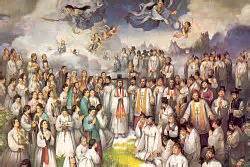
Prayers, Quips and Quotes: The Korean Martyrs, Feast Day September 20


Korean Martyrs Public Domain Image
Korean Martyrs

The martyrdom of 103 Koreans is celebrated on September 20.

For over 100 years the Christians in Korea practiced their faith in secret.  The government of Korea was based on Confucianism and believed that Christians were a threat to the government.

The first known martyrs are Paul Youn and James Kouen.  They were martyred after refusing to offer sacrifice on the death of a relative.

  Over the next 100 years over 10, 000 Korean Christians were tortured and executed.

On May 6, 1984, in Seoul, Pope John Paul II canonized 103 of the martyrs.  Their feast day is celebrated on September 20.

Martyrdom is the heroic act of love.
Quote of St. Just Bretenie’res……Korean Martyr; Feast Day March 7
September is the Month of Our Lady of Sorrows

Save

Save

Save

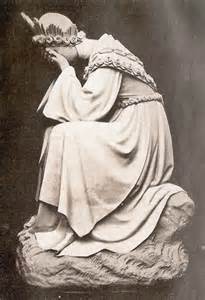
Prayers, Quips and Quotes: Our Lady of La Salette, Feast Day September 19


Our Lady La Salette Public Domain Image
Our Lady La Salette

On Saturday, Sept. 19, a globe of light opened to reveal a beautiful woman seated on a stone.  The woman appeared to two shepherd children in Salette, France.  The apparition was approved and is celebrated on September 19.

The children’s names were Melanie Calvat, age 15,  and Maiximin Graud, age 11.  The woman was gently crying and asking for the people and the priests to repent of their sins.   She called for penance.

Our Lady was tall, wearing a pearl studded dress and white shawl with a tiara on her head.  A crucifix was hanging from her neck.  She seemed to be made of light.  As she talked to the children she warned of coming war and famine.

Our Lady asked the children to pray day and night for the salvation of the world.

Our Lady of La Salette warned of chastisements that would fall upon humanity if they didn’t change their ways. Before ascending into heaven she urged the children to pray more and gave each of them a secret that was revealed to Pope Pius IX in 1851 concerning threats to the church and to the world.

While Our Lady’s message focused on conversion and penance she also gave the children a message of hope regarding the power of prayer saying:

“if they are converted, the stones and rocks will change into mounds of wheat, and the potatoes will be self-sown in the land”,

After the apparition many people made amends for the wrongs they had done.  Miracles began occurring at the site, as people were cured over various ailments from water from the spring there within weeks of Our Lady’s appearance. The Church officially approved of this apparition (deeming it worthy of belief) after much investigation and debate in 1851. Construction of a church at La Salette began in 1852 and was completed in 1865.  It was designated as the Basilica of Our Lady of La Salette in 1879.

Pope John Paul II made the following comment on the Apparition of La Salette:

“In this place, Mary, the loving Mother appeared manifesting her pain for the moral evil caused by humanity.  Her tears help us to understand the seriousness of sin and the rejection of God, and at the same time it is a manifestation of the passionate fidelity that her Son has for each person, even though His redemptive love is marked by the wounds of treason and abandonment by men.”
  Of all the virtues of the Virgin Mary, the most admirable is her great humility;  it is a virtue of which we ourselves have a great need.
Quote of Bl. Alphonsus de Orozco;  Feast Day September 19
September is the Month of Our Lady of Sorrows


Save

Save

Save

Save

Prayers, Quips and Quotes: St. Joseph of Cupertino, Feast Day September 18


St. Joseph of Cupertino Public Domain Image
St. Joseph of Cupertino

The Feast Day  of St. Joseph of Cupertino is celebrated on September 18.  St. Joseph of Cupertino is the patron saint of air travelers, pilots, astronauts, and those with learning disabilities.

St. Joseph of Cupertino was born on June 17, 1603 in Puglia, Italy.  His father died before he was born leaving his mother destitute.  He was born in a stable.  As a child he was a slow learner, probably having a learning disability.  When he was 17 he was denied acceptance to the Order of the Friars Minor Conventuals due to lack of an education.  He was however, accepted into the Capuchins at Martino near Cupertino.  He gardened, tended the animals and worked in the kitchen.

Because of his learning disabilities St. Joseph could only study small amounts of material at a time.  He then prayed to remember the material for the test.  St. Joseph was ordained in 1628.

St. Joseph was a mystic with the gift of miraculous levitation and visions.  Anything religious could cause him to levitate.  During prayer he was known for his ecstasies and  suddenly levitating.  The first time levitation occurred was on the feast of St. Francis of Assisi, October 4 1630.  During the procession he suddenly rose into the sky and hovered over the crowd.  He was so embarrassed he fled and hid.  The levitation happened so often he earned the title “The Flying Saint”.   

The most famous act of levitation occurred while he was in the presence of Pope Urban VIII.  He was filled with reverence and immediately was lifted into the air.  During the Inquisition he was confined for several weeks but released.  Crowds tried to meet him until he was place in seclusion…unable to speak to anyone other than the bishop the vicar general of the Order, his fellow friars and a doctor if needed.

After his death on Sept. 18, 1663, great crowds of people attended his funeral.  Pope Clement XIII canonized St. Joseph of Cupertino on July 16, 1767.

A movie has been made of his life named A Reluctant Saint.  St. Joseph of Cupertino is the patron saint of air travelers, pilots, astronauts, and those with learning disabilities.

“The fullness of joy is to behold God in everything.”
Quote of St. Catherine of Genoa;  Feast day September 15
September is the Month of Our Lady of Sorrows

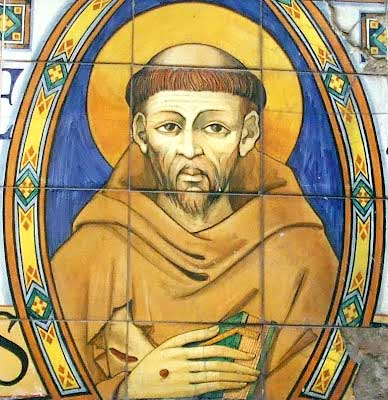
Prayers, Quips and Quotes: Stigmata of St. Francis, Feast Day September 17


Shrine of St. Francis of Assisi Public Domain Image
Shrine of St. Francis of Assisi

The Feast Day of the Stigmata of St. Francis is celebrated on September 17.

What is a stigmata?  A stigmata is the spontaneous appearance of the wound marks of Jesus Christ on a person’s body.  St. Francis is the first known saint to receive the stigmata.

St. Francis was born in 1181 in Assisi, Italy. His father was Pietro di Bernardone, a wealthy cloth salesman. Francis was indifferent to school. He enjoyed good times with his friends. He was attracted to the military and was a prisoner of war for two years.  After returning home he experienced a profound conversion after having a dream.   Christ appeared and spoke to St. Francis in a vision in the chapel at San Damiano.  He  said

“Francis go out and build up My house, for it is nearly falling down.”

St. Francis took these words literally and began to repair the old chapel.  St. Francis embraced poverty, founding the Order of St. Francis after living for a time as a hermit.  He had a strong devotion to the cross and to the Eucharist.  He served the poor and the sick, caring for the lepers who were suffering at that time.

On Sept. 14, 1224, St. Francis was just beginning the second month of a retreat in honor of St. Michael the Archangel.  He was fasting for 40 days.  Near the Feast of the Exaltation of the Cross, St. Francis experienced a vision in which a seraph with six wings appeared.  The figure not had wings but also showed signs of being crucified.  While contemplating the crucifixion of Christ, St. Francis experienced joy mingled with pain.  The vision of Christ nailed to a cross touch his soul with compassion.   The vision vanished but St. Francis was left with marks on his own body as if had been crucified.  His hands and feet now had nail wounds.  His right side had a wound as if it had been pierced and frequently it bled.

At first St. Francis tried to conceal the wounds which were real and painful.  Eventually he revealed them publicly, saying;

“Nothing gives me so much consolation as to think of the life and passion of our Lord.”

While St. Francis of Assisi was the first saint to receive the stigmata, currently 62 Saints and Blesseds have been known to receive the stigmata.  St. Catherine of Siena (1380) and Padre Pio (1918) are only two of the many who have received this grace.

The stigmata is a considered a supernatural sign that a person has united their suffering with that of Christ.   The suffering of Christ during His Passion is called redemptive suffering.  When we join our suffering to His (no matter how small our suffering is in comparison) we are participating in the Passion of Our Lord.  Our suffering can be beneficial to the salvation of others.   The sign of the stigmata shows us that our suffering has a purpose.  It unites us to Our Lord Jesus Christ.

May I feel in my soul and in my body, as much as possible, that pain which You, dear Jesus, sustained in the hour of Your most bitter Passion.  May I feel in my heart, as much as possible, that excessive love with which You, O Son of God, were inflamed in, willingly enduring such suffering for us sinners.
Quote of St. Francis of Assisi
September is the Month of Our Lady of Sorrows
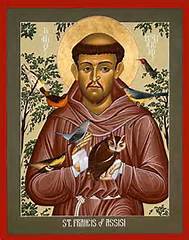
St. Francis of Assisi

Save

Save

Pope Francis Reflects on Feast Day of Our Lady of Sorrows


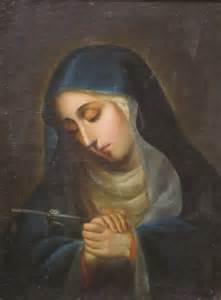
Our Lady of Sorrows Public Domain Image
Our Lady of Sorrows
Public Domain Image

Today, at Casa Santa Mara, Pope Francis reflected on the obedience and suffering of Mary at the foot of the Cross. The Mass commemorated the Feast of Our Lady of Sorrow. 

The Feast day of Our Lady of Sorrows is celebrated on September 15.  According to Vatican Radio, Pope Francis said that in the liturgy we are shown the glorious Cross, then the meek and humble Mother.


During his homily, Pope Francis said that Paul emphasized three strong words. Jesus “learned, obeyed and suffered” It was the opposite of what had happened to our father Adam. Adam did not want to learn, obey or suffer. Jesus, even though He is God, humbles Himself on the glorious Cross and becomes a servant.

Continuing his homily, Pope Francis told how Jesus came into the world to learn how to be a man, and by being a man, he walked with men. He came into the world to obey, and He obeyed. He learned obedience from suffering. This obedience brings hope. People who walk with God walk with hope.

Pope Francis shared that Mary, Jesus’ Mother, was the New Eve (as Paul himself calls her), so that she too can learn, suffer, and obey. “Thus”, Pope Francis said, “She becomes Mother.” In the Gospel Mary is at the foot of the Cross at the crucifixion. Jesus says to John, “Behold your mother.”

“Mary, is anointed Mother.” Pope Francis said. “We are not orphans, we have Mothers; Mother Mary. But the Church is Mother and Mother Church is anointed when it takes the same path of Jesus and Mary: the path of obedience, the path of suffering, and when she has that attitude of continually learning the path of the Lord. These two women…Mary and the Church…carry on the hope that is Christ, they give us Christ, they bring forth Christ in us. Without Mary, there would be no Jesus Christ; without the Church, we cannot go forward. Two women and two mothers and next to them our soul, which in the words of Isaac, the abbot of Stella, is “feminine” and is like “Mary and the Church”. Pope Francis concluded his homily by saying:

“Today, looking at this woman by the Cross, steadfast in following her Son in His suffering to learn obedience, looking at her we see the Church and look at our Mother. And also, we look at our little soul that will never be lost, if it continues to be a woman close to these two great women who accompany us in life: Mary and the Church. And just as our fathers left Paradise with a promise, today we can go forward with a hope: the hope that our Mother Mary, steadfast at the Cross, and our Holy Mother, the hierarchical Church, give us. “


Mary, Mother of Jesus Good Friday Public Domain Image
Mary, Mother of Jesus Good Friday
Public Domain Image

This article was originally published on September 15, 2014.


Save

Save

Save

Prayers, Quips and Quotes: The Exaltation of the Cross, Feast Day September 14


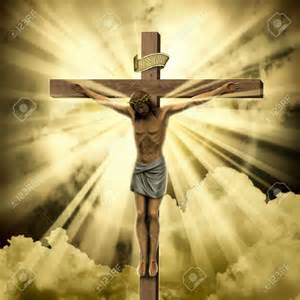
Crucifixion of Jesus Public Domain Image
Crucifixion of Jesus

The Feast of the Exaltation of the Cross is celebrated on September 14.

This feast day actually celebrated two events.

In the year 320, the actual cross on which Jesus was crucified was discovered by St. Helena, the mother of Emperor Constantine.  Constantine then had a shrine and basilica built in 335.  The Basilica, named Martyrium and the shrine named The Calverium were destroyed by the Persians in the year 614.

On a more personal level, we celebrate how we are saved by the cross.  It is the suffering and crucifixion of Jesus which redeems us.  As Christians, we must be willing to suffer for the faith, looking to Jesus in moments of weakness.

The suffering of Jesus on the cross is called Redemptive Suffering.  In today’s world it is hard to understand the meaning of suffering.  Does anything good come from suffering?

Our salvation came from the suffering of Jesus who died for our sins.

One way that helps me to understand suffering is to think about the meaning of love.  When two people love each other and promise to be there for each other they believe they are in love.  The test of true love is what happens when the going gets tough?  It is only when we are willing to suffer for another that we know we are loving them.

Willingness to suffer defines love!  Jesus is not the only one who is capable of redemptive suffering.  We too, can offer our suffering for the good of another.  Think of all the times you have suffered in silence because to complain would not help the situation.  Give your suffering to God.  You will grow in virtue and love.

Remember… God is Love.  He showed us he loved us by suffering and dying on the cross for us.

On this feast day reflect on the suffering in your life.  Can you name the cross you are carrying?  Give all your suffering to God and you will come closer to Him who is called Love.

Suffering is a sign that we have come so close to Jesus on the cross that He can kiss us;  that He can show that He is in love with us by giving us an opportunity to share in His Passion.
Quote of St. Teresa of Calcutta;  Feast Day September 5
September is the Month of Our Lady of Sorrows

Save

Save

Prayers, Quips and Quotes: St. John Gabriel Perboyre, Feast Day September 11


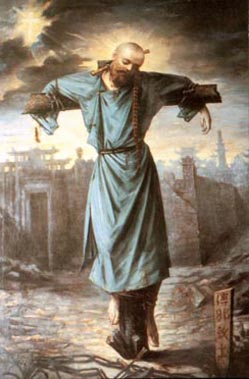
st-john-gabriel-perboyre

The Feast day of St. John Gabriel Peboyre is celebrated on September 11.

St. John was the oldest son  of a farmer in Le Puech, France.  He had seven younger siblings. Three of the brothers joined the Vincentian Fathers and two of the Daughter became Daughters of Charity.

When his younger brother was accepted into the Vincentian Seminary, his parents asked him to accompany the brother until he was settled.  He was surprised to find that he was also drawn to join the Vincentians.  His parents supported his decision to join the order rather than return home to farm.

In 1820, St. John was ordained a Vincentian priest.  He hoped to become a missionary and travel to China, however he was assigned to be a supervisor of the mother-house in Paris.

In 1835, he began his journey to China as a missionary.  It took five months to arrive.  He served the poor in Ho Nan  China before being transferred to Hubei.

Persecution began in 1839 and St. John Gabriel was arrested.  After being tortured,  he was found guilty of preaching Christianity and condemned to death.  He was tied to a stake and strangled.  His body wa retrieved and buried in the mission cemetery.

Pope John Paul II canonized St. John Gabriel Perboyre in 1996.

O my Divine Savior,
Transform me into Yourself.
May my hands be the hands of Jesus.
Grant that every faculty of my body
May serve only to glorify You.

Above all,
Transform my soul and all its powers
So that my memory, will and affection
May be the memory, will and affections
Of Jesus.
I pray You
To destroy in me all that is not of You.
Grant that I may live but in You, by You and for You,
So that I may truly say, with Saint Paul,
“I live – now not I – But Christ lives in me.
Prayer composed by St. John G. Perboyre
September is the Month of Our Sorrowful Mother


Save

Prayers, Quips and Quotes: St. Teresa of Calcutta, Feast Day September 5


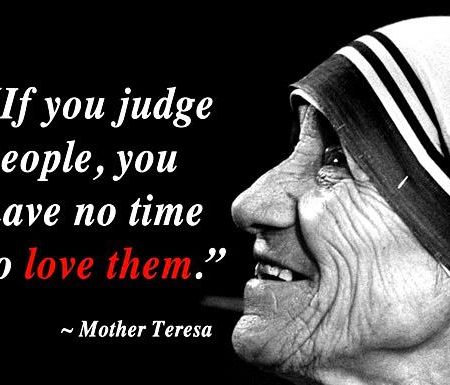
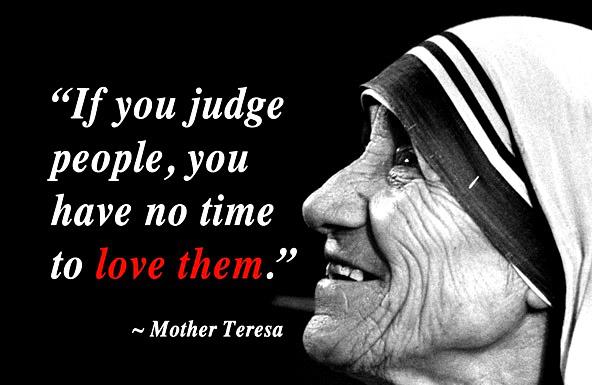
Mother Teresa Public Domain Image
Mother Teresa

The Feast Day of St. Teresa of Calcutta is celebrated on September 5.  On September 4, 2016 Pope Francis canonized Mother Teresa, proclaiming her a saint.

Mother Teresa was beatified on October 19, 2003, after confirmation of her first miracle. The miracle was reported that a woman who had a large and very visible tumor, had stayed with the Missionaries of Charity. After she and the Sisters had prayed for Mother Teresa’s intercession, the growth, six to seven inches in length, had disappeared within several hours. Finding no other medical explanation for the sudden cure it was declared her first miracle. Over 3500 other reports are being investigated as possible miracles.

After accepting a second miracle, Pope Francis cleared the way for Mother Teresa to be declared a saint.  Pope Francis signed a decree declaring that the inexplicable 2008 recovery of a Brazilian man who suddenly woke from a coma caused by a viral brain infection was due to the intercession of the Albanian nun, who died in 1997.

The Rev. Brian Kolodiejchuk, the postulator spearheading Mother Teresa’s canonization case, stated that the man fully recovered following his wife’s prayers and he has since returned to work as a mechanical engineer. The couple also have had two children.

Mother Teresa, as the world knows her, was born to parents Nikola and Drana Bojaxhiu on August 26, 1916 in Skopje of Macedonia and named Agnes Gonxha  Bojaxhiu. She was baptized on August 17, 1910 in Macedonia. She was the third child in her family, following sister Aga and a brother, Lazar. Her father, Nikola died, when she was eight years old. Her father was a traveler, an extrovert, and a businessman who spoke five languages. Her mother, Drana, was extremely pious, adopting several orphans. She was known as Gonxha (pronounced gon’KHA) which means “flower bud”.

Gonxha desired early to become a missionary. At the age of eighteen, she joined the Sisters of Loreto. Here she took the name of Sister Mary Teresa after St. Therese of Lisieux. She was sent to Calcutta, India to teach at St. Mary’s High School for Girls, which was run by the Sisters of Loreto. On May 24, 1937, she took her final Profession of Vows to a life of poverty, chastity, and obedience. She then became known as Mother Teresa. In 1944, she became principal of the school.

While on a train, she received a second calling. Christ spoke to her, asking her to work in the slums of Calcutta, caring for the sickest and poorest of the people. Pursuing this calling changed her life forever. In one year, she received approval to do the work she was being called to do. After six months of basic medical training she went to the slums to aid the needy and dying. Mother Teresa founded the Missionaries of Charity with 12 members, most of them students from St. Mary’s. She established a leper colony, an orphanage, a mission house, and several health clinics. In 1971, Mother Teresa visited New York City, where she opened a soup kitchen and a home to care for HIV/AIDS sufferers. In 1979, she received the Nobel Peace Prize.

In 1983, Mother Teresa suffered her first heart attack. After suffering from lung, kidney and heart problems for several years, she died on Sept. 5, 1997 at the age or 87. At the time of her death her Missionaries of Charity numbered over 4,000. She had 610 foundations in 123 countries.

In 2003, Mother Teresa’s private correspondence revealed she had experienced a “dark night of the soul”… feeling abandoned by God and lacking in faith. This lasted unusually long; for fifty years. Many saints have experienced such feelings, described by John of the Cross, in his book Dark Night of the Soul. She was filled with loneliness, and torture, due to this lack of consolation from God.

Mother Teresa is known for saying,

“The greatest poverty in the world, among the affluent, as well as the poorest of the poor, is to be unloved, unwanted, and uncared for.”

The world did not know that she spoke from her own experience.
There are many books written about Mother Teresa and her great love and service to the world. The following is one of my favorite quotes.

Suffering is a sign that we have come so close to Jesus on the cross that He can kiss us; that He can show that He is in love with us by giving us an opportunity to share in His Passion.


Quote of St. Teresa of Calcutta
September is the Month of Our Lady of Sorrows

Prayers, Quips and Quotes: St. Giles the Abbot, Feast Day September 1


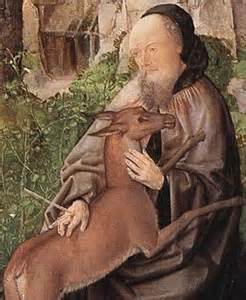
St. Giles, Abbot Public Domain Image
St. Giles, Abbot

The Feast Day of St. Giles the Abbot is celebrated on September 1.   St. Giles is the patron saint of the mentally ill, the disabled, epileptics, childhood fears, and depression.

St. Giles was born into a noble family in Athens, Greece in the seventh century.  After the death of his parents, he distributed his inheritance to the poor.    He also became known for the gift of miracles and healing he had received.  Giles longed to live a life of solitude, serving God as a recluse, away from all the praise and fame of the world.

He left Greece, sailing for France.  Everywhere he lived he became known for his gift of miracles and healing.  He would have to flee once again to find a place to live in peace and solitude.  He first lived near the mouth of the Rhone River.  Later he lived near the river Gard and finally he lived in the diocese of Nimes.  His final dwelling place was deep in the forest in a cavern in  a rock.  He occupied his time in prayer, praising God and meditating.  He was a vegetarian, living on herbs and roots.  His only companion was a red deer, which provided him with milk to drink.

After several years of living in complete solitude, the King of France instituted  a great hunt near where Giles lived.  The hunters chased the deer which led them to the cave where Giles lived.  They shot an arrow into the cave, wounding the holy hermit.  They found him covered with blood with the deer lying at his feet.  When the king was told what had happened, he ordered him taken care of.  He came to see him offering him gifts.  St. Giles refused the gifts and the King’s request to leave his solitude. Before leaving the king asked if there was anything he could do for him, St. Giles said he would like a monastery built where they were standing.

St. Giles became the Abbot of the monastery which was soon built.  Several disciples joined him.  His fame continued to spread because of his gift of miracles.  The conversion of the King was one of these miracles.

St. Giles made a pilgrimage to Rome to see the Pope.  He requested a blessing for his community which embraced the Rule of St. Benedict. Not only did he receive a blessing but he received the gift of two beautifully carved doors of cedar wood for his church.

Many sinners were converted because of the prayers and miracles of St. Giles.  St. Giles died on September 1, 725.  The miracles which took place near his tomb were so many that soon after his death a town began to grown and was named Giles.

I praise
Your humility that consoles me
Your patience that shelters me
Your eternity that preserves me
and……Your truth that rewards me.
Quote of St. Thomas Aquinas;  Feast day January 28
September is the Month of Our Lady of Sorrows