On July 26th the Catholic church will celebrate the feast day of Sts. Anne and Joachim. They are the parents of Mary and the grandparents of Jesus. St. Anne and St. Joachim are the patron saints of parents and grandparents.
Although most of what we know about them is legendary, their names were passed down in the non-biblical Gospel of James. Tradition tells us they were wealthy but pious. St. Anne conceived late in life, after the appearance of an angel. The Angel promised them they would have a child. Anne promised to dedicate the child to God. The feast day of The Holy Family is celebrated the Sunday after Christmas.
We reflect on their feast day about the importance of family and love. Tradition also tells us that a church was built on the site of the home of St. Joachim and St. Anne at the Mount of Olives.
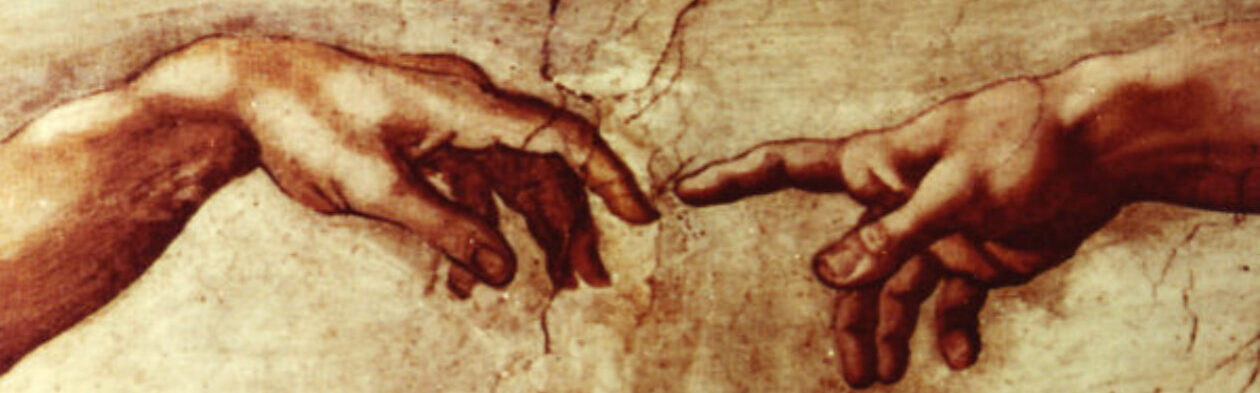
We are created in the image of God…
from the time there is conception there is the life of God…
The Feast Day of St. Mary Magdalene is celebrated on July 22. She is the patron of penitent sinners.
Mary Magdalene is well known from the gospel account of Jesus casting out seven demons from her.(Luke 8:2) She experienced great sorrow for her sins and became a devoted follower of Christ.
Because of her sorrow, she anointed Christ with her tears and dried His feet with her hair. Mary Magdalene is present at many of the important times in the life of Jesus. Mary Magdalene was one of the women present at the time of His crucifixion. She is the one who discovered His body missing from the tomb. She is honored by being the first person Christ appeared to after His Resurrection.
Each of us has sin in our lives. Whatever that sin is, we can turn to Jesus as Mary Magdalene did… with sincere sorrow… and become true disciples of Jesus. Only if we confide in Jesus in our sorrow and our joy can we truly call Jesus our ‘friend’.
Mary Magdalene reported seeing Jesus after the resurrection by exclaiming to the other followers…
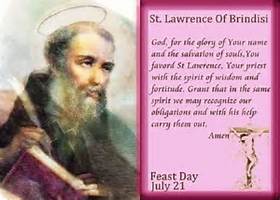
The Feast Day of St. Lawrence of Brindisi is celebrated on July 21. He was born on July 21, 1559 in Brindisi , Italy. His baptismal name was Julius Caesar. He was adventurous as a child but knew from an early age that he had a religious calling. When his father died at the age of twelve he went to Venice where he studied with the conventual Franciscans. He was accepted into the Capuchin Order and eventually became a priest. He worked as a diplomat and as a missionary. St. Lawrence is the Patron Saint of Cooks and Librarians.
St. Lawrence of Brindisi was fluent in five languages. He was Master General of his Order from 1602-1605. He was known for his eloquent preaching. He reformed the monasteries and taught theology. St. Lawrence was known for many miraculous healings. He healed a blind man and cured a paralyzed woman. His sermons have been compiled into 15 volumes.
On July 22, 1619 St. Lawrence died of natural causes. He was canonized by Pope Leo XIII on Dec. 8, 1881. St Lawrence of Brindisi is a Doctor of the Church.
The crucifix alone teaches one the worth of a single human soul.
Quote of St. Pierre Henri Dorie; Feast day September 20.
The Feast Day of St. Macrina the Younger is celebrated on July 19. She was born into a family of saints during the year 327 in Cesarea. Her grandparents were martyrs. Her grandmother was St. Macrina the Elder. Her parents Basil the Elder and Emmelia are both saints. St. Macrina is the patron saint of teachers.
Macrina’s mother taught her to read and educated her. Macrina in turn taught her brothers to read. Her brothers were St. Basil and St. Gregory of Nyssa and St. Peter of Sebastea.
At the age of twelve, Macrina became engaged to marry. Her fiance died suddenly and she then decided to remain single. She helped her mother raise her brothers as well as helping her mother run the household.
When Macrina’s father died, both Macrina and her mother consecrated themselves to a life of prayer and contemplation.
St. Macrina died a peaceful death in 371 holding the crucifix which she always had near her.
My life is an instant, an hour which passed by.
My life is a moment which I have no power to stay.
You know, O my God, that to love you here on earth…
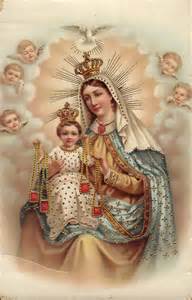
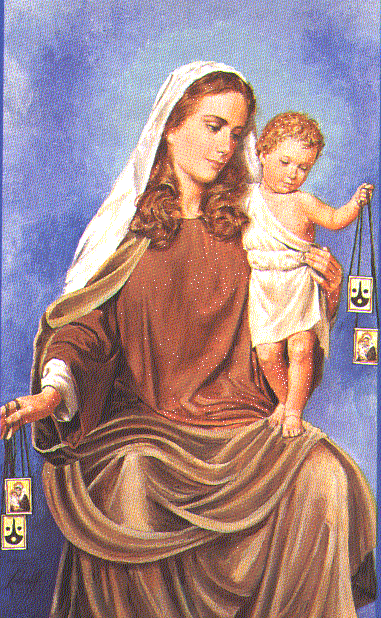
The Feast of Our Lady of Mt. Carmel is celebrated by the Catholic Church on July 16. It is on this day in about 1386 that Our Lady appeared to St. Simon Stock. She gave him a Brown Scapular saying,
“Take, beloved son this scapular of thy order as a badge of my confraternity and for thee and all Carmelites a special sign of grace; whoever dies in this garment, will not suffer everlasting fire.”
The scapular symbolizes Mary’s protection and reminds those wearing it of the call to prayer and penance. It stands for a commitment to follow Jesus and imitate Mary as the perfect model of all disciples of Christ.
Our Lady of Mt. Carmel Public Domain Image
A chapel was built near the Fountain of Elijah (northern Israel) which was dedicated to Our Lady. The hermits living there became known as the “Brothers of Mount Carmel”. St. Simon Stock was a leader of the Carmelite Order. The Carmelites have a special devotion to Mary. Their saints and theologians have a special devotion to her and the mystery of the Immaculate Conception (the belief that Mary was conceived without the stain of original sin). St. Teresa of Avila, St. John of the Cross and St. Terese of Lisieux are well known Carmelite saints.
Mt. Carmel is located north of Jerusalem along the coast of the Mediterranean Sea. It is a well known mountainous ridge in Palestine which is covered with caves. Hermits lived in the caves, living a life of solitude and prayer. Mt. Carmel is mentioned in the Old Testament many times.
The history of the Carmelites dates back to ancient times. It is believed to have been founded by the prophets Elijah and Elisha. The Carmelite Order is a contemplative order. Their spirituality follows the contemplative spirit of Elijah, living a spiritual life of contemplation and prayer. One of their goals is to “find God in the silence’. The rule of the Carmelites was written by St. Albert Avogadro in 1214.
Our Lady of Mt. Carmel The feast celebrates the appearance of Mary to St. Simon Stock.It is a special feast day for those who have a special devotion to Mary and wear the Brown Scapular. The Apparition of Our Lady of Mt. Carmel was approved by Pope Sixtus V in 1587. The feast celebrates the appearance of Mary to St. Simon Stock.
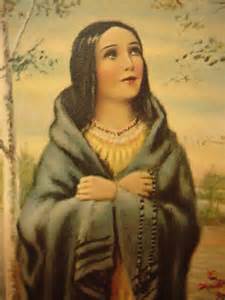
The Feast Day of St. Kateri Tekakwitha is celebrated on July 14. St. Kateri Tekakwitha is the Patron of the environment and ecology. She was known as the “Lily of the Mohawks”.
St. Kateri Tekakwitha was born in 1656 in Auriesville, NY. She was the daughter of a Mohawk warrior and Catholic Algonquin. She is the first Native American to be declared a saint.
On Easter, 1676, Kateri was baptized by Jesuit missionary Father Jacques de Lambertville at the age of 20. She was devoted to prayer, penitential practices and the care of the sick and aged in Caughnawaga near Montreal. Her relics are now enshrined in Caughnawaga.
When Kateri was four years old smallpox attacked her family. Her mother and little brother died from the disease. Kateri’s face was scarred by the disease and she became partially blind. Her two Aunts and an Uncle adopted her. Because of her conversion, she incurred hostility from her tribe. She went to a new Christian colony in Indianan, Canada. She was devoted to the Eucharist and to “Christ crucified.” She spent much time praying before the Blessed Sacrament.
At the age of 23 Kateri died on Wednesday of Holy Week, at approximately 3 p.m. Within fifteen minutes after her death, her face, which was marked by smallpox, was healed and became beautiful. Father Cholone called others to see what had happened. Miraculous cures at the Sault Mission were frequent that year (1682) and attributed to Kateri. She appeared to many people after her death, always carrying a cross.
Blessed Kateri’s tomb is found at St. Francis Xavier Mission in the Mohawk Nation at Kahnaqake, near Montreal, Quebec. She is honored at the National Shrine of Blessed Kateri Tekakwitha in Florida, NY and the Shrine of Our Lady of Martyrs in Auriesville, NY.
The Feast Day of St. Veronica is celebrated on July 12.
St. Veronica is the patron saint of photographers. Little is known about Veronica. She was a follower of Jesus and present during his crucifixion. While Jesus carried the cross, she was moved with compassion. She knelt in front of Jesus and used her veil to wipe his face clean. Her kindness is commemorated on the sixth station of the cross prayed by the church. The soldiers pushed Veronica away and she later discovered the imprint of Christ’s face on her veil. It is believed that Veronica left her veil in the care of Pope Clement I, the successor to St. Peter. The veil known as Veronica’s Veil is on display at St.Peter’s Basilica.
The name Veronica means “true image”.
St. Veronica
We are nothing without God…
but if we put our lives in God’s hands,
miracles happen.
Quote of St. Teresa of Calcutta; Feast day September 5
The Feast Day of St. Thomas the Apostle is celebrated on July 3. Thomas was also called Didymus which means twin. St. Thomas is the patron saint of India and architects.
Thomas the Apostle was known for questioning things. He was not afraid to ask questions or state his disbelief. Jesus treated him with love and compassion.
St. Thomas was also known as “Doubting Thomas”.After the resurrection Jesus appeared to the Apostles. Thomas was not there and did not believe that Jesus had risen from the dead. When Jesus later appeared to him he said “Peace be with you. Do not doubt but believe.” (John 21:24) St. Thomas also asked Jesus “How can we follow you, when we know not where you are going?” Jesus responded, “I am the way, the truth and the life. Whoever follows me will live forever.”
Thomas was one of the original twelve apostles. He was present at the Last Supper. He was also present when Jesus had the Apostles lower their nets and they miraculously caught many fish. After the resurrection, St. Thomas was sent to evangelize the Parthians, the Persians and India. He is believed to have built the first church in India. St. Thomas died a martyr’s death when at Calamine in India he was speared to death while praying.
The First Martyrs of the Church of Rome are honored on June 30. The feast day has been celebrated beginning in 1969.
More than half of Rome was destroyed by fire in July of 64. The unpopular Emperor Nero was blamed for the fire but he accused the Christians to cover his own crimes. The martyrs were executed in many different ways. Some were burned alive at night to be used as living torches. Others were crucified and still others were fed to wild animals. The crime they were charged with was “their hatred of the human race”.
There was a large Jewish population in Rome at the time of the persecution. Paul had not yet visited Rome, however there were Christians living there.
The Catholic Church celebrates the Solemnity of St. Paul and St. Peter on June 29.
Both saints were martyred for their faith during the persecution of Nero. St. Peter was crucified upside down by his own request. He did not consider himself worthy to be crucified in the same manner as Our Lord. St. Paul was beheaded. It is possible they were both martyred on the same day.
St. Peter was one of the original Apostles. He was a fisherman before he was called to follow Jesus. He was the brother to the Apostle Andrew. St. Peter was clearly the leader of the apostles. With James and John he witnessed the Transfiguration and the Agony in the Garden. His mother-in-law was cured by Jesus. Originally, Peter’s name was Simon. Jesus asked the apostles, “Who do you say that I am?” Simon said, “You are the Messiah, the son of the living God.” Jesus then said:
“Blessed are you Simon, Son of Jonah, for flesh and blood have not revealed this to you but my heavenly Father. And so I say to you, you are Peter and upon this rock I will build my church and the gates of the netherworld shall not prevail against it. I will give you the keys to the kingdom of heaven. Whatever you bind on earth shall be bound in heaven and whatever you loose on earth shall be loosed in heaven.”
During the crucifixion of Jesus, Peter denied Jesus three times. Jesus also told Peter three times…
“Feed my sheep”.
St. Peter is the patron saint of fishermen.
St. Paul was not one of the original apostles. While persecuting Christians after the death of Jesus, he was thrown to the ground by a bright light. He heard a voice asking him,
“Saul, Saul, why do you persecute me?”
He responded with “Who are you, Lord?” Jesus answered him:
“I am Jesus whom you are persecuting. But get up and enter the city and you will be told what you are to do.”
Paul was blinded by the light for three days after which scales fell from his eyes. He then joined the apostles, becoming known as “The Apostle of the Gentiles”. He wrote many of the epistles in the Bible. He is the patron saint of writers, the press, and missionaries.
Prayer to St. Peter and St. Paul
Grant, we pray, O Lord our God, that we may be sustained by the intercession of the blessed Apostles Peter and Paul, that as through them you gave your Church the foundations of her heavenly office, so through them you may help her to eternal salvation. Through our Lord Jesus Christ Your Son, who lives and reigns with you in the unity of the Holy Spirit, One God forever and ever. Amen
I can do all things through Christ who strengthens me.
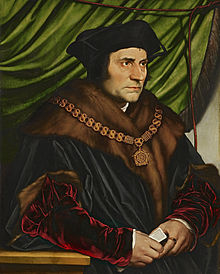
The Feast Day of St. Thomas More is celebrated on June 22. St. Thomas More is the patron saint of lawyers.
St. Thomas More was born in London, England in 1478. He wrote the famous book Utopia which was a work of fiction which depicted a pagan and communist island which was ruled by reason. It touched on many controversial issues and established him as a humanist.
St. Thomas More attended St. Anthony’s School in London and served as a page for the archbishop of Canterbury. He continued his studies at Oxford University eventually becoming a lawyer. He was tempted to become a monk and moved near to a Cathusian monastery near London. He participated as much as possible. Torn becoming a monk or working as a civil servant his desire to become a civil servant won. In 1504, he entered Parliament. Life began to change in 1527 when King Henry tried to use the Bible to prove to Thomas More that his marriage to Catherine of Aragon, who failed to produce a male child, was void. St. Thomas More could not agree with King Henry’s plan to divorce Catherine.
In 1532, Thomas More resigned from the House of Commons because of his health. When More refused to swear to King Henry’s Act of Succession and the Oath of Supremacy he was refusing allegiance to the King.
St. Thomas More was sent to the Tower of London on April 17, 1534 and found guilty of treason. He was beheaded on July 6, 1535. His last words were:
“The king’s good servant, but God’s first.”
St. Thomas More is considered a martyr of the faith. St. Thomas More was canonized in 1935 by Pope Pius XI.
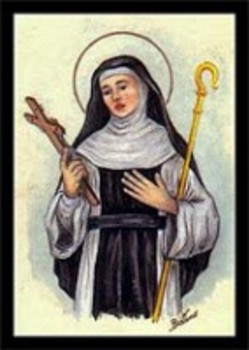
The Feast Day of St. Elizabeth of Schoenna is celebrated on June 18.
St. Elizabeth was born in 1129 in Bonn, Germany. She was raised in a monastery and at the age of twelve entered a Benedictine Monastery. She made her profession in 1147 and became superioress of the Benedictine Nuns in 1157.
Elizabeth often had visions and ecstasies which occurred on Holy Days and Sundays. She wrote down her visions and after her death in 1165, the material was published by her brother Egbert who was a priest. The church has not examined her work and has not given an opinion.
Although she has never been formally canonized her name has been entered in the Roman martyrology.
To be ignorant of the Scriptures is to be ignorant of Christ.