Category Archives: patron saints

Prayers, Quips and Quotes: St. Teresa of Calcutta, Feast Day September 5


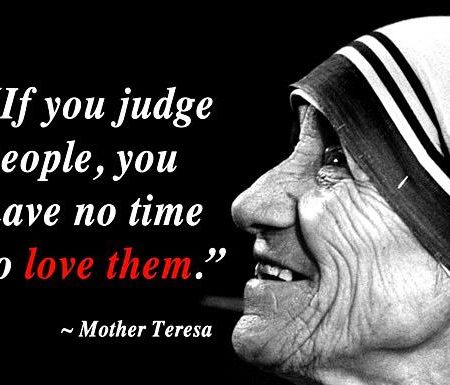
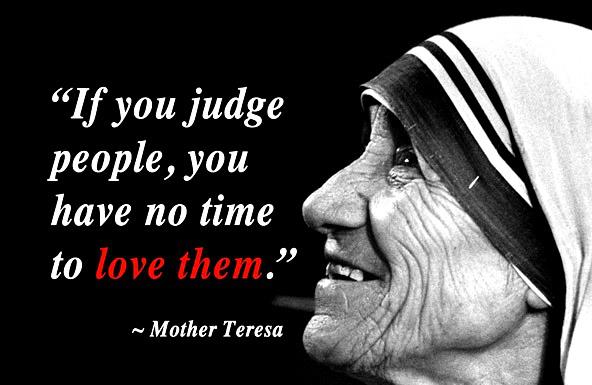
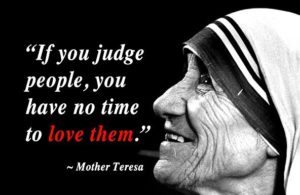
Mother Teresa Public Domain Image
Mother Teresa

The Feast Day of St. Teresa of Calcutta is celebrated on September 5.  On September 4, 2016 Pope Francis canonized Mother Teresa, proclaiming her a saint.

Mother Teresa was beatified on October 19, 2003, after confirmation of her first miracle. The miracle was reported that a woman who had a large and very visible tumor, had stayed with the Missionaries of Charity. After she and the Sisters had prayed for Mother Teresa’s intercession, the growth, six to seven inches in length, had disappeared within several hours. Finding no other medical explanation for the sudden cure it was declared her first miracle. Over 3500 other reports are being investigated as possible miracles.

After accepting a second miracle, Pope Francis cleared the way for Mother Teresa to be declared a saint.  Pope Francis signed a decree declaring that the inexplicable 2008 recovery of a Brazilian man who suddenly woke from a coma caused by a viral brain infection was due to the intercession of the Albanian nun, who died in 1997.

The Rev. Brian Kolodiejchuk, the postulator spearheading Mother Teresa’s canonization case, stated that the man fully recovered following his wife’s prayers and he has since returned to work as a mechanical engineer. The couple also have had two children.

Mother Teresa, as the world knows her, was born to parents Nikola and Drana Bojaxhiu on August 26, 1916 in Skopje of Macedonia and named Agnes Gonxha  Bojaxhiu. She was baptized on August 17, 1910 in Macedonia. She was the third child in her family, following sister Aga and a brother, Lazar. Her father, Nikola died, when she was eight years old. Her father was a traveler, an extrovert, and a businessman who spoke five languages. Her mother, Drana, was extremely pious, adopting several orphans. She was known as Gonxha (pronounced gon’KHA) which means “flower bud”.

Gonxha desired early to become a missionary. At the age of eighteen, she joined the Sisters of Loreto. Here she took the name of Sister Mary Teresa after St. Therese of Lisieux. She was sent to Calcutta, India to teach at St. Mary’s High School for Girls, which was run by the Sisters of Loreto. On May 24, 1937, she took her final Profession of Vows to a life of poverty, chastity, and obedience. She then became known as Mother Teresa. In 1944, she became principal of the school.

While on a train, she received a second calling. Christ spoke to her, asking her to work in the slums of Calcutta, caring for the sickest and poorest of the people. Pursuing this calling changed her life forever. In one year, she received approval to do the work she was being called to do. After six months of basic medical training she went to the slums to aid the needy and dying. Mother Teresa founded the Missionaries of Charity with 12 members, most of them students from St. Mary’s. She established a leper colony, an orphanage, a mission house, and several health clinics. In 1971, Mother Teresa visited New York City, where she opened a soup kitchen and a home to care for HIV/AIDS sufferers. In 1979, she received the Nobel Peace Prize.

In 1983, Mother Teresa suffered her first heart attack. After suffering from lung, kidney and heart problems for several years, she died on Sept. 5, 1997 at the age or 87. At the time of her death her Missionaries of Charity numbered over 4,000. She had 610 foundations in 123 countries.

In 2003, Mother Teresa’s private correspondence revealed she had experienced a “dark night of the soul”… feeling abandoned by God and lacking in faith. This lasted unusually long; for fifty years. Many saints have experienced such feelings, described by John of the Cross, in his book Dark Night of the Soul. She was filled with loneliness, and torture, due to this lack of consolation from God.

Mother Teresa is known for saying,

“The greatest poverty in the world, among the affluent, as well as the poorest of the poor, is to be unloved, unwanted, and uncared for.”

The world did not know that she spoke from her own experience.
There are many books written about Mother Teresa and her great love and service to the world. The following is one of my favorite quotes.

Suffering is a sign that we have come so close to Jesus on the cross that He can kiss us; that He can show that He is in love with us by giving us an opportunity to share in His Passion.


Quote of St. Teresa of Calcutta
September is the Month of Our Lady of Sorrows
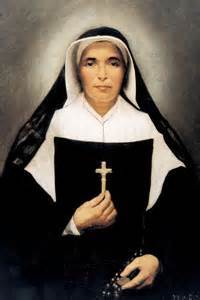
Prayers, Quips and Quotes: St. Gregory the Great, Feast Day Sept. 3


St. Gregory the Great Public Domain Image
St. Gregory the Great

The Feast Day of St. Gregory the Great is celebrated on September 3.

St. Gregory the Great was born in Rome, Italy around the year 550. He was born into a wealthy family. By the age of 23, he had become the prefect of Rome.  The following year his father died.  He decided to leave office and to become a monk.   St. Gregory is the patron saint of musicians, students, singer and teachers.

St. Gregory turned his family home into a monastery which he dedicated to St. Andrew.  He built six other monasteries on family land in Sicily and gave the remainder of his inheritance to the poor.  As a monk he devoted time to prayer, study and meditation.  He studied the writings of the Latin fathers.

After four years of prayer as a monk, Pope Pelagius II ordained Gregory a deacon and sent him to Constantinople.  He returned to Rome in 586 to serve Pope Pelagius until his death four years later.

Although Gregory was only a deacon he was elected Pope by popular acclaim.  His first act was to organize a three day penitential procession asking God to end the plague.  The plague ended after the procession reached the church of St. Mary Major.

As pope, Gregory negotiated for peace when the Lombards threatened Rome.

Over sixty of Pope Gregory’s sermons have survived, as well as over 80 letters he wrote.  He organized the liturgy and is given credit for the Gregorian Chant becoming popular.

Pope Gregory was well known for his compassion.  During a famine Pope Gregory ordered the church to use its assets to feed the poor.  He also ordered the clergy to go into the streets to help the poor.  If they did not they were replaced.

While Pope Gregory considered the Bishop of Rome to be the first among the bishops he also considered bishops to be equal.  Pope Gregory considered the Bishop of Rome to be likened to a final court of appeal.  He referred to himself as “the servant of the servants of God.”

Pope Gregory suffered from arthritis in his later years.   Pope Gregory was acclaimed a saint by popular decree.  St. Gregory the Great died on March 12, 604.

For it was not poverty that led Lazarus to heaven, but humility;  nor was it wealth that prevented the rich man from attaining eternal rest, but rather his egoism and his infidelity.
Quote of St. Gregory the Great
September is the Month of Our Lady of Sorrows
Save

Save

Prayers, Quips and Quotes: St. Giles the Abbot, Feast Day September 1


St. Giles, Abbot Public Domain Image
St. Giles, Abbot

The Feast Day of St. Giles the Abbot is celebrated on September 1.   St. Giles is the patron saint of the mentally ill, the disabled, epileptics, childhood fears, and depression.

St. Giles was born into a noble family in Athens, Greece in the seventh century.  After the death of his parents, he distributed his inheritance to the poor.    He also became known for the gift of miracles and healing he had received.  Giles longed to live a life of solitude, serving God as a recluse, away from all the praise and fame of the world.

He left Greece, sailing for France.  Everywhere he lived he became known for his gift of miracles and healing.  He would have to flee once again to find a place to live in peace and solitude.  He first lived near the mouth of the Rhone River.  Later he lived near the river Gard and finally he lived in the diocese of Nimes.  His final dwelling place was deep in the forest in a cavern in  a rock.  He occupied his time in prayer, praising God and meditating.  He was a vegetarian, living on herbs and roots.  His only companion was a red deer, which provided him with milk to drink.

After several years of living in complete solitude, the King of France instituted  a great hunt near where Giles lived.  The hunters chased the deer which led them to the cave where Giles lived.  They shot an arrow into the cave, wounding the holy hermit.  They found him covered with blood with the deer lying at his feet.  When the king was told what had happened, he ordered him taken care of.  He came to see him offering him gifts.  St. Giles refused the gifts and the King’s request to leave his solitude. Before leaving the king asked if there was anything he could do for him, St. Giles said he would like a monastery built where they were standing.

St. Giles became the Abbot of the monastery which was soon built.  Several disciples joined him.  His fame continued to spread because of his gift of miracles.  The conversion of the King was one of these miracles.

St. Giles made a pilgrimage to Rome to see the Pope.  He requested a blessing for his community which embraced the Rule of St. Benedict. Not only did he receive a blessing but he received the gift of two beautifully carved doors of cedar wood for his church.

Many sinners were converted because of the prayers and miracles of St. Giles.  St. Giles died on September 1, 725.  The miracles which took place near his tomb were so many that soon after his death a town began to grown and was named Giles.

I praise
Your humility that consoles me
Your patience that shelters me
Your eternity that preserves me
and……Your truth that rewards me.
Quote of St. Thomas Aquinas;  Feast day January 28
September is the Month of Our Lady of Sorrows

Prayers, Quips and Quotes: St. Raymond Nonnatus, Feast Day August 31


St. Ramond Nonnatus Public Domain Image
St. Ramond Nonnatus

The Feast Day of St. Raymond Nonnatus is celebrated on August 31.  He was born in Catalonia, Spain in 1204.  His mother died during childbirth prompting a delivery by caesarean section.  The name Nonnatus means not born.  St. Raymond is the patron saint of women in labor and the falsely accused.

Raymond felt great empathy for expectant mothers and is the patron saint of women in labor.  His father wanted him to take over the family farm.  He chose instead to become a priest, joining the religious order of Mercedarians.    The Mercedarians were dedicated to ransoming Christian slaves from the Moors who occupied most of Spain.

St. Raymond was sent to Algeria where he used his inheritance to ransom slaves.  When the money ran out, he traded his life for that of a slave.   He was imprisoned but succeeded in converting several of his jailers.  The Moors then bored holes in his lips and sealed his mouth shut with a padlock to prevent him from preaching!

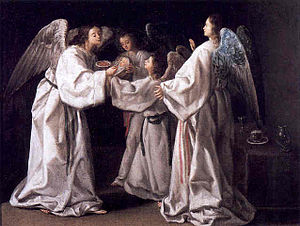
St. Raymond was sentenced to death, however, the Mercedarians ransomed him home to Spain.  He was then given the title of Cardinal by Pope Gregory IX in 1239.  Soon after, he came down with a fever and died in Cardona.   He is often shown in art in the company of angels.  Many miracles were attributed to St. Raymond before and after his death in1240 at the age of 37.

You pay God a compliment by asking great things of Him.
Quote of St. Teresa of Avila;   Feast day October 15
August is the Month of the Immaculate Heart of Mary

Prayers Quips and Quotes: St. Monica, Feast Day August 27


 St. Monica by Tristán de Escamilla, Public Domain Image
St. Monica by
Tristán de Escamilla,

The Feast Day of St. Monica is celebrated on August 27.  She is the patron saint of mothers, alcoholism and difficult marriages.

St. Monica was born of a Christian family in Tagaste in Africa in 331. She was given in marriage by her parents to a non-Christian named Patricius. He was known to have a a bad temper and alcoholism. They had three children who survived infancy. One of them was Augustine.

Monica was known for her pious nature. She prayed without ceasing for her family. A year before his death Patricius converted to Catholicism and was baptized. Augustine was 17 at the time of his father’s death. He left the faith and led an immoral life. By eighteen he had a mistress and a son. He joined a group called the Manichees. Manicheeism teaches that the material world is part of the realm of evil. There are two gods one good and one evil.

Monica never ceased praying for the return of her son to the Catholic faith. After more than 15 years of prayer, Augustine heard St. Ambrose, the bishop of Milan, preach. He decided to study the faith, and eventually returned, being baptized in 387. Eventually Augustine became a priest and then a bishop.  St. Augustine  is now considered a Doctor of the Church.

Monica is the patron of mother’s because of her persistence in prayer.

“Nothing is far from God.”
Quote of St. Monica
August is the Month of the Immaculate Heart of Mary

Save

Prayers, Quips and Quotes: St. Genesius of Rome, Feast Day August 25


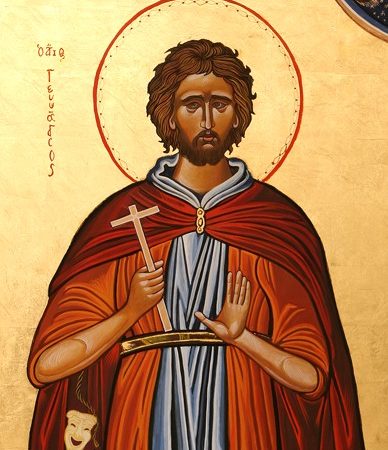
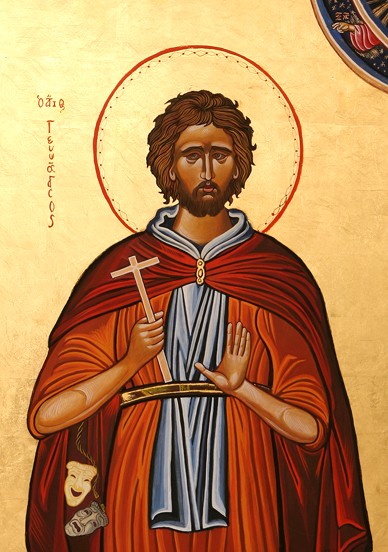
St. Genesius of Rome Public Domain Image
St. Genesius of Rome

The Feast Day of St. Genesius of Rome is celebrated on August 25.  St. Genesius is the patron saint of actors, comedians and clowns.

St. Genesius was a legal clerk who also performed as an actor.  He lived in the third century.  St. Genesius performed for Emperor Diocletian.

One of the plays he performed in was about a catechumen (student of Christianity) who was about to be baptized.  It was a satire which mocked the sacrament.  However, it was influencing St. Genesius to desire baptism.  During the play, he saw angels around him and requested baptism.

The emperor was so outraged, he had Genesius arrested and tortured.  He was eventually beheaded.

God calls me now, tomorrow will be too late.
Quote of St. Peter Julian Eymard; Feast Day August 2
August is the Month of the Immaculate Heart of Mary

Save

Save

Save

Prayers, Quips and Quotes: St. Rose of Lima, Feast Day August 23


St. Rose of Lima Public Domain Image
St. Rose of Lima


The Feast Day of St. Rose of Lima is celebrated on August 23.  She is the first saint of the Americas and known as the First Flower of America and the Patroness of the New World.  She is the patron saint of florists and gardeners.

St. Rose was born in April 1586 in Lima, Peru to Oliva and Gaspar Flores.  She was the 7th of 11 children.  Her birth name was Isabel.  However, her mother and friends witnessed a mystical rose descend from the air and light on her face while she was just an infant.  From then on she was called Rose.

Rose clearly had a religious calling from an early age.  After reading about St. Catherine of Siena, she decided to imitate her.  She fasted at least 3 times a week.  She found ways to do penance and offer her suffering for the good of others.   She understood redemptive suffering from an early age.  When given praise for her beauty, she cut her hair and disfigured her face by rubbing it with pepper.  She was also know for placing thorns under the garland of roses she wore in her hair to remind her of the crown of thorns Jesus wore.

St. Rose wished to enter the convent.  However, her parents refused to let her.  Finally, after ten years of struggle and refusal to marry she became a Third Order Dominican.  She lived in her home just as St. Catherine of Siena did.  St. Rose received the Blessed Sacrament daily and lived her life in silence and seclusion, enjoying the family garden.

St. Rose suffered from arthritis and asthma.  She was also disturbed by spiritual dreams.  Her friend Brother Martin de Porres reassured her that her visions were from God.    During the last three years of her life, St. Rose began caring for the elderly and sick.  she used a room in the house in which she lived.

During the inquisition, St. Rose faced an examination.  They found her to be in God’s favor in the midst of suffering.

At the age of 31 St. Rose came down with a high fever.  She died from the fever and paralysis.  A multitude of people attended her funeral.

St. Rose was canonized by Pope Clement X in 1671.

Without the burden of afflictions it is impossible to reach the height of grace.  The gift of grace increases as the struggle increases.
Quote of St. Rose of Lima
August is the Month of the Immaculate Heart of Mary

Save

Save

SaveSave

Prayers, Quips and Quotes: St. Maximilian Mary Kolbe, Feast Day August 14


St. Maximilian Kolbe Public Domain Image
St. Maximilian Kolbe


The Feast day of St. Maximilian Mary Kolbe is celebrated on August 14.  He was born in Poland in 1894.  His father ran a religious book store before enlisting in the army.  His mother later became a Benedictine Nun.  St. Maximilian is the patron saint of drug addicts, prisoners, families, and the pro life movement.

At the young age of 12, Maximilian experienced a vision from the Virgin Mary.

“That night I asked the Mother of God what was to become of me. Then she came to me holding two crowns, one white, the other red. She asked me if I was willing to accept either of these crowns. The white one meant that I should persevere in purity, and the red that I should become a martyr. I said that I would accept them both.”

Maximilian entered the minor seminary of the Conventual Franciscans in Lviv (formerly Poland, now the Ukraine) becoming a novice at 16.  He studied science as well as philosophy and theology.  He was ordained a priest at the age of 24.  His mission was to fight against indifference towards God.  He founded the Militia of the Immaculata which fought evil and promoted prayer, work and suffering.  He became known as the Apostle of Consecration to Mary.

When the Nazis invaded Poland in 1939, Kolbe and his friars were arrested and then released after 3 months on the feast of the Immaculate Conception.

He was arrested a second time in 1941.  After three months a prisoner escaped and ten men were ordered to be executed.  St. Maximilian Kolbe offered to take the place of a man about to be executed.   When asked who he was he replied ” a priest”.  The commandant allowed the exchange.  He was stripped naked and given no food.  The prisoners sang.  On the eve of the Feast of the Assumption the jailer came to inject the remaining prisoners with a needle with carbolic acid.  The bodies of the prisoners were burned.

Maximilian Kolbe was canonized in 1982.

No one in the world can alter the truth, all we can do is seek it and live it.
Quote of St. Maximilian Kolbe

August is the Month of the Immaculate Heart of Mary

Save

Save

Prayers, Quips and Quotes: St. Benedict, Feast Day July 11

The Feast Day of St. Benedict is celebrated on July 11.  In the Eastern Church it is celebrated on March 14th.

St. Benedict was born in Nursia in 480 to upper class parents. He attended university in Rome. To escape the vice he was surrounded by he fled Rome and spent three years in seclusion. After these three years he founded the monasteries he is famous for.

St. Benedict is considered the founder of western monasticism. His monasteries were based on the principles in his book The Rule of Benedict. This book begins with this prologue:

“Listen carefully, my son, to the masters’ instructions and attend to them with the ear of your heart. (R.B. Prologue)”
St. Benedict Public Domain Image
St. Benedict
Public Domain Image

His rule begins with the word LISTEN! The monasteries have a very strict discipline. They focus on daily personal and liturgical prayer. Singing of the Psalms and reading the Divine Office is practiced daily. Listening to the word of God is the primary focus of their spirituality.  Lectio Divino is slow reading and meditation on the scripture. Benedictine spirituality also demands obedience, hospitality, and service.

St. Benedict died while standing in prayer before God in the year 547. St. Benedict is the patron saint of students and Europe.

Shatter all your temptations against Christ.

Quote of St. Benedict

July is the Month of the Most Precious Blood.

Prayers, Quips and Quotes Articles for the Month of July

Save

Save

Prayers, Quips and Quotes: St. Lawrence, Feast Day August 10


St. Lawrence of Rome Public Domain Image
St. Lawrence of Rome
Public Domain Image


The Feast day of St. Lawrence is celebrated on August 10.  St. Lawrence is the patron saint of deacons, librarians, and the poor.

St. Lawrence served as a deacon in Rome in the third century. He was a disciple of Pope Sixtus II (251-258). The Pope chose him as one of seven deacons to serve in Rome. He eventually became an archdeacon. As archdeacon of Rome he served at the altar with the Pope and was his assistant serving the poor.

During the reign of Emperor Valerion in 258 he was arrested. While in prison it is believed that St. Lawrence cured a blind man named Lucillus and several other blind people. Because he refused to cooperate with his captors he was martyred. He was roasted alive on a gridiron. St. Lawrence died joyfully proclaiming his faith. He prayed for the conversion of the city of Rome and the world.

Before his death St. Lawrence remarked;

“At last I am finished; you may now take from me and eat!”

He then turned to God in prayer saying,

“I thank You, O Lord; that I am permitted to enter Your portals.”
My body is well done.
Turn it over.
it is roasted enough on that side.


Quote of St. Lawrence

August is the Month of the Immaculate Heart of Mary.

Save

Prayers, Quips and Quotes: St. Edith Stein, Feast Day August 9


St. Edith Stein Public Domain Image
St. Edith Stein
Public Domain Image

The Feast day of St. Edith Stein is celebrated on Aug. 9. St. Edith Stein was also known as St. Teresa Benedicta of the Cross. She is the patron saint of loss of parents and converts. Edith Stein was born in Breslav, Germany on Oct. 12, 1891. She was the youngest of a large Jewish family.  Her father ran a timber business but he died when she was only two years old. Her mother was hard working and devout. Edith, however, lost her faith when she was in her teens.

Edith studied at the University of Breslav where she studied German and history as well as philosophy and women’s issues. She considered herself a radical suffragette. When World War I began she completed a course in nursing and served in an Austrian field hospital, caring for wounded soldiers. After the war she received her degree, writing her thesis on “The problem of Empathy.

Witnessing a person kneeling for a brief prayer while holding a shopping basket in the Frankfurt Cathedral Edith had a great impact on her faith. In 1917, Edith visited a widow who had converted to Protestantism. It was during this visit that she was introduced to the cross of Christ. Edith began reading the Spiritual Exercises of St. Ignatius of Loyola. She then read the Autobiography of St. Teresa of Avila. St. Teresa described God not as a God of knowledge but as a God of Love. Edith decided to study the Catholic Catechism. Soon after she decided to become Catholic. She was baptized on Jan. 1, 1922.

St. Edith felt called into the Carmelite way of life but decided to wait. She accepted a position teaching German and history at a Dominican Sister’s school. She also translated the letters and diaries of Cardinal Newman. Edith joined the Carmelite Convent of Cologne at the age of 42. She took the name Teresa, Benedicta Cruce; Teresa of the Cross. She believed it was her vocation to intercede for others through prayer. As a Carmelite she wrote several books, including The Science of the Cross.

Sister Teresa Benedicta of the Cross was arrested by the Gestapo on Aug 2, 1931 while she was in the chapel. She was taken with other Jewish Christians to Amersfoort and then to Westerbork. They were then deported to Auschwitz. On Aug. 9, St. Teresa Benedicta of the Cross died in the gas chamber of Auschwitz at the age of 51. She was canonized as a martyr by Pope John Paul II.

If we place our hands of the divine Child,
if we say “Yes” to the “Follow me”,
then we are His, and the way is free
for His divine life to flow into us.
Quote of St. Edith Stein

August is the Month of the Immaculate Heart of Mary.

Prayers, Quips and Quotes: St. Dominic, Feast Day August 8

El_Greco,_St_Dominic_in_Prayer Public Domain Image

The Feast Day of St. Dominic is celebrated on August 8th. He was born in 1170 to Felix Guzman and Blessed Joan of Aza in Caleruega, Spain. After studying at the University at Palencia he was ordained a priest at the age of 25. St. Dominic was known for self-denial, holiness, piety and apostolic zeal. He refused to eat meat or sleep on a bed. He also renounced wealth.

In 1215 he founded an order of Dominican Nuns. Their mission was to care for young girls. This was followed by the founding of the Order of Preachers, which became known as the Dominicans. The purpose of the order was to preach the Word of God. They were also known as the “Black Friars”. The rule followed the Rule of St. Augustine. Their focus was on liturgical prayer and lifelong study.

The primary heresy the Dominicans preached against was Albigensianism. This was the belief that there are two dueling principles, good and evil, and that all matter was regarded as evil. They also taught that the devil is the creator of the material world.

A devotion which St. Dominic helped to spread is the Rosary. a Marian devotion, which combines meditation on the life of Christ, with memorized prayer. Tradition tells us that when Dominic became discouraged with the slow progress of his work of preaching against the Abligensian heresy, the Blessed Virgin appeared to him with a beautiful wreath of roses. She asked him to say the Rosary every day and to teach the people to say the Rosary. Soon the heresy began to disappear. The devotion of the rosary continues today.

After forming his order Dominic had a dream vision in which he met another person, a beggar. The next day, Dominic recognized this man when he came into his church. It was St. Francis of Assisi the future founder of the Franciscan Order. Dominic embraced him saying,

“You are my companion and must walk with me. For if we hold together, no earthly power can withstand us.”

St. Dominic and St. Francis were lifelong friends. Their orders celebrate their meeting on the feast day of their saint.

The motto of St. Dominic is: “To praise, to bless, to preach”. St. Dominic once said;

“Arm yourself with prayer, rather than a sword; wear humility rather than fine clothes.”

St. Dominic died on August 6, 1221 from a fever. Because of his love of learning and teaching, St. Dominic is known as the patron of astronomers.

Do not weep, for I shall be more useful to you
after my death and I shall help you then
more effectively than during my life.
Quote of St. Dominic
St. Dominic in Art

  • St. Dominic Public Domain Image

August is the Month of the Immaculate Heart of Mary.

Save