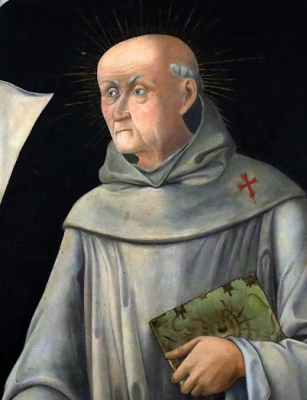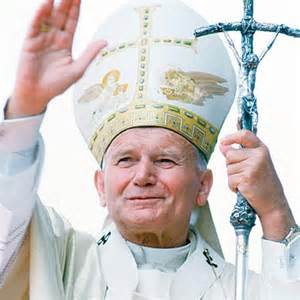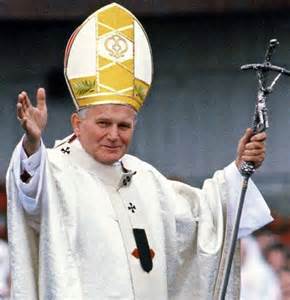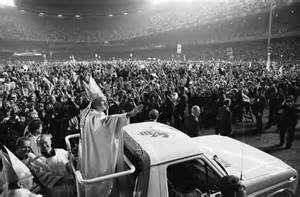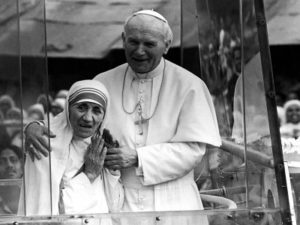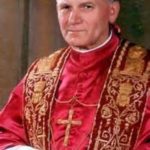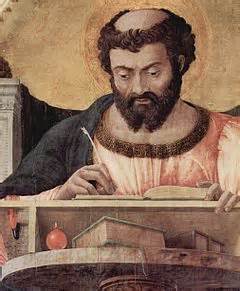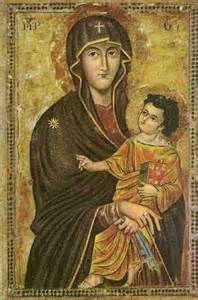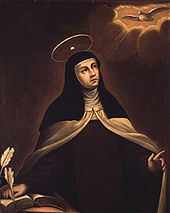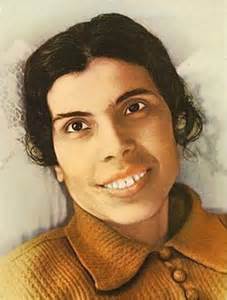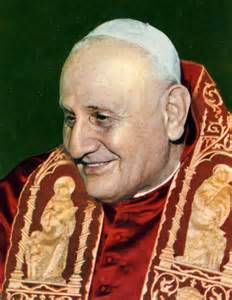
The Feast day of St. John XXIII is celebrated on October 11. He was known also known as “Good Pope John”.
Angelo Giuseppe Roncalli was born in 1881 near Borgano, Italy. He was the oldest of 13 children. Angelo joined the Secular Franciscan Order. After he was ordained a priest in 1904, he returned to Rome to study canon law. He became the bishop’s secretary, Church history teacher in the seminary and publisher of the diocesan paper.
During World War I, he served as a stretcher bearer for the Italian army. During World War II he was a papal diplomat, serving in Bulgaria, Turkey and France. With the help of Germany’s ambassador in Turkey, Archbishop Roncalli, he helped save approximately 24,000 Jewish people from death.
In 1953 he was named a cardinal and Bishop. He was elected Pope at the age of 77, taking the name of John. He soon called an ecumenical council and presided over the first session of the Second Vatican Council. The purpose of the Council was to bring the church into the modern world. It also was an effort to end hostilities between religions. Eastern Orthodox, Anglican and Protestant religious leaders were invited to attend.
One quote he is remembered for is:
“The Church has always opposed errors. Nowadays, however, the Spouse of Christ prefers to make use of the medicine of mercy rather than that of severity.”
Pope John XXIII earned the title Good Pope John because of his kind and cheerful demeanor.
He died on June 3, 1963. He was beatified November 15, 1881 by Pope John Paul II. He was canonized on the same day as Pope John Paul II by Pope Benedict on April 27, 2014.
In the Blessed Sacrament a heavenly school is open to me, with the best teacher one can possibly imagine…Jesus Christ himself.
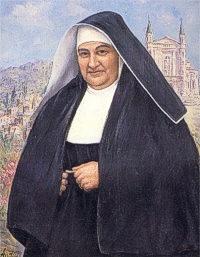
The Feast day of Bl. Mary Angela is celebrated on October 10.
Bl. Mary Angela Truszkowska was baptized as Sophia Camille after she was born in Kalisz, Poland on May 16, 1825. Her parents were well educated and devout Catholics.
As a child Sophia’s health was frail due to contracting tuberculosis. She was tutored at home. After the family moved to Warsaw in 1837, Sophia enrolled for a short time at the Academy of Madame Guerin until she withdrew due to health issues. She studied at home using her father’s library. She developed a great interest in social justice.
Sophia was drawn to a strong prayer life. She attended daily Mass and had a devotion to adoration of the Blessed Sacrament. When she was 23 she experienced a conversion which changed her life. She considered joining the cloistered Visitation Sisters but was advised by her confessor not to leave her ailing father.
While traveling with her father in Germany, Sophia felt called by Our Lord to serve the suffering poor and aging. She became a member of the Society of St. Vincent de Paul. She was constantly searching for God’s will while she served the poor. Eventually, Sophia began to teach the poor children and help the aging and homeless. Together with her cousin Clothilde they rented an attic with her father’s help and began the “Institute of Sofia Truszkowska”.
Both Clothilde and Sophia became Lay Franciscans. Sophia took the name Mary Angela. Their Franciscan spirituality led them to start a new order. On the feat day of the Presentation of the Bl. Virgin Mary, they dedicated themselves before an icon of Our Lady of Czestvehowa and founded the Congregation of the Sisters of St. Felix of Cantalice. St. Felix was the first Capuchin Franciscan to be canonized. The purpose of the order was that “in all and by all” God may be known, loved and glorified”. They became known as the “Felician Sisters”. Their ministry ranged from teaching to hospitals and caring for the poor and aging.
Mother Angela served for over 30 years. The sufferingshe experienced from progressive deafness, malignant tumors and terrible headaches was mostly unknown by those she served. Her Eucharistic spirituality inspired many. She always tried to imitate Mary and was known for her great love.
Today the Congregation of Sisters of St. Felix are known for their devotion to adoration of the Blessed Sacrament.
Mother Angela died on October 10, 1899. Her face changed from one of suffering to an expression of peace.
The feast day of St. Denis and Companions is celebrated on October 9. St. Denis is the patron saint of France and against headaches.
St. Denis was born and raised in Italy. He is also known as St. Dionysius. He was sent to Gaul by Pope St. Clement. He is probably the first Bishop of Paris. St. Denis was martyred along with two companions according to the writings of St. Gregory of Tours. His companions are believed to be St. Rustreus and St. Eleutherius, a priest and deacon. They were beheaded with a sword under the persecution of Emperor Valerius in 258. The head of St. Denis was carried into the nearby village before their bodies were thrown into the Seine River. St. Denis body was recovered and a chapel was built over his tomb.
St. Denis is one of the 14 helperswho were invoked in the middle ages against the Black Plaque. It is for this reason he became the patron saint against headaches.
Remember that this life is short, and that eternity is very long.
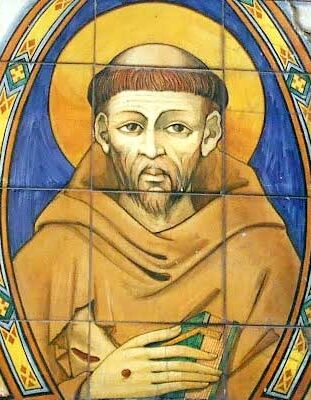
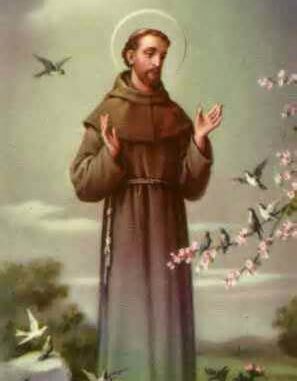
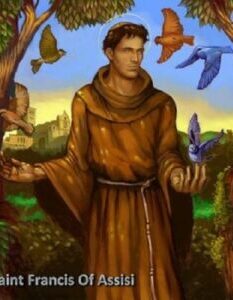
The Feast Day of St. Francis of Assisi will be celebrated on October 4th. He is the patron saint of the environment, peacemakers, and animals.
St. Francis was born in 1181 in Assisi, Italy. His father was Pietro di Bernardone, a wealthy cloth salesman. Francis was indifferent to school. He enjoyed good times with his friends. He was attracted to the military and was a prisoner of war for two years. He returned home, probably ransomed by his family, returning to his old life, however he became very ill. When he recovered, he returned to the military, however, in a dream he was told to return home. He was told to “serve the Master rather that the man.” His dream changed him. He turned from his wild ways and began to serve God. While praying in a neglected chapel in San Damiano, Christ spoke to him from the crucifix, saying;
“Francis, go out and build up My house, for it is nearly falling down.”
Francis took this quite literally, and began to repair the old chapel. In need of money, he took some of his father’s cloth and sold it. His father accused Francis of theft. At the hearing before the bishop, he was told to return the money. Francis obeyed; however, he also removed his clothes returning them to Pietro and declaring:
“I have called you father on earth, but now I say, “Our Father, who art in heaven.”
St. Francis embraced poverty. “Love of Lady Poverty” was how he described his belief that possessions were a detriment to his spirituality. After two years of living as a hermit and begging for money to repair the church, he began to attract followers to his way of living. He owned nothing, wanting to live a life of complete poverty. He lived his life caring for the poor and preaching the gospel, primarily through example. He once said;
“Preach always, and when necessary, use words.”
The heart of St. Francis message was joy, based on the love of Christ. He served primarily the poor, including the lepers of the time. He had a strong devotion to the Eucharist and the Cross.
By 1210 his group had grown to a dozen men. He received permission to form an order from Pope Innocent III. Originally it was called the Humbler Brethren, or Friars Minor. They became known for the brown robes they wore. By 1219 they numbered 5,000.
Clare Sciffo was sixteen years old when she heard Francis preach. Against her parents will she became a nun under St. Francis care. Her order became known as the Poor Clares.
St. Francis became friends with St. Dominic, whom he met while begging. St. Dominic recognized him from a dream in which he had seen Francis. When Dominic met him he embraced him saying;
“You are my companion and must walk with me.
If we hold together, no earthly power can withstand us.”
The Franciscans and Dominicans had different spiritualities, but Francis and Dominic were lifelong friends.
Some of the Franciscans wanted to change the rule of poverty. They wanted to own books so they could study scripture like the other monasteries of the time. This was contrary to Francis’ love of Lady Poverty. He went to see St. Dominic, who came up with a solution. The Franciscans were allowed to have a library, loaned to them by the Dominicans!
The Franciscans today have several different orders. There rule of poverty is not as strict as the original order.
Later, in his life, St. Francis received the stigmata (the wounds of Christ). These wounds were real and painful, a sign of how close he had come to the cross. He also suffered from a painful eye disease.
St. Francis composed several hymns, includingCanticle of the Sun. He is also known for his love of nature. Animals and birds had no fear of him and he was known for his friendships with traditionally wild creatures. It is St. Francis who started the tradition of a Christmas Crèche which honored the animals present in the stable when Christ was born.
St. Francis died in the year 1226 at the age of 45, praying the 141st Psalm and his Canticle of the Sun. His final prayer was:
“O Lord, I thank You for the pains which I suffer.”
Two years after his death, St. Francis was canonized on July 16, 1228 by Pope Gregory IX.
“My Lord, I am all yours. You know I have nothing besides my tunic, cord and underpants. And even these three things are yours.
So what can I give You?”
Quote of St. Francis of Assisi
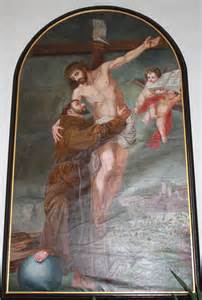
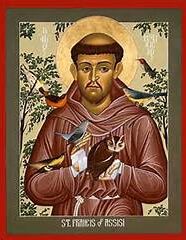
St. Francis of Assisi in Art
St. Francis of Assisi
St Francis of Assisi Stigmata
Shrine of St. Francis of Assisi
Public Domain Image
The Feast Day of St. Faustina is celebrated on October 5. She is considered the Apostle of Mercy.
St. Faustina was baptized Helena Kowalska. She was born into a very poor family of ten children on August 25, 1905 in Glogowiec, Poland. She lived on a farm receiving only three years of education.
St. Faustina worked as a housekeeper before joining the Sisters of Our Lady of Mercy in 1925 at the age of 20. For 13 years she prayed in the convent and worked as a cook, gardener and porter.
St. Faustina grew in holiness. She had a very mystical interior life. She had the gifts of visions, prophecy, the stigmata , bi-location, the gift of reading hearts and mystical marriage.
The vision which impacted the world was a vision of Jesus. She tells the story in her Diary.
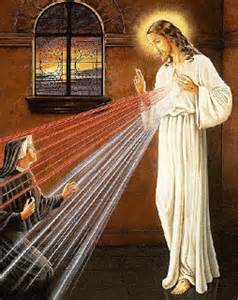
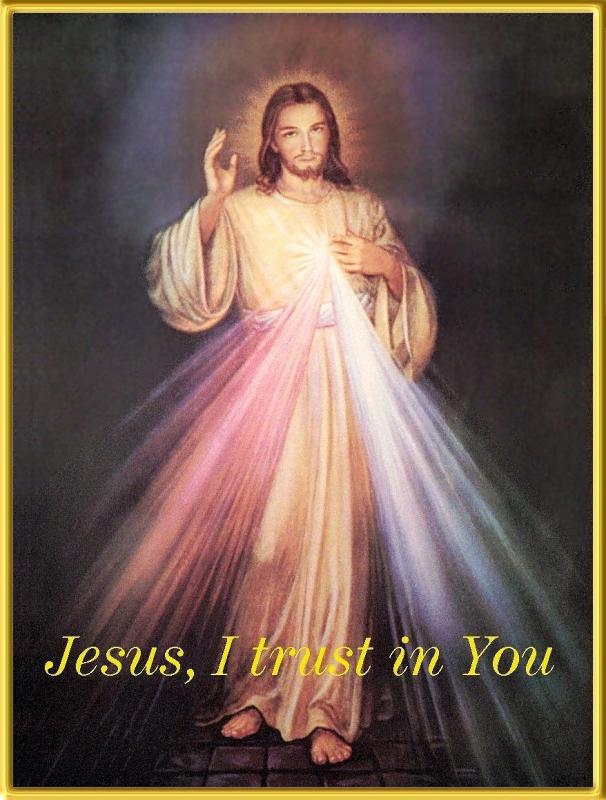
“In the evening, when I was in my cell, I became aware of the Lord Jesus clothed in a white garment. One hand was raised in blessing, the other was touching the garment at the breast. From the opening of the garment at the breast there came forth two large rays, one red and the other pale. In silence I gazed intently at the Lord; my soul was overwhelmed with fear, but also with great joy. After a while Jesus said to me, ‘paint an image according to the pattern you see, with the inscription: Jesus, I trust in You.'”
Some time later, Our Lord again spoke to her:
“The pale ray stands for the Water which makes souls righteous; the red ray stands for the Blood which is the life of souls. These two rays issued forth from the depths of My most tender Mercy at that time when My agonizing Heart was opened by a lance on the cross….Fortunate is the one who will dwell in their shelter, for the just hand of God shall not lay hold of him.”
Divine Mercy
At the request of Jesus she willingly offered her sufferings in union with him to atone for the sins of others. He also asked her to remind the world of His Divine Mercy and He taught her a very special devotion to the Divine Mercy based on trust in Him. She had a special devotion to the Immaculate Heart of Mary, the Eucharist and the Sacramentof confession which strengthened her.
One of the vision she experienced was a visit to hell, which she shares in her diary. She suffered greatly interiorly, however she only shared her suffering with her spiritual director. At the request of Jesus and her confessors, St. Faustina kept a diary in which she shared her visions.
St. Faustina died of tuberculosis in Krakow, Poland at age 33 in 1938. She was canonized by the first Polish Pope, Pope John Paul II on April 30, 2000
Divine Mercy Sunday is now celebrated every year on the first Sunday after Easter.
The Feast Day of St. Theodore Guerin is celebrated on October 3. She is the patron saint of the Diocese of Lafayette, Indiana.
St. Theodore Guérin’s birth name was Anne Thérése. She was born on Oct. 2, 1798 in Etables, France. Her father served in Napoleon’s navy. At the young age of 15 her father was murdered by bandits while traveling home for a visit.
Anne Thérése turned to God in the difficult years following his death. At the age of 25 she entered the Sisters of Providence to serve the poor, sick and dying. Anne Thérése became Sister Theodore. She was asked to lead a small missionary band of Sisters to the United States in Indiana.
Mother Théodore accepted the mission in spite of her fragile health. She could only consume soft, bland food and liquid. She traveled to the Unites States with five other sisters. After surviving a violent storm at sea in the trip Mother Théodore wrote the following:
“What strength the soul draws from prayer! In the midst of a storm, how sweet is the calm it finds in the heart of Jesus. But what comfort is there for those who do not pray?”
Mother Théodore established schools in Indiana and Illinois. She is described as saintly by people who knew her.
Sixteen years after coming to the United States she died. She is buried in the Church of the Immaculate Conception in St. Mary of the Woods, Indiana.
St. Théodore Guérin was beatified on Oct. 25, 1998 by Pope John Paul II.
St. Théodore Guérin was canonized on Oct. 15, 2006 by Pope Benedict XVI.
“If you lean with all your weight upon Providence,
The Feast Day of St. Vincent de Paul is celebrated on September 27. He is the patron saint of charities, hospitals and volunteers.
St. Vincent was born at Pouy, Gascony in Southern France in 1581 into a large peasant family. At the age of 15, he entered a Franciscan seminary. He tutored children until he was ordained a priest in 1600.
In `1605, St. Vincent was traveling on a ship from Marseilles to Narborne when he was captured by Moorish pirates! He was sold as a slave in Africa. After two years as a slave, he escaped and returned to France.
At Avignon St. Vincent continued to study. He became the chaplain to the Count of Goigny and was placed in charge of the charities for the poor. This inspired him to preach missions to provide relief for the poor. St. Vincent founded a missionary group known as the Vincentians. The priests in the Order served people primarily in small towns and villages. They had a devotion to helping the poor.
Next, St. Vincent along with the help of St. Louise de Marillac, founded theSisters of Charity. He organized the rich women in Paris to collect money for his missionary projects, including several hospitals. He also collected money for victims of war and ransomed over 1200 slaves from N. Africa.
The motto of St. Vincent was “God sees you”. He became known as the Apostle of Charity and the Father of the Poor.
St. Vincent died at the age of 80. His heart remains incorrupt and can be found in the Convent of the Sisters of Charity in Paris. He is credited with two miracles. The first was the curing of a nun with ulcers. The second was a laywoman cured of paralysis.
St. Vincent de Paul was canonized by Pope Clement XII on June 16, 1737.
St. Vincent’s bones and heart are perfectly incorrupt and have been placed inside a wax figure of his body. His relics can be seen in the Church of St. Vincent de Paul in Paris.
Do not feel that all is lost because of the revolt you feel inside. It has rained hard. The thunder has crashed. Is the weather any less beautiful because of that? Be assured you are not, for all that, any less dear to our Lord.
The Feast Day of Bl. Herman the Cripple is celebrated on September 25. He is the patron saint of the unborn child and the disabled.
Bl. Herman was the son of the Earl of Altshausen in southern Germany. He was born with a cleft palate, cerebral palsy and possibly spina bifida. The doctors told his parents he would not live past five years of age. He lived to be 41.
Herman had trouble with both moving and speaking. His parents cared for him until the age of seven. He was then given to the Abbey of Reichenau to be cared for. The monks raised him in the Benedictine monastery where he became interested in theology and the spiritual world. In spite of his disabilities, Bl. Herman was very intelligent. He studied math, astronomy, theology, history, poetry , Arabic, Greek and Latin. He built musical instruments and was known for his poetry. At the age of 20 Herman became a Benedictine monk.
Towards the end of his life Herman suffered from blindness. He began writing hymns. The most famous are the Salve Regina, Hail Holy Queen and Redemptoris Mater. Bl. Herman used prayer and music to grow closer to God.
Bl. Herman died at the age of 41 in 1054. Because so many children with disabilities die because of abortion, Bl. Herman is the saint of the unborn child. He is also the patron saint of the disabled.
Hail Holy Queen
Hail Holy Queen, Mother of Mercy! Our life, our sweetness, and our hope!
To thee do we cry, poor banished children of Eve. To thee do we send up our sighs, mourning and weeping in this valley of tears. Turn then, most gracious advocate, thine eyes of mercy towards us; and after this, our exile show unto us the blessed fruit of thy womb, Jesus.
O clement, O loving, O sweet Virgin Mary. Pray for us, O Holy Mother of God, That we may be made worthy of the promises of Christ.
The Feast Day of St. Joseph of Cupertino is celebrated on September 18. St. Joseph of Cupertino is the patron saint of air travelers, pilots, astronauts, and those with learning disabilities.
St. Joseph of Cupertino was born on June 17, 1603 in Puglia, Italy. His father died before he was born leaving his mother destitute. He was born in a stable. As a child he was a slow learner, probably having a learning disability. When he was 17 he was denied acceptance to the Order of the Friars Minor Conventuals due to lack of an education. He was however, accepted into the Capuchins at Martino near Cupertino. He gardened, tended the animals and worked in the kitchen.
Because of his learning disabilities St. Joseph could only study small amounts of material at a time. He then prayed to remember the material for the test. St. Joseph was ordained in 1628.
St. Joseph was a mystic with the gift of miraculous levitation and visions. Anything religious could cause him to levitate. During prayer he was known for his ecstasies and suddenly levitating. The first time levitation occurred was on the feast of St. Francis of Assisi, October 4 1630. During the procession he suddenly rose into the sky and hovered over the crowd. He was so embarrassed he fled and hid. The levitation happened so often he earned the title “The Flying Saint”.
The most famous act of levitation occurred while he was in the presence of Pope Urban VIII. He was filled with reverence and immediately was lifted into the air. During the Inquisition he was confined for several weeks but released. Crowds tried to meet him until he was place in seclusion…unable to speak to anyone other than the bishop the vicar general of the Order, his fellow friars and a doctor if needed.
After his death on Sept. 18, 1663, great crowds of people attended his funeral. Pope Clement XIII canonized St. Joseph of Cupertino on July 16, 1767.
A movie has been made of his life named A Reluctant Saint. St. Joseph of Cupertino is the patron saint of air travelers, pilots, astronauts, and those with learning disabilities.
“The fullness of joy is to behold God in everything.”
Quote of St. Catherine of Genoa; Feast day September 15
The Feast Day of St. Nicholas of Tolentino is celebrated on September 10. He is the patron saint of the souls in purgatory and the dying.
The parents of St. Nicholas were childless when they visited the Shrine of St. Nicholas of Myrna at Bari, Italy. The year after praying for a child they became parents. They named their child Nicholas in gratitude for their prayer being answered.
At the age of 18, Nicholas became an Augustinian monk. He was ordained a priest at 25. St. Nicholas was known for his visions and gift of miracles. He received a vision of angels reciting the phrase “to Tolentino”. He decided to move to Tolentino in 1274 where he lived the rest of his life.
St. Nicholas was a peacemaker during a time of war. He was also a miracle worker and healer. He often visited prisoners and was known for his kindness.
Once after becoming ill, he had a vision in which the Virgin Mary, St. Augustineand St. Monica appeared to him. They told him to eat a certain type of roll dipped in water. He was healed after doing so. He then began healing others by giving bread to them and reciting Marian prayers. The rolls become known as St. Nicholas Bread.
Many legends and miracles are credited to St. Nicholas. Over 300 miracles have been recognized.
After a long illness in which he became bedridden and suffered greatly, St. Nicholas died in 1245, surrounded by his community.
St. Nicholas of Tolentino was canonized by Pope Eugene IV in 1446.
There is no sin or wrong that gives a man a foretast of hell in this life as anger and impatience.
Quote of St. Catherine of Sienna; Feast day April 29
The Feast Day of St. Peter Claver is celebrated on September 9. He is the patron saint of African missions.
St. Peter Claver was born at Verdu, Catalonia, Spain in 1580. He entered the Jesuit college of Barcelona, becoming a Jesuit novitiate, taking his final vows on Aug 8, 1604. St. Peter Claver left his homeland to become a missionary in the colonies of the new world. He ministered to the slaves arriving daily in Cartagena (now Columbia). Over a thousand slaves arrived in Cartagena every month. He brought them food, ministered to their medical needs and prayed with them. He followed them to the plantation they were taken to. St. Peter Claver declared himself to be the “slave of the Negroes forever.”
After instructing them in the faith, he baptized them. By 1651 he had baptized over 300,000 slaves into the faith.
After suffering from illness for four years, St. Peter Claver died on Sept. 8, 1654. St. Peter Claver has been declared the patron saint of African Missions.
“Seek God in all things and you shall find God by your side.”
The Feast Day of St. Regina is celebrated on September 7. She was born in Alise, France. Her mother died at childbirth. Regina’s father was a prominent man who was a pagan. He hired a Christian nurse to raise Regina. While Regina was quite young the nurse secretly baptized Regina.
St. Regina became more and more religious as she grew older. When her father learned that she had been baptized, he disowned her. She lived with her nurse and worked in the fields to earn money. She also tended sheep. While working, she meditated on the love and mercy of God.
When Regina was 15 years old, the prefect of Gaul named Olybrius noticed Regina and became determined to marry her. He was unhappy that she was a Christian. Olybrius tried to convince her to deny her faith but she not only refused but proclaimed her faith even louder. Olybrius then had her imprisoned. She was chained to the walls of the cell with an iron belt. After she still refused to deny her faith, she was whipped and scourged. Finally she was beheaded. She died in the year 286. Many were converted after seeing a solitary dove hover over her during the torture.
The relics of St. Regina are enshrined in Flavigini Abbey where many miracles have since occurred.
St. Regina is honored as a martyr for the faith. She is the patron saint against poverty and for victims of abuse.
If the moon is beautiful as it reflects the light of the sun at so great a distance, what will be the beauty of the saints, who for all eternity and not at a distance, will reflect the divine image of God!