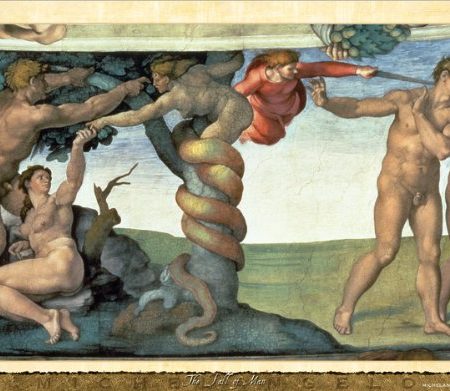

Look at the birds of the air, they neither sow nor reap nor gather into barns, and yet your heavenly Father feeds them. Are you not of more value than they? (Mat. 6: 26)
Preface
The following reflections and prayers helped me to deal with the pain of grief. During times of grief, praying can be quite difficult. Not only do we find it hard to talk and pray to God, but we may find it difficult to have any relationship with God at all.
My prayer is that these reflections on my favorite prayers will help another suffering pilgrim.
Vicki Scheenstra
In loving memory:
of my husband Perry Scheenstra (1954-1997),
my son x Alan Scheenstra (1980-2008)
and my father Leo Mahre Jr. (1922-2001).
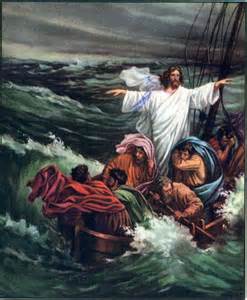 Jesus Stills the Storm
(Matthew 23-27)
And when he got into the boat, his disciples followed him. A windstorm arose on the sea, so great that the boat was being swamped by the waves; but he was asleep. And they went and woke him up, saying,
“Lord, save us! We are perishing!” And he said to them, “Why are you afraid, you of little faith?” Then he got up and rebuked the winds and the sea; and there was a dead calm. They were amazed saying, “What sort of man is this, that even the winds and the sea obey him?
Life seems to be made up of one storm after another. Turning to Jesus in a time of crisis takes faith and practice. Many of our emotions can be compared to the weather. When I think of grief, I think of a gray, rainy day. The following prayers have helped me to see the rainbow after the storm, and to appreciate that without a storm, we don’t appreciate the sunny weather nearly enough!
Many of us experience the “dark night of the soul” during grief. Only through turning to God in prayer can we begin to enjoy life completely again. Seeing God (the creator of everything) in nature can help during a stormy, stressful time.
A flower needs a rainy day to bloom.
We, as spiritual people, need prayer to deal with our emotions and to grow spiritually. The following prayers and reflections are how Jesus calmed the water during the storms in my life.

The Beatitudes
Blessed are the poor in spirit,
for theirs is the kingdom of heaven.
Blessed are those who mourn,
for they will be comforted.
Blessed are the meek,
for they will inherit the earth.
Blessed are those who hunger and thirst
for righteousness
for they will be filled.
Blessed are the merciful,
for they will receive mercy.
Blessed are the pure in heart,
for they will see God.
Blessed are the peacemakers,
for they will be called children of God.
Blessed are those who are persecuted
for righteousness’ sake,
for theirs is the kingdom of heaven.
Blessed are you when people revile you and persecute you and utter all kinds of evil against you falsely on my account.
Rejoice and be glad, for your reward is great in heaven, for in the same way they persecuted the prophets who were before you.
BLESSED ARE THOSE WHO MOURN.
This beatitude is one which hopefully we all experience. If we don’t, it probably means we have not learned how to love.
All of the beatitudes are lessons in how to love. If we are sad over losing a loved one then, this is a good thing. Let us rejoice and be glad! Loving someone means we have shared ourselves with someone, and have come to know them on a personal level. The love we have given and received is priceless.
Everyone experiences the death of some one they are close to at some point in their life. How we deal with the loss shows who we are. We may want to hide away and be by ourselves for awhile. This is perfectly normal. Hopefully, we talk to God in these moments when we are alone.
Turning to the beatitudes can be very helpful for times of grief. The beatitudes guide our meditation and help us to redirect our emotions.
The beatitude of mourning is often the first time we passionately turn to God for answers to our questions and doubts.
The answers to these questions and doubts can be found in the remaining beatitudes.
BLESSED ARE THE POOR IN SPIRIT.
Humility is what we seek with this beatitude. It is the exact opposite of pride. When we completely lose our selfishness, we open ourselves up to God’s presence in our life.
BLESSED ARE THE MEEK.
What does it mean to be meek? This beatitude is knowing that God is the creator and trusting in His plan for us. The arrogant person is not meek. Being meek, means accepting that we are nothing without God and trusting in Him, even during difficult and depressing times.
BLESSED ARE THOSE WHO HUNGER AND THIRST FOR RIGHTEOUSNESS.
Passion is a wonderful emotion. Hopefully, we are passionate about more than just our own welfare. Wanting justice for not only ourselves but everyone around us means we must actually do something when we see injustice. Finding a cause or a purpose in life is a very good way to work our way through grief issues.
BLESSED ARE THE MERCIFUL.
The merciful person is a loving person. This beatitude is all about love; not only having a forgiving attitude, but being kind to people around us. The merciful heart is always kind and helpful. Doing a good deed for others always lifts the spirit!
BLESSED ARE THE PURE OF HEART.
Having the right motive in everything we do can be very difficult. If we reflect before acting, sometimes we can avoid being manipulative or selfish. The easiest way to increase the presence of God in my life is to get rid of my selfish thoughts and desires. It’s not easy!
BLESSED ARE THE PEACEMAKERS.
Sometimes anger is justified. Peacemakers are not people who put up with behaviors that are unacceptable. To be peacemakers, we must first be at peace with ourselves. Peacemakers deal with conflict in the world by being decisive, turning to God for guidance, and having respect for other people. We must again get rid of selfishness and arrogance in order to be a peacemaker.
The Peace of Christ is the gift we receive when we treat everyone as if…THEY ARE CHRIST!
BLESSED ARE THOSE WHO ARE PERSECUTED FOR RIGHTEOUSNESS SAKE.
There is a huge difference between being righteous and being self-righteous! This is where I need to turn to God for guidance. Am I being persecuted for standing up for my faith or am I being judgmental? If I am judging other people, I am playing God. However, that doesn’t mean I must condone behavior that is wrong. It means I must also be kind and forgiving. Let God be the judge. At the same time, I should never lower my standards to make other people happy. That would make ME miserable!
Living the Beatitudes during times of grief can be very challenging. It is natural to focus on our own feelings. Praying the Beatitudes reminds me to be less selfish and try to love the people I come into contact with. They also remind me that God is in charge. If I can let go and trust in God’s plan, my grief will be less painful. Knowing that God loves me, I have to work at believing He wants me to be happy.
Trusting God can be hard after loss. After all, the miracle I prayed for probably didn’t happen! However, the Beatitudes tell me to be meek…to trust that God has a plan and then live every day trying to do God’s will.
May my attitude be Christlike always.

Serenity Prayer
God, grant me the serenity
To accept the things I cannot change
Courage to change the things I can,
And the wisdom to know the difference.
Living one day at a time,
Accepting hardships as the pathway to peace.
Taking, as He did, this world as it is,
Not as I would have it.
Trusting that He will make all things right
If I surrender to His will.
That I may be reasonably happy in this life,
And supremely happy with Him,
Forever in the next.
(Reinhold Neibuhr, 1926)
The Serenity Prayer is a powerful prayer to help reinforce trust in God.
Often, it helps me to get through the most difficult moments of my life. When life is out of control, this prayer reminds me that I am not supposed to be in control of everything, only God is! I am a very visual person. When I say a prayer, I often have pictures to meditate on in my mind. One day as I was praying the serenity prayer, I realized my definition of serenity was wrong!
My definition of the word serenity is similar to complete calm. While praying this prayer I was picturing a calm lake on a sunny day. It was so calm there were no whitecaps on the water. It was so calm if I was on a sailboat, I would not be able to sail due to lack of wind. I was stuck! This is not serenity! We need movement in our lives! Without progress we stagnate and then we seem to go backwards or become lost.
When I am the opposite of serene, I am frantic and in a panic.
This frame of mind makes it impossible to make rational decisions. I finally realized that serenity is being able to make decisions while we are in the eye of a storm! While I prefer a sunny day on the lake, I always want there to be a breeze so the sailboat I am in will actually go where I direct it. Serenity is being calm enough during the storm to know which ropes to pull to keep the boat from turning over!
Help me make good decisions Lord. Direct my life!
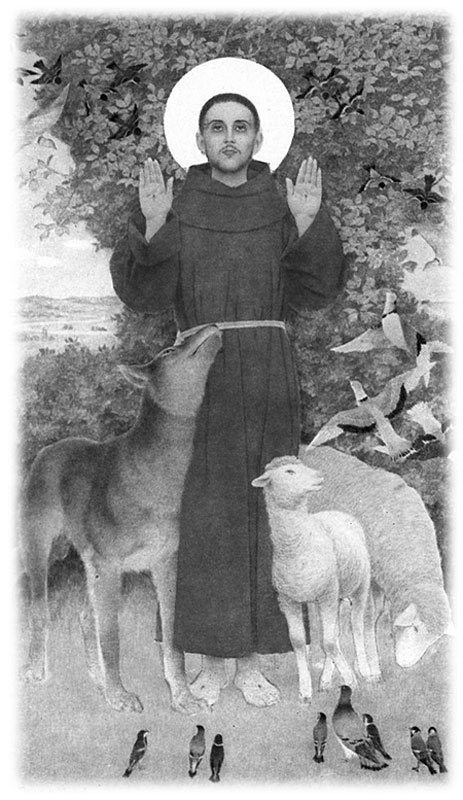
The Prayer of St. Francis
Make me an instrument of your peace.
Where there is hatred let me sow love.
Where there is injury, Your pardon, Lord.
And where there’s doubt
True faith in You.
Make me an instrument of your peace.
Where there’s despair in life,
Let me bring hope.
Where there is darkness, only light.
And where there’s sadness, ever joy.
Oh, Master, grant that I may never seek,
So much to be consoled as to console
To be understood as to understand
To be loved as to love with all my soul.
Make me an instrument of your peace.
It is in pardoning that we are pardoned.
In giving of ourselves that we receive,
And in dying that we are born to eternal life.
Amen
How can I love my neighbor?
This prayer tells me how. Love is actually the opposite of selfishness. Being more concerned about the people in my life than myself takes a great deal of practice and prayer! God wants me to put the needs of others before my own needs and desires. It is also about letting God use me to do his will.
This prayer teaches me to live by example,
Loving and forgiving others will in the end bring me peace,
happiness, and eternal life.
The only way to live this prayer is to put myself in someone else’s place to enable me to be more understanding and loving.
Sometimes, I find it impossible to understand someone’s actions. When this happens, I need to give my negative feelings and reactions to my master, God. If I listen to him in prayer, He will lead me and make me an instrument of his peace. He will also help me forgive those I am angry with.
It is more important to love someone than to understand them.
When I actually live this prayer, I can be confident that I am doing God’s will.
Put me to work Lord!
 Celtic Cross
Breastplate of St. Patrick
Christ be behind me,
Christ be before me,
Christ be beside me,
King of my heart.
Christ be within me,
Christ be below me,
Christ be above me,
Never to part.
Christ on my right hand,
Christ on my left hand,
Christ all around me,
Shield in the strife.
Christ in my sitting,
Christ in my sleeping,
Christ in my rising,
Light of my life.
(may be sung to the melody of Morning is Broken)
Christ is everywhere: especially in the eye of the storm!
This prayer beautifully expresses the need to let Christ be the center of my life. If I try to follow Him always, people will recognize Christ when they see me! It’s almost impossible to imagine. From morning until night, even while I am asleep, turning to Christ, and letting him lead and guide, me, assures me, that Jesus will be with me always. What a comfort in times of grief!
Knowing what pain Christ suffered for me, helps me to give my suffering back to him and ask for his help. Life is not always easy, but when Christ is my shield, I feel as though he is giving me strength, protecting, and comforting me.
My past, present, and future are in God’s hands.
If I truly love Christ, I will always want his guidance and presence in my life and in my heart. The more often I turn to Christ and let Him into my life, the more I will come to love Christ.
Christ Everywhere!
Prayer of Quiet
The prayer of quiet is simply resting in the presence of God, emptying your mind of all thoughts and anxieties, offering them to God and experiencing the presence of God.
Often, it helps to have a sacred word to repeat slowly while you inhale and exhale slowly.
Following are some possibilities.
Lord…Mercy
Abba…Father
Jesus…Peace
Holy Spirit…Come
May the presence of the Father, Son, and Holy Spirit guide me today.
 Thy kingdom come…..
.
The Lord’s Prayer
Our Father, who art in heaven,
Hallowed be thy name.
Thy kingdom come, Thy will be done.
On earth as it is in heaven.
Give us this day our daily bread.
And forgive us our trespasses
As we forgive those who
trespass against us.
Lead us not into temptation,
But deliver us from evil.
Amen
The Lord’s Prayer covers all the bases. We first acknowledge God as our father (creator). We honor his name and ask for his will to be done. This is perhaps the most difficult part. When we are suffering, is this his will?
Can you picture Jesus in the Garden before the crucifixion? He prays that this cup be taken from him, but the will of His Father be done.
To be like Christ is our goal, so we must accept that suffering is part of God’s plan. If even Jesus, the son of God, suffers…what makes me so special that I should be spared? Everyone someday will die. This fact alone causes suffering to the person who is left behind.
Anger at God is a natural stage of grief. However, if we look to the cross and see the suffering Jesus went through for us, it becomes obvious…
Jesus did not come to earth to eliminate suffering!
Suffering brings us closer to Jesus and the cross. Grief and sorrow over this loss is not something to be ashamed of.
Our love matters!
Living without them changes our life forever, but we can take comfort knowing that they are in the arms of God. Death is simply a doorway to heaven. While it is hard to imagine what heaven is like, we know it is filled with the love and mercy of God.
Asking for God’s will to be done means we must stop playing God and assuming our will is His. Let Him lead us!
Asking for our daily bread, is asking for the things we need not the things we want!
How hard it is to remember this!
Just because we pray for something does not mean we will receive it. When God says NO, it helps to ask God to show us HIS will. We need to remember that God knows what is best for us. How different my life would be if all my prayers were answered YES!
Forgiveness is a two-way street. We must forgive to be forgiven. How easy it is to hold a grudge! Sometimes, we don’t even realize we are doing it. We simply refuse to think about it and simmer away continually angry!
When we acknowledge our own sinfulness, it is easier to forgive the sins of others. Remind yourself of your weaknesses daily…it will help you to forgive and understand others. When you are having trouble forgiving someone…pray for them!
It is truly amazing how this almost always works.
Temptation is everywhere, especially in our mind! What are we to do about it? One thing we can do is pray often, asking God to lead us. When we recognize the things that tempt us, we need to avoid them if at all possible.
We need to recognize evil in our lives.
To ignore it encourages it to flourish. There is a difference between being judgmental and having high moral standards. Deal with the evil in your own life before you judge the evil in someone else’s. To Judge is the job of God. Our job is to make moral decisions. I try to remember always; I will be judged by how I love! Loving one’s enemies needs to be practiced when we see evil.
How is it even possible to love our enemy? Perhaps all I can do is begin by praying for my enemy instead of cursing him. At least this is a beginning, and when I pray for the person I am angry at I have refused to have hatred grow and consume me.
Let thy will, not my will be done.
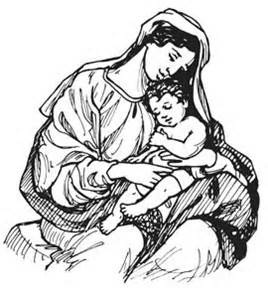
Hail Mary, Full of Grace
(Ave Maria)
Hail Mary, full of grace.
The Lord is with thee.
Blessed art thou among women,
And blessed is the fruit of thy womb, Jesus.
Holy Mary, Mother of God
Pray for us sinners,
now, and at the hour of our death.
Ave Maria, gratia plena
Dominus tecum
Benedicta tu in mulieribus
Et benedictus fructus ventris tui Jesus
Sancta Maria, Mater Dei
Ora pro no bis peccatoribus
Nunc et in hora mortis nostrae
Amen
Hail Mary, full of grace.
What does the word grace mean?
Grace, like faith, is a gift from God. We cannot receive it on our own,
but we can ask (pray) for it. A gift is something given to us;
which reminds me of Christmas when we receive
so many Christmas presents.
Grace is the gift (presen) of God’s presence.
Of all the people in the world who but Mary
was Jesus most present to?
Being pregnant with Jesus, the son of God,
is hard to imagine.
I pray daily that I may come closer to Jesus.
One way to do that is to imitate Mary,
who loved Jesus as none of us can
because she was His mother.
Her love was a special and unique love.
On the cross, Jesus told John the disciple…
“Here is your mother” (John: 19.27)
By doing this, she becomes the mother of all disciples of Jesus. Mary’s grief must have been so great!
I ask her now to help me know the will of Jesus in my life and to teach me how to love.
Pray for us sinners, now and at the hour of death. Amen
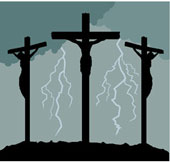 Calvary
Jesus Remember Me, when you come into your kingdom.
Luke 23: 32-43
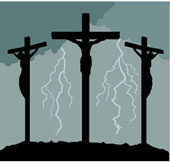
Two others also, who were criminals, were led away to be put to death with him. When they came to the place that is called The Skull, they crucified Jesus there with the criminals, one on his right and one on his left. Then Jesus said, “Father, forgive them; for they do not know what they are doing.” And they cast lots to divide his clothing. And the people stood by, watching; but the leaders scoffed at him saying, “He saved others, let him save himself if he is the Messiah of God, his chosen one!” The soldiers also mocked him, coming up and offering him sour wine, and saying, “If you are the King of the Jews, save yourself!” There was also an inscription over him which said…
“This is the King of the Jews.”
One of the criminals who were hanged there kept deriding him and saying, “Are you not the Messiah? Save yourself and us!” But the other rebuked him, saying, “Do you not fear God, since you are under the same sentence of condemnation? And we indeed have been condemned justly, for we are getting what we deserve for our deeds, but this man has done nothing wrong.” Then he said, “Jesus, remember me when you come into your kingdom.”
Jesus replied, “Truly I tell you, today you will be with me in Paradise.”
The Good Thief turned to Jesus at the very end of his life. He did not need to know all the answers regarding religion. He had not been baptized. He simply acknowledged his guilt and asked Jesus to remember him. Sometimes, we make faith way too complicated. All we really need to do is turn to God and ask him to lead us to the truth.
God is Love… God is truth.
Let’s keep it simple…. Seek Love…Seek Truth
Redemptive Suffering
Are you angry at God? This is a normal stage after a loss. Christianity teaches us that Jesus redeemed us by the cross…his suffering is what saves us! This is called redemptive suffering. When we suffer, we can participate by putting our suffering at the foot of the cross and giving it to Jesus. This is what is meant when we hear the phrase “Offer it up”. By giving our suffering to Jesus as a prayer for loved ones who have died, Jesus actually turns our suffering into a virtue.
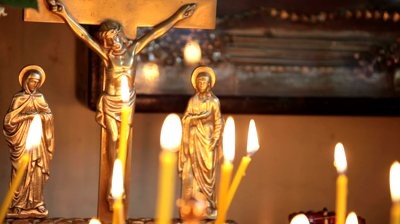
Meditate on a crucifix.
Your anger at God will not last forever. Spending time with God has been very important in my healing process. I could not pretend my feelings did not exist or that I was ready to move on with my life when I was not.
Music has also been very helpful.
When you sing you pray twice. (St. Augustine)
Praying through my favorite hymns enables me to pray when I cannot put my feelings into words.
Suffering came first. The crucifixion came before the resurrection.
Jesus teaches us how to suffer!
Meditating on the crucifixion, and the Stations of the Cross we learn how to deal with the sufferings in our own life, small in comparison.
In order to know the meaning of joy, we must experience sorrow.
Be with me, Lord!

Seasons of Life
Ecclesiastes: 3: 1-8
For everything there is a season, and a time for every matter under heaven.
A time to be born and a time to die.
A time to plant, and a time to pluck up what is planted.
A time to kill and a time to heal.
A time to break down and a time to build up.
A time to weep, and a time to laugh.
A time to mourn and a time to dance.
A time to throw away stones and a time to gather stones together.
A time to embrace, and a time to refrain from embracing.
A time to seek, and time to lose.
A time to keep and a time to throw away.
A time to tear, and a time to sew.
A time to keep silence and a time to speak.
A time to love, and a time to hate.
A time for war, and a time for peace.
To me, tears are spiritual rain.
A garden grows in all types of weather. Without rain to water it, it will die of drought. The flowers in a garden need both sun and rain to be healthy and beautiful.
When we grieve, we need to acknowledge our suffering and pain. Tears help to cleanse our soul and bring us closer to God. Denying our pain prevents us from having an honest relationship with God. We avoid our feelings and end up pretending we are just fine. This actually just prolongs our grief!
Even Jesus wept at the death of Lazarus. (John 11: 35)
Our soul is similar to a flower garden. When we acknowledge our pain and sorrow, we enable God to heal us and bring the sunshine back into our lives. In time, we will be able to remember both the good and the sad times without tears. We can come to embrace every day as a beautiful gift from God meant to be lived in joy.
The garden of our soul needs to be fed by honest feelings, both sorrow and joy, but especially love.
Let us turn to God (who is love) during all the seasons of our life. Spending time with nature and acknowledging both God as our creator and sharing with Him whatever feelings we are experiencing will help us through the hard times. To love is to take a risk. We share ourselves with someone not knowing what the future will bring.
The rainbow which comes after the rain is a symbol of God’s promise to us that he will not abandon us. After the rain comes peace. God is always with us, if only we will turn to him. He will take us down a garden path and show us the beauty we are blind to. When we cannot see the path beneath our feet, we must turn to God for guidance. Only He knows what the future will bring.
Bloom where you are planted!
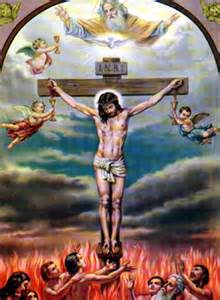
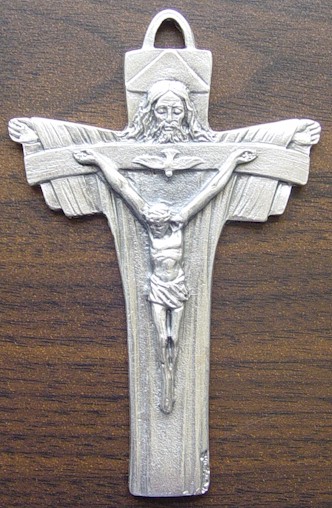 Trinity Crucifix
Glory Be
Glory be
to The Father,
and to the Son,
and to the Holy Ghost,
as it was in the beginning,
is now, and ever shall be,
forever and ever,
Amen.
Many of of our formal prayers end with the Glory Be prayer. I asked my friends which person in the trinity they found it easier to turn to, and who they found it difficult to turn to in prayer. There is no wrong answer!
After reflecting, I realized that during my prayer journey (my pilgrimage) I have come to know each of the persons in the trinity in a more personal way.
During my childhood I was aware that I was a child of God, I am in awe of his majesty and the beauty of his creation and the people I know and love. It was the Creator I turned to in prayer first…
God the Father.
As an adult, recognizing the movement of the Holy Spirit has become easier. The Holy Spirit is the director of the show. When the apostles were confused after the crucifixion, the Holy Spirit came and removed the confusion and fear. The Holy Spirit enlightened the apostles as to what the will of the Father was. Through the guidance of the Holy Spirit on Pentecost, the Christian Church was born. When I am in confusion, I turn to the Holy Spirit to guide me. Sometimes, He actually pushes me in the direction I need to go…
Getting to know Jesus has been the most difficult. I know now that I was avoiding Jesus. I have always connected Jesus to the cross…suffering! When I began to experience the loss of loved ones in my life, however, I found it absolutely necessary to turn to Jesus…The Son of God.
I also turned to Mary and Joseph, the Holy Family.
The Holy Family knows in a very real and human way what our pain is like. I no longer felt alone. They always listen to me, and they understand me. Each of the Holy Family is very human… even Jesus. I share my troubles and my joys with them every day.
Each of us has a unique prayer journey.
We are pilgrims, trying to get to know God.
Daily reflection is an important part of the journey.
What a long way I have come! What a long way I have to go!