Category Archives: Prayer

Prayers, Quips and Quotes; St. Benedict, Feast Day July 11


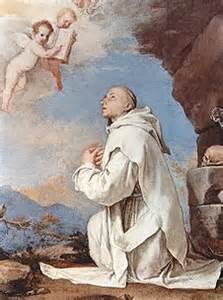
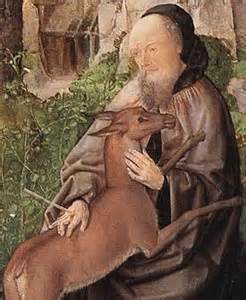
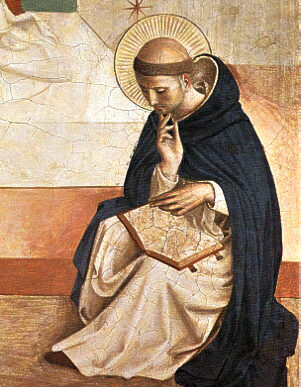
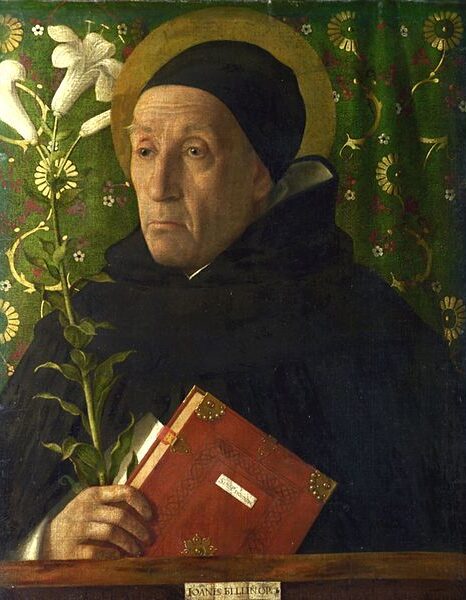
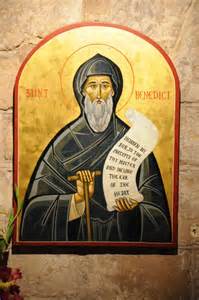
St. Benedict Public Domain Image
St. Benedict
Public Domain Image

The feast day of St. Benedict is celebrated on July 11. In the Eastern Church it is celebrated on March 14th.

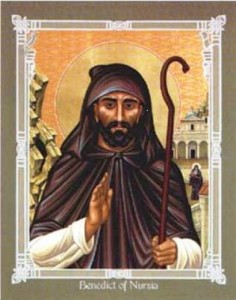
St. Benedict was born in Nursia in 480 to upper class parents. He attended university in Rome. To escape the vice he was surrounded by he fled Rome and spent three years in seclusion. After these three years he founded the monasteries he is famous for.

St. Benedict is considered the founder of western monasticism. His monasteries were based on the principles in his book The Rule of Benedict. This book begins with this prologue: “Listen carefully, my son, to the masters’ instructions and attend to them with the ear of your heart. (R.B. Prologue)”

His rule begins with the word LISTEN! The monasteries have a very strict discipline. They

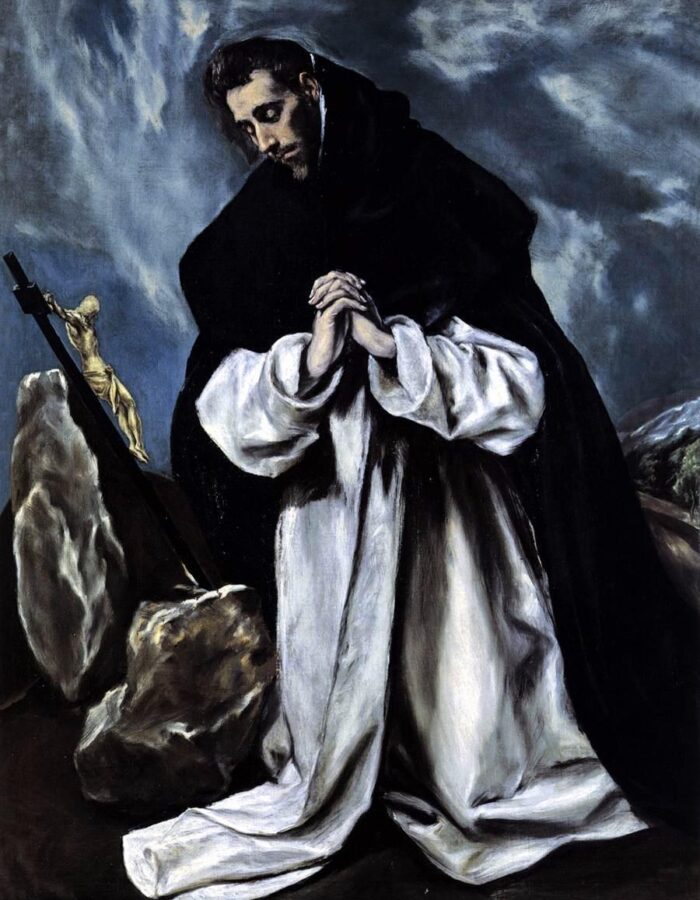
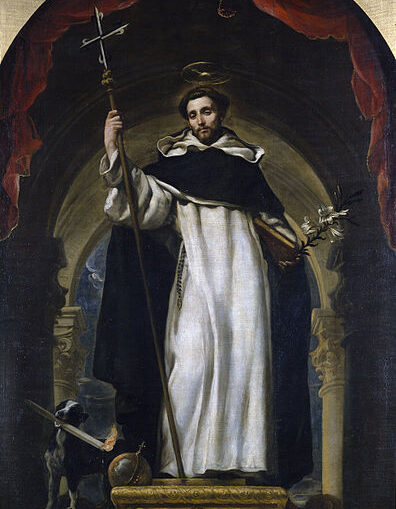
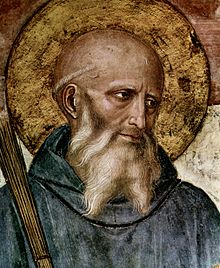
St. Benedict Public Domain Image
St. Benedict
Public Domain Image

focus on daily personal and liturgical prayer. Singing of the Psalms and reading the Divine Office is practiced daily. Listening to the word of God is the primary focus of their spirituality. Lectio Divino is slow reading and meditation on the scripture. Benedictine spirituality also demands obedience, hospitality, and service.

St. Benedict died while standing in prayer before God in the year 547. St. Benedict is the patron saint of students and Europe.


Shatter all your temptations against Christ.

Quote of St. Benedict

July is the Month of the Most Precious Blood.


Save

Save

Save

St. Benedict

Save

Five Famous Hymns Written by St. Thomas Aquinas


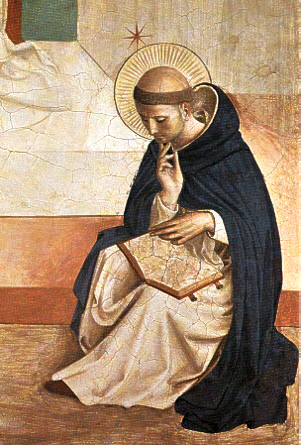
St Thmas Aquinas-cr-01 Public Domain Image

St. Thomas was was born in Sicily in the year 1225. He died in 1274. The Feast Day of St. Thomas Aquinas is celebrated on Jan. 28. He is considered the patron saint of students and universities.

At the age of five he was placed in the care of the Benedictines of Monte Casino.

He became a Dominican priest against his families wishes. His brothers followed careers in the military. In an attempt to end his desires to become a Dominican, his brothers hired a prostitute to seduce him. According to legend, two angels appeared to Thomas to strengthen him and increase his determination to remain celibate. He thus became known as the “Angelic Doctor”.

St. Thomas studied at Cologne under St. Albert the Great. He was called “the dumb-ox” because he was so shy and quiet. He was also of a very large stature. Actually, he was quite brilliant, eventually being declared a Doctor of the Church.

After becoming a priest he was sent to Paris. In Paris he became a friend of the King, St. Louis, dining with him frequently. He was asked to teach at the age of 22. He has published many writings. The most well known are Summa Theologica and Summa Contra Gentiles.  He also wrote Hymns of Adoration which are well known today.  The belief in the Real Presence of Christ in the Eucharist is very evident in his hymns of praise and adoration.

His well known hymns are the following:

1. Panis Angelicus (Bread of Angels)  sung by Andre Bocelli

2. Adore te Devote (Humbly I adore thee)…Gregorian Chant

3. O Salutaris hostia (O saving victim)   Gregorian Chant

4. Pange Lingua Corperis (Now, my tongue, the mystery telling)  Gregorian Chant

5. Tantum Ergo Sacramentum (Come Adore)…sung by Daughters of Mary


St. Thomas Aquinas Public Domain Image
St. Thomas Aquinas

Panis Angelicus (Bread of Angels)

Holy and living bread,

Wondrous food from heaven sent,

God’s sacrifice foretold,

now in our hands we hold.

Sign and reality, challenge for us to be

Humble servants to all the poor.

God, Holy Three in One,

through this off’ring of your Son

All now on earth can see what we are called to be:

Hope for a world in need, signs that love can succeed

Where true justice and peace endure.

O Salutaris Hostia ( O Saving Victim)

O saving Victim, open wide

The gate of heav’n to us below,

Our foes press on from ev’ry side;

Your aid supply your strength bestow.

To your great name be endless praise,

Immortal Godhead, One in Three;

O grant us endless length of days

In our true native land with thee.

Amen

St. Thomas Aquinas Public Domain Image
St. Thomas Aquinas

Zion, to thy Savior; singing

Zion, To Thy Savior Singing
Zion, to Thy Savior singing,

To thy Prince and Shepherd bringing,
Sweetest hymns of love and praise,
Thou wilt never reach the measure
Of His worth, by all the treasure
Of thy most ecstatic lays.

Of all wonders that can thrill thee,
And, with adoration fill thee,
What than this can greater be,
That Himself to thee He giveth?
He that eateth ever liveth,
For the Bread of Life is He.

Fill thy lips to overflowing
With sweet praise, His mercy showing
Who this heav’nly table spread:
On this day so glad and holy,
To each longing spirit lowly
Giveth He the living Bread.

Here the King hath spread His table,
Whereon eyes of faith are able
Christ our Passover to trace:
Shadows of the law are going,
Light and life and truth inflowing,
Night to day is giving place.

Lo, this angels’ food descending
Heavenly love is hither sending,
Hungry lips on earth to feed:
So the paschal lamb was given,
So the manna came from Heaven,
Isaac was His type indeed.

O Good Shepherd, Bread life giving,
Us, Thy grace and life receiving,
Feed and shelter evermore;
Thou on earth our weakness guiding,
We in Heaven with Thee abiding,
With all saints will Thee adore.


Adore te Devote (Humbly I adore thee)

Humbly I adore thee, Verity unseen,
who thy glory hiddest ‘neath these shadows mean;
low, to thee surrendered, my whole heart is bowed,
tranced as it beholds thee, shrined within the cloud.

Taste and touch and vision to discern thee fail;
faith, that comes by hearing, pierces through the veil.
I believe whate’re the Son of God hath told;
what the Truth hath spoken, that for truth I hold.

O memorial wondrous of the Lord’s own death;
living Bread that givest all thy creatures breath,
grant my spirit ever by thy life may live,
to my taste thy sweetness never failing give.

Jesus, whom now hidden, I by faith behold,
what my soul doth long for, that thy word foretold:
face to face thy splendor, I at last shall see,
in the glorious vision, blessed Lord, of thee.

St. Thomas Aquinas Public Domain Image
St. Thomas Aquinas

Tantum Ergo Sacramentum (Come Adore)

Come adore this wondrous presence,

Bow to Christ the source of grace.

Here is kept the ancient promise

of God’s earthly dwelling place.

Sight is blind before God’s glory,

Faith alone may see his face.

Glory be to God the Father,

Praise to his co-equal Son.

Adoration to the Spirit,

Bond of love, in God-head one.

Blest be God by all creation

Joyously while ages run.


Save

Save

Save

Prayers, Quips and Quotes: St. Josemaria Escriva, Feast Day June 26


St. Josemaria Escriva Public Domain Image
St. Josemaria Escriva

The Feast Day of St. Josemaria Escriva is celebrated on June 26.

St. Josemaria Escriva was born in Barbastro, Spain on Jan. 9, 1902. He was the second of six children and attended Catholic schools. At an early age he learned the meaning of suffering when three of his younger sisters died.

After reflecting on footprints in the snow from a discalced Carmelite, he became aware that he had a religious calling. He decided to study for the priesthood and was ordained a priest in 1925. Within three years in 1928, he was inspired to found Opus Dei which was dedicated to all people following Christ. Married people and non Catholics were allowed to join. Their ministry included working among the poor in schools and hospitals. He also founded the Priestly Society of the Holy Cross. Opus Dei spread to many countries throughout the world.

St. Josemaria is also an author of three popular books: The Way, Furrow and The Forge.

On June 26, 1975, St. Josemaria died in his office suddenly at the age of 73. He was canonized by Pope John Paul II in 2002.

It’s not enough to be good, you need to show it.
What would you say of a rose bush which produced only thorns?
Quote of St. Josemaria Escriva
June is the Month of the Sacred Heart.

Save

Save

Ten Types of Prayer To Help You Know God


The Cross and Prayer Pope Francis Facebook
The Cross and Prayer
Pope Francis Facebook

How do we come to know and love God? The first commandment is:

“Love the Lord thy God with your whole heart, mind, and soul.”

How is it possible to love someone we don’t know? When we truly love someone we don’t fear them, we want to spend time with them; we enjoy their company.

Prayer is the way we come to know God. It is not enough to pray just on Sunday. If we love God, we will pray without ceasing…always, … in our thoughts and in our actions.

Knowing the different forms of prayer can help us explore getting to know God better. When Jesus was asked by his disciples how to pray he responded by giving us the well known “Lord’s Prayer”.

The following are different types of prayer:
1. Prayer of petition: When we ask for specific things we are making a petition. Hopefully we also say “Thy will be done.” Our will is not always God’s will. This is why God’s answer is sometimes “No, I have a better solution.”

  1. Prayer of intercession: When we pray for the welfare of someone else, this is the prayer of intercession. When the saints pray for us they are interceding for us.
  2. Prayer of Glory, Praise and Thanksgiving. Saying thank you to God is an important part of our spiritual journey. Remember the story of Jesus healing the ten lepers? Only one returned and thanked Jesus. Let me be grateful for all the gifts God gives me.
  3. Prayer of Adoration: This prayer is acknowledging God as our creator; all good and all powerful.
  4. Prayer of Quiet: This prayer is the prayer of LISTENING to God. We sit quietly in the presence of God, quiet our mind, and ask God to lead us. We find God in the silence. Actually, God finds us.

6. Scripture: Reading Holy Scripture is a form of prayer. We read and meditate on both the Old and the New Testament.

  1. Music: Music is a powerful way to pray. “When we sing we pray twice.” St. Augustine. Music is prayer which comes from the heart. Some people find it easier to connect with God with this type of prayer.
  2. Meditation: Reflection on nature, art, humanity  and scripture are all forms of meditation.  Take the time to reflect on what is happening in your life.  Ask God to lead you in your meditative prayer.
  3. The Catholic Mass:  It incorporates all of these types of prayer.  During the Mass we pray  for others, give glory and thanks, ask for mercy and guidance, listen to scripture, adore Christ in the Eucharist, and pray through silence and singing.

10. Praying can be either spontaneous or memorized. When we are in a crisis it is sometimes hard to know what to say to God. This is when memorized prayer is very powerful. The Catholic Church has many formal prayers for every occasion and need. They guide us when we are at a loss for words.  Spontaneous prayer is also a very meaningful way to pray to God.

When Jesus is our closest friend, we can tell him anything.  Praying on a regular basis in all these different ways helps us to come closer to God. Letting ourselves be led by God in prayer is how we put into action the first commandment.

Loving God means spending time with him. Each of us has a different prayer style. If we are too busy to pray, we are too busy for God. God does not force himself on anyone. If you are having difficulty praying start by meditating on the Our Father, the prayer Jesus himself gave us.  Ponder each word in the prayer.    Your relationship with God will begin to grow.

The Lord's Prayer Public Domain Image
The Lord’s Prayer

Their is a different prayer style for each person.  Each of the saints also prays in a way that is special to that saint  If you are searching for the type of prayer that works for you a wonderful book to read is Six Ways to Pray from Six Great Saints by Gloria Hutchinson.

This book introduces you to six different saints:  St. Francis of Assisi (Franciscan), St. Clare ( Poor Clares), St. Teresa of Lisieux (Carmelite), St. Therese of Avila (Carmelite), St. John of the Cross (Carmelite ) and St. Ignatius of Loyola (Jesuit).   You will learn not only their story but also their prayer style.  Each chapter contains exercises to help you  discover what type of prayer works best for you.  When I read this book, I learned about the “Prayer of Detachment” taught by St. John of the Cross.  The exercises helped me to practice and meditate in a way I had never tried before.  I encourage everyone to read it and discover their own prayer type.

Save

Save

Save

Save

Save

Save


Prayers, Quips and Quotes: St. Ephrem of Syria, Feast Day June 9


St. Ephrem of Syria Public Domain Image
St. Ephrem of Syria

The Feast Day of St. Ephrem of Syria is celebrated on June 9.  He was born in Nisibis, Mesopotamia in the 4th century.  At the age of 18 he was baptized.  Along with other Christians, he became a refugee in Edessa during the persecutions by the Persians.  He was ordained a deacon and served under four bishops.

St. Ephrem is most known for his prolific writing.  He wrote both hymns and poetic homilies.  Over 400 hymns still exist, earning him the title of “Harp of the Holy Spirit”.   The hymns he wrote were used to instruct the people against the heresies of the time.  He often used popular melodies, putting his own words to the music.    Because of his music he is credited with a spiritual awakening during that time period.  St. Ephrem was also a poet, writing many of his homilies as poetry.  His description of heaven and hell is said to have inspired Dante.  St. Ephrem had a special devotion to the humanity of Jesus.

St. Ephrem lived a very simple life, living in a cave with a view of Edessa.  During the great famine which occurred, he influenced those with money to help him establish a poor house for the sick and poor.  St. Ephrem died in June in 373.

O Giver of light!  Fulfill my supplications and grant me Your gifts according to my prayer; impart to my heart just one drop of Your grace, that the flame of Your love may begin to burn in my heart; and like a fire, may it consume evil thoughts like thorns and thistles!
Quote of St. Ephrem of Syria
June is the Month of the Sacred Heart

Save

Save

Catholics Nourished by Living Bread


Monstrance Body and Blood of Jesus Christ
Monstrance
Body and Blood of Jesus Christ

At the center of the Catholic faith is its’ belief in the Eucharist. Jesus Himself said:

“I am the bread of life, whoever comes to me will never be hungry, and whoever believes in me will never be thirsty.” (John 6, 35).

In John 6.53 He states,

“Very truly, I tell you, unless you eat the flesh of the Son of Man and drink his blood, you have no life in you. Those who eat my flesh and drink my blood have eternal life, and I will raise them up on the last day, for my flesh is true food and my blood is true drink.”

The church has always interpreted this statement to be literally true. How is this possible? All things are possible with God!!

In the Old Testament, God rained down manna from the sky to feed the Israelites in the desert for forty years. The Eucharist is modern day manna. Our faith is nourished and kept alive by living bread… the body and blood of Jesus Christ. St. Paul teaches us that the church is the Body of Christ. In I Corinthians 12-13 St. Paul states:

“For in the one Spirit we were all baptized into one body-Jews or Greeks, slaves or free-and we were all made to drink of one Spirit.”

The Saints in the early church all professed a belief in the Real Presence of Christ in the Eucharist.   Justyn Martyr (100-165) was one of the first to try to explain this belief.

Next Sunday, we celebrate Corpus Christi (The Body of Christ). It is important for us to reflect on how Jesus came to nourish us, not only by scripture but by being true food for us.

Through God all things are possible. When we read the bread of life discourse (John 6), we need to ask ourselves, do we truly believe what Jesus tells us, or like the disciples who turn away do we pick and choose the teachings of Jesus we want to believe.

To quote St. Augustine ((354-430),

“If you believe what you like in the gospel, and reject what you don’t like, it’s not the gospel you believe, but yourself.”

To be true disciples of Jesus, we must get to know Him, to love Him and let ourselves be fed by Him.


Prayers, Quips and Quotes: St. Paschal Baylon, Feast Day May 17


st. paschal baylon
St. Paschal Baylon

The Feast Day of St. Paschal Baylon is celebrated on May 17.

St. Paschal Baylon was born into a peasant family in Aragon, Spain. He worked as a shepherd while he was young. He taught himself to read while tending the sheep. He was known from an early age to have the gift of miracles. After having a mystical vision to enter a Franciscan Community nearby he joined the Reformed Franciscan Order as a lay Franciscan brother in 1564. He worked as a doorkeeper.

St. Paschal Baylon had a great devotion to the Blessed Sacrament. He spent many hours before the Blessed Sacrament in prayer. He is known to have defended the belief in the Real Presence to the Calvinists he knew. He lived a life of poverty and prayer.

St. Paschal died on May 17. Miracles were reported immediately after his burial. St. Paschal was canonized in 1690.

O Father Eternal God, Grant me faith and courage;
Son, wisdom of the Father, grant me light and make me wise;
Holy Spirit, beloved of Father and Son, inflame my heart and purify my soul,
that I may approach this majestic Sacrament with faith and love.
Quote of St. Paschal Baylon; Feast day May 17
May is the Month of Our Lady.

Prayers, Quips and Quotes: St. Leopold, Feast Day May 12

St. Leopold


The Feast Day of St. Leopold is celebrated on May 12.

St. Leopold was born in Croatia, Italy. He joined the Capuchin Franciscans and was ordained even though he had disabilities and health problems. He had a speech impediment which made it difficult to preach. He also suffered from severe arthritis, poor eyesight and a stomach ailment. His vocation became that of a confessor. He was known to spend as many as 15 hours a day hearing confessions. Several bishops were known to seek his spiritual direction. He was often criticized for his compassion and leniency. He was very understanding and caring towards expectant mothers and children. This led to his work starting orphanages.

St. Leopold wanted to become a missionary and work for the reunion between Roman Catholics and Orthodoxy. Because of his health he was unable to travel but unity was constantly in his prayers. He became known as the Apostle of Confession and Unity.

Most of his life St. Leopold lived in Padua, Italy. However, because he did not want to renounce his Croatian nationality he spent one year in prison during World War I.

St. Leopold had a great devotion to the Blessed Virgin Mary. He often prayed the Rosary. He also received the Eucharist daily and visited the sick in nursing homes.

St. Leopold died from esophagus cancer on July 30, 1942. While he was dying the friars gathered around him and sang the Salve Regina (Hail Holy Queen). St. Leopold was canonized in 1982 by Pope John Paul II..

You have become an ornament to heaven,
O Mother of God, and a light for all the earth!
Quote of St. Germanus of Constantinople; Feast day May 12
May is the Month of Our Lady

Prayers, Quips and Quotes: St. John Climacus, Feast Day March 30


St. John Climacus

The Feast Day of St. John Climacus is celebrated on March 30. 

St. John Climacus was born in Syria in 525. He enjoyed studying science and the arts. In 547, at the age of 16 he dedicated himself to God. He went to Mt. Sinai to live as a hermit. His spiritual advisor was Martyrius. St. John lived in silence and solitude living with humility and obedience. He never argued with anyone. After four years of living as a hermit John made his profession at the age of twenty.

St. John had received from God the power to heal spiritual disorders. One person he healed was named Isaac who was on the verge of despair by temptations of the flesh. St. John could see that Isaac had faith and said to him, “My son, let us have recourse to God by prayer.” They both lay prostrated on the ground in fervent prayer and Isaac felt the despair leave and was filled with peace. Many others came to John for assistance. Due to jealousy, St. John was censored and accused of vanity. John imposed on himself a year of silence. Those who charged him asked him to resume giving advice and told him not to bury the talent given to him by God.

St. John Climacus 2

                                                                         St. John became Abbot of Mt. Sinai and Superior General to all the monks and hermits in that country when he was 75. During a severe drought the people asked him to intercede on their behalf to God. His prayers were soon answered with large rain storms.

After four years as Abbot he resigned to prepare for death. St. John died on March 30, 605. After his death, his book Ladder of Divine Ascent became very popular making him very well known.

Humility is the only virtue no devil can imitate.  If pride made demons out of angels, there is no doubt that humility can make angels out of demons.
Quote of St. John Climacus
March is the Month of St. Joseph

Save

Save

Prayers, Quips and Quotes: St. John of Egypt, Feast Day March 27


St. John of Egypt

The Feast Day of St. John of Egypt is celebrated on March 27.  

St. John of Egypt was born in Lycopolis, which is now Egypt, in 214. He worked with his father as a carpenter. He felt a call from God to live a solitary life of prayer in the desert. For ten years he was the disciple of an elderly hermit, whom he considered his spiritual father. When this man died he chose to live in various monasteries to learn the life of a monk.

Eventually, John decided to live in a cave he found in the desert rocks. The cave had three rooms; a living room, workroom and a chapel. He had a single window through which he would preach to people who sought his advice. He would spend five days of the week in solitude with God, but on Saturday and Sunday he would listen to and give advice to people who sought it. Emperor Theodosius the Elder is believed to have sought his advice twice. People brought him food and necessities. He attracted followers who became his disciples. They built a hospice nearby so people could seek his advice.

St. John was known for his gifts of prophecy and healing. He seemed to be able to look into people’s souls and know what they were thinking. Many people were cured after he anointed them with holy oil. In spite of his growing fame, St. John remained humble and lived a very frugal life. St. John died at the age of 90 from natural causes. He was found on his knees as if in prayer.


The trouble is that everyone talks about reforming others and no one things about reforming himself.
Quote of St. Peter of Alcantara; Feast day October 19


March is the Month of St. Joseph

Save


Prayers, Quips and Quotes: St. Turibius of Magrovejo, Feast Day March 23


St. Turibius
St. Turibius


The Feast Day of St. Turibius of Magrovejo is celebrated on March 23.   St. Turibius was born in Mayorga, Spain in 1538 to a noble family. He was very prayerful as a child. He had a devotion to the rosary and The Little Office of the Blessed Virgin Mary. He studied law at the University of Salamanca. He practiced law as a judge for five years. King Phillip II was impressed by his holiness and wanted him to become a missionary. Turibius protested but eventually he was ordained a priest and then a Bishop in 1581. He was sent to Lima, Peru in South America.


In Peru, St. Turibius established schools, seminaries and hospitals. He learned the native languages to enable him to teach and minister to the people. He made three visitations of the entire diocese staying several days in each community. He denounced the exploitation of the Indians by Spanish nobles and brought about administrative reforms. He was assisted by St. Francis Solarius and St. Rose of Lima.
 

In 1606 he became seriously ill. Sensing his death he gave all his possessions to the poor before he died. St. Turibius was canonized in 1726.


Christ said “I am the Truth”, He did not say “I am the custom”‘.
Quote of St. Turibius of Magrovejo
March is the Month of St. Joseph

Save

Save

Which person in the Trinity do you find it easiest to pray to?


 Many of our formal prayers end with the Glory Be prayer. I asked my friends which person in the Trinity they found it easier to turn to, and who they found it difficult to turn to in prayer. There is no wrong answer! After reflecting, I realized that during my prayer journey (my pilgrimage) I have come to know each of the persons in the Trinity in a more personal way.

Save