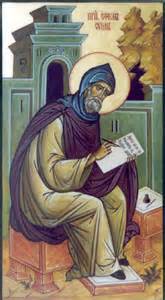
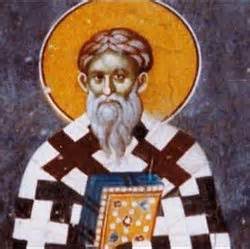
The Feast Day of St. Ephrem of Syria is celebrated on June 9. He was born in Nisibis, Mesopotamia in the 4th century. At the age of 18 he was baptized. Along with other Christians, he became a refugee in Edessa during the persecutions by the Persians. He was ordained a deacon and served under four bishops.
St. Ephrem is most known for his prolific writing. He wrote both hymns and poetic homilies. Over 400 hymns still exist, earning him the title of “Harp of the Holy Spirit”. The hymns he wrote were used to instruct the people against the heresies of the time. He often used popular melodies, putting his own words to the music. Because of his music he is credited with a spiritual awakening during that time period. St. Ephrem was also a poet, writing many of his homilies as poetry. His description of heaven and hell is said to have inspired Dante. St. Ephrem had a special devotion to the humanity of Jesus.
St. Ephrem lived a very simple life, living in a cave with a view of Edessa. During the great famine which occurred, he influenced those with money to help him establish a poor house for the sick and poor. St. Ephrem died in June in 373.
O Giver of light! Fulfill my supplications and grant me Your gifts according to my prayer; impart to my heart just one drop of Your grace, that the flame of Your love may begin to burn in my heart; and like a fire, may it consume evil thoughts like thorns and thistles!
St. William was born into a powerful family in England during the 12th century. He was the son of Count Herbert.
In 1142 he was elected Archbishop of York, however his election was disputed on charges of simony and unchastity. After proving his innocence he was finally consecrated Bishop in 1143. Because of his charity and gentleness he was very popular.
When Eugenius II was elected Pope complaints again surfaced and he was suspended. St. William went to Sicily where he lived as a monk devoting himself to a life of prayer. After the death of Pope Eugene III Pope Anastastius IV restored William as Archbishop of York. However just one month after he resumed office he died. Many believed he was poisoned. Many miracles took place at his tomb. Pope Honorius III canonized William of York in 1227.
I have not even begun to think of unity when the Trinity bathes me in its splendor.
I have not even begun to think of the Trinity when unity grasps me.
Quote of St. Gregory of Nazianzus; Feast Day Jan. 2
The feast day of St. Paul of Constantinople is celebrated on June 7. St. Paul was elected the Bishop of Constantinople to succeed Alexander of Constantinople. The Arian controversy was causing a great deal of turmoil at this time. Arianism denied the divinity of Christ and the Trinity.
Emperor Constantus II was an Arian and did not approve of the election of St. Paul. Because St. Paul defended the belief that Christ is divine as well as human, he was exiled several times by the emperor. The first time he was exiled but allowed to return in the year 338. The second time he returned in the year 340. The third time he was exiled to Mesopotamia, returning in the year 344. His last time of exile was in the year 350 when he was exiled to Armenia. Here, he died a martyr’s death. He was starved and then strangled.
The man who has the mission of saying great things
(and all of us Christians have this sweet obligation)
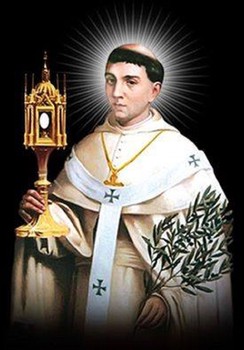
The Feast Day of St. Norbet is celebrated on June 6.
St. Norbet was born at Xanten in the Rhineland around 1080. He was born into a noble family and enjoyed luxury. While a young man he pursued worldly pleasures. He accepted orders as a sub deaconate to ensure his success at court, but he hesitated at becoming a priest.
This all ended after a near fatal accident during a thunderstorm. While riding in the rain, the thunder and lightning spooked his horse and he was thrown to the ground. He lay unconscious for about an hour. When he awoke he asked the Lord, “Lord, What do you want me to do?” These were the same words of Saul before his conversion. God’s response to Norbet was:
“turn from evil and do good. Seek peace and pursue it.”
St. Norbet embraced a life of prayer and penance. He now wanted to become a priest. he was ordained in 1115 at the age of 35. He gave everything he owned to the poor. After receiving permission from the pope he traveled throughout Europe preaching the gospel. He was known for his intense devotion to the Real Presence in the Blessed Sacrament. The bishop of Laon requested his aid in reforming the canons, which he willingly did.
At the request of Pope Calictus II Norbet founded a religious order in France, called Canons Regular of Premontre. They followed the Rule of St. Augustine. He continued to preach in France, Belgium and Germany.
St. Norbet eventually became the archbishop of Magdebury however he died on June 6, 1134 soon after his election.
Oh, how good and pleasant a thing it is to dwell in the Heart of Jesus!
Who is there that does not love a heart so wounded?
Who can refuse a return of love to a heart so loving?
The Feast Day of St. Boniface is celebrated on June 5.
St. Boniface was born in Wessex, England in 675. After studying in English monasteries he became a missionary traveling to Europe where he converted pagans in what today is Germany and the Netherlands.
St. Boniface became the bishop of Mainz in 722. He is remembered for cutting down an oak tree which was associated with the god Thor. Those who witnessed the event expected him to be punished by Thor. When nothing immediately happened many people converted.
The pope wanted St. Boniface to reform the German Church. St. Boniface organized the German Church solving many of the existing problems which included the education and proper ordination of the clergy.
On his final mission, at the age of 80, he and 53 companions were martyred while he was instructing converts for the sacrament of confirmation. The date of his martyrdom was June 5, 754. He is referred to as the Apostle to the Germans.
In her voyage across the ocean of this world,
the Church is like a great ship being pounded by the waves
of life’s different stresses. Our duty is not to abandon ship
but to keep her on her course. Let us stand fast in what is right
and prepare our souls for trial. Let us wait upon God’s strengthening
aid and say to him “O Lord, You have been our refuge in all generations.”
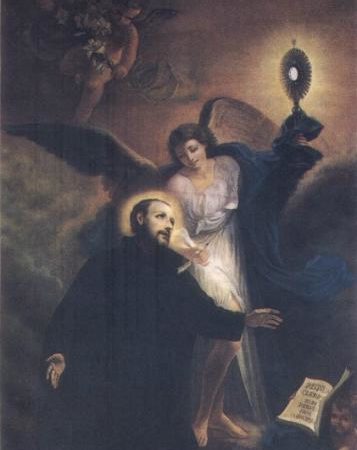
The Feast Day of St. Francis Caracciolo is celebrated on June 4.
St. Francis Caracciolo was born at Villa Santa Maria, Italy in 673. He was born into a noble family. While still young he came down with a skin disease that resembled leprosy. Already a very pious child, he vowed to devote his life to God if he was cured. After making the vow the skin disease was cured. At the age of 22, he began studying for the priesthood at Naples. He had a great devotion to the Blessed Sacrament spending many hours in prayer before Our Lord. He also visited those in prisons and hospitals.
St. Francis was ordained in 1587. He soon joined a confraternity known as “The White Robes of Justice”. They visited the criminals sentenced to die. Together with two other devout men he started a religious order called the Minor Clerks Regular. They were very strict. They fasted and did penitential acts. Two years later Francis became the Superior of the Order.
St. Francis spent many hours in the confession. He was known for his gift of discerning hearts and prophecy, foretelling the date of his own death. St. Francis died surrounded by his community on the Vigil of Corpus Christi, June 4, 1608 after coming down with a fever.
The Sacred Heart of Jesus is not only the temple and the altar,
but also the censer of divine love….In that precious censer
all the worship, praise, prayers, desires, and affections
of all the saints are placed, like so many grains of incense
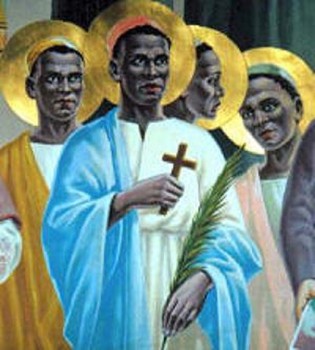
The Feast Day of St. Charles Lwanga is celebrated on June 3.
The Society of Missionaries attracted many converts in Uganda. The converts soon became teachers of the faith also. Uganda was ruled by King Mwanga who was violent and a pedophile. The Christians who lived and taught at King Mwanga’s court tried to protect the pages from the King. The leader of the 200 Christians was Joseph Mkassa. He confronted the King after a Protestant missionary and his companions were killed. Mwanga ordered his execution. Before he was beheaded and burned on Nov. 15, 1885 Joseph forgave Mwanga, but asked for repentance.
St. Charles, who was 18 when he converted, became the new leader of the Christian group. For six months the persecution lessened. Then, however, King Mwanga became angry and killed another student of Christianity with a spear. He ordered the royal compound sealed so no one could escape. Charles baptized four catecheumens (students) that night. The next day the king ordered the 15 boys and men to be executed because they refused to give up being Christians. They were ordered to walk 37 miles to be executed in Namugongo. Three died on the journey. After seven days in prison, they were burned to death. Thirteen Catholics and eleven Protestant’s died.
The Catholic faith was practiced in secret without clergy. After the death of King Mwanga, there were 500 Christians and 1000 catecheumans waiting to receive the sacraments again.
The 22 Catholic Martyrs of Uganda were canonized.
Do not be ashamed to confess the cross, for angels glory in it.
The Feast Day of St. Erasmus (also known as St. Elmo), is celebrated on June 2. He is the patron saint of sailors and against intestinal troubles.
St. Erasmus lived in Italy. He is also known as St. Elmo. He served as the Bishop of Formiae, Campagna, Italy and was martyred during the persecutions of Christians by Diocletan.
Trying to flee the persecutions St. Elmo fled to Mt. Lebanon and lived in solitude for a time. When he was found, he was tortured and imprisoned. Because he refused to deny his faith he was scourged and cast into boiling oil, sulfur and pitch. He was miraculously saved from harm. According to legend and angel led him to freedom.
After escaping prison he converted many with his preaching and miracles. A second time he was captured, imprisoned and tortured. Again, an angel led him to freedom. During his torture he had hot iron hooks struck into his intestines. He survived these wounds which is why he is invoked for intestinal problems.
St. Elmo is also the patron saint of sailors. A blue light appears at mastheads before and after a storm; the seamen took it as a sign of St. Erasmus’s protection. This became known as St. Elmo’s Fire.
St. Elmo died was martyred in 303. He was tortured and disemboweled.
St. Elmo is considered one of the 14 Helpers. These fourteen saints are considered very effective in their ability to intercede in times of trouble, especially matters of health.
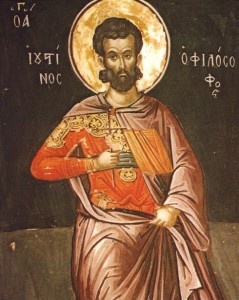
The Feast Day of St. Justin Martyr is celebrated on June 1. He is a martyr and the patron saint of philosophers.
St. Justin Martyr was born at Flavia Neapolis, Palestine about the year 100. He was raised pagan in a Jewish culture. Justin was a student of philosophy. He was very interested in the teachings of Plato. As a student he studied a multitude of different philosophies before converting to Christianity. After his conversion, Justin began to proclaim his new found faith as he traveled from town to town trying to convert others to the faith. He also spent a great deal of time in Rome. After debating Crescens in Rome, Justin was denounced and condemned to death. Records of his death still exist. He was beheaded in 165.
St. Justin was known as an Apologist. An apologist is one who defends in writing the Christian faith. Two of his Apologies still exist. They are addressed to the Roman emperor and to the Senate. St. Justin is considered the first Christian Philosopher and the patron saint of philosophers.
The greatest grace God can give someone is to send him a trial
he cannot bear with his own powers…and then sustain him
with His grace so he may endure to the end and be saved.
The Feast of the Visitation of the Blessed Virgin is celebrated on May 31.
We celebrate Mary visiting her cousin Elizabeth while she was pregnant with Jesus. Elizabeth was six months pregnant with St. John the Baptist. When they met, the baby lept for joy in Elizabeth’s womb.
Not only the baby, but Mary and Elizabeth were filled with joy. Elizabeth tells Mary:
“Blessed art thou among women, and blessed is the fruit of thy womb.”
Mary responds with the Magnificat which has become a beautiful hymn of praise and thanksgiving.
Magnificat
My soul does magnify the Lord: And my spirit has rejoiced in God my Savior Because He has regarded the lowliness of His handmaid: for, behold, from henceforth all generations shall call me blessed. For He that is mighty has done great things to me: and holy is His Name. And His mercy is from generation until generations, to them that fear Him. He has showed might with His arm: He hath scattered the proud in the conceit of their heart. He has put down the mighty from their seat, and hath exalted the lowly. He has filled the hungry with good things: and the rich he hath sent empty away. He has received Israel His servant, being mindful of His mercy: As He spoke to our fathers, to Abraham and to his seed for ever.
The Visitation
As we celebrate the Feast of the Visitation let us reflect on how important our families are to us. Imagine the joy Elizabeth and Mary shared together as they anticipated the birth of their babies! It is important that we too, give thanks to God for the many blessings he has bestowed on us and our families.
God hugs you.
Quote of St. Hildegarde of Bingen; Feast day Sept. 17
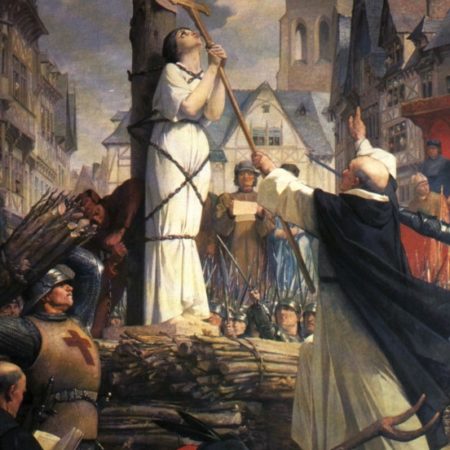
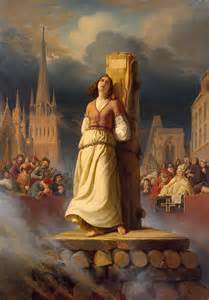
St. Joan of Arc Burning at Stake Public Domain Image
St. Joan of Arc was born in Domremy, Francs in 1412 on the Feast of the Epiphany on Jan. 6. Her parents, Jacques and Isabelle were peasants. She was the youngest of four children, having three older brothers. She helped her mother with spinning and helped shepherd the animals. She was very devout as a child enjoying her religious faith and spending her free time in church.
St. Joan grew up during the “Hundred Years War”, which never seemed to end. The French were losing the war while she was young. England was invading the country of France causing much suffering. Joan prayed with great devotion and fervor for the suffering people.
At the age of thirteen, Joan began to have visions and hear voices which counseled her. She claimed to hear the Voice of God, Michael the Archangel,St. Catherine of Alexandria and St. Margaret of Antioch. In 1428, the voices told her to go tho the King of France and help him reconquer his kingdom. She was told to accompany Prince Charles to his coronation. St. Joan went to the town of Vaucouleurs seeking help from the military commander. After three trips he decided to listen to her.
She was given an escort of six which included two knights. They left on Feb. 23, 1429. The journey was 400 miles, taking eleven days in the winter to travel. She was given permission to meet with Prince Charles VII. However, he concealed himself in the crowd to test Joan. Joan, however, recognized him. St. Joan spoke to him, saying:
“I am Joan the Maid and to you is sent word by me from the King of Heaven that you will be anointed and crowned in Reims and you will be Lieutenant to the King of Heaven who is King of France.”
After being questioned by clerics who asked for a sign Joan was eventually given a sword, armor and a banner with the names of Jesus and Maria to lead the French Army to Tours in 1429. She was only 17 years old.
St. Joan led French troops against the English and recaptured the cities of Orleans and Troyes. Prince Charles was then anointed King with St. Joan at his side holding the banner in 1429.
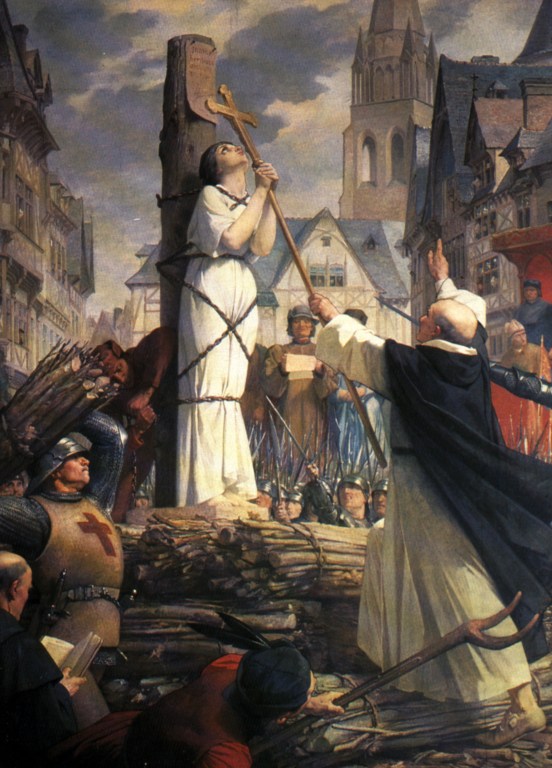
St. Joan of Arc Burning at Stake Public Domain Image
St. Joan was later captured and then sold to the English. Joan spent six months in prison before she was put on trial for heresy and witchcraft. After being found guilty she was burned at the stake in 1431. Her ashes were scattered in the Seine River. A second trial was held 25 years later which overturned the first verdict because it was politically motivated. Joan was declared a martyr.
St. Joan was beatified by Pope Pius X and canonize by Pope Benedict XV in 1920 who said that she is a “most brilliantly shining light of God.”
I know this now,
Every man gives his life for what he believes.
Every woman gives her life for what she believes.
Sometimes people believe in little or nothing.
One life is all we have and we live it as we believe in living it and then it’s gone.
But to surrender what you are and to live without belief
is more terrible than dying…even more terrible than dying young.
The Feast Day of St. Bona of Pisa is celebrated on May 29. She is the patron saint of flight attendants, travelers, pilgrims and travel guides.
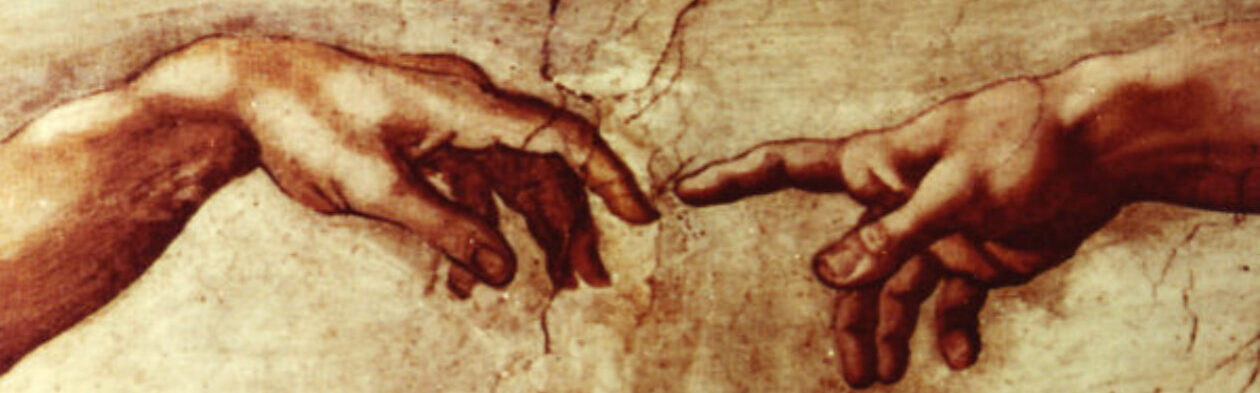
St. Bona of Pisa was born in 1156 in Pisa, Italy. She was the child of a single mother. She was told that her father had vanished during a pilgrimage to the Holy Land. As a child she was very pious. In a vision while praying before the crucifix, Jesus reached out his hand and touched her. By the age of ten she had become an Augustiniantertiary. (A tertiary is a lay member of a monastic order).
In another vision she learned that her father was still alive and fighting in the Crusades in Jerusalem. St. Bona decided to make a trip to Jerusalem to find her father. After finding him she returned home, only to be captured by pirates on the Mediterranean Sea! Countrymen came to her rescue and she eventually arrived home safely.
St. Bona was appointed the official pilgrimage guide by the Knights of St. James. She made nine trips to Spain and Santiago de Compostella, always leading a group of pilgrims. On her final trip she became very ill. She died at the age of 51 after returning home from the pilgrimage.
Pope John XXIII named her the patron saint of flight attendants, travel guides, couriers and travelers.
The greatest method of prayer is to have none.
If in going to prayer one can form in oneself a pure capacity
for receiving the spirit of God, that will suffice all method.