St. Berard was born at Carbro, Umbria, Italy. He became a Franciscan monk at the time of St. Francis in 1213. He spoke Arabic.
St. Francissent him and other Franciscans to preach to Muslims in Morocco, (Peter Otho, Accursius, and Adjutus). When they arrived they began preaching in the marketplace. They were immediately arrested and told to stop. They refused which resulted in them being beaten.
After refusing to renounce Christ, the sultan beheaded them on January 16, 1220. They are believed to be the first Franciscan martyrs. After viewing their relics, Anthony of Paduadecided to join the Franciscans.
St. Berard was canonized in 1481 by Pope Sixtus IV.
Watch, dear Lord, with those who wake
or watch or weep tonight, and give your angels
charge over those who sleep. Tend your sick ones,
O Lord Jesus Christ, rest your weary ones,
bless your dying ones, soothe your suffering ones,
The Feast Day of St. Macarius of Egypt is celebrated on January 15. He was and Egyptian priest and monk.
St. Macarius was born in Upper Egypt in the year 300. He went into the desert of Skete. He was falsely accused of assaulting a woman, but proven innocent. He was ordained a priest at the age of 40. St. Macarius was a student of St. Anthony the Abbot.
Because of his opposition to Arianism, which is the belief that Christ is not divine, he was sent into exile. He was known for his gift of healing and his sanctity. He believed in mercy and forgiveness.
St. Macarius died at the age of 90 in the year 391.
The Feast Day of St. Marguerite Bourgeoye is celebrated on January 12. She was a Canadian missionary.
St. Marguerite Bourgeoye was born in Troyes, France in 1620. She died in 1700. After her mother’s death at the age of 19, she consecrated herself to the service of God. Eventually she became a missionary in Canada. She established a school for Indian girls in Montreal and became known as “Mother of the Colony”. She spent her time teaching the poor, the natives and young girls.
St. Marguerite co-founded the Congregation of Notre-Dame.   St. Marguerite Bourgeoye was canonized on October 31, 1982.
It seems to me that we do not pay enough attention to prayer, for unless it arises from the heart which ought to be its center, it is no more than a fruitless dream. Prayer ought to carry over into our thoughts, our words and our actions.
The Feast Day of Bl. William Carter is celebrated on January 11. He was born in London, England in 1548. He was a book publisher and a martyr. Bl. William Carter was a married bookseller living in London. He owned his own printing press. The press was so small he could only produce one page at a time. He used the press to publish Catholic literature. He was always in danger from the Elizabethan authorities.
When the authorities searched his house they found vestments and chalices put in his care. They also found prayer books which contained Catholic prayers, meditations and spiritual exercises. He was charged with printing and publishing the Treatise of Schisme which allegedly incited violence by Catholics and was said to have been written by a traitor.
After the trial, the jury met for 15 minutes before finding him guilty. While the jury was deliberating, William had his final confession heard by a priest who was also on trial. The next day, which was January 11, 1584, he was executed by being hanged, drawn and quartered. Bl. William Carter was beatified in 1987.
“You have made us for yourself, O Lord, and our heart is restless until it rests in you.”
The Feast Day of St. Peter Orseolo is celebrated on January 10.
St. Peter Orseolo married at the age of 18. He had one son. At the age of 20 he became the Commander of the Venetian Fleet and led them against Dalmatian pirates. After the revolution, he became a Doge (chief magistrate) in 976. He worked on restoring the city and began to rebuild the Church of San Marco. He also tried to help the widows and orphans and built hospitals. After two years of service as a Doge he joined the Benedictine Monastery in Southern France living the life of a hermit in the forest surrounding the monastery.
In 976, he decided to live a life of complete solitude, having contact only with God.
St. Peter Orseolo died in 987. His tomb became a site popular with pilgrims.
“Before all, and above all, attention shall be paid to the care of the sick, so that they shall be served as if they were Christ Himself.”
The Feast Day of Bl. Eurosia is celebrated on January 9.
Bl. Eurosia was born in Quinto Vicentino, Italy in 1866. Her parents were farmers. She was called Rosina by her family. At age four they moved to Marola where she attended school for only two years before stopping to help with the farm work and domestic chores. She joined the Association of the Daughters of Mary and taught catechism. She had a devotion to the infant Jesus, the Eucharist, the Virgin Mary and the souls in purgatory.
After the death of a neighbor, Rosina began caring for the two children left with no mother. Eventually, she married the father, Carlo Barban. They had nine children, Bl. Eurosia became known as “Mama Rosa”. She became a member of the Franciscan Third Order. She was known for feeding the hungry and nursing the sick.
In Jan, 1932, Bl. Eurosia died surrounded by family.
“I want to spend my heaven in doing good upon earth.”
The Feast Day of St. Apollenaris is celebrated on January 8.Â
St. Apollenaris was a bishop during the second century. What we know about him we learned from St. Jerome, Theodoret and Eusebius. Each spoke highly about him.
Apollenaris wrote an ‘Apology’, which is a defense of the Christian faith. He wrote it to Emperor Marcus Ayrelius trying to protect his flock from persecution. The emperor’s army, which was in dire need of water, fell on their knees and invoked the aid of God. Rain began to fall and with the help of the storm his army defeated the Germans. The emperor gave his legion the name “Thundering Legion” and ended his persecution.
St. Apollenaris died about the year 175.
“The Lord was Baptized not to be cleansed Himself,
but to cleanse the water so that those waters
cleansed by the flesh of Christ which knew no sin,
The Feast Day of St. Raymond is celebrated on January 7. He is the patron saint of canon lawyers.
St. Raymond was born in Spain in 1174. He was related to the King of Aragon. After becoming a well-known teacher, he decided to join the Order of Preachers, also known as the Dominicans.
Thousands of Muslims are believed to have been converted to Christianity by his influence. St. Raymond had a great devotion to the Blessed Virgin. He founded the Order of Our Lady of Ransom. The order devoted itself to helping Christians who had been captured by the Moors during the crusades.
St. Raymond compiled Church decisions and decrees for the Pope. His collection filled five books. He is the patron saint of canon lawyers. For two years Raymond was the leader of the Dominicans. After he resigned the position, he devoted himself to what he loved most; praising God and preaching about him to the people.
St. Raymond died in the year 1275 at the age of 100.
The Feast Day of St. Peter of Canterbury is celebrated on January 6. He was a Roman monk and missionary.
St. Peter of Canterbury accompanied St. Augustine of Canterburyon a missionary journey to England in 597. Peter was chosen to deliver a letter detailing the success of the mission to Pope Gregory the Great.
St. Peter of Canterbury was the first Abbot of what became known as St. Augustine’s Abbey.
The death of St. Peter of Canterbury in 607 was due to drowning off the shore of France. The local people, not knowing who he was, buried him without honor. An unexplained light appeared over his grave on a nightly basis. When the people investigated and learned who he was, his body was moved to a church in Boulogne.
The Feast Day of St. John N. Neumann is celebrated on January 5. He was a Redemptorist priest and bishop. He is the patron of sick children and of immigrants and Catholic education.
St. John Neumann was born in Bohemia in 1811. Due to the shortage of priests in the colonies, he traveled to New York to be ordained a priest and worked in an isolated parish. Father John eventually joined the Redemptorists who were dedicated to helping the poor and abandoned. In 1852, he was appointed Bishop of Philadelphia. He increased the number of Catholic schools from two to a hundred.
The desire to hear confessions led St. John Neumann to learn at least six languages. He knew Spanish, English, French, Italian, Dutch and Gaelic.
While doing errands on January 5, 1860, Neumann collapsed and died on a Philadelphia street. He was 48 years old. After his death the National Shrine of St. John Neumann was constructed at the Parish of St. Peter the Apostle in Philadelphia. Our Lady of the Angels College, founded by the Congregation of Franciscan Sisters which he had founded was renamed. It became known as the Neumann College. It was later given University status.
St. John Neumann was beatified on Oct. 13, 1963 by Pope Paul VI. He was canonized on June 19, 1977 by Pope Paul VI.
“A man must always be ready for death, for death comes when and where God wills it.”
The Feast Day of St. Basil the Great is celebrated on January 2. He is the patron saint of hospital administrators and a Doctor of the Church. He was the Bishop of Caesarea
St. Basil was born in 330 at Caesarea of Cappadocia. He was born into a family of ten children. He studied at Constantinople and Athens where he met St. Gregory Nazianzen.
Before deciding to become a monk, he practiced law and opened a school. He directed the monastery in Pontus for five years. He eventually was ordained a priest. St. Basil became bishop in 370. He fought against Arianism ( the belief that Jesus was not divine in nature) at the Council of Constantinople. He also fought for reform of the clergy. He was known for his holiness and was tireless in caring for his people. He was known for preaching twice a day to huge crowds. The hospital that he built was a hospital that was called a wonder of the world.
Basil was best known for his preaching. Because of his writings he is considered a one of the great teachers of the Church.
Sickly since youth, the work of teaching, his life of abstinence, and the responsibilities and sorrows of pastoral service took their toll on him. Saint Basil died on January 1, 379 at age 49.
St. Basil is considered a Doctor of the Church. He is the patron saint of hospital administrators.
“Troubles are usually the brooms and shovels that
smooths the road to a good man’s fortune;Â
and many a man curses the rain that falls upon his head,
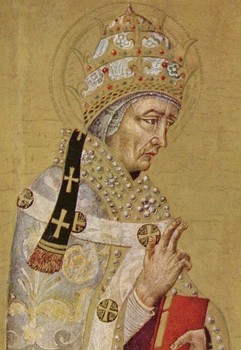
The Feast Day of St. Sylvester I is celebrated on December 31.
St. Sylvester I was the 33 pope, succeeding Pope Militades on Jan 31, 314. Although he became pope during peaceful times, his reign occurred during the persecutions of Diocletian. These persecutions came to an end when Emperor Constantine converted to Christianity.
A popular legend states that Constantine was cured of leprosy by Pope Sylvester, after which he converted to the faith. Constantine built several churches during his reign with the help of Pope Sylvester. These included the original St. Peter’s Basilica and the Basilica of St. John Lateran.
Pope Sylvester served as the Bishop of Rome for 21 years. He was involved in the debate about Arianism at the Council of Nicea. The Arians believed that Jesus Christ was not fully divine but a created being. It was at this council that the Nicean Creed was proclaimed by the Catholic Church. Pope Sylvester died in the year 335.
Nicean Creed
We believe in one God, the Father, the Almighty, maker of heaven and earth, and of all that is, seen and unseen. We believe in one Lord, Jesus Christ, the only Son of God, eternally begotten of the Father, God from God, Light from Light, true God from true God, begotten, not made, one in Being with the Father.
Through him all things were made. For us men and for our salvation, he came down from heaven: by the power of the Holy Spirit he was born of the Virgin Mary, and became man.
For our sake he was crucified under Pontius Pilate; he suffered, died, and was buried. On the third day he rose again in fulfillment of the Scriptures; he ascended into heaven and is seated at the right hand of the Father. He will come again in glory to judge the living and the dead, and his kingdom will have no end.
We believe in the Holy Spirit, the Lord, the giver of life, who proceeds from the Father and the Son. With the Father and the Son he is worshiped and glorified. He has spoken through the Prophets.
We believe in one holy catholic and apostolic Church.
We acknowledge one baptism for the forgiveness of sins.
We look for the resurrection of the dead, and the life of the world to come. Amen.
Jesus calls Peter
Do not be afraid; from now on, you will be catching people.