The dedication of St. John Lateran Basilica is celebrated on November 9.
St. John Lateran Basilica is the oldest of the four great basilicas in Rome. The four basilicas are:
The Basilica of St. Peter
The Basilica of St. Mary Major
The Basilica of St. Paul Outside the Wallls
The Basilica of St. John Lateran
Originally, the site was occupied by the palace of the family of the Laterani. The term “Lateran” does not refer to a saint but to the church’s ancient origins as the the Lateran palace, which once belonged the Roman noble family of the Laterni.
Constantine acquired the old palace through marriage. Not only did Constantine end the persecution of the Church he also gave the palace to the Church as a gift and it was enlarged. It became the residency for the Pope. The Basilica has been dedicated to both St. John the Baptist and St. John the Evangelist.
Until the 14th century popes resided in the Lateran palace. Its official title is:
“Mother Church of the whole world.”
The Basilica of St. John Lateran is the official seat of the Pope (the Pope’s Cathedral). Pope Sylvester officially dedicated the basilica in the year 324 declaring it a house of God. The Basilica has been dedicated to both St. John the Baptist and St. John the Evangelist.
“Little children, love one another.”
Quote of St. John the Evangelist; Feast Day Dec. 27
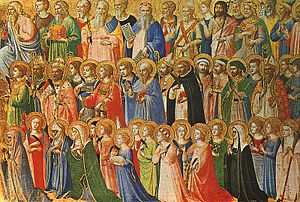
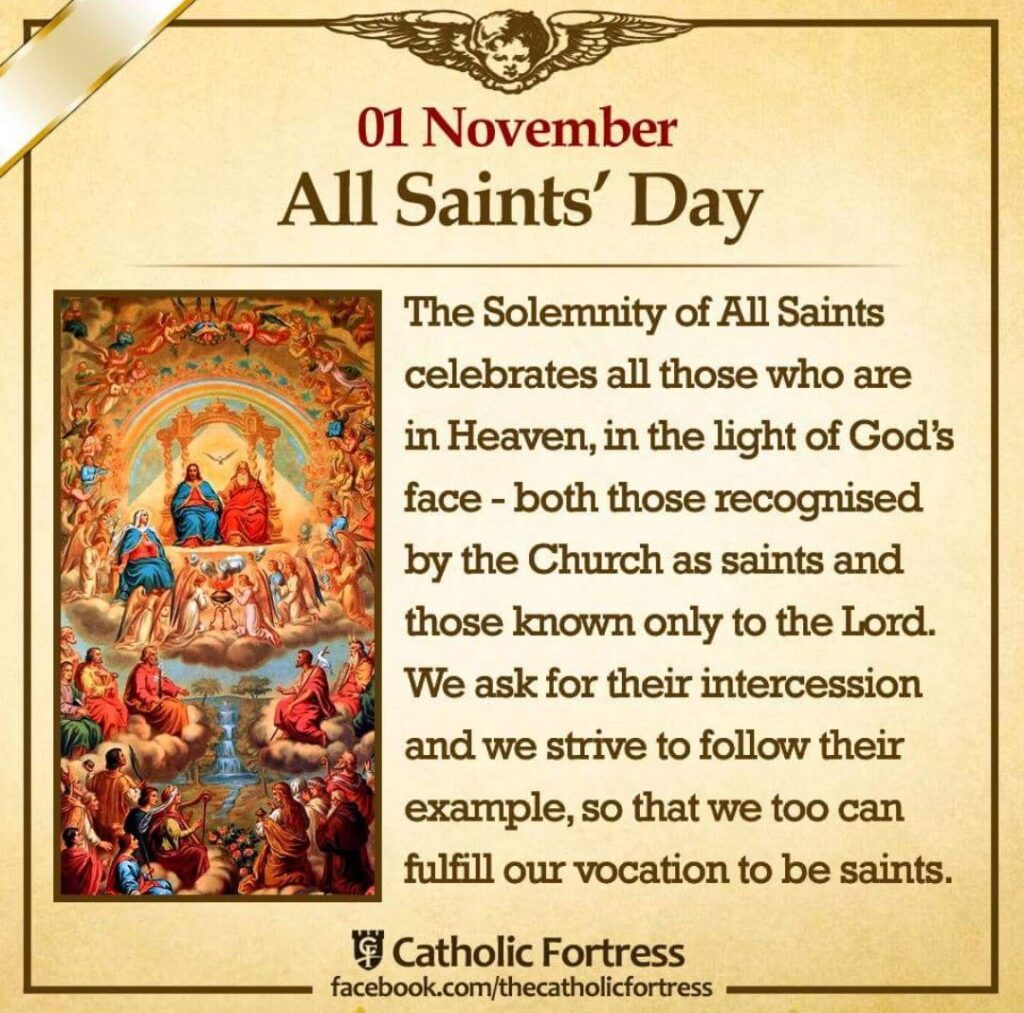
The Solemnity of All Saints Day is also known as All Hallows Eve. It is celebrated on November 1 by Western Christianity. It honors all souls who have arrived in heaven. Many countries celebrate it as a national holiday. It is followed by All Souls’ Day on Nov. 2 in which Catholics pray for those still on their journey to heaven. This journey is known as purgatory. Catholics believe that life is a spiritual pilgrimage. Death is the beginning of our journey through purgatory to heaven. Purgatory is where a soul is prepared and purified to enter heaven.
A Saint is a person whose soul has arrived in its’ eternal home…heaven. The journey to heaven is not easy! We ask for the prayers of those in heaven to aid us on our journey to heaven.
The observanceof All Saints Day goes back to the early centuries of the Christian Church. Prior to All Saints Day, Christians would celebrate martyrs on the anniversaries of their death, because those days marked their birthdays unto eternal life with Jesus in heaven. When the number of martyrs grew during persecutions like that of Emperor Diocletian and his successor…which lasted from A.D. 303-311…it became difficult to assign a specific day to each witness who died for the Faith. Therefore, beginning in the fourth century, the Church established a common day to honor all martyrs on All Saints Day’
True learning consists in the science of the saints: