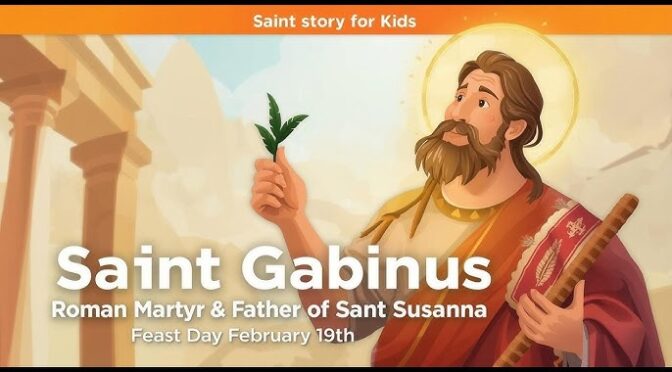
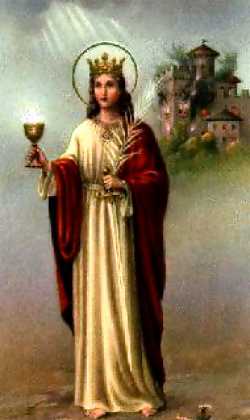
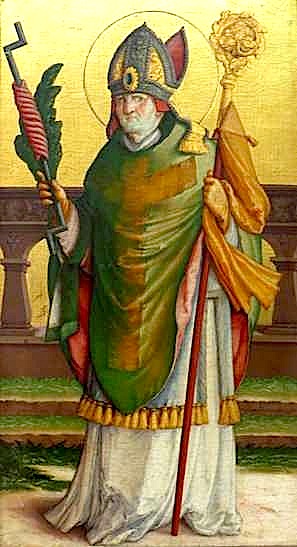
St. Gabinus was born into a noble family in Rome. His brother St. Caius became the 29th Bishop of Rome, serving as Pope for 12 years.
St. Gabinus was a priest and the father of St. Susanna whose original feast day was celebrated on August 11. Due to lack of information the feast day was removed. Her story is considered a legend, however her death is recorded in Roman Martyrology. She is believed to have been beheaded in her father’s house in the year 295 after refusing to marry Maximilian, the son in law of the pagan Emperor Diocletian. She was believed to have converted the court officers sent to convince her to marry, however, she had taken a vow of virginity.
One year later St. Gabinus was also beheaded, making him a martyr, in the year 296. He is believed to have been a missionary priest. His feast day is celebrated on Feb. 19. The Basilica San Gavino was built to honor him and local martyrs in Porte Torres, Italy.
St. Joan of Arc was born in Domremy, France in 1412 on the Feast of the Epiphany on Jan. 6. Her parents, Jacques and Isabelle were peasants. She was the youngest of four children, having three older brothers. She helped her mother with spinning and helped shepherd the animals. She was very devout as a child enjoying her religious faith and spending her free time in church.
St. Joan grew up during the “Hundred Years War”, which never seemed to end. The French were losing the war while she was young. England was invading the country of France causing much suffering. Joan prayed with great devotion and fervor for the suffering people.
At the age of thirteen, Joan began to have visions and hear voices which counseled her. She claimed to hear the Voice of God, Michael the Archangel,St. Catherine of Alexandria and St. Margaret of Antioch. In 1428, the voices told her to go tho the King of France and help him reconquer his kingdom. She was told to accompany Prince Charles to his coronation. St. Joan went to the town of Vaucouleurs seeking help from the military commander. After three trips he decided to listen to her.
She was given an escort of six which included two knights. They left on Feb. 23, 1429. The journey was 400 miles, taking eleven days in the winter to travel. She was given permission to meet with Prince Charles VII. However, he concealed himself in the crowd to test Joan. Joan, however, recognized him. St. Joan spoke to him, saying:
“I am Joan the Maid and to you is sent word by me from the King of Heaven that you will be anointed and crowned in Reims and you will be Lieutenant to the King of Heaven who is King of France.”
After being questioned by clerics who asked for a sign Joan was eventually given a sword, armor and a banner with the names of Jesus and Maria to lead the French Army to Tours in 1429. She was only 17 years old.
St. Joan led French troops against the English and recaptured the cities of Orleans and Troyes. Prince Charles was then anointed King with St. Joan at his side holding the banner in 1429.
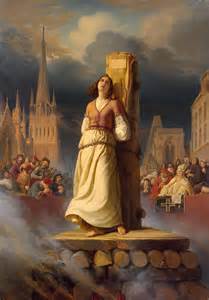
St. Joan of Arc Burning at Stake
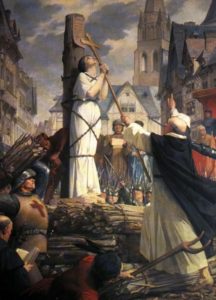
St. Joan was later captured and then sold to the English. Joan spent six months in prison before she was put on trial for heresy and witchcraft. After being found guilty she was burned at the stake in 1431. Her ashes were scattered in the Seine River. A second trial was held 25 years later which overturned the first verdict because it was politically motivated. Joan was declared a martyr.
St. Joan was beatified by Pope Pius X and canonize by Pope Benedict XV in 1920 who said that she is a “most brilliantly shining light of God.”
I know this now,
Every man gives his life for what he believes.
Every woman gives her life for what she believes.
Sometimes people believe in little or nothing.
One life is all we have and we live it as we believe in living it and then it’s gone.
But to surrender what you are and to live without belief
is more terrible than dying…even more terrible than dying young.
The feast day of St. Rita of Cascia is celebrated on May 22. She is the patron saint of impossible causes, abuse victims and widows.
St. Rita was born in 1386 in Cascia, Italy. She was known to be very spiritual even as a young child. She enjoyed visiting shrines and wished to become a nun. Her parents were opposed to the idea and arranged for her to be married. Her husband turned out to have a bad temper and was very difficult for her to live with. She dealt with his abuse with prayer, patience and kindness. They had twin sons. Their difficult marriage lasted 22 years.
One day while returning home from work her husband was ambushed and killed. St. Rita’s sons were now teenagers and began to talk of revenging their father’s death. St. Rita turned to prayer. She prayed that her sons would not be able to go through with the revenge. Her prayer was soon answered. Both her sons died from a deadly illness soon after without taking revenge on their father’s killer.
After the death of her husband and sons, Rita applied to enter the Augustinian Convent. Her first attempt was denied because of the ongoing feud. Rita persisted however. She convinced her husband’s family to put aside their hostility. The two rival families embraced peace. Rita turned to St. John the Baptist, St. Nicholas of Tolentino and St. Augustine, requesting their intercession. The convent changed their decision and allowed her entry. She was 36 when she entered the monastery.
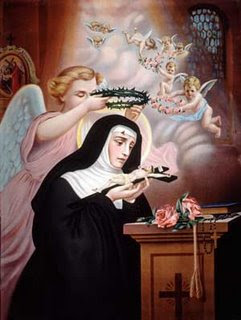
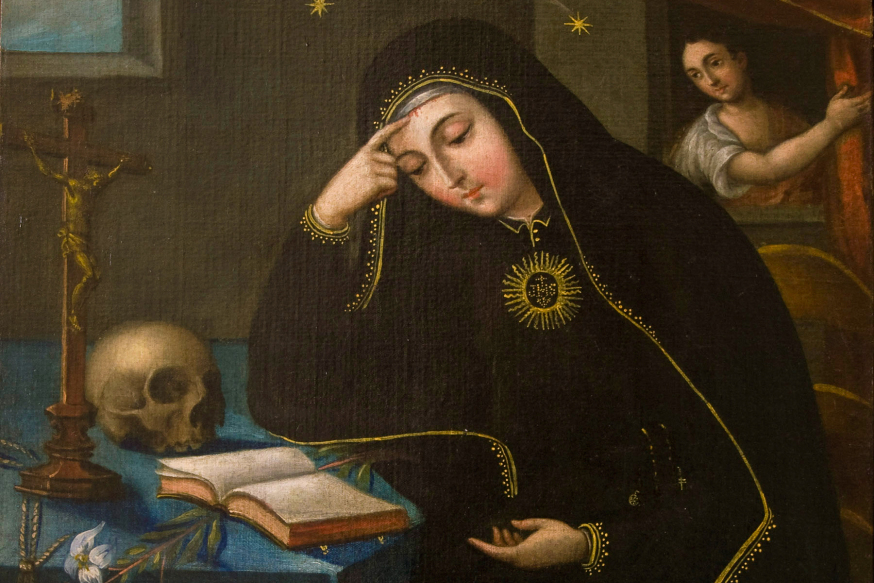
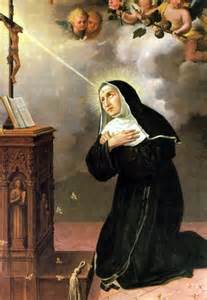
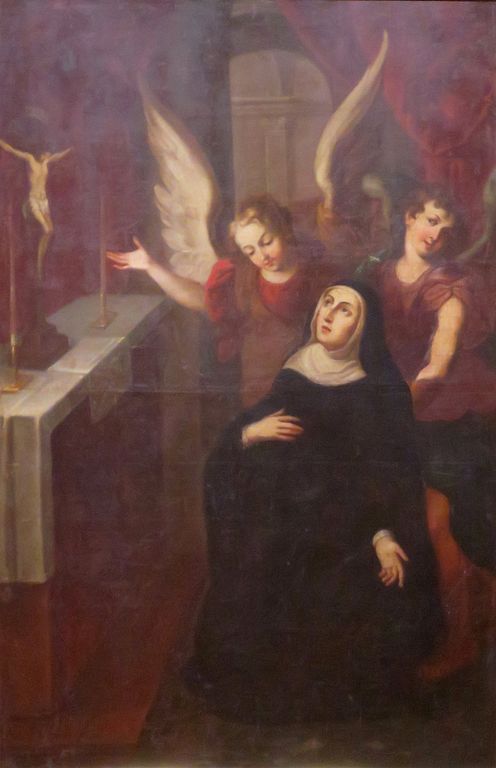
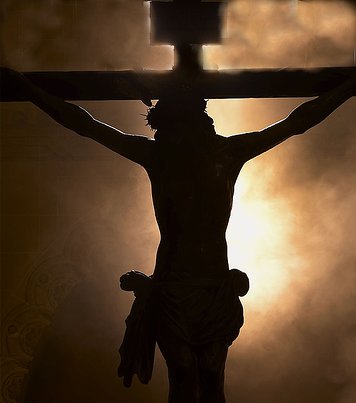
St. Rita had a great devotion for the passion of Christ. She meditated often on the crucifix. On Good Friday, 1442, St. Rita meditated on the suffering of Jesus on the crucifix. She offered to relieve Christ’s suffering by sharing even the smallest part of his pain. As she was meditating, a small wound on her forehead appeared. It appeared to be a thorn from the crown that Jesus wore. St. Rita had this stigmatafor 15 years.
St. Rita was confined to bed for the last four years of her life. She ate very little. The Eucharist sustained her and she remained joyful during her suffering. Before her death St. Rita requested a rose be brought to her from her parents’ garden even though it was January. Surprisingly, a rose was discovered to be blooming on the rosebush and it was presented to her. St. Rita gave thanks to God for this sign of God’s love.
Because this impossible request of St. Rita for a rose in January was answered she became the patron of impossible causes. It was also known that her prayers were known to obtain remarkable cures.
St. Rita died on May 29, 1456. Many miracles were recorded after her death . She was canonized by Pope Leo XIII in 1900.
St. Rita’s incorrupt body is venerated today in the National Shrine of Cascia.
Be at peace with your own soul, then heaven and earth will be at peace with you.
Easter is actually the last day of Holy Week. It is the day celebrated every Sunday by Christians, and is the core of our faith. However, it is important to reflect on the entire meaning of Holy Week.
The Tridium actually begins on Holy Thursday. We remember the institution by Jesus of the Eucharist. At every Mass we repeat the words of Jesus at the Last Supper.
“This is my body. This is my blood.”
We are a Eucharistic people. When we receive the body and blood of Jesus in the Eucharist we become the Body of Christ. We are called to bring Jesus to the world by our actions.
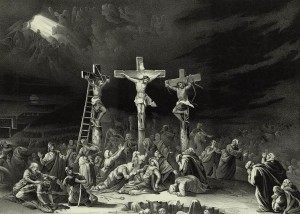
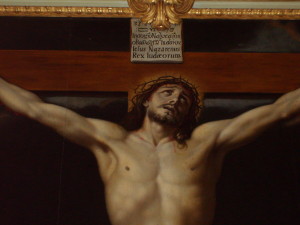
On Good Friday, we remember the actual death and crucifixion of our Lord, Jesus Christ. How is it possible to put God to death? Why did Jesus have to suffer in such a terrible way? Unless we reflect on these questions, we miss an important part of our faith. In Luke 9:23 Jesus says,
“If any want to become my followers, let them deny themselves and take up their cross daily and follow me. For those who want to save their life will lose it, and those who lose their life for my sake will save it.”
Suffering is part of everyone’s life. How we react to suffering determines the quality of our discipleship. Jesus is telling us to be selfless. He then shows us how to suffer. Catholics, meditate on the Stations of the Cross during Good Friday services. This helps us to apply our faith to our daily life.
Good Friday is followed by Easter, truly a glorious and joyful day. The resurrection tells us that Jesus has conquered death. We are redeemed by the suffering, death, and resurrection Jesus Christ.
We celebrate Easterevery week, never forgetting the sacrifice Jesus made for us. We must never forget that before he rose, he suffered and died…for us.
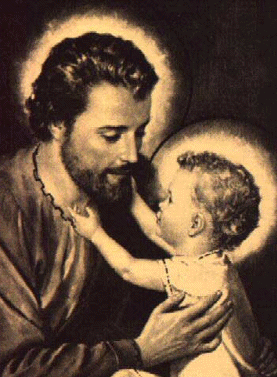
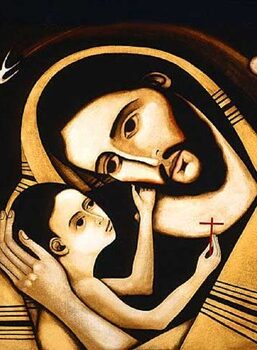
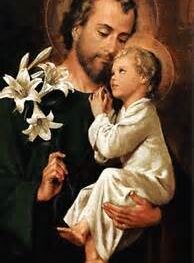
The Feast Day of St. Joseph the Worker is celebrated on May 1.
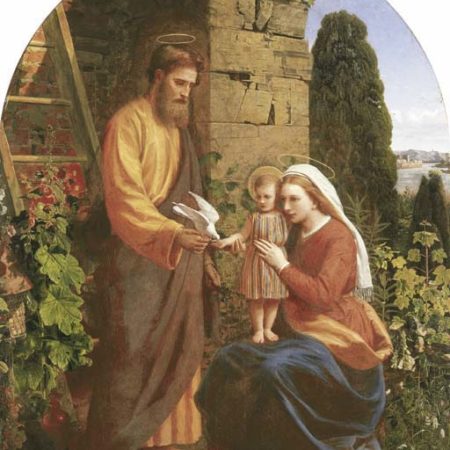
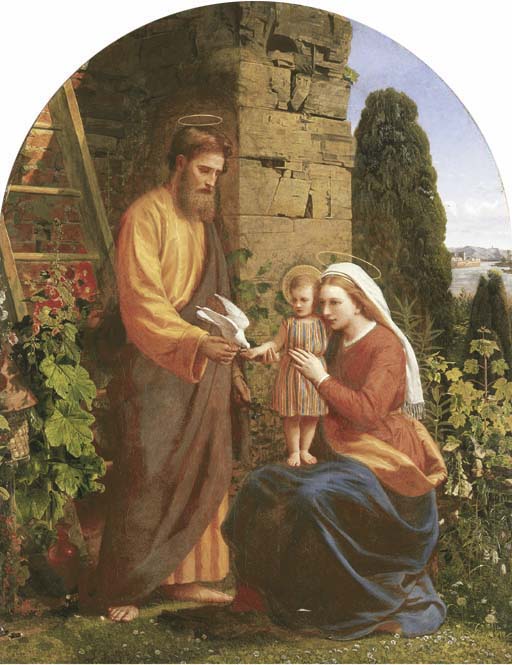
St. Joseph was entrusted by God to be the guardian of Jesus Christ, the son of God. His primary mission was to keep Jesus safe and to provide for him. Joseph, Mary and Jesus are referred to as “The Holy Family”. St. Joseph was a carpenter.
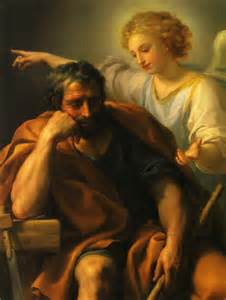
Joseph was engaged to be married to Mary, when she was found with child. He was going to divorce her quietly to avoid scandal, however an angelappeared to him in a dream, saying;
“Joseph, son of David, do no be afraid to take Mary as your wife, for the child conceived in her is from the Holy Spirit. She will bear a son, and you are to name him Jesus, for he will save his people from their sins.Mat: 1: 20-21
Joseph immediately took Mary as his wife.
The angel appeared to Joseph a second time. This time he was told his family was in danger. They fled to Egypt where they stayed until the angel told him it was safe to return.
We celebrate two feast days for St. Joseph. The first is on March 19; Feast Day of St. Joseph, Husband of Mary. The second feast day is May 1; The Feast Day of St. Joseph the Worker.
St. Joseph is the patron for a happy death because tradition tells us that he died with Jesus and Mary at his side. He is also the patron of fathers and workers.
Prayer in a difficult problem
Oh glorious St. Joseph, thou who hast power to render possible even things which are considered impossible, come to our aid in our present trouble and distress.
Take this important and difficult affair under thy particular protection, that it may end happily. (Name your request.)
O dear St. Joseph, all our confidence is in thee. let it not be said that we would invoke thee in vain; and since thou art so powerful with Jesus and Mary. show that thy goodness equals thy power.
St. Joseph, friend of the Sacred Heart, pray for us.
Amen
St. Joseph with Angel
First, do what is necessary, then do what is possible,
and before long you will find yourself doing the impossible.
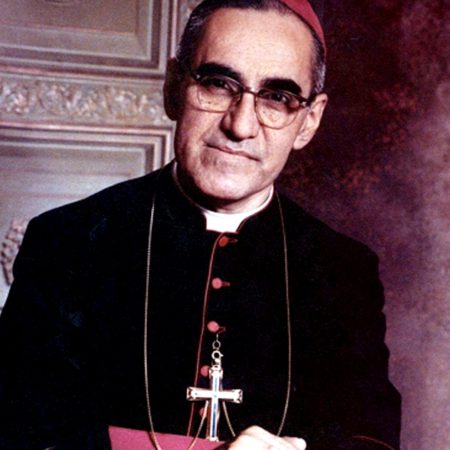
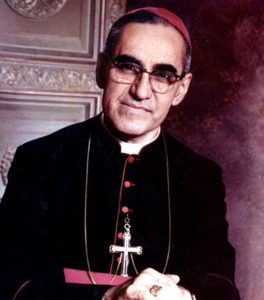
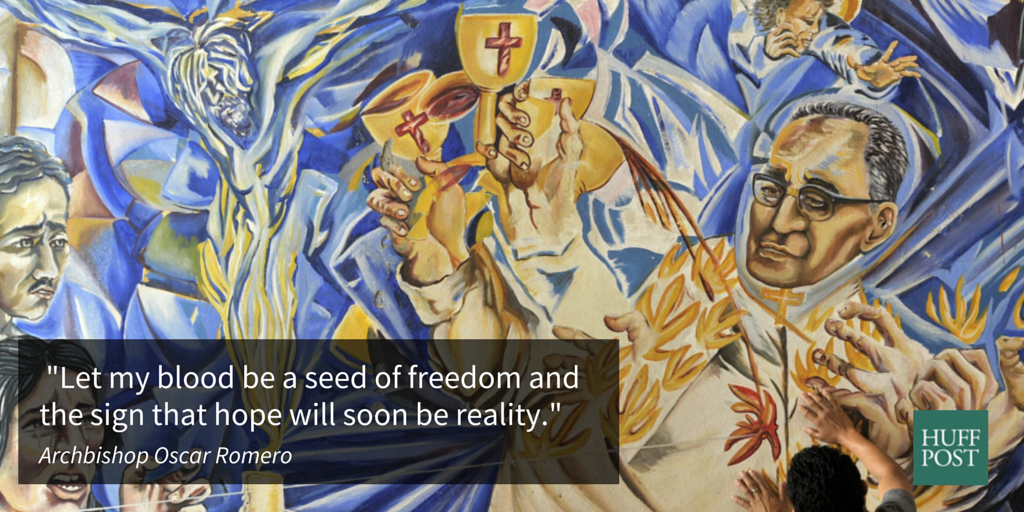
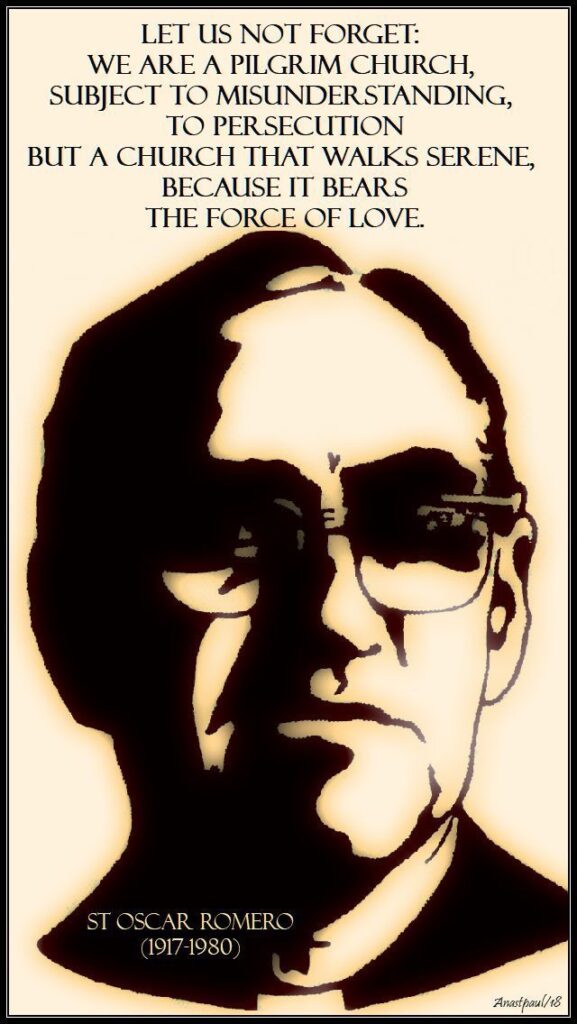
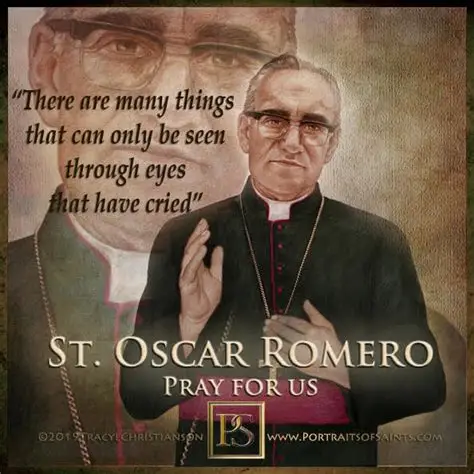
The feast day of St. Oscar Romero is celebrated on March 24.
St. Oscar Romero was born on August 15, 1917 in Ciudad, Barrios. He had six brothers and sisters. At the age of 13 he entered a seminary run by Claretians. He studied under the Jesuits in the national seminary and finished his studies in Rome in the Gregorian University. He was ordained on April 4, 1931 remaining in Rome to further his studies.
His first parish when he returned home was in Anamoras. He then worked for twenty years in San Miguel. In 1970 he was appointed auxiliary bishop; becoming archbishop in 1977. Because of his conservative beliefs his appointment was opposed by some. On March 12 a progressive Jesuit priest and friend to Oscar Romero was assassinated. Romero urged an investigation but was ignored.
Bishop Romero spoke out against poverty, social injustice, assassinations and torture which was taking place in his country. In 1979 the government was taken over by a radical group which resulted in civil war. Over 75,000 El Salvadorians were murdered. Bishop Romero was nominated for the Nobel Peace Prize in 1979. Bishop Romero said it was a problem to support the government in El Salvador because it legitimized the terror and assassinations. Bishop Romero warned U.S. President Jimmy Carter in Feb. 1978 that increased military aid would “sharpen the injustice and the repression inflicted on the organized people, whose struggle has often been for their most basic human rights.” President Carter ignored Bishop Romero’s warning.
Archbishop Romero denounced the persecution of the Church. There had been over six priests martyred in three years while he was bishop.
On March 13, 1980, Archbishop Romero was shot to death while celebrating mass in the chapel near his cathedral. The day before the assassination, he had called for soldiers to obey God and to stop carrying out government repression and violations of human rights. It is believed the assassination was carried out by members of Salvadorian death squads.
Over 250,000 mourners attended his funeral. During the funeral a bomb exploded resulting in mass panic. Between 30-50 people died during the following chaos.
Pope Francis has recognized the martyrdom of Archbishop Romero, paving the way for his beatification which was held on May 23, 2015.
Pope Francis canonized St. Oscar Romero on October 14, 2018.
“Beautiful is the moment in which we understand that we are no more than an instrument of God; we live only as long as God wants us to live; we can only do as much as God makes us able to do; we are only as intelligent as God would have us be.”
Intercessory prayer has always been an important form of prayer in the church. The church believes that we can and should pray for each other. This does not end when we die. The saints are closer to God than we are. We ask them to pray for us in our time of need. This is called intercessory prayer.
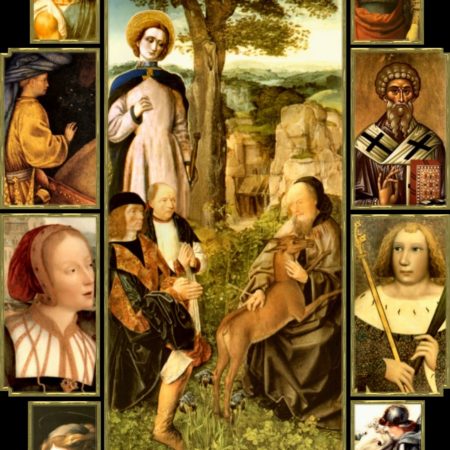
During the black plague, which lasted from 1346-1349, a number of saints gained great popularity for their ability to intercede and were given credit for many miraculous cures. They became known as the Holy Helpers. A feast day was created to celebrate their sanctity and celebrated on August 8. in 1969, this feast day of the Holy Helpers was dropped because of the reform of the liturgical calendar. The 14 Holy Helpers are still popular today.
All of the Holy Helpers except St. Giles were martyrs. Symptoms of the plague were a black tongue, painful throat, severe headache, fever, and boils on the abdomen. It came on suddenly and could result in death within hours. The people who contracted the disease turned to the Holy Helpers to intercede for them during the frightening experience.
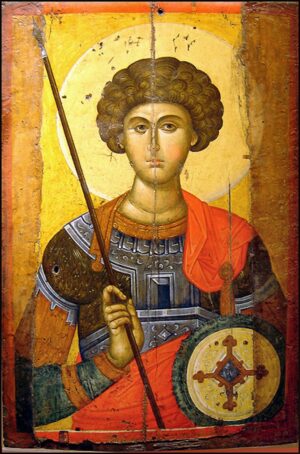
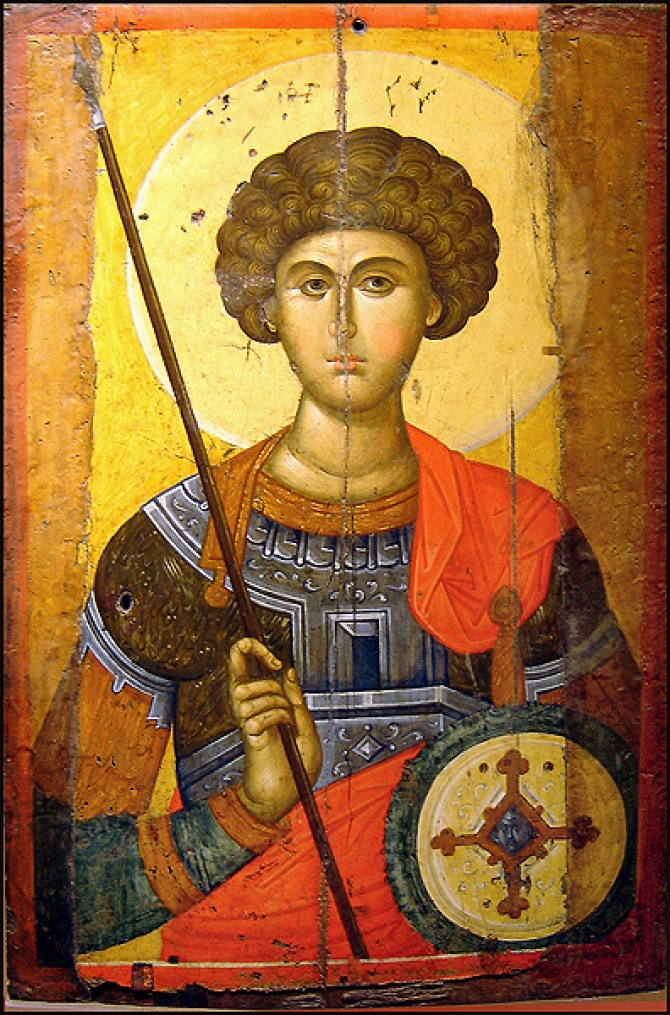
1. St. George…Feast Day April 23rd…Died 303
St. George
St. George was born in Cappadocia (modern Turkey) into a Christian family. He became a high ranking soldier. When Emperor Diocletian began persecuting Christians, he protested. He was then jailed and tortured. He died a martyr after being beheaded. Legend tells us that St. George killed a dragon which was threatening the townspeople. He made the sign of the cross and then killed it with a lance. Many people were converted and baptized because of St. George.
St George is invoked for protection of domestic animal.
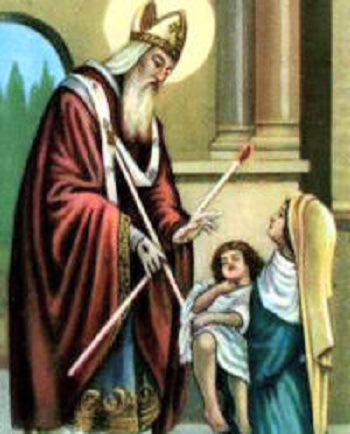
St. Blaise was born in Armenia. He was a physician and a philosopher. He became a Bishop of Armenia. Due to persecution, he fled and lived as a hermit. Legend tells us that hunters came upon him praying in a cave. He was surrounded by lions, wolves and bears. He was imprisoned. He was known for his gift of healing. The most famous healing happened while he was in prison. A mother came with her young son who had a fish bone lodged in his throat. At Blaise’s command the child was able to cough up the bone.
St. Blaise died a martyr. After being tortured, he was beheaded.
St. Blaise is invoked for healing of the throat.
3. St. Erasmus (or St. Elmo)…Feast Day June 2…Martyr
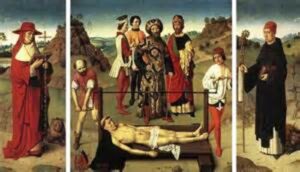
Martyrdom of St. Erasmos Public Domain Image
St. Elmo lived in Italy. He served as the Bishop of Formiae, Campagna, Italy and was martyred during the persecutions of Christians by Diocletan.
Trying to flee the persecutions, St. Elmo fled to Mt. Lebanon and lived in solitude for a time. When he was found, he was tortured and imprisoned. Because he refused to deny his faith he was scourged and cast into boiling oil, sulfur and pitch. He was miraculously saved from harm. According to legend an angel led him to freedom. After escaping prison he converted many with his preaching and miracles. A second time he was captured, imprisoned and tortured. Again, an angel led him to freedom. During his torture he had hot iron hooks struck into his intestines. He survived these wounds which is why he is invoked for intestinal problems.
St. Elmo is considered the patron saint of sailors. A blue light appears at mastheads before and after a storm; the seamen took it as a sign of St. Erasmus’s protection. This became known as St. Elmo’s Fire. St. Elmo died as a martyr in 303. He was tortured and disemboweled.
St. Elmo  is the patron saint of sailors
and against intestinal troubles.
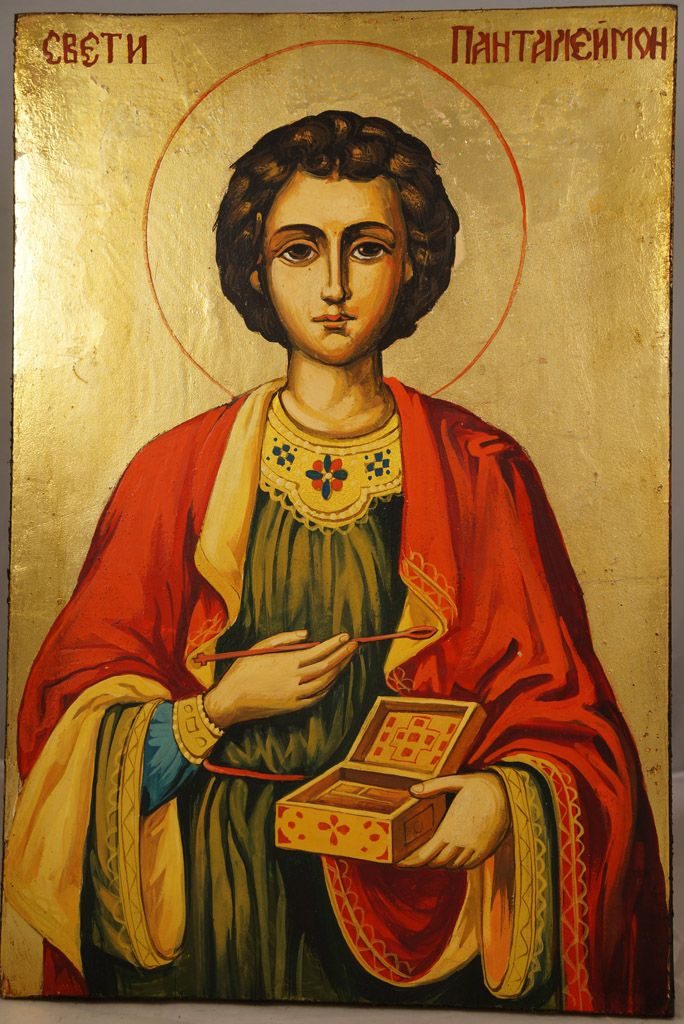
4. St. Pantaleon … Feast Day July 27th…D. 304
St. Pantaleon was born into a wealthy christian family. He left the faith and became a physician. He returned to the faith before his father died leaving him a large inheritance. During the persecution of Dicletian, he refused to denounce his faith. After healing a man with palsy, he was tortured in many ways. Tradition says he was burned by torches until Christ appeared and put out the flames. Attempts at boiling him and drowning at sea also failed. He was finally nailed to a tree and beheaded. He prayed for forgiveness of his persecutors before his death.
St. Pantaleon is patron saint of physicians, midwives,
tuberculosis and torture victims.
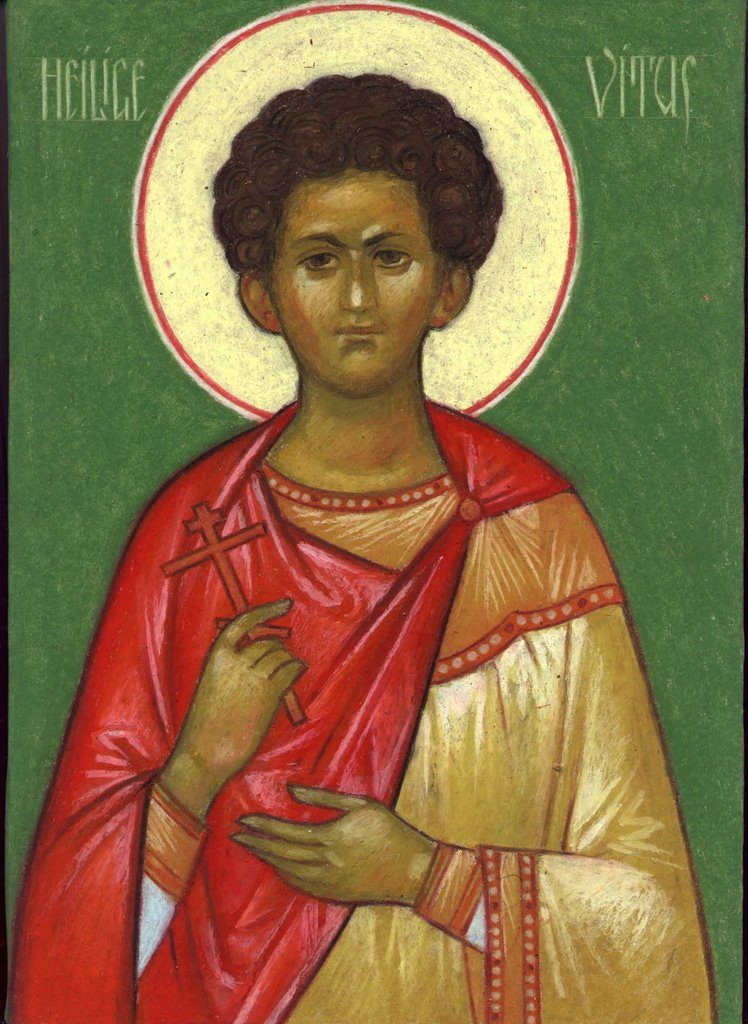
5. St. Vitus (also St. Guy)… Feast Day June 14
St. Vitus was born in 291 into a pagan family in Sicily. He was cared for by a Christian family who had him baptized. His furious father tried to have him renounce his faith. When he would not, his father turned him over to the governor Valerian who had him tortured for refusing to deny his faith. He was ordered scourged, however his executioners’ hands were paralyzed. They were healed after St. Vitus made a sign of the cross over ther. Escaping during a storm, St. Vitus fled to Italy. After converting many, Diocetian had him arrested and tortured again. When he was thrown to the wild beasts, the animals cowered at his feet. He wurvived boiling oil but was martyred on the rack in the year 303.
St. Vitus is the patron saint of dancers and actors.
He is invoked during storms and against epilepsy
and those afflicted with St Vitus Dance.
6. St. Christopher … martyr … Former Feast Day July 25
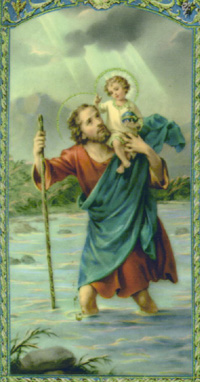
St. Christopher
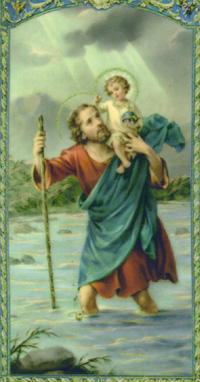
Because the existence of St. Christopher is not verified his feast day was dropped when the liturgical year was reformed. However, his legend is powerful and many still ask for his intercession. Legend says that he converted to the faith after following the devil. He was very tall and considered a giant. He devoted his life to carrying people across a river with no bridge. One day, he was carrying a small child. The child became heavier and heavier until St. Christopher staggered. When they had crossed the river the child told St. Christopher that he was the Christ child and that he had been carrying the burdens of the world on his shoulders. St. Christopher is believed to be martyred by Emperor Deius in approximately 250
St. Christopher is the patron saint of travelers,
transportation workers and soldiers.
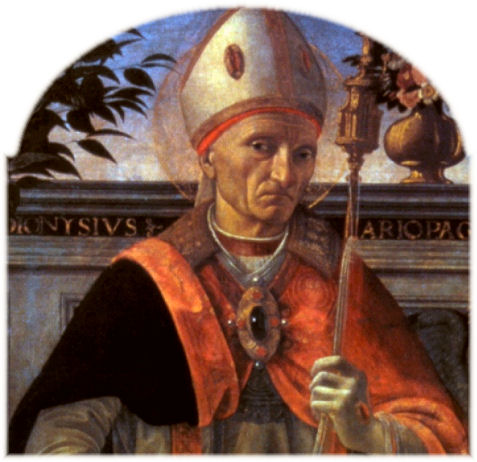
7. St. Denis (also Dionysius) Feast Day October 9 bishop and martyr
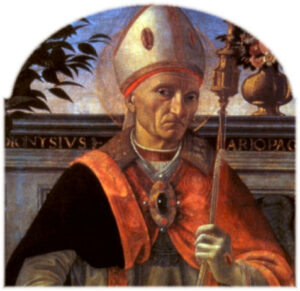
St. Denis, Bishop of Paris
St. Denis is also known as St. Diomysius. He was converted by St. Paul, becoming one of his followers. He was known converting many people. Pope St. Clement sent him to Gaul where he became the first bishop of France, At the age of 110, he was martyred by beheading. Tradition tells us that after he was beheaded, he took his head in his own hands placing it 2000 paces away where a chapel was later built.
St. Denis is invoked against diabolical possession and headaches.
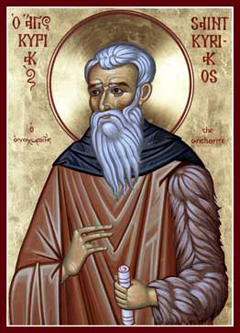
8. St. Cyriacus (also Cyriac)… Feast Day August 8 … deacon and martyr
St. Cyriacus was a pious Roman who became a deacon and tried to help people being persecuted for their faith. He also ministered to people in prison. Eventually, he was put in prison himself. While in prison he converted many and restored the sight of several blind men. When Emperor Diocletian’s daughter was found to be possessed by the devil it was St. Cyriacus who was able to free her of this possession. After she was healed the Emperor left him to live in peace. However, under the persecution of the co Emperor Maximum, he was again persecuted. He was tortured and beheaded on March 16, 303.
St. Cyriacus is the patron against eye disease,diabolical possession and temptation, especially at the time of death.
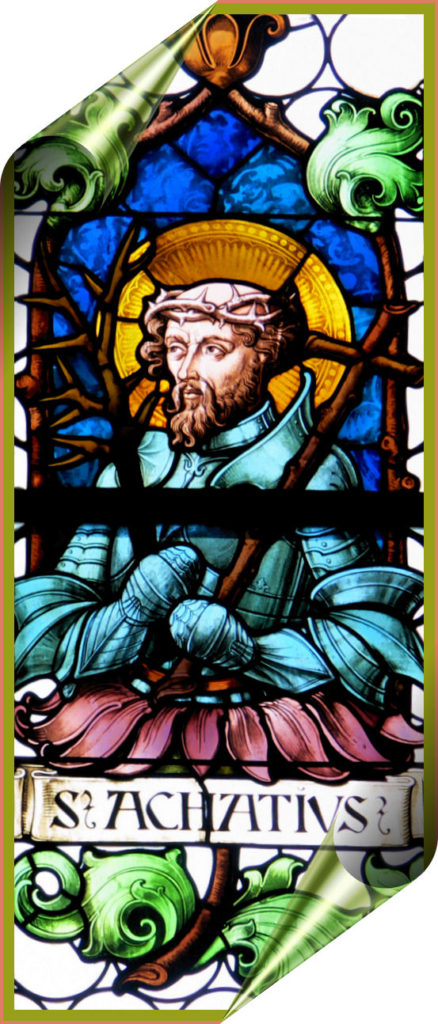
9. St. Aciathius (also Acaciid) … Feast Day May 8th
St. Aciathius was a Roman soldier. He joined the army during the reign of Emperor Hadrian, becoming a captain. He converted to Christianity and was filled with zeal. He converted many pagan soldiers. The emperor had him thrown into prison and tortured on the rack when he would not renounce his faith. He was brought before the tribune Bibianus. After declaring that his name was Christian, because he was a follower of Christ, Bibianus ordered him beaten with clubs and chained. After suffering more torture, he was beheaded on May 8, 311.
St. Acathius is the invoked against headaches.
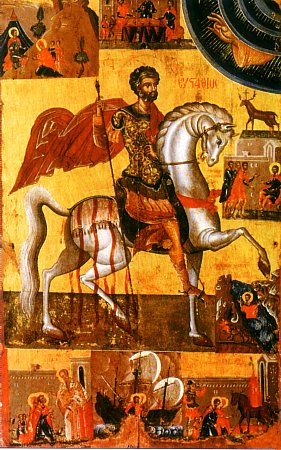
10. St. Eustace (also Eustachius, Eustathius)… Feast Day Sept. 20th
Before his conversion St. Eustace was none as Placedas. He was a kind man who enjoyed hunting. He was also a Roman general. One day he followed a stag into the forest. While he was staring at the deers antlers they vegan to glow showing a cross between them. He heard a voice asking him to convert to Christianity. Pacedus and his family were soon baptized and he became known as Eustace. St. Eustace was martyred in the year 118 by being burned inside a bronze bull.
St. Eustaca is the patron against fire, difficult situations,
family troubles and hunters and fire fighters.
11. St. Giles the Abbot (also Aegildius)… Feast Day Sept. 1… Hermit and abbot
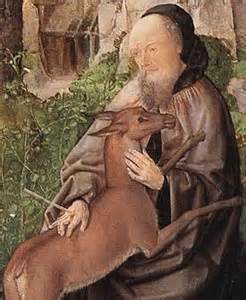
St. Giles, Abbot
St. Giles was born into a noble family in Athens, Greece in the seventh century. After the death of his parents, he distributed his inheritance to the poor. He also became known for the gift of miracles and healing he had received. Giles longed to live a life of solitude, serving God as a recluse. He left Greece, sailing for France. Everywhere he lived he became known for his gift of miracles and healing. He would have to flee once again to find a place to live in peace and solitude. His final dwelling place was deep in the forest in a cavern in a rock. He occupied his time in prayer, praising God and meditating. His only companion was a red deer, which provided him with milk to drink. St. Giles is the only Holy Helper who was not a martyr.
After several years of living in complete solitude, the King of France instituted a great hunt near where Giles lived. The hunters chased the deer which led them to the cave where Giles lived. They shot an arrow into the cave, wounding the holy hermit. They found him covered with blood with the deer lying at his feet. When the king was told what had happened, he ordered him taken care of. He came to see him offering him gifts. St. Giles refused the gifts requesting a monastery instead. St. Giles became the Abbot of the monastery which was soon built. Several disciples joined him. His fame continued to spread because of his gift of miracles. The conversion of the King was one of these miracles.
St. Giles is the patron saint of the mentally ill, the disabled,
epileptics,childhood fears, and depression.
12. St. Margaret of Antioch … Feast Day July 2
St. Margaret of Antioch
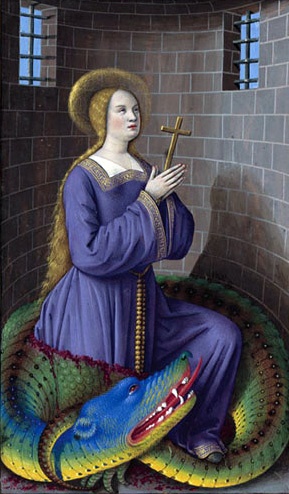
St. Margaret was a virgin and martyr. St. Margaret was born in Antioch. She was raised by a Catholic nurse. When her pagan father learned of her faith, he was very displeased. He wanted her to marry the city prefect. When she refused, the prefect hd her tortured on the rack and pierced with iron hooks. She was then left in prison to die. Miraculously, all her wounds were healed. She was then tortured again with flaming hooks which did her no harm. Finally, she was beheaded. She was one of the saints who talked to St. Joan of Arc.
St. Margaret is the patron of women in childbirth.St. Margaret is invoked against backaches and kidney disease.
13. St. Catherine of Alexandria … Feast Day Nov 25th
St. Catherine Alexandria
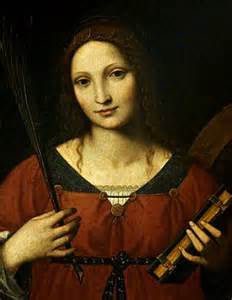
While there is no historical evidence regarding St. Catherine of Alexandriathere is a strong tradition about her martyrdom. St. Catherine was born around 287 in Alexandria, Egypt. She was the daughter of a wealthy pagan couple. She had a love of learning and studied philosophy and religion. After studying Christianity, she converted. She is known to have debated 50 philosophers, converting them.
Legend tells us that she was imprisoned and tortured by Emperero Maxentius after she refused to marry him. He forced her to debate the most learned pagan philosophers hoping she would commit apostasy, however the debates resulted in many conversions to the Christian faith. St. Catherine was tortured by being placed on a wheel full of spikes in an attempt to kill her. The wheel broke into two pieces and fell apart. She was then beheaded.
St. Catherine is invoked as the patron saint of students, teachers,
librarians and lawyers.
14. St. Barbara… Feast Day December 4
St. Barbara
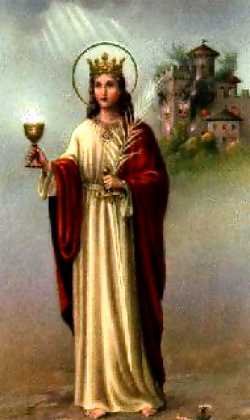
St. Barbarawas a virgin and martyr. She is the patron of builders, artillery men and miners. She was martyred in Asia Minor in the 3rd or 4th century. Her father isolated her in a high tower where she was tutored by philosophers and poets. She converted to Christianity, which infuriated her father. He ordered her killed. She was caught trying to escape and then beheaded by her father. He was immediately struck dead by lightning.
St. Barbara is invoked against fever, lightning, fire and sudden death.
The saints are men and women who have joy in their hearts and spread it to others… never hating, but serving the others.
Quote by Pope Frances on Nov. 1, 2013 All Saints Day
During colonial times, Catholic immigrants coming to the U.S.from Europe settled primarily in the colonies of Maryland, Pennsylvania and New York. Laws protecting religious freedom had not yet been written. Intolerance between religious groups was a common occurrence.
After over fifty years without a bishop, Father John Carroll, a Jesuit, was consecrated bishop and served the Archdiocese of Baltimore. Catholics were a distinct minority at the time. Bishop Carroll estimated the Catholic population in the colonies to be 25,000, or less than one percent of the total population. The church grew rapidly under his guidance.
Today, according to Pew Research there are 75 million Catholics in the United States, approximately 24 percent of the total population.
The colonial Catholics were served by missionaries, both Jesuits and Franciscans.
The following men and women in the U.S. have been proclaimed saints by the Pope. They are considered role models in holiness for Catholics today to turn to for guidance.
There are four steps to becoming a saint in the Catholic Church.
Servant of God…….Formal investigation has begun…………………….82 investigations ongoing
Venerable……………Heroic virtue has been decreed by Pope……….16 from U.S.A.
Blessed……………….First miracle has been confirmed……………………7 from U.S.A.
Saint..………………….Second miracle has been confirmed……………..12 from U.S.A.
The following saints have lived in the United States. Most are immigrants, however two were born in the United States; Kateri Tekakwitha is the first Native American saint and Elizabeth Ann Seton is the first saint from the United States to be canonized.
The Catholic Church teaches that everyone in heaven is a saint. The Church declares certain people to be saints when their holiness is obvious, if they were martyred for the faith and after miracles attributed to them have been investigated.
While there are thousands of declared saints, only the following Americans have received the official title of Saint.
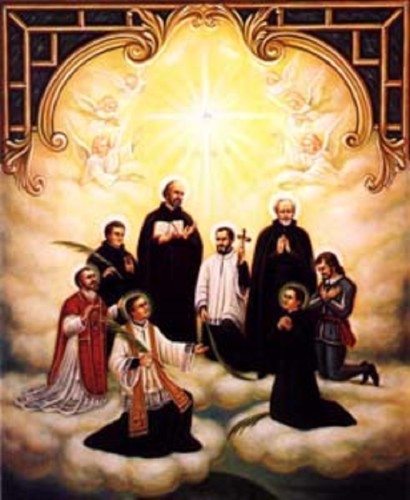
North America Jesuit Martyrs Public Domain Image
North American Martyrs
In the 1600’s, eight French Jesuit missionaries lost their lives while trying to spread the news of the gospel to the Huron, Iroquois, and Mohawk Indians. Three of them died in what is now New York State, five of them died in what is now Canada.
Isaac Jogues, René Goupil and Jean La Laude died in New York.
John DeBrebeuf, Gabriel Lalemant, Charles Garnier, Anthony Daniel, and Noel Chabanel died in Canada.
St. René Goupit was a Jesuit Lay brother. He was the first to be martyred. He was killed by tomahawk at Osermenon, (Auriesville, NY)) in 1942.
Father Isaac Jogues, a Jesuit priest, was held captive by the Mohawks for thirteen months. He had several fingers cut off his hand. He escaped and returned to France. He later returned to the mission. He was killed by tomahawk by a Mohawk brave in 1946.
St. Jean de La Lande, a Jesuit donné (not a member of the Society, but at their service) tried to retrieve Father Isaac Jogues’ body, but was killed also.
These martyrs were the first saints of North America.
The martyrs were canonized by Pope Pius XI on June 29, 1930.
The memorial in the U.S.A is celebrated on Oct. 19.
The memorial in Canada is celebrated on September 26.
The martyrs are patron saints of America
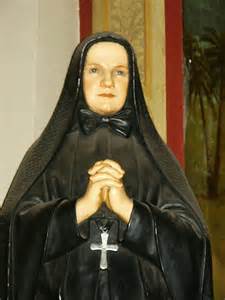
St. Frances Xavier Cabrini
St. Francis Xavier Cabrini
St. Frances Xavier Cabrini. Francesco Cabrini was born in Lombardi, Italy in 1850. She was one of 13 children, raised on a farm. She attended school in a convent. She wanted to become a nun but was hindered by poor health. She became a teacher, teaching at a girl’s school for six years.
Frances took religious vows in 1877, adding Xavier to her name to honor St. Francis Xavier.
At the urging of Pope Leo XIII, she immigrated to the Unites States with six nuns to work with Italian immigrants. She crossed the Atlantic ocean in spite of her great fear of water.
She founded many schools, hospitals, and orphanages in the United States, England, France, Spain and South America. In New York City, St. Frances Cabrini founded Columbus Hospital and Italian Hospital. In the 1980’s they merged into Cabrini Hospital.
In 1909 St. Frances Xavier Cabrini became a naturalized United States citizen. She died from malaria at the age of 67, on December 22, 1917, at Columbus Hospital in Chicago, IL.
In 1931, her body was exhumed, found partially incorrupt, and is now enshrined under glass in the altar at St. Frances Cabrini Shrine in Manhattan.
St. Frances Cabrini was canonized on July 7, 1946 by Pope Pius XII
St. Frances Cabrini is the patron saint of immigrants. orphans and against malaria.
St. Elizabeth Ann Seton Public Domain Image
St. Elizabeth Ann Seton
St. Elizabeth Ann Seton is the first native born American to be canonized a saint.
Elizabeth was born on Aug. 28, 1774 in New York City. She was raised in the Episcopal Church. At the early age of 3 her mother died. At the age of 19 she married William Seton, a wealthy businessman.
Within four years, she suffered the death of her father in-law which left William in charge, not only of his father’s business but the seven half-brothers and sisters as well. The business failed, forcing bankruptcy.
William became ill with tuberculosis. In an attempt to find a cure they moved to Italy. He died while living in Italy. Elizabeth grew very close to God. She accepted and embraced the will of God. Elizabeth eventually was led into the Catholic church. She had a strong devotion to the Virgin Mary.
St. Elizabeth Ann Seton established the first free Catholic school in America. On March 25, 1809 she took a vow of poverty, chastity, and obedience. She became the founder of the Sisters of Charity, which followed the rules written by St. Vincent de Paul for the Daughters of Charity in France. She became Mother Seton.
Her final years were spent leading and developing the new congregation. The sisters opened free schools and orphanages along the East Coast.
Elizabeth. died in 1821 of tuberculosis at age 46.
Pope John XXIII canonized her as St. Elizabeth Ann Seton on Sept. 14, 1975. He stated, “In a house that was very small, but with ample space for charity, she sowed a seed in America.”
The feast day of St. Elizabeth Ann Seton is celebrated on Jan. 4.
St. John Neumannwas born in Bohemia in 1811. Due to the shortage of priests in the colonies, he traveled to New York to be ordained a priest and worked in an isolated parish.
Father John eventually joined the Redemptorists who were dedicated to helping the poor and abandoned. In 1852, he was appointed Bishop of Philadelphia. He increased the number of Catholic schools from two to a hundred.
His desire to hear confessions led him to learn at least six languages. He knew Spanish, English, French, Italian, Dutch and Gaelic.
Bishop Neumann died at the age of 48 on Jan. 5, 1860.
After his death the National Shrine of St. John Neumann was constructed at the Parish of St. Peter the Apostle in Philadelphia. Our Lady of the Angels College, founded by the Congregation of Franciscan Sisters he had founded renamed the College Neumann College. It was later given University status.
St. John Neumann was beatified on Oct. 13, 1963 by Pope Paul VI.
St. John Neumann was canonized on June 19, 1977 by Pope Paul VI.
The feast day of St. John Neumann is celebrated on Jan. 5, the day of his death.
St. John Neumann is the patron saint of Catholic education.
St. Rose Philippine Duchesne Public Domain Image
St. Rose Philippine Duchesne
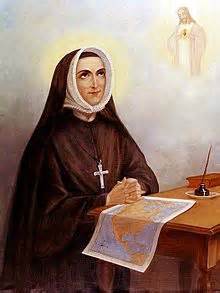
St. Rose was born in Grenoble, France in 1769. She was drawn to the contemplative life. During the French revolution she spent her time nursing prisoners. She soon joined the Society of the Sacred Heart of Jesus.
During Eucharistic Adoration she experienced a vision where she was serving God in the New World. Twelve years later , at the age of 49, she moved to the United States. She was sent to the Louisiana Territory.
In Louisiana, she opened the first free school west of the Missouri River. By 1828 she had founded six houses. She worked among the Potawatomie Indians who named her Quah-kak-ka-num-ad, “Woman-Who-Prays-Always”.
St. Rose died at the age of 83 at St. Charles, Missouri on November 18, 1852.
St. Rose was Beatified by Pope Pius XII in 1940.
St. Rose was canonized by Pope John Paul II in 1988.
The feast day of St. Rose is celebrated on November 18.
St. Rose is the patron saint of the Diocese of Springfield-Cape Girardeau, Missouri
St. Theodore Guerin Public Domain Image
St. Theodore Guerin
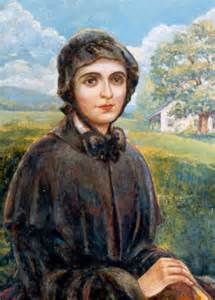
St. Theodore Guérin’s birth name was Anne Thérése. She was born on Oct. 2, 1798 in Etables, France. Her father served in Napoleon’s navy. At the young age of 15 her father was murdered by bandits while traveling home for a visit.
Anne Thérése turned to God in the difficult years following his death. At the age of 25 she entered the Sisters of Providence to serve the poor, sick and dying. Anne Thérése became Sister Theodore. She was asked to lead a small missionary band of Sisters to the United States in Indiana.
Mother Théodore accepted the mission in spite of her fragile health. She could only consume soft, bland food and liquid. She traveled to the Unites States with five other sisters. After surviving a violent storm at sea in the trip Mother Théodore wrote the following:
“What strength the soul draws from prayer! In the midst of a storm, how sweet is the calm it finds in the heart of Jesus. But what comfort is there for those who do not pray?”
Mother Théodore established schools in Indiana and Illinois. She is described as saintly by people who knew her.
Sixteen years after coming to the United States she died. She is buried in the Church of the Immaculate Conception in St. Mary of the Woods, Indiana.
St. Théodore Guérin was beatified on Oct. 25, 1998 by Pope John Paul II.
The feast day of Théodore Guérin is celebrated on October 3.
St. Théodore Guérin is the patron saint of the Diocese of Lafayette, Indiana.
St. Katharine Drexel Public Domain Image
St. Katherine Drexel
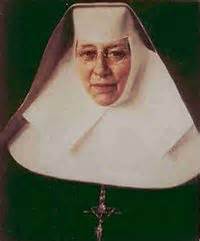
St. Katerine Drexel was born in Philadelphia, Pennsylvania on Nov. 26, 1858. She was the child of wealthy parents who taught her to be generous.
Katherine became a Sister in 1889 at the age of 31. She founded the Sisters of the Blessed Sacrament for Black and Native American people. She dedicated her life and great wealth to this work.
She helped to open the first mission school for Indians in Santa Fe, New Mexico. Other schools soon followed. She then founded Xavier University in New Orleans.
St. Katherine Drexel is the second recognized American born saint.
Katherine Drexel was beatified on Nov. 2, 1988 by Pope John Paul II.
St. Katherine Drexel was canonized on Oct. 1, 2000 by Pope John Paul II.
We celebrate the feast day of St. Katherine Drexel on March 3.
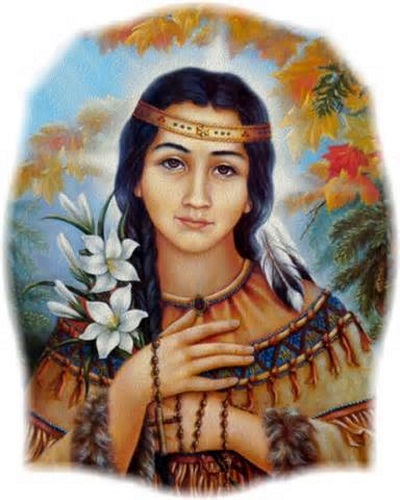
St. Kateri is the first Native American saint. She was born in 1656 to the daughter of a Mohawk warrior and a Catholic Alqonquin.
When Kateri was four years old smallpox attacked her family. Her mother and little brother died from the disease. Kateri’s face was scarred by the disease and she became partially blind. Her two Aunts and an Uncle adopted her.
On Easter, 1676, Kateri was baptized by Jesuit missionary Father Jacques de Lambertville at the age of 20. She was devoted to prayer, penitential practices and the care of the sick and aged in Caughnawaga near Montreal. Her relics are now enshrined in Caughnawaga
Because of her conversion, she incurred hostility from her tribe. She went to a new Christian colony in Indianan, Canada. She was devoted to the Eucharist and to “Christ crucified.” She spent much time praying before the Blessed Sacrament. Her motto was
“Who can tell me what is most pleasing to God that I may do it?”
At the age of 23 Kateri died on Wednesday of Holy Week, at approximately 3 p.m. Within fifteen minutes after her death, her face, which was marked by smallpox, was healed and became beautiful. Father Cholone called others to see what had happened.
Miraculous cures at the Sault Mission were frequent that year (1682) and attributed to Kateri. She appeared to many people after her death, always carrying a cross.
She was beatified (declared Blessed) by Pope John Paul II in 1980 and canonized by Pope Benedict XVI at Saint Peter’s Basilica on October 21, 2012
We celebrate St. Kateri‘s feast day on July 14. She was known as “the Lily of the Mohawks”.
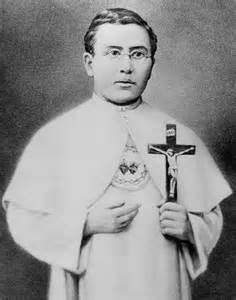
Damien was still in minor orders when he volunteered to go to Hawaii. Two months after his arrival in Hawaii, he was ordained a priest on May 24, 1864.
The Hawaiin King Kamehameha IV created an isolated settlement on the island of Molakai to deal with the public health crisis. Many people were dying of influenza, syphilis and leprosy. Father Damien wished to minister to the sick so he asked his Bishop to send him to Molokai knowing the risk of death.
When he arrived in Molokai, there were 600 lepers for him to minister to. He built the Parish Church of St. Philomena for the people to learn the Catholic faith. He restored personal pride and dignity to people who needed hope. He provided care and comfort for sixteen years. working as a priest, doctor and builder. He built houses, a school and an orphanage. Not only did he dress their ulcers, he also built over 600 coffins and dug graves.
Father Damien said ” My greatest pleasure is to go there (the cemetery) to say my beads, and meditate on that unending happiness which so may of them are already enjoying.”.
In 1885, Father Damien contracted leprosy. In his final years, he enlarged his orphanages and sought help. St. Marianne Cope came with her sisters to help him while he was ill. She reassured him she would carry on his work.
Father Damien died at the age of 49 on April 15, 1889.
The feast day of Father Damien is celebrated on May 10.
Father Damien was beatified by Pope John Paul II on June 4, 1195.
St. Damien was canonized by Pope Benedict XVI on Oct. 11, 2009.
St. Damienis known as “The Apostle of the Lepers.”
St. Damien of Molokai is the patron saint of Hawaii, leprosy and the outcast.
St. Marianne cope Public Domain Image
St. Marianne Cope
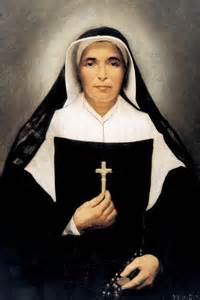
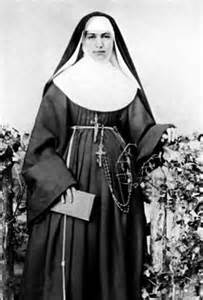
St. Marianne Cope was the first Franciscan woman from North America to become a saint.
The birth name of St. Marianne Cope was Barbara Koob (now officially Cope) She was born on Jan 23, 1838 in SE Hessen, West Germany. She was one of ten children. Her father was a farmer. The family moved to the United States one year after her birth.
Her vocation to the religious life was delayed by the necessity to support her family when her father became ill. At the age of 25, Barbara entered the Sisters of St. Francis in Syracuse, New York. She received her religious habit and the name of Sister Marianne. She served as a teacher and principal in several elementary schools in New York. She also helped establish two of the first hospitals in central NY. In 1870, she became a nurse administrator at St. Joseph’s in Syracuse, NY.
In 1882, a priest requested help managing hospitals and schools in Hawaii; primarily working with leprosy patients. She responded to his letter with the following words.
“I am hungry for the work and I wish with all my heart to be one of the chosen ones, whose privilege it will be to sacrifice themselves for the salvation of the souls of the poor Islanders…I am not afraid of any disease, hence, It would be my greatest delight to minister to the abandoned lepers.”
Along with six other sisters of St. Francis, she arrived in Honolulu in Nov. 1833. Mother Marianne was the supervisor as they managed Kakóako Branch Hospital on Oahu which treated 200 leprosy patients. They began by thoroughly cleaning the hospital. They also opened a home for the healthy daughters of the patients who were ill.
Mother Marianne met Fr. Damien (now St. Damien…the Apostle to Lepers) in January 1884 while he was still healthy.
In 1887 the new government in charge of Hawaii closed the Hospital. In 1888, she went to Kalaupapa several months before the death of St. Damien. She reassured him she would provide care for the patients at the Boy’s Home at Kalawao on the Island of Molokai.
Three Sisters ran the Bishop Home for boys and girls.
Mother Marianne died in Hawaii of natural cause on August 9, 1918 and is buried on the grounds of Bishop Home.
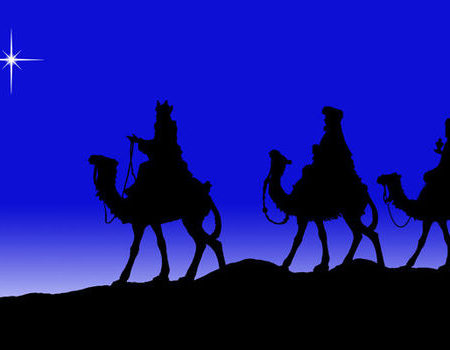
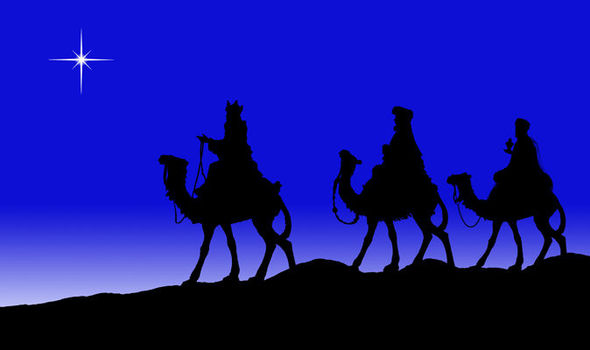
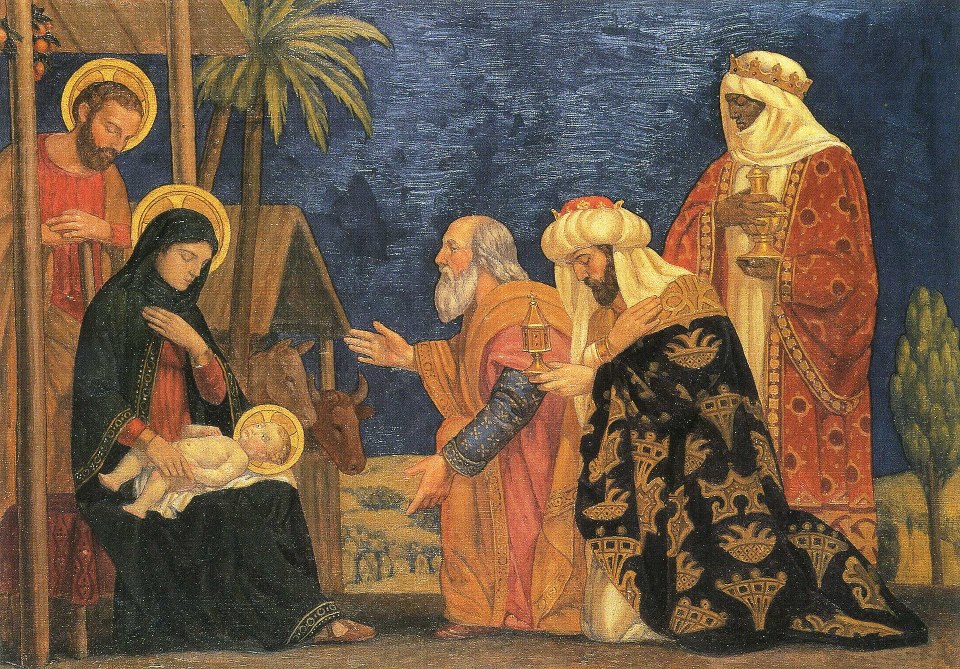
The Christmas season ends with the Feast of the Epiphany. The celebration takes place on January 6th. It is time to reflect on the journey of the Three Wise Men, bearing gifts for the Christ-child…Jesus.
Are we searching for Jesus? We will have difficulty finding God if we look for him as a scientist would…through a microscope or a telescope. We can find him in creation, but I have found that letting God know I am open to the truth and asking Him to reveal the truth to me has helped me on my journey towards God. God is Truth. God is Love. God is mercy. Let Him lead you.
What gifts do we give to Our Lord? The wise men brought gold, frankincense and myrrh. These gifts symbolize the importance of the gifts of time, talent and treasure. Do we spend time in prayer? Do we offer God the gift of our life? If our talents are given to us by God, do we use our talent to serve Him?
The three gifts also symbolize the royal priesthood of Jesus. Gold symbolizes a kingdom. Myrrh symbolizes bitterness, suffering, and affliction. Frankincense is considered a symbol of prayer. (Let my prayer rise like incense!)
Life is a journey…a pilgrimage. The wise men followed a star. They knew it would lead them to God. How are we letting God lead us? Do we have the wisdom to know that we need help? Do we have the wisdom to ask for help in making decisions on our pilgrimage? What does God want us to do for Him? How Does God want us to serve Him?
The answer to these questions are different for everyone. God is a personal God. He knows us by name and wants to speak to us. Listen!
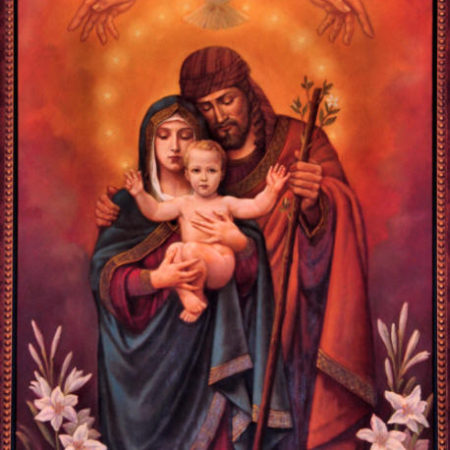
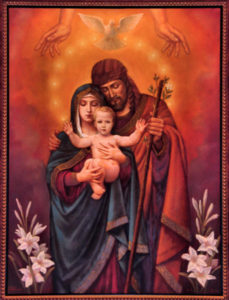
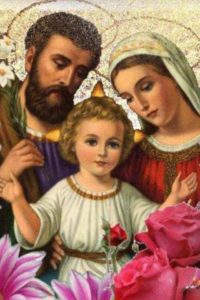
The Feast of the Holy Family is celebrated the first Sunday after Christmas. It is a time to reflect on the love and tenderness Jesus, Mary and Joseph had for one another. How can we improve our own family lives to be more loving?
One way to celebrate the Feast Day of the Holy Family is to make an act of consecration. An act of consecration is a sacred act and should be done in a very prayerful way. It needs to be prayed deeply. and slowly..from the heart.
Consecration to the Holy Family Prayer
O Lord Jesus, you lived in the home of Mary and Joseph in Nazareth. There you grew in age, wisdom and grace as you prepared to fulfill your mission as our Redeemer. We entrust our family to you.
O Blessed Mary, you are the Mother of our Savior. At Nazareth you cared for Jesus and nurtured him in the peace and joy of your home. We entrust our family to you.
O Saint Joseph, you provided a secure and loving home for Jesus and Mary, and gave us a model of fatherhood while showing us the dignity of work. We entrust our family to you.
Holy Family, we consecrate ourselves and our family to you. May we be completely united in a love that is lasting, faithful and open to the gift of new life. Help us to grow in virtue, to forgive one another from our hearts, and to live in peace all our days.
Keep us strong in faith, persevering in prayer, diligent in our work, and generous toward those in need.
our home, O Holy Family, truly become a domestic church where we reflect your example in our daily life. Amen.
Jesus, Mary and Joseph, pray for us!
Short Prayer to the Holy Family
Jesus, Mary, and Joseph, I give you my heart and my soul; Jesus Mary, and Joseph, assist me in my last agony; Jesus, Mary, and Joseph, may I breathe forth my soul in peace with you.
“If you want to bring happiness to the whole world, go home and love your family.”