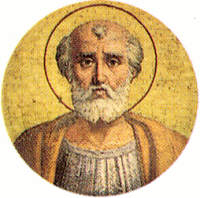
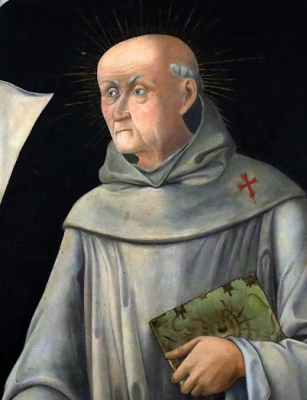
The feast day of St. Denis and Companions is celebrated on October 9. St. Denis is the patron saint of France and against headaches.
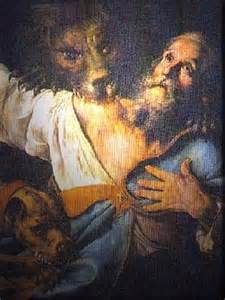
St. Denis was born and raised in Italy. He is also known as St. Dionysius. He was sent to Gaul by Pope St. Clement. He is probably the first Bishop of Paris. St. Denis was martyred along with two companions according to the writings of St. Gregory of Tours. His companions are believed to be St. Rustreus and St. Eleutherius, a priest and deacon. They were beheaded with a sword under the persecution of Emperor Valerius in 258. The head of St. Denis was carried into the nearby village before their bodies were thrown into the Seine River. St. Denis body was recovered and a chapel was built over his tomb.
St. Denis is one of the 14 helperswho were invoked in the middle ages against the Black Plaque. It is for this reason he became the patron saint against headaches.
Remember that this life is short, and that eternity is very long.
The Feast Day of St. Francis of Assisi will be celebrated on October 4th. He is the patron saint of the environment, peacemakers, and animals.
St. Francis was born in 1181 in Assisi, Italy. His father was Pietro di Bernardone, a wealthy cloth salesman. Francis was indifferent to school. He enjoyed good times with his friends. He was attracted to the military and was a prisoner of war for two years. He returned home, probably ransomed by his family, returning to his old life, however he became very ill. When he recovered, he returned to the military, however, in a dream he was told to return home. He was told to “serve the Master rather that the man.” His dream changed him. He turned from his wild ways and began to serve God. While praying in a neglected chapel in San Damiano, Christ spoke to him from the crucifix, saying;
“Francis, go out and build up My house, for it is nearly falling down.”
Francis took this quite literally, and began to repair the old chapel. In need of money, he took some of his father’s cloth and sold it. His father accused Francis of theft. At the hearing before the bishop, he was told to return the money. Francis obeyed; however, he also removed his clothes returning them to Pietro and declaring:
“I have called you father on earth, but now I say, “Our Father, who art in heaven.”
St. Francis embraced poverty. “Love of Lady Poverty” was how he described his belief that possessions were a detriment to his spirituality. After two years of living as a hermit and begging for money to repair the church, he began to attract followers to his way of living. He owned nothing, wanting to live a life of complete poverty. He lived his life caring for the poor and preaching the gospel, primarily through example. He once said;
“Preach always, and when necessary, use words.”
The heart of St. Francis message was joy, based on the love of Christ. He served primarily the poor, including the lepers of the time. He had a strong devotion to the Eucharist and the Cross.
By 1210 his group had grown to a dozen men. He received permission to form an order from Pope Innocent III. Originally it was called the Humbler Brethren, or Friars Minor. They became known for the brown robes they wore. By 1219 they numbered 5,000.
Clare Sciffo was sixteen years old when she heard Francis preach. Against her parents will she became a nun under St. Francis care. Her order became known as the Poor Clares.
St. Francis became friends with St. Dominic, whom he met while begging. St. Dominic recognized him from a dream in which he had seen Francis. When Dominic met him he embraced him saying;
“You are my companion and must walk with me.
If we hold together, no earthly power can withstand us.”
The Franciscans and Dominicans had different spiritualities, but Francis and Dominic were lifelong friends.
Some of the Franciscans wanted to change the rule of poverty. They wanted to own books so they could study scripture like the other monasteries of the time. This was contrary to Francis’ love of Lady Poverty. He went to see St. Dominic, who came up with a solution. The Franciscans were allowed to have a library, loaned to them by the Dominicans!
The Franciscans today have several different orders. There rule of poverty is not as strict as the original order.
Later, in his life, St. Francis received the stigmata (the wounds of Christ). These wounds were real and painful, a sign of how close he had come to the cross. He also suffered from a painful eye disease.
St. Francis composed several hymns, includingCanticle of the Sun. He is also known for his love of nature. Animals and birds had no fear of him and he was known for his friendships with traditionally wild creatures. It is St. Francis who started the tradition of a Christmas Crèche which honored the animals present in the stable when Christ was born.
St. Francis died in the year 1226 at the age of 45, praying the 141st Psalm and his Canticle of the Sun. His final prayer was:
“O Lord, I thank You for the pains which I suffer.”
Two years after his death, St. Francis was canonized on July 16, 1228 by Pope Gregory IX.
“My Lord, I am all yours. You know I have nothing besides my tunic, cord and underpants. And even these three things are yours.
So what can I give You?”
Quote of St. Francis of Assisi
St. Francis of Assisi in Art
St. Francis of Assisi
St Francis of Assisi Stigmata
Shrine of St. Francis of Assisi
Public Domain Image
Bl. Ambrose of Sienna was born on April 16, 1220. He was born with a congenital deformity. Cared for by a nurse, she took him to Mass at The Dominican Church of St. Mary Magdalene.
It was noticed that little Ambrose was always calm near the altar. When they left the altar he would cry. At about the age of a year while they were near the altar Ambrose distinctly pronounced the sacred name of Jesus. He was instantly healed of his deformity.
Not surprisingly, Ambrose was a very pious child. At the age of seven he spent his time in meditation and praying the Little Office of the Blessed Virgin. His Father was an illuminator of books. One of the gifts he gave Ambrose was a book of saints. It became Ambrose favorite book.
At the age of 17 Ambrose joined the Dominican Friars. He was sent to Paris to study with St. Albert the Great. St. Thomas Aquinas was a fellow student. Ambrose was influenced by the writing of St. Thomas Aquinas which convinced him to preach rather than write.
Bl. Ambrose preached in Germany, France and Italy, living a life of constant prayer. He became known as a peacemaker. He restored peace between Venice and Genoa and also Florence and Pisa. He was sent on many peacemaking missions.
Bl. Ambrose was given the gift of ecstasy and vision. After his death miracles were reported at his tomb.
If the highest aim of a captain were to preserve his ship,
The Feast Day of St. Bruno is celebrated on October 6. He is the founder of the Carthusian Order.
St. Bruno was born at Cologne, Germany in 1030. He studied in France and was ordained a priest. For 18 years he was a professor of theology. He then became the Chancellor of the archdiocese. He supported the reform of clergy by Pope Gregory VII and removed his own archbishop because of scandal.
St. Bruno had a great love of silence and solitude. He received a vision from God showing him a hermitage where he should spend his life growing closer to God. Along with friends, St. Bruno opened a hermitage in Chartreuse. Their order became known as the Carthusians. The hermitage was in a mountainous, desert region which was very isolated. The hermits lived in private cells, coming together for Matins and Vespers each day. The rest of their day was spent in solitude. They ate together only on great feast days. Their time was spent copying manuscripts.
Pope Urban II requested St. Bruno to come to Rome as an advisor. When the pope fled Rome Bruno moved to Calabria after turning down an offer to become a bishop.
St. Bruno died of natural causes on October 6, 1101.
Although he was not formally canonized, Pope Clement X extended his feast day to the whole church in 1674.
The Feast Day of St. Theodore Guerin is celebrated on October 3. She is the patron saint of the Diocese of Lafayette, Indiana.
St. Theodore Guérin’s birth name was Anne Thérése. She was born on Oct. 2, 1798 in Etables, France. Her father served in Napoleon’s navy. At the young age of 15 her father was murdered by bandits while traveling home for a visit.
Anne Thérése turned to God in the difficult years following his death. At the age of 25 she entered the Sisters of Providence to serve the poor, sick and dying. Anne Thérése became Sister Theodore. She was asked to lead a small missionary band of Sisters to the United States in Indiana.
Mother Théodore accepted the mission in spite of her fragile health. She could only consume soft, bland food and liquid. She traveled to the Unites States with five other sisters. After surviving a violent storm at sea in the trip Mother Théodore wrote the following:
“What strength the soul draws from prayer! In the midst of a storm, how sweet is the calm it finds in the heart of Jesus. But what comfort is there for those who do not pray?”
Mother Théodore established schools in Indiana and Illinois. She is described as saintly by people who knew her.
Sixteen years after coming to the United States she died. She is buried in the Church of the Immaculate Conception in St. Mary of the Woods, Indiana.
St. Théodore Guérin was beatified on Oct. 25, 1998 by Pope John Paul II.
St. Théodore Guérin was canonized on Oct. 15, 2006 by Pope Benedict XVI.
“If you lean with all your weight upon Providence,
Marie Therese Martin was born at Alencon, France on Jan. 2, 1873. St Thérèse of Lisieux is the patron saint of florists, missionaries, pilots and against tuberculosis.
The father of St. Thérèse, Louis Martin, was a watchmaker. Her Mother, Zelie was a lace maker. She died when Thérèse was four year old. Pope Francis canonized both Louise and Zelie as saints on Oct. 18, 2015. All five of their daughters entered religious life. The family attended daily Mass, visited the elderly and the sick and helped the poor.
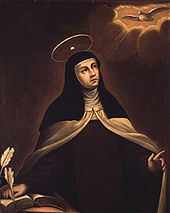
St. Thérèse felt called into the religious life at the age of 15. She asked permission to enter the Carmel of Lisieux a Carmelite convent. She took the name of St. Thérèse of the Child Jesus and the Holy Face.
St. Thérèse had a childlike trust in the providence of God and in His merciful love. Her life as contemplative Carmelite was short but it influenced many souls. She was declared a Doctor of the Church by St. Pope St. John Paul II in 1997.
During her nine years living as a Carmelite Nun St. Thérèse became known for her spirituality. Her love of God was profound and she wanted to share that love with others. She developed her “Little Way” which was her way of loving Jesus. When asked to explain it, she replied:
“It is the way of spiritual childhood, the way of trust and absolute self-surrender. I want to point out to souls the means that I have always found so completely successful…to tell them there is only one thing to do here below…to offer Our Lord the flowers of little sacrifices and win Him by our caresses.”
St. Thérèse’s spirituality began with scripture and the gospels. She offered any suffering in her life to God and trusted in Him completely. She found joy in suffering for it united her to the cross and the Passion of Our Lord. She also had a devotion to the Sacred Heart of Jesus.
“How little known is the merciful love of the Heart of Jesus! It is true that to enjoy that treasure we must humble ourselves, must confess our nothingness . . . and here is where many a soul draws back.”
St. Thérèse liked to use the image of flowers, especially roses, in her prayers. She considered each sacrifice a flower given to God. She compared souls to flowers, each one unique.
St. Thérèse came down with tuberculosis and died after several years of suffering at the age of 24 on Sept. 30, 1897. She was canonized in 1925.
The autobiography St. Thérèse wrote, The Story of a Soul, was published the year after her death.
“I want to suffer and even rejoice for love, for this is my way of scattering flowers. Never a flower shall I find but its petals shall be scattered for you, and all the while I will sing, yes sing, even when gathering my roses in the midst of thorns, and the longer and sharper the thorns may be, the sweeter shall be my song!”
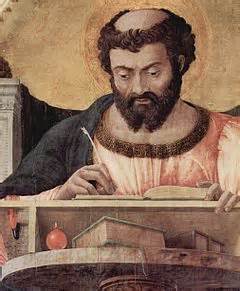
The Feast Day of St. Jerome is celebrated on September 30. He is the patron saint of Bible scholars. He is considered one of the four great Doctors of the Church along with St. Ambrose, St. Augustine and St. Gregory of Nazianzus.
St. Jerome was born in Dalmatia around 340-342 A.D into a wealthy family. His father was a Christian and made sure he was well educated. His mother was a pagan. At the age of 20 he visited Rome. He enjoyed visiting the tombs of the martyrs and the Apostles and converted to Christianity. He was baptized by Pope Liberius in 360.
St. Jerome studied theology and then began life as a hermit in the Syrian desert. He was ordained a priest in Antioch at about the age of 40. He then went to Constantinople where he met St. Gregory of Nazianzus. He became the secretary for Pope Darnasus who commissioned him to translate the Bible. This project took him 30 years.
While living in Rome he was known for his personal holiness, learning and integrity. He was, however, disliked by many for his blunt sarcasm. He left Rome and went to Bethlehem where he established a monastery. He lived in prayer and study until the end of his life.
In art, St. Jerome is often shown with an angel with a trumpet. He was believed to have had a dream when he was seriously ill. In the dream he appeared before God’s judgment seat and was condemned for not being a Christian.
St. Jerome died peacefully on September 39, 420 after sufferingfrom an illness for two years.
“The letters of the apostles are spiritual rain for us.”
The Feast Day of St. Wenceslas is celebrated on September 28. He is most remembered for the Christmas Carol Good King Wenceslas. He became King of Bohemia at the age of 18.
King Wenceslaus was born to the Duke of Bohemia. His family had been converted by St. Cyril and St. Methodius. His mother however, was a pagan. After her husbands death she persecuted Christians.
The Duchess Ludmilla was the mother in law of Drahomira and grandmother to Wenceslaus. She taught him about religion. He practiced his faith and received the sacramentsin secret.
When he became King of Bohemia the persecution ended. He built churches, recalled priests from exile and welcomed Christian missionaries into Bohemia.
St. Wenceslaus had a strong devotion to the Eucharist and helped prepare the altar bread with his own hands. He also made wine from wheat and grapes he grew himself.
A reconciliation was attempted with his family when they gathered at a banquet on the Feast of St. Cosmas and Damien (Sept. 27). The next morning his brother killed him with a lance on the steps of the church. Two years before, his mother had arranged for his grandmother Ludmilla to be strangled to death. The feast day of St. Ludmilla is celebrated on September 16.
The good king died at the age of 22. Miracles were reported at his tomb.
The Christmas Carol sung about Gook King Wenceslaus reminds us to serve others as the good King did. To think less of ourselves and to see Christ in the poor.
“God has not created poverty……it is we who have created it.
The Feast Day of St. Vincent de Paul is celebrated on September 27. He is the patron saint of charities, hospitals and volunteers.
St. Vincent was born at Pouy, Gascony in Southern France in 1581 into a large peasant family. At the age of 15, he entered a Franciscan seminary. He tutored children until he was ordained a priest in 1600.
In `1605, St. Vincent was traveling on a ship from Marseilles to Narborne when he was captured by Moorish pirates! He was sold as a slave in Africa. After two years as a slave, he escaped and returned to France.
At Avignon St. Vincent continued to study. He became the chaplain to the Count of Goigny and was placed in charge of the charities for the poor. This inspired him to preach missions to provide relief for the poor. St. Vincent founded a missionary group known as the Vincentians. The priests in the Order served people primarily in small towns and villages. They had a devotion to helping the poor.
Next, St. Vincent along with the help of St. Louise de Marillac, founded theSisters of Charity. He organized the rich women in Paris to collect money for his missionary projects, including several hospitals. He also collected money for victims of war and ransomed over 1200 slaves from N. Africa.
The motto of St. Vincent was “God sees you”. He became known as the Apostle of Charity and the Father of the Poor.
St. Vincent died at the age of 80. His heart remains incorrupt and can be found in the Convent of the Sisters of Charity in Paris. He is credited with two miracles. The first was the curing of a nun with ulcers. The second was a laywoman cured of paralysis.
St. Vincent de Paul was canonized by Pope Clement XII on June 16, 1737.
St. Vincent’s bones and heart are perfectly incorrupt and have been placed inside a wax figure of his body. His relics can be seen in the Church of St. Vincent de Paul in Paris.
Do not feel that all is lost because of the revolt you feel inside. It has rained hard. The thunder has crashed. Is the weather any less beautiful because of that? Be assured you are not, for all that, any less dear to our Lord.
The Feast Day of St. Terese Couderc is celebrated on September 26. She is the founder of the Cenacle Sisters.
St. Terese was born in Masle, France on Feb. 1, 1805. She joined the Sisters of St. Regis. St. Terese and Father Stephen founded the Congregation of Our Lady of the Retreat in the Cenacle. She became its superior in 1828, and when the mother house was established, its superior general until 1838. St. Terese helped to conduct spiritual retreats.
The spirituality of St. Terese focused on surrendering her life to the will of God. She experienced a vision which clarified for her the goodness of God in all creation.
On September. 26, 1885 St. Terese died of natural causes in Lyon, France at the age of 80. She was canonized in 1970 by Pope Paul VI.
Take a step at a time in the darkness, and the path will unwind beneath your feet. It is not necessary to understand God’s purposes. Just follow His will.
The Feast Day of Bl. Herman the Cripple is celebrated on September 25. He is the patron saint of the unborn child and the disabled.
Bl. Herman was the son of the Earl of Altshausen in southern Germany. He was born with a cleft palate, cerebral palsy and possibly spina bifida. The doctors told his parents he would not live past five years of age. He lived to be 41.
Herman had trouble with both moving and speaking. His parents cared for him until the age of seven. He was then given to the Abbey of Reichenau to be cared for. The monks raised him in the Benedictine monastery where he became interested in theology and the spiritual world. In spite of his disabilities, Bl. Herman was very intelligent. He studied math, astronomy, theology, history, poetry , Arabic, Greek and Latin. He built musical instruments and was known for his poetry. At the age of 20 Herman became a Benedictine monk.
Towards the end of his life Herman suffered from blindness. He began writing hymns. The most famous are the Salve Regina, Hail Holy Queen and Redemptoris Mater. Bl. Herman used prayer and music to grow closer to God.
Bl. Herman died at the age of 41 in 1054. Because so many children with disabilities die because of abortion, Bl. Herman is the saint of the unborn child. He is also the patron saint of the disabled.
Hail Holy Queen
Hail Holy Queen, Mother of Mercy! Our life, our sweetness, and our hope!
To thee do we cry, poor banished children of Eve. To thee do we send up our sighs, mourning and weeping in this valley of tears. Turn then, most gracious advocate, thine eyes of mercy towards us; and after this, our exile show unto us the blessed fruit of thy womb, Jesus.
O clement, O loving, O sweet Virgin Mary. Pray for us, O Holy Mother of God, That we may be made worthy of the promises of Christ.
The Feast day of St. Gerard Sagredo is celebrated on September 24. He is a martyr and patron saint of Hungary.
St. Gerard was born in Venice in 980. He went on a pilgrimage to the Holy Land but his ship landed at Istria. He became the educator of the prince and played a role in the conversion of Hungary to Christianity.
St. Gerard became the first Bishop of Csanad in 1030. After the death of the King, St. Stephen, he refused to serve the new King. Persecution against Christians became common.
St. Gerard was martyred on September 24, 1046. Legend states he was placed in a wooden barrel hauled to the hilltop and rolled down what is now named Gillert Hill. At the bottom he was beaten to death.
St. Gerard Sagredo was canonized in 1083.
“It is in loving the cross that one discovers his heart.”