The Feast Day of St. Thomas the Apostle is celebrated on July 3. Thomas was also called Didymus which means twin. St. Thomas is the patron saint of India and architects.
Thomas the Apostle was known for questioning things. He was not afraid to ask questions or state his disbelief. Jesus treated him with love and compassion.
St. Thomas was also known as “Doubting Thomas”.After the resurrection Jesus appeared to the Apostles. Thomas was not there and did not believe that Jesus had risen from the dead. When Jesus later appeared to him he said “Peace be with you. Do not doubt but believe.” (John 21:24) St. Thomas also asked Jesus “How can we follow you, when we know not where you are going?” Jesus responded, “I am the way, the truth and the life. Whoever follows me will live forever.”
Thomas was one of the original twelve apostles. He was present at the Last Supper. He was also present when Jesus had the Apostles lower their nets and they miraculously caught many fish. After the resurrection, St. Thomas was sent to evangelize the Parthians, the Persians and India. He is believed to have built the first church in India. St. Thomas died a martyr’s death when at Calamine in India he was speared to death while praying.
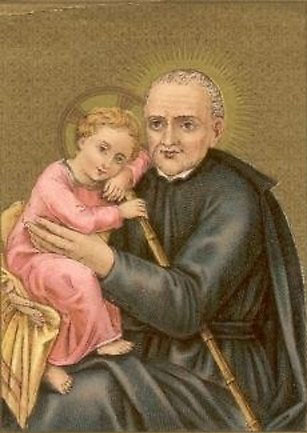
The Feast Day of St. Bernadino Realino is celebrated on July 2. St. Bernadino is the patron saint of advertising and communication.
St. Bernadino was born to a noble family of Capri, Italy in 1530. He studied medicine and law at the University of Bologna. He received his doctorate in 1563. After attending a retreat giving by the Jesuits, Bernadino realized he had a religious calling. He joined the Society of Jesus and was ordained a Jesuit priest in 1567. After ministering to the poor and the youth of Naples for several years he was sent to Lecce where he served for 42 years.
St. Bernadino was a powerful preacher and confessor. He was known for his acts of kindness and serving the poor. He died in 1616. His fame occurred after his death when his body was found to be partially incorrupt when his tomb was opened in 1711.
St. Bernadino Realino was canonized by Pope Pius XII in 1947.
It has hands to help others.
It has feet to hasten to the poor and the needy.
It has eyes to see misery and want.
It has ears to hear the sighs and sorrows of women and men.
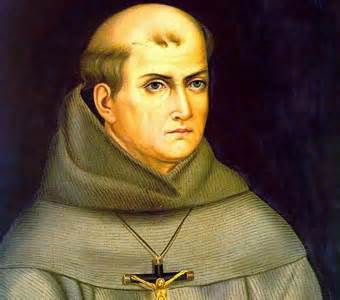
The Feast Day of St. Junipero Serra is celebrated on July 1.
St. Junipero Serra was born Miguel Jose Serra on the Island of Mallorca, Spain in 1713. At a young age Miguel joined the Order of St. Francis of Assisi taking the name Junipero which was the name of St. Francis’ original companion friar. Until he was 35, he was a student and them a professor. He was well known for his preaching ability.
Suddenly he gave up his life as a professor. He volunteered to serve in the Franciscan missions in the new world. He traveled by ship to Vera Cruz, Mexico and then walked with a companion the 250 miles to Mexico City. The Franciscans of Mexico were asked to take over the missions in Baja, California. It became Father Serra’s responsibility. St. Serra established nine of the missions in California. He baptized over 6,000 people and confirmed over 5,000. He died at the age of 70 and is buried at Mission San Carlos Borromeo.
St. Junipero Serra was beatified in 1988. Pope Francis canonized St. Junipero Serra on Sept. 23, 2015 while visiting the United States. He is the first saint to be canonized on U. S. soil.
We found on our journey, as well as in the place where we stopped,
that they treated us with as much confidence and goodwill
The First Martyrs of the Church of Rome are honored on June 30. The feast day has been celebrated beginning in 1969.
More than half of Rome was destroyed by fire in July of 64. The unpopular Emperor Nero was blamed for the fire but he accused the Christians to cover his own crimes. The martyrs were executed in many different ways. Some were burned alive at night to be used as living torches. Others were crucified and still others were fed to wild animals. The crime they were charged with was “their hatred of the human race”.
There was a large Jewish population in Rome at the time of the persecution. Paul had not yet visited Rome, however there were Christians living there.
The Catholic Church celebrates the Solemnity of St. Paul and St. Peter on June 29.
Both saints were martyred for their faith during the persecution of Nero. St. Peter was crucified upside down by his own request. He did not consider himself worthy to be crucified in the same manner as Our Lord. St. Paul was beheaded. It is possible they were both martyred on the same day.
St. Peter was one of the original Apostles. He was a fisherman before he was called to follow Jesus. He was the brother to the Apostle Andrew. St. Peter was clearly the leader of the apostles. With James and John he witnessed the Transfiguration and the Agony in the Garden. His mother-in-law was cured by Jesus. Originally, Peter’s name was Simon. Jesus asked the apostles, “Who do you say that I am?” Simon said, “You are the Messiah, the son of the living God.” Jesus then said:
“Blessed are you Simon, Son of Jonah, for flesh and blood have not revealed this to you but my heavenly Father. And so I say to you, you are Peter and upon this rock I will build my church and the gates of the netherworld shall not prevail against it. I will give you the keys to the kingdom of heaven. Whatever you bind on earth shall be bound in heaven and whatever you loose on earth shall be loosed in heaven.”
During the crucifixion of Jesus, Peter denied Jesus three times. Jesus also told Peter three times…
“Feed my sheep”.
St. Peter is the patron saint of fishermen.
St. Paul was not one of the original apostles. While persecuting Christians after the death of Jesus, he was thrown to the ground by a bright light. He heard a voice asking him,
“Saul, Saul, why do you persecute me?”
He responded with “Who are you, Lord?” Jesus answered him:
“I am Jesus whom you are persecuting. But get up and enter the city and you will be told what you are to do.”
Paul was blinded by the light for three days after which scales fell from his eyes. He then joined the apostles, becoming known as “The Apostle of the Gentiles”. He wrote many of the epistles in the Bible. He is the patron saint of writers, the press, and missionaries.
Prayer to St. Peter and St. Paul
Grant, we pray, O Lord our God, that we may be sustained by the intercession of the blessed Apostles Peter and Paul, that as through them you gave your Church the foundations of her heavenly office, so through them you may help her to eternal salvation. Through our Lord Jesus Christ Your Son, who lives and reigns with you in the unity of the Holy Spirit, One God forever and ever. Amen
I can do all things through Christ who strengthens me.
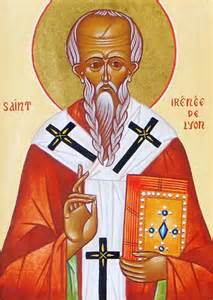
The Feast Day of St. Irenaeus of Lyons is celebrated on June 28.
St. Irenaeus of Lyons is considered a martyr and Church Father. St. Irenaeus was born around 125 in Asia Minor. He was raised in a Christian family, becoming a student of St. Polycarp of Smyrna.
St. Irenaeus was ordained a priest in 177 and became the Bishop of Lyons after the martyrdom of St. Pothinus. He is considered one of the first great Christian theologians. The most well known of his books is titled “Against Heresies”. He defended the holiness of the body and preached to the Gnostics.
St. Irenaeus was martyred in 202 in Lyons, France under the Emperor Septimus Severus.
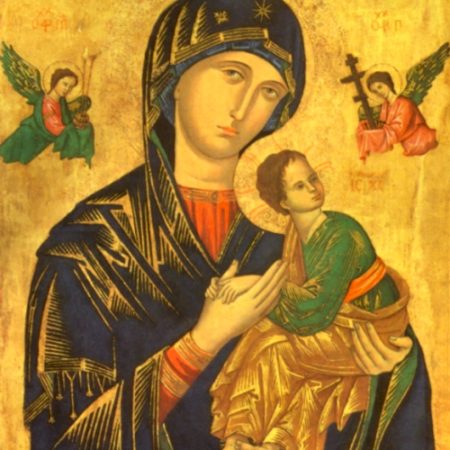
The Feast Day of Our Lady of Perpetual Help is celebrated on June 27.
Many people believe the icon of Our Lady of Perpetual Help was originally painted by St. Luke. It is presently in the Church of St. Alphonsus under the care of the Order of Redemptorists. Numerous miracles have followed the icon.
The icon is an authentic expression of Byzantine art from ancient times. The gold background reflects God’s glory. In the portrait are Mary, the Mother of God, the Christ Child and the Archangels Michael and Gabriel. Mary is gazing at the person who is looking at the icon moving everyone to love Jesus her son and Our Savior. The Christ Child is comforted in his mother’s arms. One of his sandals is almost lost indicating that we sometimes need to seek assistance in our troubles. It is Mary who protected Our Lord in his childhood. She will protect us also.
Our Lady of Perpetual Help Icon Chapel Bydgoszcz
The Icon of Our Lady of Perpetual Help was first venerated in Crete. Tradition tells us however, that in 1480 the icon was smuggled from Crete to Rome by a thief! The smugglers asked Mary for protection during a storm at sea and God answered their prayers. After arriving in Rome, the merchant who had stolen the icon became very ill. He asked his caretaker to return the icon to the Church. The wife of the caretaker however insisted they keep the picture for themselves after the man had died. The Blessed Virgin Mary appeared several times to the man and his wife requesting that the icon be returned to a church. When she was ignored, she began appearing to their six year old daughter, requesting that the icon be placed between the Churches of St. Mary Major and St. John Lateran. Eventually, the icon was returned and enshrined at St. Matthews in 1499. St. Matthews was destroyed when Napoleon’s army invaded Rome in 1798. The icon was believed to be lost.
In 1855, The Order of Redemtorists came to Rome. They were granted possession of the land on which St. Matthew’s previously existed to build a new church. A Redemptorist priest remembered that he had learned as a young boy that the holy icon was in an Augustinian monastery near Rome. The Redemptorists petitioned the pope to allow the image to be returned to the spot the Blessed Virgin had requested that it be placed.
Our Lady of Perpetual Help
On April 26, 1866 the icon was transferred in a solemn procession to the Church of St. Alphonsus. They were given permission to spread the devotion to Our Lady of Perpetual Help.
Prayer to Our Lady:
Mother of Perpetual Help, Woman of Eternal Hope, your wordless gaze tells us so much about you. Knowing eyes look upon us with tender love. The slight bend of your head reveals such maternal concern. While. your left hand supports the Child, your right hand is ready to receive us, too. Just as He feels the beating of your heart, so you encourage us to lead a life of hope and holiness. Just as His sandal will fall on your lap, through your intercession may God pick us up as we stumble and fall. Never let us be parted from you and your son, Jesus.
Lady of love, you invite us to place our hand where His fingers touch yours — near a heart of endless hope — so that we may be united often in prayer here on earth and joined forever with you in heaven. Amen.
Never be afraid of loving the Blessed Virgin too much. You can never love her more than Jesus did.
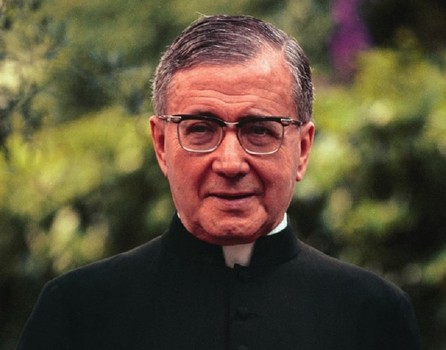
The Feast Day of St. Josemaria Escriva is celebrated on June 26.
St. Josemaria Escriva was born in Barbastro, Spain on Jan. 9, 1902. He was the second of six children and attended Catholic schools. At an early age he learned the meaning of suffering when three of his younger sisters died.
After reflecting on footprints in the snow from a discalced Carmelite, he became aware that he had a religious calling. He decided to study for the priesthood and was ordained a priest in 1925. Within three years in 1928, he was inspired to found Opus Dei which was dedicated to all people following Christ. Married people and non Catholics were allowed to join. Their ministry included working among the poor in schools and hospitals. He also founded the Priestly Society of the Holy Cross. Opus Dei spread to many countries throughout the world.
St. Josemaria is also an author of three popular books: The Way, Furrow and The Forge.
On June 26, 1975, St. Josemaria died in his office suddenly at the age of 73. He was canonized by Pope John Paul II in 2002.
It’s not enough to be good, you need to show it.
What would you say of a rose bush which produced only thorns?
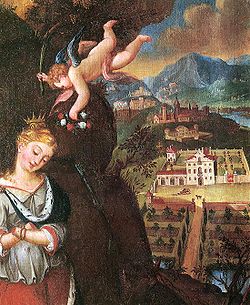
The Feast Day of St. Eurosia is celebrated on June 25. St. Eurosia is considered the patron saint against bad weather.
St. Eurosia was a French martyr. She was born in Bayonne, France into a noble family. Betrothed against her will to a Moore, she escaped through the mountains and hid in a cave. Eurosia was pursued and captured. Her captures dragged her out of the cave by her hair. She was then martyred. Her limbs were amputated and then she was beheaded. At the moment of her death a violent storm came which terrorized her captures.
St. Eurosia’s remains were discovered by a shepherd. Her head remained at the original shrine, but her body was taken to Jaca for burial. Miracles were reported at the original shrine which became a site of pilgrimage.
St. Eurosia was canonized by Pope Leo XIII.
Where the sign of the cross is erected,
the wickedness of the devil is immediately repelled.
The Nativity of St. John the Baptist is celebrated on June. The Feast of the Baptism of the Lord is celebrated on the Sunday after January 6th.
John the Baptist is the last prophet proclaiming the coming of the Lord. We actually meet John when Mary visits her cousin Elizabeth, who is pregnant with John. Elizabeth was filled with the Holy Spirit and exclaimed with a loud cry,
“Blessed are you among women, and blessed is the fruit of your womb. And why has this happened to me that the mother of my Lord comes to me? For as soon as I heard the sound of your greeting, the child in my womb leaped for joy.”( Luke1: 39)
John was actually about six months older than his cousin Jesus.
The next time we hear of John the Baptist he comes out of the wilderness, proclaiming a baptism of repentance for the forgiveness of sins. People from the whole Judean countryside and all the people of Jerusalem were going out to him, and were baptized by him in the river Jordan, confessing their sins. John proclaimed:
“I baptize you with water for repentance, but one who is more powerful than I is coming after me; I am not worthy to carry his sandals. He will baptize you with the Holy Spirit and fire. His winnowing fork is in his hand, and he will clear his threshing floor and will gather his wheat into the granary; but the chaff he will burn with unquenchable fire.”(Matthew 3: 11)
St. John the Baptist baptizing Jesus Public Domain Image
In Matthew 3: 13, Jesus came from Galilee to John at the Jordan, to be baptized by him. John would have prevented him, saying, “I need to be baptized by you, and do you come to me?” But Jesus answered him, “Let it be so now, for it is proper for us in this way to fulfill all righteousness.”
After Jesus had been baptized, the heavens were opened to him and he saw the Spirit of God descending like a dove and a voice from heaven said,
“This is my Son, the Beloved, with whom I am well pleased.”
We learn in Mark 1:14 that it is after the arrest of John the Baptist by King Herod, that Jesus came to Galilee, proclaiming the good news of God and saying, “The time is fulfilled and the kingdom of God has come near, repent, and believe in the good news.”
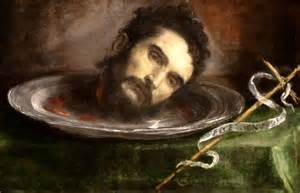
Why was John arrested? The story is told in Mark 6: 17-29. John was arrested and bound in prison on account of Herodias, the wife of his brother Philip, whom he had married. John had said to Herod, “It is not lawful for you to have your brother’s wife.” Herodias harbored a grudge against him and wanted to kill him but was unable to do so because Herod feared John, knowing him to be a righteous and holy man. On Herod’s birthday Herodias’ own daughter came in and performed a dance that so delighted Herod and his guests that Herod promised her whatever she requested. She went to her mother asking “What shall I ask for?” Herodias replied, “The head of John the Baptist.” The girl hurried back to King
St. John the Baptist Public Domain Image
Herod saying “I want you to give me at once on a platter the head of John the Baptist.” King Herod was distressed at the request, but because of his oaths in front of guest he did not wish to break his word to her. So he promptly dispatched an executioner with orders to bring back John the Baptists’ head. The head, on a silver platter, was given to the girl. In turn the girl gave it to her mother.
When the disciples heard about it, they came and took his body and laid it in a tomb.
John the Baptist is most remembered for his call to repentance and baptism. The following is one of his last statements before his death.
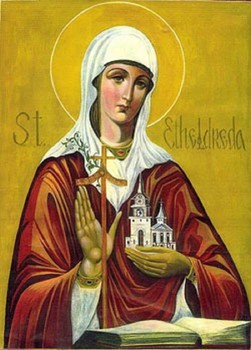
The Feast Day of St. Audrey is celebrated on June 23.
St. Audrey was also known as Etheldreda. She was born an English princess. At her parents insistence, she married a prince named Tonbert. He permitted her to keep the vow of virginity which she had earlier made. However, after three years she was a widow.
She was later forced to marry a king from Northumberland, named Egfrid. After twelve years he tried to change her mind about living as brother and sister. When she refused he tried to bribe the bishop St. Wilfred of York, asking him to release her from her vows. St. Wilfrid refused.
With the permission of her husband St. Audrey became a nun and founded the Abbey of Ely. She died from an enormous growth on her neck in 679. She was not yet 50 years old.
Sixteen years later her body was found to be incorrupt.
Charity is the sweet holy bond that binds the soul with the Creator.
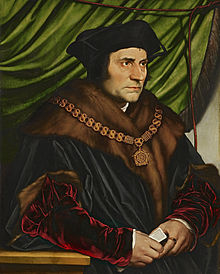
The Feast Day of St. Thomas More is celebrated on June 22. St. Thomas More is the patron saint of lawyers.
St. Thomas More was born in London, England in 1478. He wrote the famous book Utopia which was a work of fiction which depicted a pagan and communist island which was ruled by reason. It touched on many controversial issues and established him as a humanist.
St. Thomas More attended St. Anthony’s School in London and served as a page for the archbishop of Canterbury. He continued his studies at Oxford University eventually becoming a lawyer. He was tempted to become a monk and moved near to a Cathusian monastery near London. He participated as much as possible. Torn becoming a monk or working as a civil servant his desire to become a civil servant won. In 1504, he entered Parliament. Life began to change in 1527 when King Henry tried to use the Bible to prove to Thomas More that his marriage to Catherine of Aragon, who failed to produce a male child, was void. St. Thomas More could not agree with King Henry’s plan to divorce Catherine.
In 1532, Thomas More resigned from the House of Commons because of his health. When More refused to swear to King Henry’s Act of Succession and the Oath of Supremacy he was refusing allegiance to the King.
St. Thomas More was sent to the Tower of London on April 17, 1534 and found guilty of treason. He was beheaded on July 6, 1535. His last words were:
“The king’s good servant, but God’s first.”
St. Thomas More is considered a martyr of the faith. St. Thomas More was canonized in 1935 by Pope Pius XI.