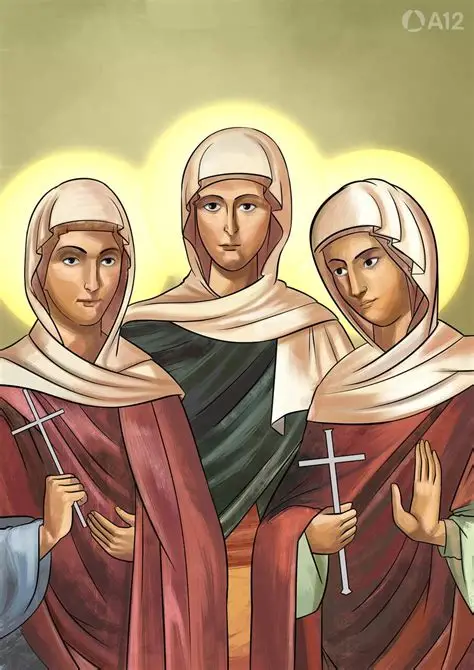
Sts. Irene, Agape and Chionia were sisters living in Salonika. Their feast day is celebrated on April 3. They lived during the reign of Emperor Diocilian in a pagan family. In 303 he issued a decree making it an offense punishable by death to possess sacred Christian writings. The sisters owned several volumes of Holy Scriptures which they kept hidden.
The three sisters were arrested for refusing to eat food that had been offered to the Gods. The governor (Dulcetius) questioned each of them. Agape answered his questions by saying…
“I believe in the living God and will not by an evil action
lose all the merit of my past life”
St. Chionia and St Agape were sentenced to be burned alive. Irene, because of her age was to be imprisoned. After her sisters were executed, the house was searched and the forbidden books were found. Irene was sent to a brothel where she was forced to strip naked. Miraculously she was protected from harm. After once again refusing to conform she was sentenced to death. She died either by being forced to throw herself into flames or by being shot in the throat with an arrow. The books were publicly burned after her death.
The martyrdom of the three sisters is recorded in an existing document.
“It is in loving the cross that one discovers his heart.”
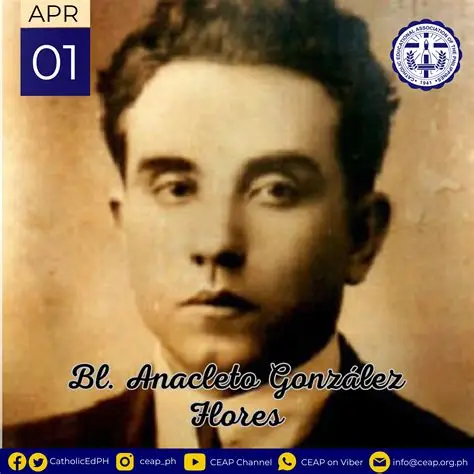
The Feast Day of Bl. Anacleto Gonzalez Florez is celebrated on April 1.
Bl. Anacleto Gonzalez Florez was born on July 13, 1888 in Tepatitlan, Jalisco, Mexico. He studied law during a time of persecution.
Anacleto was greatly involved in social and religious activities and a member of the Catholic Association of Young Mexicans. He taught religious education, wrote articles and books and was dedicated to works of charity. In 1922 he married Maria Concepcion Guerrero and they had two children.
Anacleto joined the League for the Defense of Religious Freedom after four journalists were murdered. He began a weekly newspaper named “Word”. He was periodically imprisoned; however, he preached the gospel to inmates while in prison.
In 1927 guerrilla warfare spread. Anacleto wrote bulletins from his hiding places. He was captured on April 1, 1927 in the home of the Vargas Gonzalez family. He and two of the Vargas brothers were arrested. Anacleto was tortured be being hung by his thumbs until his fingers were dislocated and having the bottoms of his feet slashed. He refused to give his captors any information.
Bl. Anacleto was sentenced to death and was shot with the Vargas Gonzalez brothers and Luis Padilla Gomez on April 1, 1927.
The last words of Bl. Anacleto were….“I die, but God does not die. Viva! Cristo Rey!”
“Well, Lord, if this is how You treat Your friends,
The Feast Day of St. Benjamin is celebrated on March 31.
St. Benjamin was a deacon serving in Persia. There had been twelve years of peace in Persia when Abdas, a Christian bishop, burned the Temple of Fire which was a great sanctuary. King Isdegerd threatened to destroy all Christian churches unless it was rebuilt. When Abdas refused to rebuild the sanctuary, the King proceeded to carry out his threat.
It was during this time that St. Benjamin was arrested. He was imprisoned for one year for his faith. At the end of the year, he was released on the condition that he could not speak about religion.
St. Benjamin declared that it was his duty to preach about Christ and refused to be silent. He was arrested again and tortured. Reeds were thrust between his nails and then withdrawn. A knotted stake was inserted into his bowels to rend and tear him.
St. Benjamin died a martyr in 424. St. Benjamin is the patron of Evangelists.
“The cross means there is no shipwreck without hope;
there is no dark without dawn; nor storm without haven.”
The Feast Day of St. John Climacus is celebrated on March 30.
St. John Climacus was born in Syria in 525. He enjoyed studying science and the arts. In 547, at the age of 16 he dedicated himself to God. He went to Mt. Sinai to live as a hermit. His spiritual advisor was Martyrius. St. John lived in silence and solitude living with humility and obedience. He never argued with anyone. After four years of living as a hermit John made his profession at the age of twenty.
St. John had received from God the power to heal spiritual disorders. One person he healed was named Isaac who was on the verge of despair by temptations of the flesh. St. John could see that Isaac had faith and said to him, “My son, let us have recourse to God by prayer.” They both lay prostrated on the ground in fervent prayer and Isaac felt the despair leave and was filled with peace. Many others came to John for assistance. Due to jealousy, St. John was censored and accused of vanity. John imposed on himself a year of silence. Those who charged him asked him to resume giving advice and told him not to bury the talent given to him by God.
St. John became Abbot of Mt. Sinai and Superior General to all the monks and hermits in that country when he was 75. During a severe drought the people asked him to intercede on their behalf to God. His prayers were soon answered with large rain storms.
After four years as Abbot, he resigned to prepare for death. St. John died on March 30, 605. After his death, his book Ladder of Divine Ascentbecame very popular making him very well known.
“Humility is the only virtue no devil can imitate. If pride made demons out of angels, there is no doubt that humility can make angels out of demons.”
The Feast Day of St. Mark of Arethusa is celebrated on March 29.
St. Mark was a priest in Syria during the reign of Constantine. He became the Bishop of Arethan. There were many conversions to Christianity during this time. Mark undertook the challenge of transforming pagan temples into Christian churches. He faced resistance; however his gentle demeanor, compassion and humility made it possible. However, when Emperor Julian the Apostate succeeded the throne the advances of Christianity came to a sudden halt and persecutions began.
A mob turned on St. Mark. The mob demanded that he pay to have the temple rebuilt. When he refused, they tortured him. They cut off his ears, stripped him naked, smeared him with honey and bound him to a tree for wasps, mosquitoes and hornets to eat. He still refused to pay for the temple to be rebuilt. His endurance impressed the people who began to feel sorry for him. They eventually set him free. Many people who had left the faith because of Emperor Julian began to return to the faith.
St. Mark died on March 28, 389.
“Our discovery of God is, in a way,
God’s discovery of us.
We cannot go to heaven to find Him because we have no way of knowing where heaven is or what it is.
The Feast Day of St. Sixtus III is celebrated on March 28.
St. Sixtus III was born in Rome, Italy. He became the Bishop of Rome on July 31, 432. While he was Pope he defended the authority of the Papacy. He approved the results of the Council of Ephesus.
Pope Sixtus fought against the heresies of Pelagianism and Nestorianism. While defending the teachings of the Church, Pope Sixtus was also sympathetic and tried to heal the divisions within the church.
Nestorianism denied that Jesus was both human and divine. It believed Jesus existed as two distinct persons: the man Jesus and the divine Son of God. It did not accept Mary as the Mother of God but did believe her to be the Mother of Christ.
Pelagianism did not believe in original sin. It also believed grace was not necessary for salvation; it could be attained by free will.
Pope Sixtus restored St. Peter’s Basilica and St. John Lateran Basilica. He died of natural caused on August 19, 440.
“Take care of your body as if you were going to live forever, and take care of your soul as if you were going to die tomorrow.”
The Feast Day of St. John of Egypt is celebrated on March 27.
St. John of Egypt was born in Lycopolis, which is now Egypt, in 214. He worked with his father as a carpenter. He felt a call from God to live a solitary life of prayer in the desert. For ten years he was the disciple of an elderly hermit, whom he considered his spiritual father. When this man died he chose to live in various monasteries to learn the life of a monk.
Eventually, John decided to live in a cave he found in the desert rocks. The cave had three rooms; a living room, workroom and a chapel. He had a single window through which he would preach to people who sought his advice. He would spend five days of the week in solitude with God, but on Saturday and Sunday he would listen to and give advice to people who sought it. Emperor Theodosius the Elder is believed to have sought his advice twice. People brought him food and necessities. He attracted followers who became his disciples. They built a hospice nearby so people could seek his advice.
St. John was known for his gifts of prophecy and healing. He seemed to be able to look into people’s souls and know what they were thinking. Many people were cured after he anointed them with holy oil. In spite of his growing fame, St. John remained humble and lived a very frugal life. St. John died at the age of 90 from natural causes. He was found on his knees as if in prayer.
“The trouble is that everyone talks about reforming others and no one things about reforming himself.”
Quote of St. Peter of Alcantara; Feast day October 19
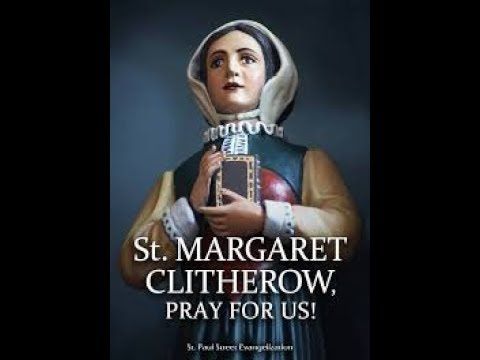
The Feast Day of St. Margaret Clitherow is celebrated on March 26.
St. Margaret Clitherow was born in Middleton, England in 1555. She was raised in the Anglican faith. Her father was Thomas Middleton, the Sheriff of York. She married John Clitherow who was a wealthy butcher. They had two children.
Margaret converted to the Catholic faith after several years of marriage. She began harboring fugitive priests during the persecution of Queen Elizabeth. She also was known to let the priest celebrate Mass on her property. St. Margaret was arrested and put into prison. She refused to deny her faith and sentenced to die by being ‘pressed to death’. At the trial Margaret’s only statement was…
“Having made no offense, I need no trial”.
<
The martyrdom of St. Margaret took place in 1586. St. Margaret was stretched on the ground with a sharp rock on her back and crushed under a door laden with heavy weights. She died within fifteen minutes. Many of her bones were broken. She was 33 years old.
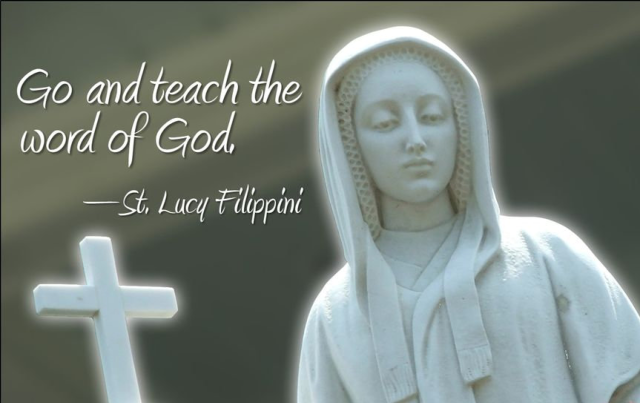
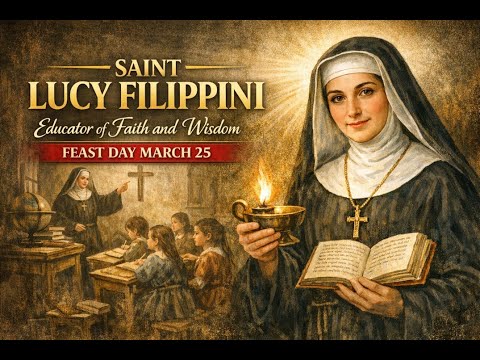
The Feast Day of St. Lucy Filippini is celebrated on March 25. She is the patron saint of teachers.
St. Lucy Filippini was born in Corneto-Tarquinia, Italy in 1672. Her mother died before she turned a year old. Her father died when she was seven years old. Lucy was a very prayerful child. She was raised by her aunt and uncle who had her educated by the Benedictine nuns at Santa Lucia.
Cardinal Marcantonio Barbarigo made a great impression on Lucy when he visited her church. She turned to him for guidance. She had a devotion to Our Lady and wanted to leave the world behind her. The cardinal put Lucy in charge of opening new schools to teach girls.
St. Lucy and Rosa Venerini were Co founders of the Institute of the Maestre Pie which was dedicated to teaching girls, including poor girls. Young girls were taught domestic arts, weaving, embroidery, reading and Christian doctrine. Twelve years later the Cardinal devised a set of rules to guide Lucy and her followers in religious life. Lucy helped to found 52 schools. Pope Clement XI called Lucy to Rome in 1707 to start schools there.
St. Lucy died from breast cancer on March 25, 1732 on the Feast of the Annunciation. Her body lies incorrupt under the altar dedicated to her in the Cathedral of Montefiascone.
The Feast Day of St. Turibius of Magrovejo is celebrated on March 23. St. Turibius was born in Mayorga, Spain in 1538 to a noble family. He was very prayerful as a child. He had a devotion to the rosary and The Little Office of the Blessed Virgin Mary. He studied law at the University of Salamanca. He practiced law as a judge for five years. King Phillip II was impressed by his holiness and wanted him to become a missionary. Turibius protested but eventually he was ordained a priest and then a Bishop in 1581. He was sent to Lima, Peru in South America.
In Peru, St. Turibius established schools, seminaries and hospitals. He learned the native languages to enable him to teach and minister to the people. He made three visitations of the entire diocese staying several days in each community. He denounced the exploitation of the Indians by Spanish nobles and brought about administrative reforms. He was assisted by St. Francis Solarius and St. Rose of Lima.
In 1606 he became seriously ill. Sensing his death he gave all his possessions to the poor before he died. St. Turibius was canonized in 1726.
The Feast Day of St. Catherine of Sweden is celebrated on March 22.
St. Catherine was born in 1331 in Sweden to St. Brigid and Ulfo. At the age of thirteen she was married to Egad, a German nobleman. Catherine convinced him to take a mutual vow of chastity with her. They dedicated themselves to serving God and to a life of prayer.
After Catherine’s father died in 1349 Catherine traveled with her mother to Rome. Shortly after arriving there, she learned of the death of her husband. St. Catherine and St. Brigid stayed in Rome for several years making pilgrimages to various holy places. St. Catherine refused to marry again. After several years, her mother also died. St. Catherine brought the body of her mother back to Sweden. She promoted the cause for her canonization and the approval of the Rule her mother had written for a group of religious women. Catherine became the Abbess of the Convent of Wadstena.
St. Catherine was known for daily participation in the Sacrament of Confession to purify her soul. St. Catherine wrote a book titled Consolation of a Soul. Although she had no children of her own, she counseled women with difficult pregnancies. She is the patron saint against abortion, and for those suffering from miscarriages and difficult pregnancies.
Pope Innocent VIII assigned her the feast day of March 22. She was canonized by Pope Pius II in 1484.
The Feast Day of St. Ambrose Sansedoni is celebrated on March 20.
St. Ambrose Sansedoni was born in Siena, Italy in 1220. At birth, he was very deformed. He needed the care of a nurse. The nurse found that he was most peaceful when he was in St. Mary Magdalene Church near the altar. She reported that an unknown pilgrim said,
“Do not cover that child’s face. He will one day be the glory of this city.”
A few days later the child stretched out his deformed limbs saying the name “Jesus” and was healed; all of his deformities were gone
. As a child Ambrose was very devout. He prayed and meditated during the night. He was drawn to reading the lives of the saints and reciting from the Little Office of the Blessed Virgin.
At the age of 17, he joined the Dominicans in Siena, Italy. He was sent to study for the priesthood in Paris, France and Cologne, Germany with St. Thomas Aquinas. As a priest he devoted himself to preaching and teaching. He became well known for his elegant preaching. He also became a peacemaker; restoring peace between Venice and Genoa and also between Florence and Pisa.
St. Ambrose died of natural causes in 1287. His writings have not survived.
To be an angel in prayer, and a beast in one’s relations with people is to go lame in both legs.