Tag Archives: Virgin

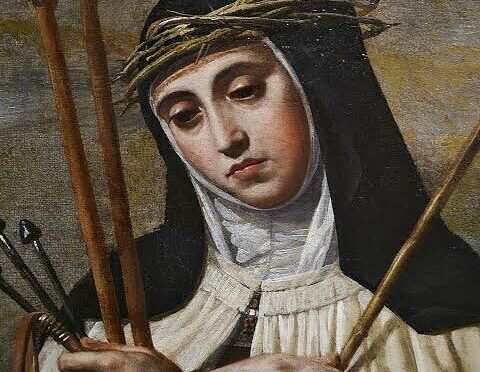
Prayers, Quips and Quotes: St. Mary Magdalene de’ Pazzi, Feast Day May 25

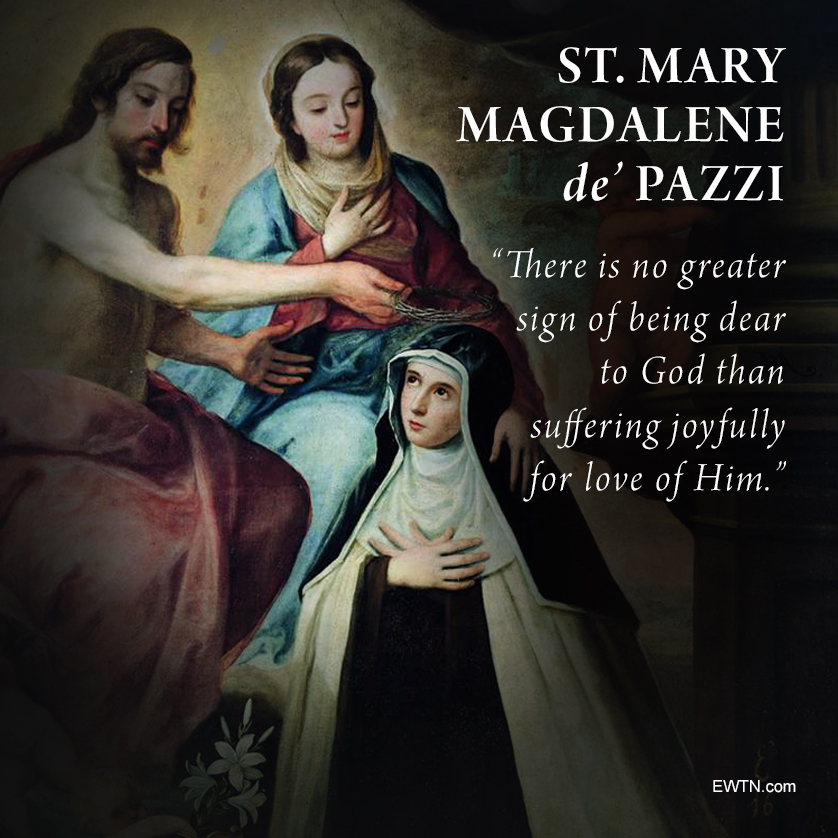
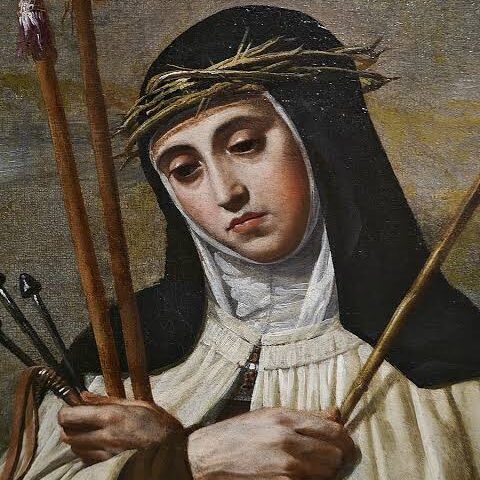
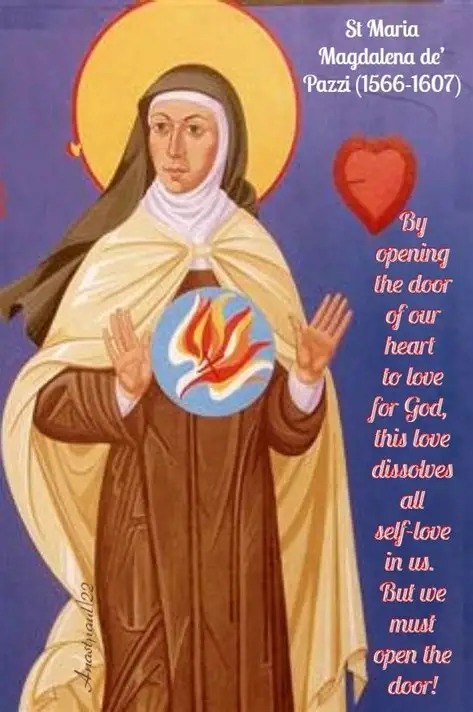
St. Mary Magdalene de’ Pazzi

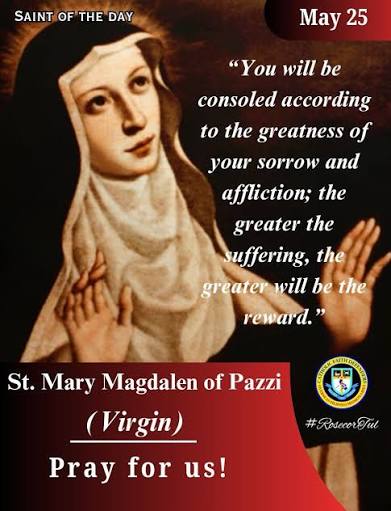
The Feast Day of St. Mary Magdalene de’ Pazi is celebrated on May 25. She is the patron saint of the sick and against sexual temptation. She was a Carmelite nun, virgin, mystic and incorruptible

St. Mary Magdalene was born on April 2, 1607 into a noble family in Florence, Italy. She was baptized with the name Catrina Lucrezia de’ Pazzi.

At the age of 8, Catrina became a student at San Giovannia. The nuns prepared her for her first communion which she received when she was 10 years old. Soon…she made a vow of virginity, knowing she did not desire to marry.

Catrina enjoyed a life of prayer and penance. She especially enjoyed the meditations of St. Augustine and the Lord ‘s Passion by Loarto.
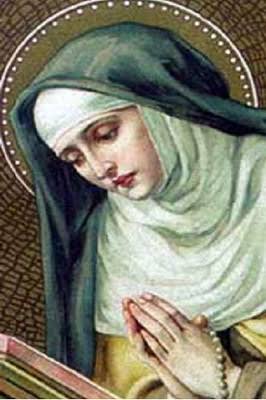
When Catrina was 16, she chose to enter the Carmelite Community of Santa Maria. She was led to this decision because they offerred daily Holy Communion, which was rare during this time.

As a novice, Catrina took the name Mary Magdalene de Pazzi. After a year, she became very ill and was near death. On the Feast of the Trinity, she was allowed to make her profession of vows in the chapel. Immediately, she experienced an ecstasy which lasted two hours. For the following 40 days she experienced ecstasy after receiving communion. She was given a sense of union with God and many insights about divine teachings. During the ecstacies the nuns recorded what she said and did. This resulted in five volumes of books about her life. They are referred to as The Life and Works of St. Mary Magdalene de’ Pazzi.

Mary Magdalene experienced both spiritual ecstasies and dryness with internal suffering. Throughout her life she had a strong devotion to the crown of thorns which Jesus wore during the crucifixion. She joyfully offered her suffering to God.

Mary Magdalene became the novice mistress and the the superior of the Community. She died on May 25, 1607 of natural causes after suffering a painfull illness for three years. Many miracles occurred following her death.

St. Mary Magdalene was beatified on 1626 by Pope Urban III. She was canonized by Pope Clement X on April 28, 1669.

The incorruptable body of St. Mary Magdalene de’ Pazzi lies preserved in a glass coffin within the Carmelite Monastery of Santa Maria degli. Angel in Florence.
Prayer of Mary Magdalene de’ Pazzi

Come, Holy Spirit. May the union of the Father and the will of the Son…Come to us. You, Spirit of truth, are the reward of the saints, the refreshment of souls, light in darkness, the riches of the poor, the treasures of lovers, the satisfaction of the hungry, the consolation of the pilgrim Church; You are he whom all treasures are contained.

Come, You who, desending into Mary, caused the Word to take flesh; effect in us by grace what you accomplished in her by grace and nature.

Come, You who are the nourishment of all chaste thoughts, the fountain of all clemency, the summit of all purity.

Come, and take away from us all that hinders us from being absorbed in You.
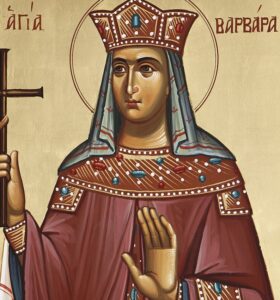
Prayers, Quips and Quotes: St. Barbara, Feast Day Dec. 4

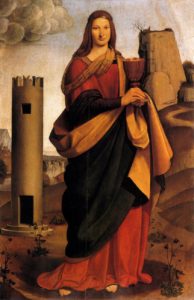
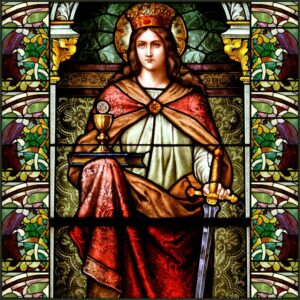
The Feast Day of St. Barbara is celebrated on December 4.  She is one of the Holy Helpers who are known for the healing power of prayer. She is invoked to prevent sudden death.

St. Barbara was a virgin and a martyr. She lived in Sicily in the third century.  Her father was a wealthy Syrian.  When his wife died he devoted himself to his only daughter.  Because Barbara was so beautiful, her father (Dioscorus) decided he needed to protect her from strangers and built her a tower.  She was educated by pagan tutors.

From the tower, Barbara had a wonderful view of the meadows, hills and river.  She developed a spirituality which focused on the beauty of creation by our creator.  She also decided to devote herself to God and to remain a virgin.  Because of her beauty she had many suitors, but she refused to marry.

Barbara’s father wanted her to marry, so he decided to let her come down from the tower and socialize.  Barbara became friends with some Christians. While her father was away she was baptized after being instructed in the faith by a priest.

At the time, a bathhouse was being built on their property.  It had two windows.  Barbara requested a third window to create a trinity of light.  Barbara traced the sign of the cross on one of the walls and it left an imprint on the marble.  The water in the bathhouse  became known for its healing power.

When her father returned from his traveling, he was furious to learn Barbara had converted to Christianity.  He became enraged and almost struck her with a sword.  Barbara fled into the hills and hid in a cave.  She was eventually found and severely beaten.  She was then turned over to the city prefect.  Barbara was then tortured and had her wounds rubbed with a hair cloth.  During the night, after praying for relief, Jesus appeared to her and healed them.  The next day she was beaten again.  A woman in the crown named Juliana denounced the torturers and she was also seized and tortured.

Barbara and Juliana were both tortured and paraded through town naked.  An angel appeared after hearing Barbara’s prayers and gave them splendid robes.  Both Barbara and Juliana were beheaded.   St. Barbara was beheaded by her own father.  Immediately, after the execution, he was struck by lightning.

The relics of St. Barbara were moved in the sixth century to Constantinople.  Six hundred years later they were moved to Kiev.

St. Barbara is known for protecting against sudden death.


“Keep a clear eye toward life’s end. Do not forget your purpose and destiny as God’s creature. What you are in his sight is what you are and nothing more. Remember that when you leave this earth, you can take nothing that you have received…but only what you have given; a full heart enriched by honest service, love, sacrifice, and courage.”
Quote of St. Francis of Assisi   Feast Day Oct. 4


December is the Month of the Divine                       

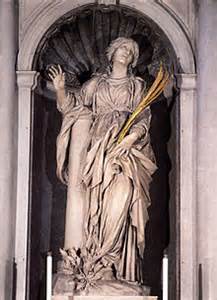
Prayers, Quips and Quotes: St. Bibiana, Feast Day Dec. 2


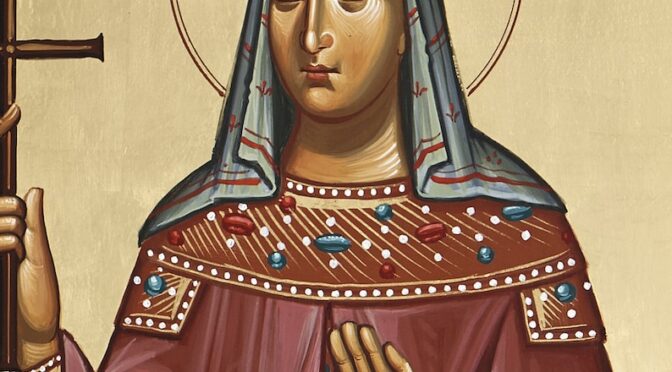
St. Bibiana Public domain Image
St. Bibiana


The Feast Day of St. Bibiana is celebrated on December 2.  She was a virgin and a martyr in the year 361.

St. Bibiana was born in Rome. Her father was a knight, whose name was Flavian. Her mother’s name was Dafrosa. When Apronianus was named the Governor of Rome he persecuted the Christians mercilessly. Flavian was arrested and tortured. He fled into exile where he died from his wounds. Bibiana’s mother, Dafrosa, was beheaded.

Bibiana and her sister Demetria were robbed of all their possessions leaving them in poverty. They did however, stay in their house, spending much time in prayer.

They were summoned by Apronianus. Demetria confessed her Faith and then fell dead at the governors feet. Bibiana was given to a woman named Rufina who tortured her unsuccessfully. Apronianus ordered her to be tied to a pillar and beaten with scourges laden with lead plummets until she died. St. Bibiana endured the torture with joy until her death.

Two days later, a priest buried her next to her mother and sister. A church was built over her grave.

I believe Lord but let me believe more firmly.
I hope Lord but let me hope more surely.
I love, Lord, but let me love more warmly.
I repent Lord but let me repent more deeply.
Quote of St. Antony Claret; Feast Day October 24
December is the Month of the Divine Infancy

SaveSave