Category Archives: Featured

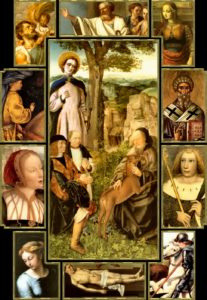
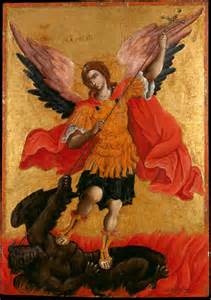
Who were the 14 Holy Helpers?

icon 14 holy helpers

Intercessory prayer has always been an important form of prayer in the church. The church believes that we can and should pray for each other. This does not end when we die. The saints are closer to God than we are. We ask them to pray for us in our time of need. This is called intercessory prayer.

During the black plague, which lasted from 1346-1349, a number of saints gained great popularity for their ability to intercede and were given credit for many miraculous cures. They became known as the Holy Helpers. A feast day was created to celebrate their sanctity and celebrated on August 8. in 1969, this feast day of the Holy Helpers was dropped because of the reform of the liturgical calendar. The 14 Holy Helpers are still popular today.

All of the Holy Helpers except St. Giles were martyrs. Symptoms of the plague were a black tongue, painful throat, severe headache, fever, and boils on the abdomen. It came on suddenly and could result in death within hours. The people who contracted the disease turned to the Holy Helpers to intercede for them during the frightening experience.

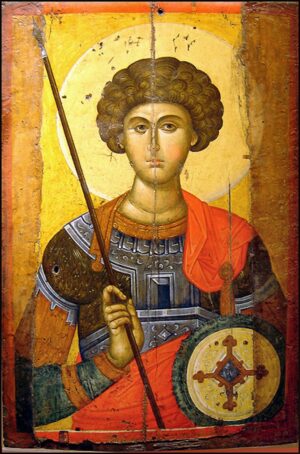
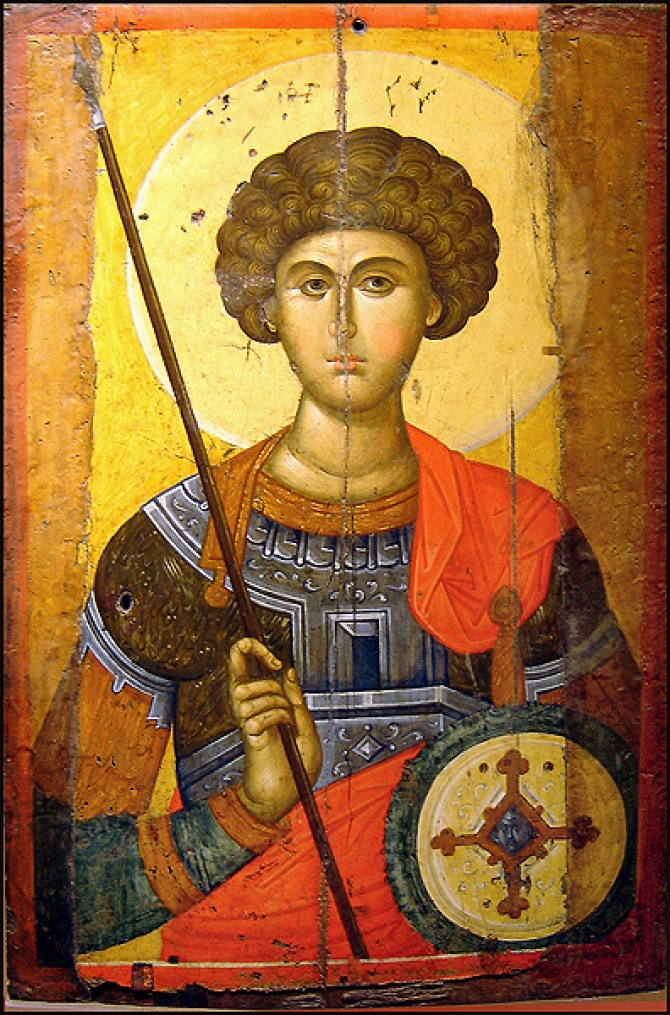
1. St. George…Feast Day April 23rd…Died 303
St. George

St. George was born in Cappadocia (modern Turkey) into a Christian family. He became a high ranking soldier. When Emperor Diocletian began persecuting Christians, he protested. He was then jailed and tortured. He died a martyr after being beheaded. Legend tells us that St. George killed a dragon which was threatening the townspeople. He made the sign of the cross and then killed it with a lance. Many people were converted and baptized because of St. George.

St George is invoked for protection of domestic animal.
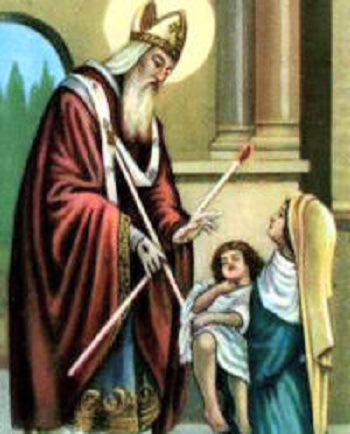
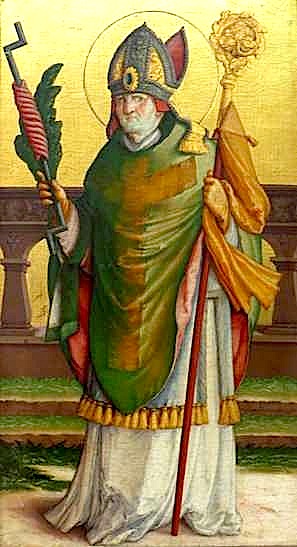
2. St. Blaise… Feast Day Feb. 3
St. Blaise

St. Blaise was born in Armenia. He was a physician and a philosopher. He became a Bishop of Armenia. Due to persecution, he fled and lived as a hermit. Legend tells us that hunters came upon him praying in a cave. He was surrounded by lions, wolves and bears. He was imprisoned. He was known for his gift of healing. The most famous healing happened while he was in prison. A mother came with her young son who had a fish bone lodged in his throat. At Blaise’s command the child was able to cough up the bone.

St. Blaise died a martyr. After being tortured, he was beheaded.

St. Blaise  is invoked for healing of the throat.
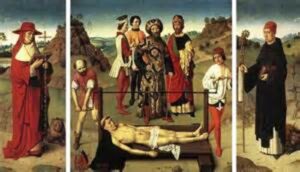
3. St. Erasmus (or St. Elmo)…Feast Day June 2…Martyr
Martyrdom of St. Erasmos
Public Domain Image

St. Elmo lived in Italy. He served as the Bishop of Formiae, Campagna, Italy and was martyred during the persecutions of Christians by Diocletan.

Trying to flee the persecutions, St. Elmo fled to Mt. Lebanon and lived in solitude for a time. When he was found, he was tortured and imprisoned. Because he refused to deny his faith he was scourged and cast into boiling oil, sulfur and pitch. He was miraculously saved from harm. According to legend an angel led him to freedom. After escaping prison he converted many with his preaching and miracles. A second time he was captured, imprisoned and tortured. Again, an angel led him to freedom. During his torture he had hot iron hooks struck into his intestines. He survived these wounds which is why he is invoked for intestinal problems.

St. Elmo is considered the patron saint of sailors. A blue light appears at mastheads before and after a storm; the seamen took it as a sign of St. Erasmus’s protection. This became known as St. Elmo’s Fire. St. Elmo died as a martyr in 303. He was tortured and disemboweled.

St. Elmo  is the patron saint of sailors 
and against intestinal troubles.
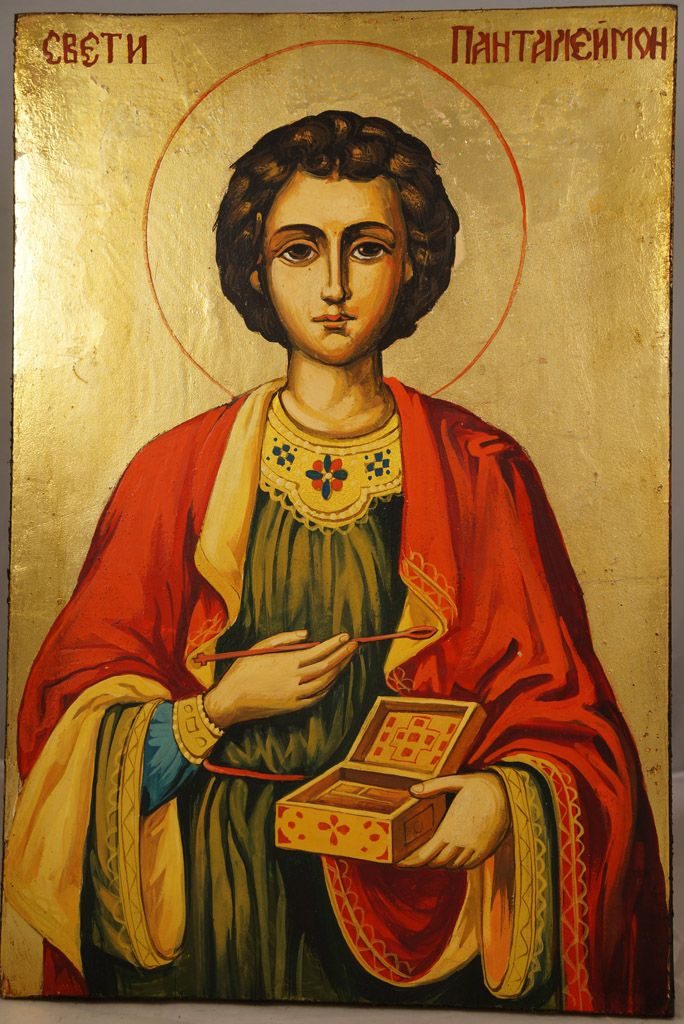
4. St. Pantaleon … Feast Day July 27th…D. 304

St. Pantaleon was born into a wealthy christian family. He left the faith and became a physician. He returned to the faith before his father died leaving him a large inheritance. During the persecution of Dicletian, he refused to denounce his faith. After healing a man with palsy, he was tortured in many ways. Tradition says he was burned by torches until Christ appeared and put out the flames. Attempts at boiling him and drowning at sea also failed. He was finally nailed to a tree and beheaded. He prayed for forgiveness of his persecutors before his death.

St. Pantaleon is patron saint of physicians, midwives, 
tuberculosis and torture victims.
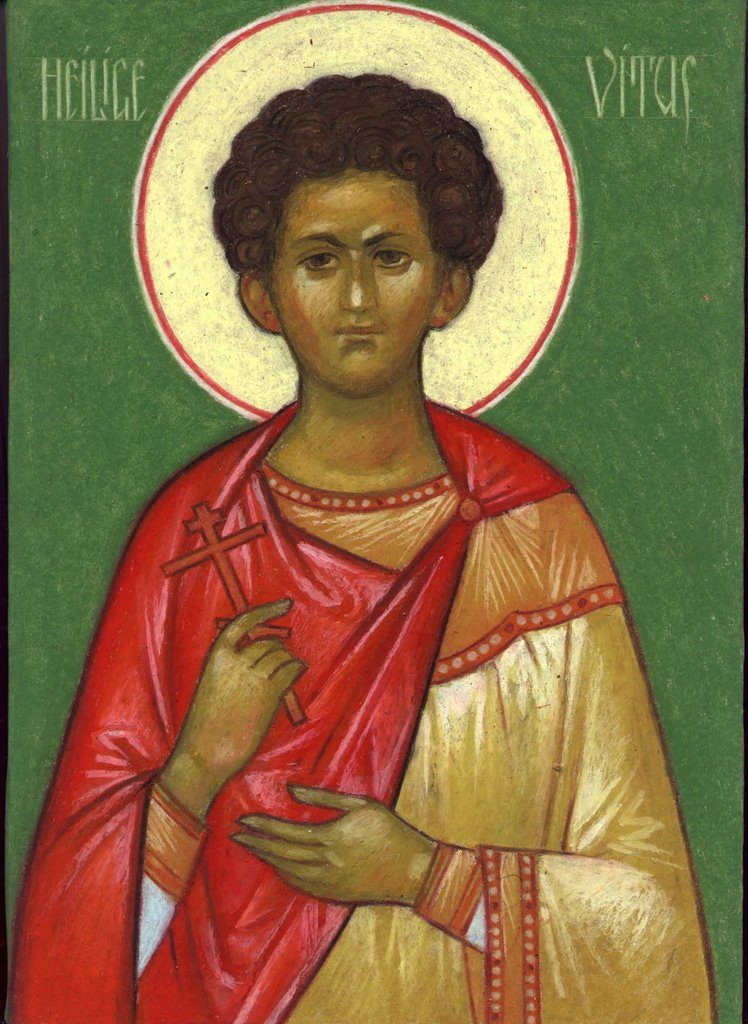
5. St. Vitus (also St. Guy)… Feast Day June 14

St. Vitus was born in 291 into a pagan family in Sicily. He was cared for by a Christian family who had him baptized. His furious father tried to have him renounce his faith. When he would not, his father turned him over to the governor Valerian who had him tortured for refusing to deny his faith. He was ordered scourged, however his executioners’ hands were paralyzed. They were healed after St. Vitus made a sign of the cross over ther. Escaping during a storm, St. Vitus fled to Italy. After converting many, Diocetian had him arrested and tortured again. When he was thrown to the wild beasts, the animals cowered at his feet. He wurvived boiling oil but was martyred on the rack in the year 303.

St. Vitus is the patron saint of dancers and actors. 
He is invoked during storms and against epilepsy
and those afflicted with St Vitus Dance.
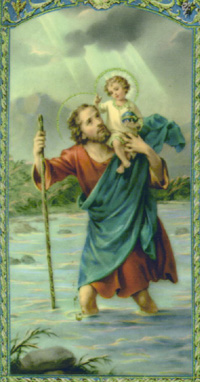
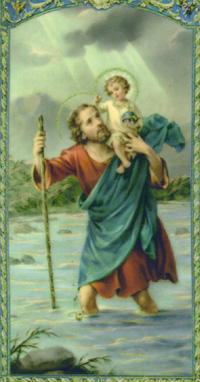
6. St. Christopher … martyr … Former Feast Day July 25
St. Christopher

Because the existence of St. Christopher is not verified his feast day was dropped when the liturgical year was reformed. However, his legend is powerful and many still ask for his intercession. Legend says that he converted to the faith after following the devil. He was very tall and considered a giant. He devoted his life to carrying people across a river with no bridge. One day, he was carrying a small child. The child became heavier and heavier until St. Christopher staggered. When they had crossed the river the child told St. Christopher that he was the Christ child and that he had been carrying the burdens of the world on his shoulders. St. Christopher is believed to be martyred by Emperor Deius in approximately 250

St. Christopher is the patron saint of travelers,
transportation workers and soldiers.
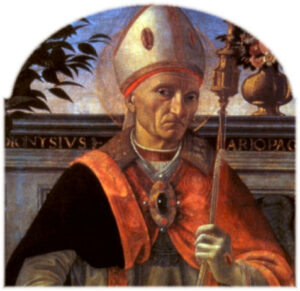
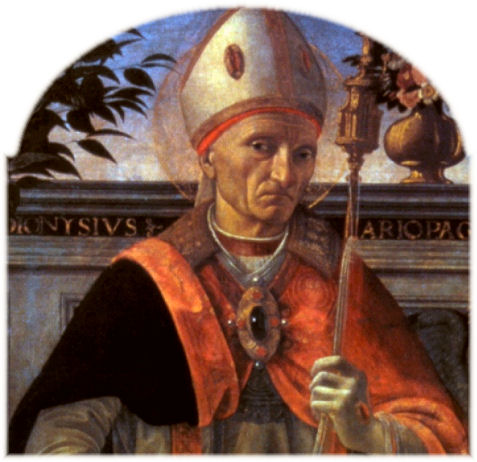
7. St. Denis (also Dionysius) Feast Day October 9 bishop and martyr
St. Denis, Bishop of Paris

St. Denis is also known as St. Diomysius. He was converted by St. Paul, becoming one of his followers. He was known converting many people. Pope St. Clement sent him to Gaul where he became the first bishop of France, At the age of 110, he was martyred by beheading. Tradition tells us that after he was beheaded, he took his head in his own hands placing it 2000 paces away where a chapel was later built.

St. Denis is invoked against diabolical possession and headaches.
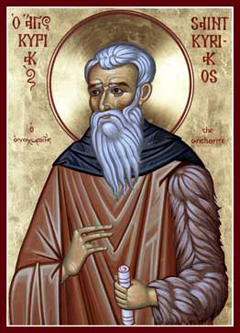
8. St. Cyriacus (also Cyriac)… Feast Day August 8 … deacon and martyr

St. Cyriacus was a pious Roman who became a deacon and tried to help people being persecuted for their faith. He also ministered to people in prison. Eventually, he was put in prison himself. While in prison he converted many and restored the sight of several blind men. When Emperor Diocletian’s daughter was found to be possessed by the devil it was St. Cyriacus who was able to free her of this possession. After she was healed the Emperor left him to live in peace. However, under the persecution of the co Emperor Maximum, he was again persecuted. He was tortured and beheaded on March 16, 303.

St. Cyriacus is the patron against eye disease,
diabolical possession and temptation, especially at the time of death.
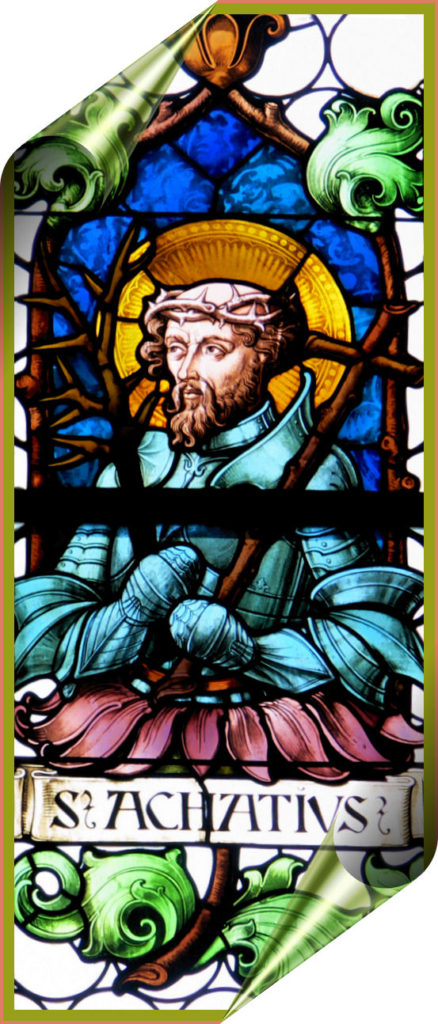
9. St. Aciathius (also Acaciid) … Feast Day May 8th

St. Aciathius was a Roman soldier. He joined the army during the reign of Emperor Hadrian, becoming a captain. He converted to Christianity and was filled with zeal. He converted many pagan soldiers. The emperor had him thrown into prison and tortured on the rack when he would not renounce his faith. He was brought before the tribune Bibianus. After declaring that his name was Christian, because he was a follower of Christ, Bibianus ordered him beaten with clubs and chained. After suffering more torture, he was beheaded on May 8, 311.

St. Acathius is the invoked against headaches.  

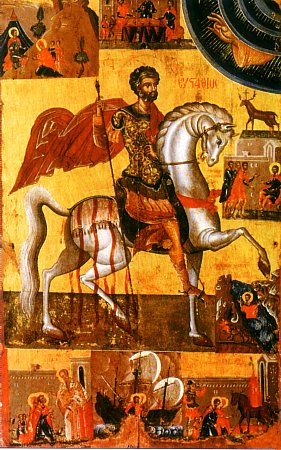
10. St. Eustace (also Eustachius, Eustathius)… Feast Day Sept. 20th

Before his conversion St. Eustace was none as Placedas. He was a kind man who enjoyed hunting. He was also a Roman general. One day he followed a stag into the forest. While he was staring at the deers antlers they vegan to glow showing a cross between them. He heard a voice asking him to convert to Christianity. Pacedus and his family were soon baptized and he became known as Eustace. St. Eustace was martyred in the year 118 by being burned inside a bronze bull.

St. Eustaca is the patron against fire, difficult situations,
family troubles and hunters and fire fighters.
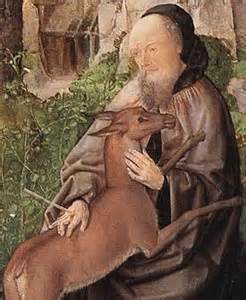
11. St. Giles the Abbot (also Aegildius)… Feast Day Sept. 1… Hermit and abbot
St. Giles, Abbot

St. Giles was born into a noble family in Athens, Greece in the seventh century. After the death of his parents, he distributed his inheritance to the poor. He also became known for the gift of miracles and healing he had received. Giles longed to live a life of solitude, serving God as a recluse. He left Greece, sailing for France. Everywhere he lived he became known for his gift of miracles and healing. He would have to flee once again to find a place to live in peace and solitude. His final dwelling place was deep in the forest in a cavern in a rock. He occupied his time in prayer, praising God and meditating. His only companion was a red deer, which provided him with milk to drink. St. Giles is the only Holy Helper who was not a martyr.

After several years of living in complete solitude, the King of France instituted a great hunt near where Giles lived. The hunters chased the deer which led them to the cave where Giles lived. They shot an arrow into the cave, wounding the holy hermit. They found him covered with blood with the deer lying at his feet. When the king was told what had happened, he ordered him taken care of. He came to see him offering him gifts. St. Giles refused the gifts requesting a monastery instead. St. Giles became the Abbot of the monastery which was soon built. Several disciples joined him. His fame continued to spread because of his gift of miracles. The conversion of the King was one of these miracles.

St. Giles is the patron saint of the mentally ill, the disabled,
epileptics,childhood fears, and depression.


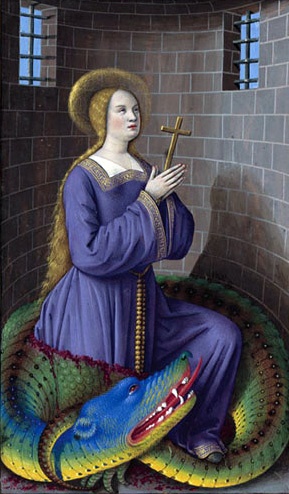
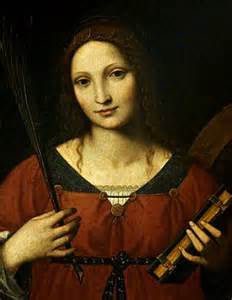
12. St. Margaret of Antioch … Feast Day July 2

St. Margaret of Antioch

St. Margaret was a virgin and martyr. St. Margaret was born in Antioch. She was raised by a Catholic nurse. When her pagan father learned of her faith, he was very displeased. He wanted her to marry the city prefect. When she refused, the prefect hd her tortured on the rack and pierced with iron hooks. She was then left in prison to die. Miraculously, all her wounds were healed. She was then tortured again with flaming hooks which did her no harm. Finally, she was beheaded. She was one of the saints who talked to St. Joan of Arc.

St. Margaret is the patron of women in childbirth.
St. Margaret is invoked against backaches and kidney disease.
13. St. Catherine of Alexandria … Feast Day Nov 25th
St. Catherine Alexandria

While there is no historical evidence regarding St. Catherine of Alexandria there is a strong tradition about her martyrdom. St. Catherine was born around 287 in Alexandria, Egypt. She was the daughter of a wealthy pagan couple. She had a love of learning and studied philosophy and religion. After studying Christianity, she converted. She is known to have debated 50 philosophers, converting them.

Legend tells us that she was imprisoned and tortured by Emperero Maxentius after she refused to marry him. He forced her to debate the most learned pagan philosophers hoping she would commit apostasy, however the debates resulted in many conversions to the Christian faith. St. Catherine was tortured by being placed on a wheel full of spikes in an attempt to kill her. The wheel broke into two pieces and fell apart. She was then beheaded.

St. Catherine is invoked as the patron saint of students, teachers, 
librarians and lawyers.
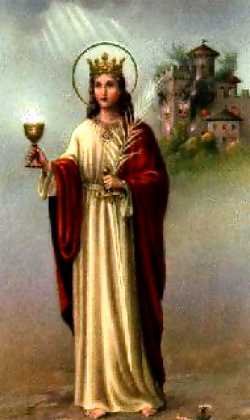
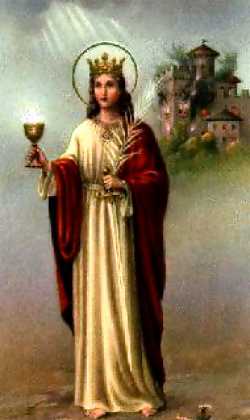
14. St. Barbara… Feast Day December 4
St. Barbara

St. Barbara was a virgin and martyr. She is the patron of builders, artillery men and miners. She was martyred in Asia Minor in the 3rd or 4th century. Her father isolated her in a high tower where she was tutored by philosophers and poets. She converted to Christianity, which infuriated her father. He ordered her killed. She was caught trying to escape and then beheaded by her father. He was immediately struck dead by lightning.

St. Barbara is invoked against fever, lightning, fire and sudden death.


The saints are men and women who have joy in their hearts and spread it to others… never hating, but serving the others.

Quote by Pope Frances on Nov. 1, 2013 All Saints Day
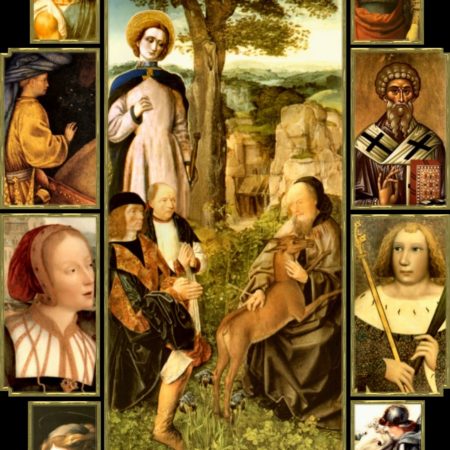
The 14 Holy Helpers in Art


Prayers, Quips and Quotes; Our Lady of Mt. Carmel


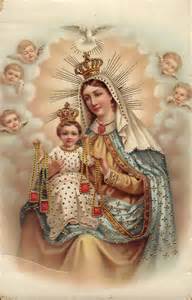
Our Lady of Mt. Carmel Public Domain Image
Our Lady of Mt. Carmel

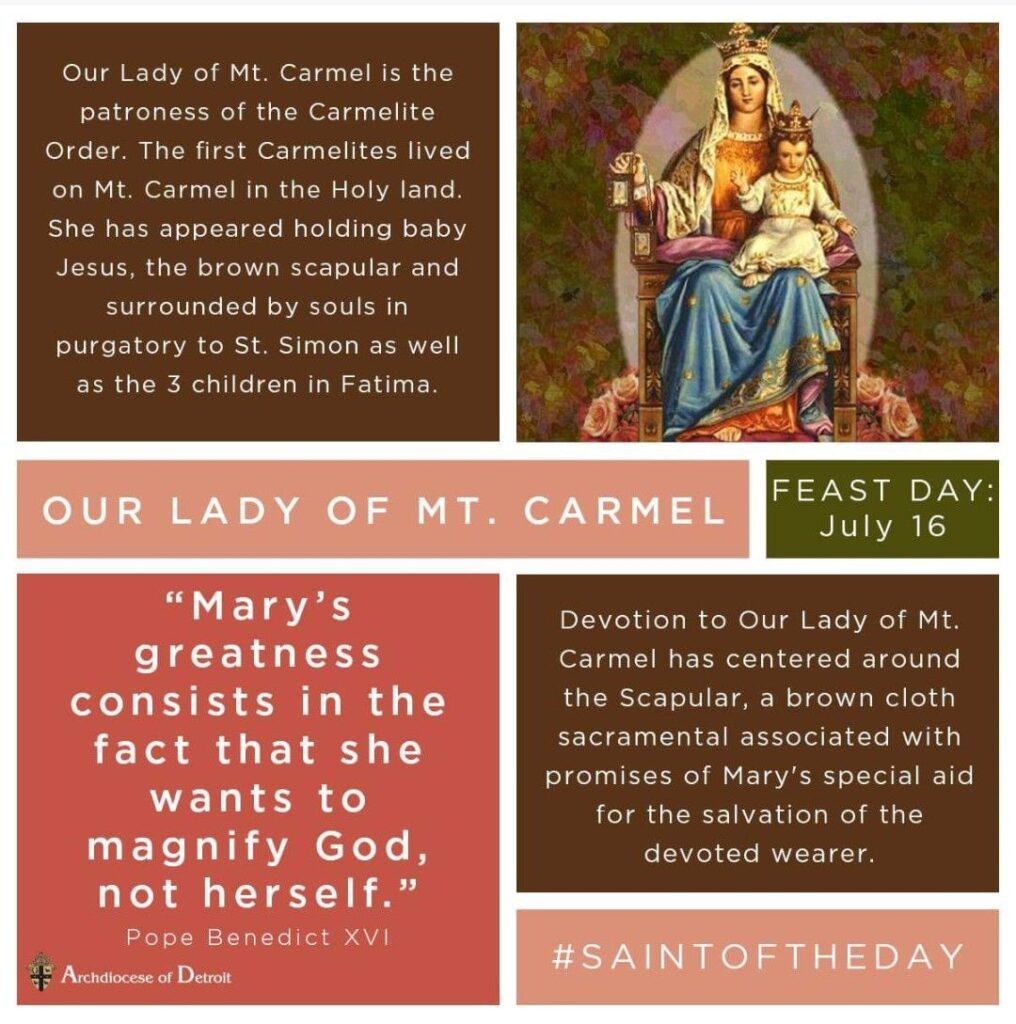
The Feast of Our Lady of Mt. Carmel is celebrated by the Catholic Church on July 16.  She is the patron of the Carmelite Order.   It is on this day in about 1386 that Our Lady appeared to St. Simon Stock. She gave him a Brown Scapular saying,

Take, beloved son this scapular of thy order as a badge of my confraternity and for thee and all Carmelites a special sign of grace; whoever dies in this garment, will not suffer everlasting fire.”

The scapular symbolizes Mary’s protection and reminds those wearing it of the call to prayer and penance. It stands for a commitment to follow Jesus and imitate Mary as the perfect model of all disciples of Christ.

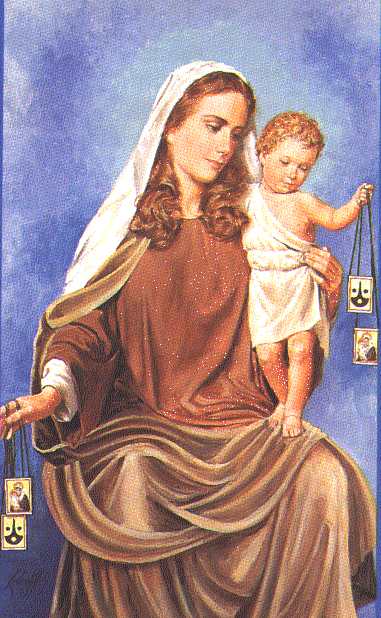
Our Lady of Mt. Carmel Public Domain Image
Our Lady of Mt. Carmel

A chapel was built near the Fountain of Elijah (northern Israel) which was dedicated to Our Lady. The hermits living there became known as the “Brothers of Mount Carmel”. St. Simon Stock was a leader of the Carmelite Order. The Carmelites have a special devotion to Mary. Their saints and theologians have a special devotion to her and the mystery of the Immaculate Conception (the belief that Mary was conceived without the stain of original sin). St. Teresa of Avila, St. John of the Cross and St. Terese of Lisieux are well known Carmelite saints.  Our Lady of Mt. Carmel is the patron of the Carmelite Order.

Mt. Carmel is located north of Jerusalem along the coast of the Mediterranean Sea. It is a well known mountainous ridge in Palestine which is covered with caves. Hermits lived in the caves, living a life of solitude and prayer. Mt. Carmel is mentioned in the Old Testament many times.

The history of the Carmelites dates back to ancient times. It is believed to have been founded by the prophets Elijah and Elisha. The Carmelite Order is a contemplative order. Their spirituality follows the contemplative spirit of Elijah, living a spiritual life of contemplation and prayer. One of their goals is to “find God in the silence’. The rule of the Carmelites was written by St. Albert Avogadro in 1214.

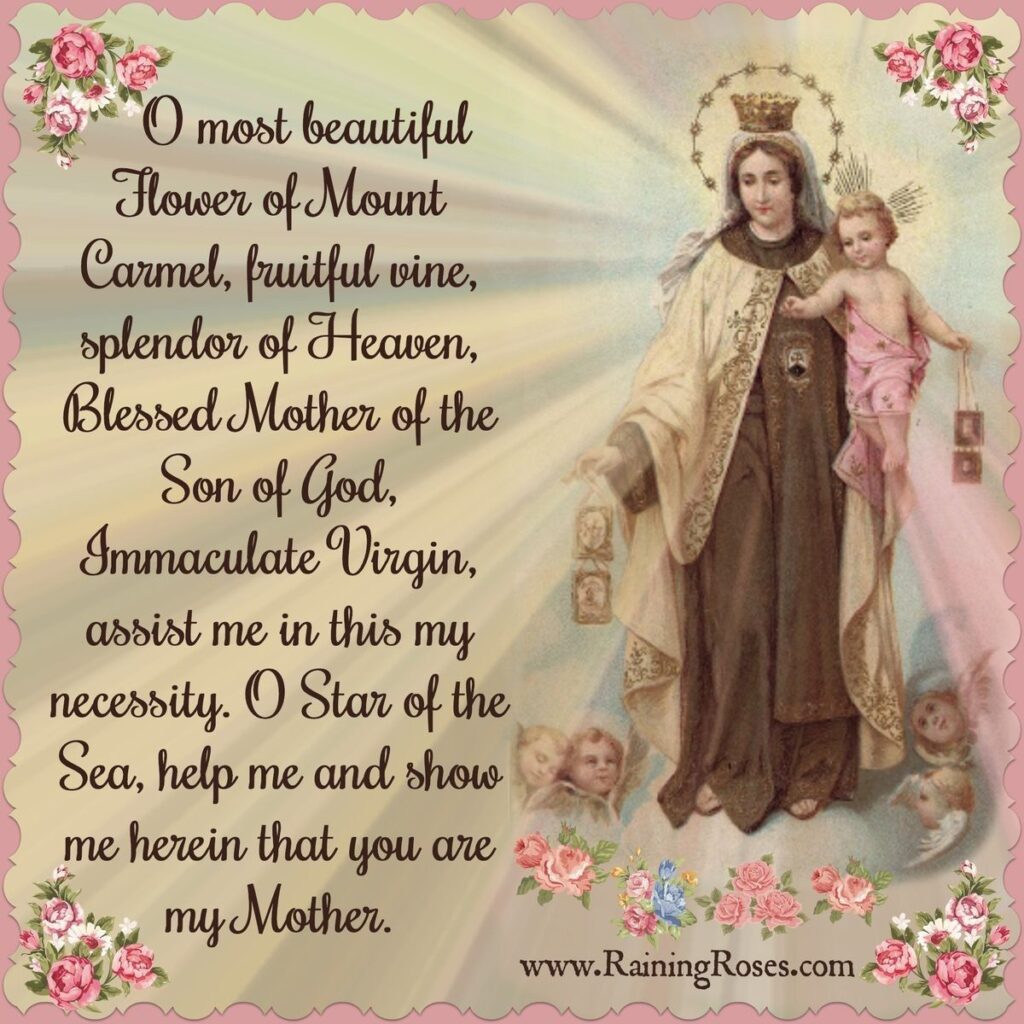
Our Lady of Mt. Carmel Public Domain Image
Our Lady of Mt. Carmel

The feast celebrates the appearance of Mary to St. Simon Stock. It is a special feast day for those who have a special devotion to Mary and wear the Brown Scapular. The Apparition of Our Lady of Mt. Carmel was approved by Pope Sixtus V in 1587.

Blessed is he for whom Mary prays.

Quote of St. Peter Julian Eymard; Feast day August 2

July is the Month of the Most Precious Blood.

Save

Save

Save


Save


Who were the 14 Holy Helpers?

icon 14 holy helpers


Intercessory prayer has always been an important form of prayer in the church.  The church believes that we can and should pray for each other.  This does not end when we die.  The saints are closer to God than we are.  We ask them to pray for us in our time of need.  This is called intercessory prayer.

During the black plague, which lasted from 1346-1349,  a number of saints gained great popularity for their ability to intercede and were given credit for many miraculous cures.  They became known as the Holy Helpers.  A  feast day was created to celebrate their sanctity and celebrated on August 8.  in 1969, this feast day of the Holy Helpers was dropped because of the reform of the liturgical calendar.  The 14 Holy Helpers are still popular today.

All of the Holy Helpers except St. Giles were martyrs.  Symptoms of the plague were  a black tongue, painful throat, severe headache, fever, and boils on the abdomen.  It came on suddenly and could result in death within hours.  The people who contracted the disease turned to the Holy Helpers to intercede for them during the frightening experience.

1. St. George…Feast Day April 23rd…Died 303

St. George was born in Cappadocia (modern Turkey) into a Christian family.  He became a high ranking soldier.  When Emperor Diocletian began persecuting Christians, he protested.  He was then jailed and tortured.  He died a martyr after being beheaded.  Legend tells us that St. George killed a dragon which was threatening the townspeople.  He made the sign of the cross and then killed it with a lance.  Many people were converted and baptized because of St. George.

St George is invoked for protection of domestic animal.
2.  St. Blaise… Feast Day Feb. 3

St. Blaise was born in Armenia.  He was a physician and a philosopher.   He became a Bishop of Armenia.  Due to persecution, he fled and lived as a hermit.  Legend tells us that hunters came upon him praying in a cave.  He was surrounded by lions, wolves and bears.  He was imprisoned.    He was known for his gift of healing.  The most famous healing happened while he was in prison.  A mother came with her young son who had a fish bone lodged in his throat. At Blaise’s command the child was able to cough up the bone.

St. Blaise died a martyr.  After being tortured, he was beheaded.

St. Blaise  is invoked for healing of the throat.
3.  St. Erasmus (or St. Elmo)…Feast Day June 2…Martyr

St. Elmo lived in Italy. He served as the Bishop of Formiae, Campagna, Italy and was martyred during the persecutions of Christians by Diocletan.

Trying to flee the persecutions, St. Elmo fled to Mt. Lebanon and lived in solitude for a time. When he was found, he was tortured and imprisoned. Because he refused to deny his faith he was scourged and cast into boiling oil, sulfur and pitch. He was miraculously saved from harm. According to legend an angel led him to freedom.  After escaping prison he converted many with his preaching and miracles. A second time he was captured, imprisoned and tortured. Again, an angel led him to freedom.  During his torture he had hot iron hooks struck into his intestines. He survived these wounds which is why he is invoked for intestinal problems.

St. Elmo is considered the patron saint of sailors. A blue light appears at mastheads before and after a storm; the seamen took it as a sign of St. Erasmus’s protection. This became known as St. Elmo’s Fire.  St. Elmo died as a martyr in 303. He was tortured and disemboweled.

St. Elmo  is the patron saint of sailors 
and against intestinal troubles.
4.  St. Pantaleon … Feast Day July 27th…D. 304

St. Pantaleon was born into a wealthy christian family.  He left the faith and became  a physician.  He returned to the faith before his father died leaving him a large inheritance.  During the persecution of Dicletian, he refused to denounce his faith.    After healing a man with palsy, he was tortured in many ways.  Tradition says he was burned by torches until Christ appeared and put out the flames.  Attempts at boiling him and drowning at sea also failed.  He was finally nailed to a tree and beheaded.  He prayed for forgiveness of his persecutors before his death.

St. Pantaleon is patron saint of physicians, midwives, 
tuberculosis and torture victims.
5.  St. Vitus  (also St. Guy)… Feast Day June 14

St. Vitus was born in 291 into a pagan family in Sicily.  He was cared for by a Christian family who had him baptized.  His furious father tried to have him renounce his faith.  When he would not, his father turned him over to the governor Valerian who had him tortured for refusing to deny his faith.  He was ordered scourged, however his executioners’ hands were paralyzed.  They were healed after St. Vitus made a sign of the cross over ther.  Escaping during a storm, St. Vitus  fled to Italy.  After converting many, Diocetian had him arrested and tortured again.  When he was thrown to the wild beasts, the animals cowered at his feet.  He wurvived boiling oil but was martyred on the rack in the year 303.

St. Vitus is the patron saint of dancers and actors. 
He is invoked during storms and against epilepsy
and those afflicted with St Vitus Dance.
6.  St. Christopher …  martyr …  Former Feast Day July 25

Because the existence of St. Christopher is not verified his feast day was dropped when the liturgical year was reformed.  However, his legend is powerful and many still ask for his intercession.  Legend says that he converted to the faith after following the devil.  He was very tall and considered a giant.  He devoted his life to carrying people across a river with no bridge.  One day, he was carrying a small child.  The child became heavier and heavier until St. Christopher staggered.  When they had crossed the river the child told St. Christopher that he was the Christ child and that he had been carrying the burdens of the world on his shoulders.  St. Christopher is believed to be martyred by Emperor Deius in approximately 250

St. Christopher is the patron saint of travelers,
transportation workers and soldiers.
7.  St. Denis  (also Dionysius)     Feast Day October 9     bishop and martyr

St. Denis is also known as St. Diomysius.  He was converted by St. Paul, becoming one of his followers.   He was known converting many people.  Pope St. Clement sent him to Gaul where he became the first bishop of France, At the age of 110, he was martyred by beheading.  Tradition tells us that after he was beheaded, he took his head in his own hands placing it 2000 paces away where a chapel was later built.

St. Denis is invoked against diabolical possession and headaches.
8.  St. Cyriacus  (also Cyriac)… Feast Day August 8 … deacon and martyr

St. Cyriacus was a pious Roman who became a deacon and tried to help people being persecuted for their faith.  He also ministered to people in prison.  Eventually, he was put in prison himself.  While in prison he converted many and restored the sight of several blind men.  When Emperor Diocletian’s daughter was found to be possessed by the devil it was St. Cyriacus who was able to free her of this possession.  After she was healed the Emperor left him to live in peace.  However, under the persecution of the co Emperor Maximum, he was again persecuted.  He was tortured and beheaded on March 16, 303.

St. Cyriacus is the patron against eye disease,
diabolical possession and temptation, especially at the time of death.


9.  St. Aciathius (also Acaciid) … Feast Day May 8th

St. Aciathius was a Roman soldier.  He joined the army during the reign of Emperor Hadrian, becoming a captain.  He converted to Christianity and was filled with zeal.  He converted many pagan soldiers.  The emperor had him thrown into prison and tortured on the rack  when he would not renounce his faith.  He was brought before the tribune Bibianus.  After declaring that his name was Christian, because he was a follower of Christ, Bibianus ordered him beaten with clubs and chained.  After suffering more torture, he was beheaded on May 8, 311.

St. Acathius is the invoked against headaches.  

10.  St. Eustace  (also Eustachius, Eustathius)…  Feast Day Sept. 20th

Before his conversion St. Eustace was none as Placedas.  He was a kind man who enjoyed hunting.  He was also a Roman general.  One day he followed a stag into the forest. While he was staring at the deers antlers they vegan to glow showing a cross between them.  He heard a voice asking him to convert to Christianity.  Pacedus and his family were soon baptized and he became known as Eustace.  St. Eustace was martyred in the year 118  by being burned inside a bronze bull.

St. Eustaca is the patron against fire, difficult situations,
family troubles and hunters and fire fighters.
11.  St. Giles the Abbot  (also Aegildius)…  Feast Day Sept. 1…  Hermit and abbot

St. Giles was born into a noble family in Athens, Greece in the seventh century.  After the death of his parents, he distributed his inheritance to the poor.    He also became known for the gift of miracles and healing he had received.  Giles longed to live a life of solitude, serving God as a recluse.  He left Greece, sailing for France.  Everywhere he lived he became known for his gift of miracles and healing.  He would have to flee once again to find a place to live in peace and solitude.    His final dwelling place was deep in the forest in a cavern in  a rock.  He occupied his time in prayer, praising God and meditating.   His only companion was a red deer, which provided him with milk to drink.  St. Giles is the only Holy Helper who was not a martyr.

After several years of living in complete solitude, the King of France instituted  a great hunt near where Giles lived.  The hunters chased the deer which led them to the cave where Giles lived.  They shot an arrow into the cave, wounding the holy hermit.  They found him covered with blood with the deer lying at his feet.  When the king was told what had happened, he ordered him taken care of.  He came to see him offering him gifts.  St. Giles refused the gifts requesting a monastery instead.  St. Giles became the Abbot of the monastery which was soon built.  Several disciples joined him.  His fame continued to spread because of his gift of miracles.  The conversion of the King was one of these miracles.

St. Giles is the patron saint of the mentally ill, the disabled,
epileptics,childhood fears, and depression.

12.  St. Margaret of Antioch … Feast Day July 2

St. Margaret was a virgin and martyr. St. Margaret was born in Antioch.  She was raised by a Catholic nurse.  When her pagan father learned of her faith, he was very displeased.  He wanted her to marry the city prefect.  When she refused, the prefect hd her tortured on the rack and pierced with iron hooks.  She was then left in prison to die.  Miraculously, all her wounds were healed.  She was then tortured again with flaming hooks which did her no harm.  Finally, she was beheaded.  She was one of the saints who talked to St. Joan of Arc.

St. Margaret is the patron of women in childbirth.
St. Margaret is invoked against backaches and kidney disease.


13.  St. Catherine of Alexandria … Feast Day Nov 25th

While there is no historical evidence regarding St. Catherine of Alexandria there is a strong tradition about her martyrdom. St. Catherine was born around 287 in Alexandria, Egypt. She was the daughter of a wealthy pagan couple. She had a love of learning and studied philosophy and religion. After studying Christianity, she converted.  She is known to have debated 50 philosophers, converting them.

Legend tells us that she was imprisoned and tortured by Emperero Maxentius after she refused to marry him. He forced her to debate the most learned pagan philosophers hoping she would commit apostasy, however the debates resulted in many conversions to the Christian faith.  St. Catherine was tortured by being placed on a wheel full of spikes in an attempt to kill her. The wheel broke into two pieces and fell apart. She was then beheaded.

St. Catherine is invoked as the patron saint of students, teachers, 
librarians and lawyers.


14.  St. Barbara… Feast Day December 4

St. Barbara was a virgin and martyr.    She is the patron of builders, artillery men and miners.  She was martyred in Asia Minor in the 3rd or 4th century.     Her father isolated her in a high tower where she was tutored by philosophers and poets.  She converted to Christianity, which infuriated her father.  He ordered her killed.  She was caught trying to escape and then beheaded by her father.  He was immediately struck dead by lightning.

St. Barbara is invoked against fever, lightning, fire and sudden death.


The saints are men and women who have joy in their hearts and spread it to others… never hating, but serving the others.

Quote by Pope Frances on Nov. 1, 2013  All Saints Day


The 14 Holy Helpers in Art


The Suffering Pilgrim; Short Reflections During Times of Grief

Look at the birds of the air, they neither sow nor reap nor gather into barns, and yet your heavenly Father feeds them. Are you not of more value than they? (Mat. 6: 26)

Preface

The following reflections and prayers helped me to deal with the pain of grief. During times of grief, praying can be quite difficult. Not only do we find it hard to talk and pray to God, but we may find it difficult to have any relationship with God at all.

My prayer is that these reflections on my favorite prayers will help another suffering pilgrim.

Vicki Scheenstra

In loving memory:

of my husband                                                                    Perry Scheenstra     (1954-1997),

my son                                                                                x Alan Scheenstra      (1980-2008)

and my father                                                                        Leo Mahre Jr.           (1922-2001).
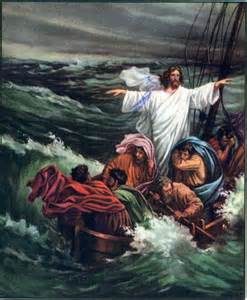
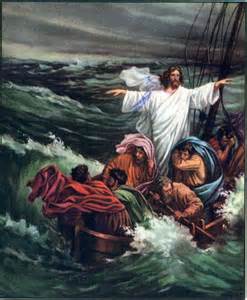
Jesus calms the waterJesus Stills the Storm
(Matthew 23-27)

And when he got into the boat, his disciples followed him. A windstorm arose on the sea, so great that the boat was being swamped by the waves; but he was asleep. And they went and woke him up, saying,

“Lord, save us! We are perishing!” And he said to them, “Why are you afraid, you of little faith?” Then he got up and rebuked the winds and the sea; and there was a dead calm. They were amazed saying, “What sort of man is this, that even the winds and the sea obey him?

Life seems to be made up of one storm after another. Turning to Jesus in a time of crisis takes faith and practice. Many of our emotions can be compared to the weather. When I think of grief, I think of a gray, rainy day. The following prayers have helped me to see the rainbow after the storm, and to appreciate that without a storm, we don’t appreciate the sunny weather nearly enough!

Many of us experience the “dark night of the soul” during grief. Only through turning to God in prayer can we begin to enjoy life completely again. Seeing God (the creator of everything) in nature can help during a stormy, stressful time.

A flower needs a rainy day to bloom.

We, as spiritual people, need prayer to deal with our emotions and to grow spiritually. The following prayers and reflections are how Jesus calmed the water during the storms in my life.

beatitudes

The Beatitudes

Blessed are the poor in spirit,
for theirs is the kingdom of heaven.
Blessed are those who mourn,
for they will be comforted.
Blessed are the meek,
for they will inherit the earth.
Blessed are those who hunger and thirst
for righteousness
for they will be filled.
Blessed are the merciful,
for they will receive mercy.
Blessed are the pure in heart,
for they will see God.
Blessed are the peacemakers,
for they will be called children of God.
Blessed are those who are persecuted
for righteousness’ sake,
for theirs is the kingdom of heaven.

Blessed are you when people revile you and persecute you and utter all kinds of evil against you falsely on my account.
Rejoice and be glad, for your reward is great in heaven, for in the same way they persecuted the prophets who were before you.

BLESSED ARE THOSE WHO MOURN.

This beatitude is one which hopefully we all experience. If we don’t, it probably means we have not learned how to love.

All of the beatitudes are lessons in how to love. If we are sad over losing a loved one then, this is a good thing. Let us rejoice and be glad! Loving someone means we have shared ourselves with someone, and have come to know them on a personal level. The love we have given and received is priceless.

Everyone experiences the death of some one they are close to at some point in their life. How we deal with the loss shows who we are. We may want to hide away and be by ourselves for awhile. This is perfectly normal. Hopefully, we talk to God in these moments when we are alone.

Turning to the beatitudes can be very helpful for times of grief.  The beatitudes guide our meditation and help us to redirect our emotions.

The beatitude of mourning is often the first time we passionately turn to God for answers to our questions and doubts.

The answers to these questions and doubts can be found in the remaining beatitudes.

BLESSED ARE THE POOR IN SPIRIT.

Humility is what we seek with this beatitude. It is the exact opposite of pride. When we completely lose our selfishness, we open ourselves up to God’s presence in our life.

BLESSED ARE THE MEEK.

What does it mean to be meek?  This beatitude is knowing that God is the creator and trusting in His plan for us. The arrogant person is not meek. Being meek, means accepting that we are nothing without God and trusting in Him, even during difficult and depressing times.

BLESSED ARE THOSE WHO HUNGER AND THIRST FOR RIGHTEOUSNESS.

Passion is a wonderful emotion. Hopefully, we are passionate about more than just our own welfare. Wanting justice for not only ourselves but everyone around us means we must actually do something when we see injustice. Finding a cause or a purpose in life is a very good way to work our way through grief issues.

BLESSED ARE THE MERCIFUL.

The merciful person is a loving person.  This beatitude is all about love; not only having a forgiving attitude, but being kind to people around us. The merciful heart is always kind and helpful. Doing a good deed for others always lifts the spirit!

BLESSED ARE THE PURE OF HEART.

Having the right motive in everything we do can be very difficult. If we reflect before acting, sometimes we can avoid being manipulative or selfish. The easiest way to increase the presence of God in my life is to get rid of my selfish thoughts and desires. It’s not easy!

BLESSED ARE THE PEACEMAKERS.

Sometimes anger is justified. Peacemakers are not people who put up with behaviors that are unacceptable. To be peacemakers, we must first be at peace with ourselves. Peacemakers deal with conflict in the world by being decisive, turning to God for guidance, and having respect for other people. We must again get rid of selfishness and arrogance in order to be a peacemaker.

The Peace of Christ is the gift we receive when we treat everyone as if…THEY ARE CHRIST!
BLESSED ARE THOSE WHO ARE PERSECUTED FOR RIGHTEOUSNESS SAKE.

There is a huge difference between being righteous and being self-righteous! This is where I need to turn to God for guidance. Am I being persecuted for standing up for my faith or am I being judgmental? If I am judging other people, I am playing God. However, that doesn’t mean I must condone behavior that is wrong. It means I must also be kind and forgiving. Let God be the judge. At the same time, I should never lower my standards to make other people happy. That would make ME miserable!

Living the Beatitudes during times of grief can be very challenging. It is natural to focus on our own feelings. Praying the Beatitudes reminds me to be less selfish and try to love the people I come into contact with. They also remind me that God is in charge. If I can let go and trust in God’s plan, my grief will be less painful. Knowing that God loves me, I have to work at believing He wants me to be happy.

Trusting God can be hard after loss. After all, the miracle I prayed for probably didn’t happen! However, the Beatitudes tell me to be meek…to trust that God has a plan and then live every day trying to do God’s will.

May my attitude be Christlike always.
serenity prayer

Serenity Prayer

God, grant me the serenity
To accept the things I cannot change
Courage to change the things I can,
And the wisdom to know the difference.

Living one day at a time,
Accepting hardships as the pathway to peace.
Taking, as He did, this world as it is,
Not as I would have it.

Trusting that He will make all things right
If I surrender to His will.
That I may be reasonably happy in this life,
And supremely happy with Him,
Forever in the next.

(Reinhold Neibuhr, 1926)

The Serenity Prayer is a powerful prayer to help reinforce trust in God.

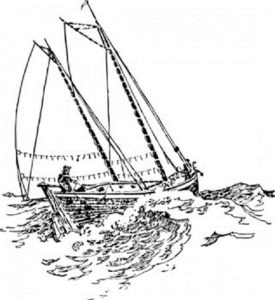
Often, it helps me to get through the most difficult moments of my life. When life is out of control, this prayer reminds me that I am not supposed to be in control of everything, only God is! I am a very visual person. When I say a prayer, I often have pictures to meditate on in my mind. One day as I was praying the serenity prayer, I realized my definition of serenity was wrong!

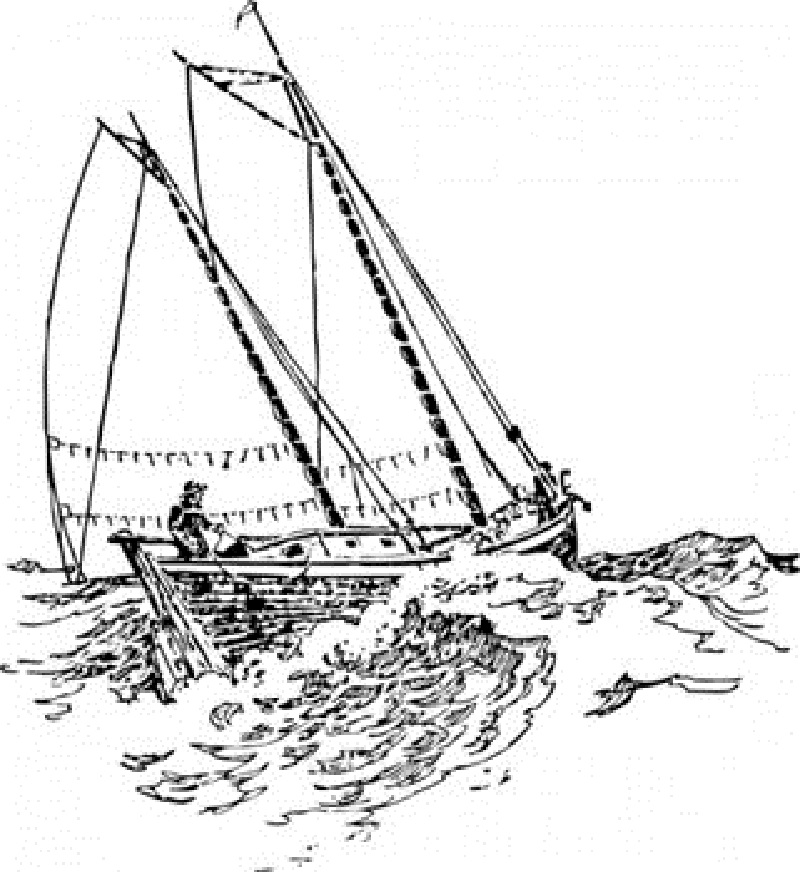
My definition of the word serenity is similar to complete calm. While praying this prayer I was picturing a calm lake on a sunny day. It was so calm there were no whitecaps on the water. It was so calm if I was on a sailboat, I would not be able to sail due to lack of wind. I was stuck! This is not serenity! We need movement in our lives! Without progress we stagnate and then we seem to go backwards or become lost.

When I am the opposite of serene, I am frantic and in a panic.

This frame of mind makes it impossible to make rational decisions. I finally realized that serenity is being able to make decisions while we are in the eye of a storm! While I prefer a sunny day on the lake, I always want there to be a breeze so the sailboat I am in will actually go where I direct it. Serenity is being calm enough during the storm to know which ropes to pull to keep the boat from turning over!

Help me make good decisions Lord. Direct my life!
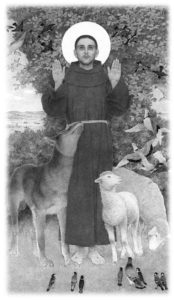
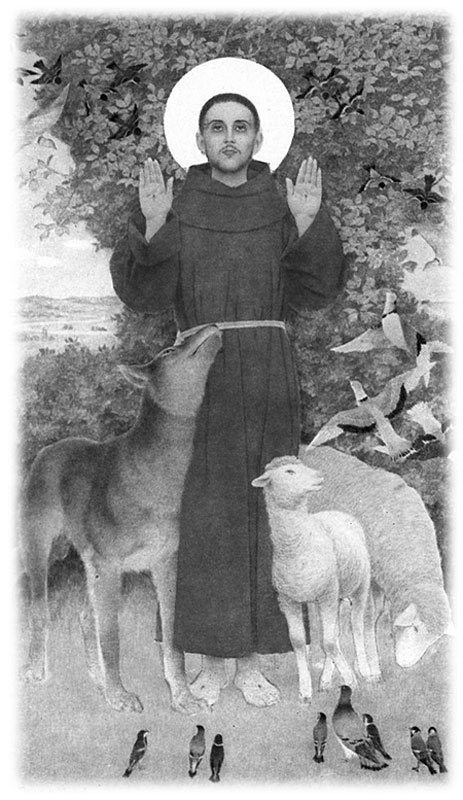
St. Francis

The Prayer of St. Francis

Make me an instrument of your peace.

Where there is hatred let me sow love.
Where there is injury, Your pardon, Lord.
And where there’s doubt
True faith in You.

Make me an instrument of your peace.

Where there’s despair in life,
Let me bring hope.
Where there is darkness, only light.
And where there’s sadness, ever joy.

Oh, Master, grant that I may never seek,
So much to be consoled as to console
To be understood as to understand
To be loved as to love with all my soul.

Make me an instrument of your peace.

It is in pardoning that we are pardoned.
In giving of ourselves that we receive,
And in dying that we are born to eternal life.

Amen

How can I love my neighbor?

This prayer tells me how. Love is actually the opposite of selfishness. Being more concerned about the people in my life than myself takes a great deal of practice and prayer! God wants me to put the needs of others before my own needs and desires. It is also about letting God use me to do his will.

This prayer teaches me to live by example,
Loving and forgiving others will in the end bring me peace,
happiness, and eternal life.

The only way to live this prayer is to put myself in someone else’s place to enable me to be more understanding and loving.

Sometimes, I find it impossible to understand someone’s actions. When this happens, I need to give my negative feelings and reactions to my master, God. If I listen to him in prayer, He will lead me and make me an instrument of his peace. He will also help me forgive those I am angry with.

It is more important to love someone than to understand them.

When I actually live this prayer, I can be confident that I am doing God’s will.

Put me to work Lord!
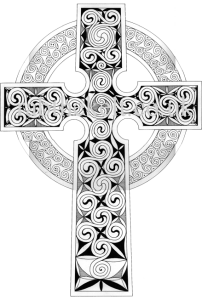
Celtic CrossCeltic Cross

Breastplate of St. Patrick

Christ be behind me,
Christ be before me,
Christ be beside me,
King of my heart.

Christ be within me,
Christ be below me,
Christ be above me,
Never to part.

Christ on my right hand,
Christ on my left hand,
Christ all around me,
Shield in the strife.

Christ in my sitting,
Christ in my sleeping,
Christ in my rising,
Light of my life.

(may be sung to the melody of Morning is Broken)

Christ is everywhere: especially in the eye of the storm!

This prayer beautifully expresses the need to let Christ be the center of my life. If I try to follow Him always, people will recognize Christ when they see me! It’s almost impossible to imagine. From morning until night, even while I am asleep, turning to Christ, and letting him lead and guide, me, assures me, that Jesus will be with me always. What a comfort in times of grief!

Knowing what pain Christ suffered for me, helps me to give my suffering back to him and ask for his help. Life is not always easy, but when Christ is my shield, I feel as though he is giving me strength, protecting, and comforting me.

My past, present, and future are in God’s hands.

If I truly love Christ, I will always want his guidance and presence in my life and in my heart. The more often I turn to Christ and let Him into my life, the more I will come to love Christ.

Christ Everywhere!
prayer of quiet

Prayer of Quiet

The prayer of quiet is simply resting in the presence of God, emptying your mind of all thoughts and anxieties, offering them to God and experiencing the presence of God.

Often, it helps to have a sacred word to repeat slowly while you inhale and exhale slowly.
Following are some possibilities.

Lord…Mercy

Abba…Father

Jesus…Peace

Holy Spirit…Come

May the presence of the Father, Son, and Holy Spirit guide me today.

Thy kingdom comeThy kingdom come…..

.

The Lord’s Prayer

Our Father, who art in heaven,

Hallowed be thy name.

Thy kingdom come, Thy will be done.

On earth as it is in heaven.

Give us this day our daily bread.

And forgive us our trespasses

As we forgive those who

trespass against us.

Lead us not into temptation,

But deliver us from evil.

Amen

The Lord’s Prayer covers all the bases. We first acknowledge God as our father (creator). We honor his name and ask for his will to be done. This is perhaps the most difficult part. When we are suffering, is this his will?

Can you picture Jesus in the Garden before the crucifixion? He prays that this cup be taken from him, but the will of His Father be done.

To be like Christ is our goal, so we must accept that suffering is part of God’s plan. If even Jesus, the son of God, suffers…what makes me so special that I should be spared? Everyone someday will die. This fact alone causes suffering to the person who is left behind.

Anger at God is a natural stage of grief. However, if we look to the cross and see the suffering Jesus went through for us, it becomes obvious…

Jesus did not come to earth to eliminate suffering!

Suffering brings us closer to Jesus and the cross. Grief and sorrow over this loss is not something to be ashamed of.

Our love matters!

Living without them changes our life forever, but we can take comfort knowing that they are in the arms of God. Death is simply a doorway to heaven. While it is hard to imagine what heaven is like, we know it is filled with the love and mercy of God.

Asking for God’s will to be done means we must stop playing God and assuming our will is His. Let Him lead us!

Asking for our daily bread, is asking for the things we need not the things we want!

How hard it is to remember this!

Just because we pray for something does not mean we will receive it. When God says NO, it helps to ask God to show us HIS will. We need to remember that God knows what is best for us. How different my life would be if all my prayers were answered YES!

Forgiveness is a two-way street. We must forgive to be forgiven. How easy it is to hold a grudge! Sometimes, we don’t even realize we are doing it. We simply refuse to think about it and simmer away continually angry!

When we acknowledge our own sinfulness, it is easier to forgive the sins of others. Remind yourself of your weaknesses daily…it will help you to forgive and understand others. When you are having trouble forgiving someone…pray for them!

It is truly amazing how this almost always works.

Temptation is everywhere, especially in our mind! What are we to do about it? One thing we can do is pray often, asking God to lead us. When we recognize the things that tempt us, we need to avoid them if at all possible.

We need to recognize evil in our lives.

To ignore it encourages it to flourish. There is a difference between being judgmental and having high moral standards. Deal with the evil in your own life before you judge the evil in someone else’s. To Judge is the job of God. Our job is to make moral decisions. I try to remember always; I will be judged by how I love! Loving one’s enemies needs to be practiced when we see evil.

How is it even possible to love our enemy? Perhaps all I can do is begin by praying for my enemy instead of cursing him. At least this is a beginning, and when I pray for the person I am angry at I have refused to have hatred grow and consume me.

Let thy will, not my will be done.
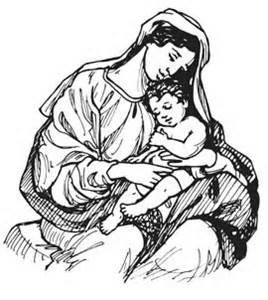
Ave Maria

Hail Mary, Full of Grace

(Ave Maria)

Hail Mary, full of grace.
The Lord is with thee.
Blessed art thou among women,
And blessed is the fruit of thy womb, Jesus.

Holy Mary, Mother of God
Pray for us sinners,
now, and at the hour of our death.

Ave Maria, gratia plena
Dominus tecum
Benedicta tu in mulieribus
Et benedictus fructus ventris tui Jesus

Sancta Maria, Mater Dei
Ora pro no bis peccatoribus
Nunc et in hora mortis nostrae

Amen

Hail Mary, full of grace.

What does the word grace mean?
Grace, like faith, is a gift from God. We cannot receive it on our own,
but we can ask (pray) for it. A gift is something given to us;
which reminds me of Christmas when we receive
so many Christmas presents.

Grace is the gift (presen) of God’s presence.

Of all the people in the world who but Mary
was Jesus most present to?
Being pregnant with Jesus, the son of God,
is hard to imagine.

I pray daily that I may come closer to Jesus.
One way to do that is to imitate Mary,
who loved Jesus as none of us can
because she was His mother.

Her love was a special and unique love.

On the cross, Jesus told John the disciple…

“Here is your mother” (John: 19.27)

By doing this, she becomes the mother of all disciples of Jesus. Mary’s grief must have been so great!

I ask her now to help me know the will of Jesus in my life and to teach me how to love.

Pray for us sinners, now and at the hour of death. Amen
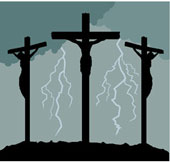
CalvaryCalvary

Jesus Remember Me, when you come into your kingdom.
Luke 23: 32-43

Two others also, who were criminals, were led away to be put to death with him. When they came to the place that is called The Skull, they crucified Jesus there with the criminals, one on his right and one on his left. Then Jesus said, “Father, forgive them; for they do not know what they are doing.” And they cast lots to divide his clothing. And the people stood by, watching; but the leaders scoffed at him saying, “He saved others, let him save himself if he is the Messiah of God, his chosen one!” The soldiers also mocked him, coming up and offering him sour wine, and saying, “If you are the King of the Jews, save yourself!” There was also an inscription over him which said…

“This is the King of the Jews.”

One of the criminals who were hanged there kept deriding him and saying, “Are you not the Messiah? Save yourself and us!” But the other rebuked him, saying, “Do you not fear God, since you are under the same sentence of condemnation? And we indeed have been condemned justly, for we are getting what we deserve for our deeds, but this man has done nothing wrong.” Then he said, “Jesus, remember me when you come into your kingdom.”

Jesus replied, “Truly I tell you, today you will be with me in Paradise.”

The Good Thief turned to Jesus at the very end of his life. He did not need to know all the answers regarding religion. He had not been baptized. He simply acknowledged his guilt and asked Jesus to remember him. Sometimes, we make faith way too complicated. All we really need to do is turn to God and ask him to lead us to the truth.

God is Love… God is truth.

Let’s keep it simple…. Seek Love…Seek Truth

Redemptive Suffering

Are you angry at God? This is a normal stage after a loss. Christianity teaches us that Jesus redeemed us by the cross…his suffering is what saves us! This is called redemptive suffering. When we suffer, we can participate by putting our suffering at the foot of the cross and giving it to Jesus. This is what is meant when we hear the phrase “Offer it up”. By giving our suffering to Jesus as a prayer for loved ones who have died, Jesus actually turns our suffering into a virtue.

Meditate on a crucifix.

Your anger at God will not last forever. Spending time with God has been very important in my healing process. I could not pretend my feelings did not exist or that I was ready to move on with my life when I was not.

Music has also been very helpful.

When you sing you pray twice. (St. Augustine)

Praying through my favorite hymns enables me to pray when I cannot put my feelings into words.

Suffering came first. The crucifixion came before the resurrection.
Jesus teaches us how to suffer!

Meditating on the crucifixion, and the Stations of the Cross we learn how to deal with the sufferings in our own life, small in comparison.

In order to know the meaning of joy, we must experience sorrow.
Be with me, Lord!

Seasons of Life

Seasons of Life

Ecclesiastes: 3: 1-8

For everything there is a season, and a time for every matter under heaven.
A time to be born and a time to die.
A time to plant, and a time to pluck up what is planted.
A time to kill and a time to heal.
A time to break down and a time to build up.
A time to weep, and a time to laugh.
A time to mourn and a time to dance.
A time to throw away stones and a time to gather stones together.
A time to embrace, and a time to refrain from embracing.
A time to seek, and time to lose.
A time to keep and a time to throw away.
A time to tear, and a time to sew.
A time to keep silence and a time to speak.
A time to love, and a time to hate.
A time for war, and a time for peace.

To me, tears are spiritual rain.

A garden grows in all types of weather. Without rain to water it, it will die of drought. The flowers in a garden need both sun and rain to be healthy and beautiful.
When we grieve, we need to acknowledge our suffering and pain. Tears help to cleanse our soul and bring us closer to God. Denying our pain prevents us from having an honest relationship with God. We avoid our feelings and end up pretending we are just fine. This actually just prolongs our grief!

Even Jesus wept at the death of Lazarus. (John 11: 35)

Our soul is similar to a flower garden. When we acknowledge our pain and sorrow, we enable God to heal us and bring the sunshine back into our lives. In time, we will be able to remember both the good and the sad times without tears. We can come to embrace every day as a beautiful gift from God meant to be lived in joy.

The garden of our soul needs to be fed by honest feelings, both sorrow and joy, but especially love.

Let us turn to God (who is love) during all the seasons of our life. Spending time with nature and acknowledging both God as our creator and sharing with Him whatever feelings we are experiencing will help us through the hard times. To love is to take a risk. We share ourselves with someone not knowing what the future will bring.

The rainbow which comes after the rain is a symbol of God’s promise to us that he will not abandon us. After the rain comes peace. God is always with us, if only we will turn to him. He will take us down a garden path and show us the beauty we are blind to. When we cannot see the path beneath our feet, we must turn to God for guidance. Only He knows what the future will bring.

Bloom where you are planted!
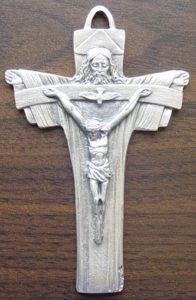
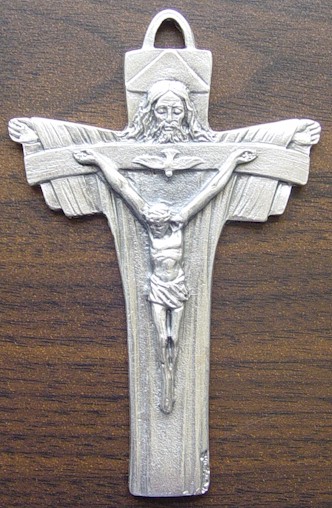
Trinity crucifixTrinity Crucifix

Glory Be

Glory be

to The Father,

and to the Son,

and to the Holy Ghost,

as it was in the beginning,

is now, and ever shall be,

forever and ever,

Amen.

Many of of our formal prayers end with the Glory Be prayer. I asked my friends which person in the trinity they found it easier to turn to, and who they found it difficult to turn to in prayer. There is no wrong answer!

After reflecting, I realized that during my prayer journey (my pilgrimage) I have come to know each of the persons in the trinity in a more personal way.

During my childhood I was aware that I was a child of God, I am in awe of his majesty and the beauty of his creation and the people I know and love.  It was the Creator I turned to in prayer first…

God the Father.

As an adult, recognizing the movement of the Holy Spirit has become easier. The Holy Spirit is the director of the show. When the apostles were confused after the crucifixion, the Holy Spirit came and removed the confusion and fear. The Holy Spirit enlightened the apostles as to what the will of the Father was. Through the guidance of the Holy Spirit on Pentecost, the Christian Church was born. When I am in confusion, I turn to the Holy Spirit to guide me. Sometimes, He actually pushes me in the direction I need to go…

Getting to know Jesus has been the most difficult. I know now that I was avoiding Jesus. I have always connected Jesus to the cross…suffering! When I began to experience the loss of loved ones in my life, however, I found it absolutely necessary to turn to Jesus…The Son of God.

I also turned to Mary and Joseph, the Holy Family.

The Holy Family knows in a very real and human way what our pain is like. I no longer felt alone. They always listen to me, and they understand me. Each of the Holy Family is very human… even Jesus. I share my troubles and my joys with them every day.

Each of us has a unique prayer journey.

We are pilgrims, trying to get to know God.

Daily reflection is an important part of the journey.

What a long way I have come! What a long way I have to go!


Save
Prayers, Quips and Quotes: St. Alphonsus Rodriguez, Feast Day October 30


St. Alphonsus Rodriguez

The Feast day of St. Alphonsus Rodriguez is celebrated on October 30.  He was born in Segovia, Spain on July 25, 1532.   His father was a wealthy merchant.

At the age of 14 Alphonsus’ father died.  He left school to help his mother run the family business.  When he was 23 he married.  However, three years later his wife died during childbirth.  Within the next several years his mother died as well as his three children.  He also found it necessary to sell his failing business.

In response to his grief and suffering, Alphonsus turned to a life of prayer.  He applied  to become a Jesuit, (The Society of Jesus).  He was denied entry due to lack of education.  He returned to school and reapplied.  In 1571 he was accepted as a lay Jesuit brother.  He was sent to Montesione College on Majorca.  He served as a doorkeeper for 45 years.

As doorkeeper, St. Alphonsus believed Christ was in every person at the door.    He ministered to both the visitors and the students.  He became friends with St. Peter Claver who was a champion of slaves rights.

St. Alphonsus developed a method for finding joy in his hardships which followed him throughout his life into old age.  He became a contemplative who meditated on the crucifix and the suffering of Christ.  He stated that by bearing his suffering  with prayer.

“I felt the grandeur of the Lord”. 

“This I encourage myself to endure for love of the Lord who is before me, until I make what is bitter sweet.  In this way, learning from Christ Our Lord, I take and convert the sweet into bitter, renouncing myself and all earthly and carnal pleasures, delights and honors of this life so that my whole heart is centered solely on God. 

St. Alphonsus Rodriguez was canonized on September 6, 1887.

“Whenever you do anything, you must offer it to God, at the beginning, in the middle, and at the end.”

Quote of St. Alphonsus Rodriguez

October is the Month of the Most Holy Rosary

Save
Save

Save
Prayers, Quips and Quotes: St. Anthony Mary Claret, Feast Day October 24


St. Anthony Mary Claret Public Domain Image
St. Anthony Mary Claret


The Feast Day of St. Anthony Mary Claret is celebrated on October 24.  He is the patron saint of educators, the Catholic Press and weavers.

St. Anthony Mary Claret was the Archbishop of the Diocese of the Canary Islands. With a group of five other priests he was the Founder of the Sons of the Immaculate Heart of Mary, also known as the Claretians.

St. Anthony Mary Claret was born in Catalonia, Spain in 1807. At the age of twelve he became a weaver. He entered the seminary at Vic in 1829 and was ordained to the priesthood on June 13, 1835, on the Feast of St. Anthony of Padua, whom he was named after. He entered the Jesuit novitiate but had to leave due to his ill health.

St. Anthony Mary Claret was assigned to missionary work throughout Catalonia. In 1848 he was sent to the Canary Islands where he gave retreats for fifteen months. When he returned to Spain, he established the Congregation the Missionary Sons of the Immaculate Heart of Mary (The Claretians) on the feast of Our Lady of Mt. Carmel (July 16, 1848).

He also founded the religious library at Barcelona called “Libreria Religiosa”. It is now known as “Libreria Claret). He was appointed Archbishop of Santiago, Cuba in 1849. Over 9,000 marriages were validated within two years of his arrival. He began a hospital and several schools. The first women’s religious institute in Cuba was begun by St. Anthony. It was known as the Religious of Mary Institute.

In 1857 he was recalled to Spain and he became the Confessor to Queen Isabella II. He became a resident of an Italian Hospice. Preaching everywhere he went, he also distributed books. Eventually, his life in danger, he went to France where he preached in Paris.

In 1869, he participated in the First Vatican Council. He had to withdraw due to poor health. He died on Oct. 24, 1870, at the age of 62 in a Cistercian monastery in France.

“The man who burns with the fire of divine love is a son of the Immaculate Heart of Mary and wherever he goes, he enkindles that flame. He desires and works with all his strength to inflame all men with the fire of God’s love. Nothing deters him, he rejoices in poverty, he labors strenuously, he welcomes hardships, he laughs off false accusations, he rejoices in anguish. He thinks only of how he might follow Jesus Christ and imitate him by his prayers, his labors, his sufferings, and be caring always and only for the glory of God and the salvation of souls.”

Quote of St. Anthony Mary Claret

October is the Month of the Most Holy Rosary

Save

Prayers, Quips and Quotes: St. Benedict, Feast Day July 11

The Feast Day of St. Benedict is celebrated on July 11.  In the Eastern Church it is celebrated on March 14th.

St. Benedict was born in Nursia in 480 to upper class parents. He attended university in Rome. To escape the vice he was surrounded by he fled Rome and spent three years in seclusion. After these three years he founded the monasteries he is famous for.

St. Benedict is considered the founder of western monasticism. His monasteries were based on the principles in his book The Rule of Benedict. This book begins with this prologue:

“Listen carefully, my son, to the masters’ instructions and attend to them with the ear of your heart. (R.B. Prologue)”
St. Benedict Public Domain Image
St. Benedict
Public Domain Image

His rule begins with the word LISTEN! The monasteries have a very strict discipline. They focus on daily personal and liturgical prayer. Singing of the Psalms and reading the Divine Office is practiced daily. Listening to the word of God is the primary focus of their spirituality.  Lectio Divino is slow reading and meditation on the scripture. Benedictine spirituality also demands obedience, hospitality, and service.

St. Benedict died while standing in prayer before God in the year 547. St. Benedict is the patron saint of students and Europe.

Shatter all your temptations against Christ.

Quote of St. Benedict

July is the Month of the Most Precious Blood.

Prayers, Quips and Quotes Articles for the Month of July

Save

Save

Prayers, Quips and Quotes: St. Maximus the Confessor, Feast Day August 13


The Feast day of St. Maximus the Confessor is celebrated on August 13.  He was born in 580 in Constantinople to a noble family.

After serving as secretary to Emperor Heraclius, Maximus became a monk and abbot at Chrysopolis, which is now Turkey.

St. Maximus attended the Lateran Council which condemned Monotheism.  Monotheism believed Jesus Christ had a divine nature not a human nature.  After returning from the council St. Maximus refused to accept Monotheism which was a heresy prevalent at the time.  He was arrested and charged with treason.  After six years in prison he was brought back to Constantinople with two of his disciples to be tortured and mutilated.   Their tongues and right hands were cut off.  They were then sent to Skhemaris on the Black Sea where he died in the year 662

St. Maximus is considered a mystic and honored for his theology of the Incarnation and the two natures of Christ…human and divine.  He wrote over 90 works on the faith.

After his death miracles were reported to have occurred at this tomb.

 
“Be on guard lest the vice
that separated you from your brother
be not found in your brother, but in you; 
and hasten to be reconciled to him
lest you fall away from the commandment of love.”
Quote of St. Maximus the Confessor


August is the Month of the Immaculate Heart of Mary

Save

Save

Prayers, Quips, and Quotes: St. Jane Frances de Chantal, Feast Day August 12


St. Jane Frances de Chantal Public Domain Image
St. Jane Frances de Chantal

The Feast Day of St. Jane Frances de Chantal is celebrated on August 12. Jane was born on Jan. 18, 1572, in Dijon, France. She was born into a family of nobility. Her father was the president of the parliament of Burgundy. At the age of 29 she married Baron Christophe de Chantal. Their marriage lasted seven years during which they had three daughters and a son. Jane became a widow when Christophe died tragically in a hunting accident when Jane was 28 years old. Although her husband forgave the man who shot him, Jane struggled for a long time to forgive him. With time and God’s grace she was finally able to do so. Because she was able to forgive him, she became the godmother of his child.

To support her children, Jane moved home with her father-in-law. For seven years she managed his estate bearing patiently his abusive behavior. Jane turned to God for guidance. In a vision she saw the person who was meant to be her spiritual director. When she met St. Francis de Sales while he was preaching, she recognized him as the person in her vision. He soon became her spiritual director. They corresponded by letter. Many of the letters have survived.

With the guidance of St. Francis de Sales, Jane opened the Congregation of the Visitation in 1610. They focused on uniting their will to the will of God; trusting in Him and seeking to please Him. After the death of St. Francis de Sales, St. Vincent de Paul became her spiritual director. By the time of her death 86 convents were opened. The Order welcomed women who had been rejected from entering other orders due to health and age. When St. Jane died at the age of 69 she was known for her sanctity. She was credited with miracles before and after her death. St. Jane was canonized in 1767.

We should throw ourselves into God as

a little drop of water into the sea,

and lose ourselves indeed,

in the ocean of the divine goodness.

Quote of St. Jane Frances de Chantal


August is the Month of the Immaculate Heart of Mary

SaveSave

Prayers, Quips and Quotes: St. Clare of Assisi, Feast Day August 11


St. Clare of Assisi Public Domain Image
St. Clare of Assisi


The Feast day of St. Clare of Assisi is celebrated on August 11. St. Clare was born to a wealthy family in Assisi, Italy on July 16, 1194. At the age of 15 she refused to marry as her parents wished her to do. When she heard St. Francis speak on Palm Sunday, she left home to join him at San Damiano. She took a vow of poverty after which St. Francis cut off her long hair and gave her a brown habit to wear. She was later followed by her sister Agnes and her mother. The ladies who followed St. Francis became known as “The Poor Ladies.” After Clare eventually was named Abbess they became known as “The Poor Clares.”

The Poor Clares went barefoot, ate no meat and observed almost complete silence. They lived an enclosed life, away from the world. The Poor Clares actually predated the Franciscans which was later founded by St. Francis. St. Clare saw St. Francis as a spiritual father figure and cared for him during his illness and at the end of his life in 1226.

St. Clare died  in Assisi on August 11, 1253.  She was discovered to be incorrupt on September 23,1850 when her coffin was opened.  Her body can be viewed in the crypt at Santa Chiara, Italy.

St. Clare was canonized by Pope Alexander in 1255.

Love Him totally
who gave Himself totally
for your love.
Quote of St. Clare of Assisi
St. Clare of Assisi in Art

Continue reading Prayers, Quips and Quotes: St. Clare of Assisi, Feast Day August 11

Prayers, Quips and Quotes: St. Dominic, Feast Day August 8

El_Greco,_St_Dominic_in_Prayer Public Domain Image

The Feast Day of St. Dominic is celebrated on August 8th. He was born in 1170 to Felix Guzman and Blessed Joan of Aza in Caleruega, Spain. After studying at the University at Palencia he was ordained a priest at the age of 25. St. Dominic was known for self-denial, holiness, piety and apostolic zeal. He refused to eat meat or sleep on a bed. He also renounced wealth.

In 1215 he founded an order of Dominican Nuns. Their mission was to care for young girls. This was followed by the founding of the Order of Preachers, which became known as the Dominicans. The purpose of the order was to preach the Word of God. They were also known as the “Black Friars”. The rule followed the Rule of St. Augustine. Their focus was on liturgical prayer and lifelong study.

The primary heresy the Dominicans preached against was Albigensianism. This was the belief that there are two dueling principles, good and evil, and that all matter was regarded as evil. They also taught that the devil is the creator of the material world.

A devotion which St. Dominic helped to spread is the Rosary. a Marian devotion, which combines meditation on the life of Christ, with memorized prayer. Tradition tells us that when Dominic became discouraged with the slow progress of his work of preaching against the Abligensian heresy, the Blessed Virgin appeared to him with a beautiful wreath of roses. She asked him to say the Rosary every day and to teach the people to say the Rosary. Soon the heresy began to disappear. The devotion of the rosary continues today.

After forming his order Dominic had a dream vision in which he met another person, a beggar. The next day, Dominic recognized this man when he came into his church. It was St. Francis of Assisi the future founder of the Franciscan Order. Dominic embraced him saying,

“You are my companion and must walk with me. For if we hold together, no earthly power can withstand us.”

St. Dominic and St. Francis were lifelong friends. Their orders celebrate their meeting on the feast day of their saint.

The motto of St. Dominic is: “To praise, to bless, to preach”. St. Dominic once said;

“Arm yourself with prayer, rather than a sword; wear humility rather than fine clothes.”

St. Dominic died on August 6, 1221 from a fever. Because of his love of learning and teaching, St. Dominic is known as the patron of astronomers.

Do not weep, for I shall be more useful to you
after my death and I shall help you then
more effectively than during my life.
Quote of St. Dominic
St. Dominic in Art


August is the Month of the Immaculate Heart of Mary.

  • St. Dominic Public Domain Image


Save

Prayers, Quips and Quotes: The Transfiguration, Feast Day August 6


The Transfigurateion by Rubens Public Domain Image
The Transfiguration by Rubens

Has your faith in Jesus Christ transformed you?  The Feast of the Transfiguration of Our Lord is celebrated on August 6.

On this feast day we remember the event which took place shortly after St Peter proclaimed his faith in the Lord, saying…  “You are the Messiah!”

Three Apostles accompanied Jesus into the mountains believed to be Mount Tabor.  They were the Apostles John, James and Peter

And he was transfigured before them and His face shone like the sun and his clothes became dazzling white.  Appearing with Jesus were Moses and Elijah, talking with him.  (Matthew 17.2-4).

The Apostles heard a voice saying:

This is my Son, the Beloved;  with him I am well pleased listen to him!”” (Matthew 17:5)

The Apostles fell to the ground overcome by fear.  But Jesus came and said,

“Get up and do not be afraid”

How does your faith in Jesus change your life?  Does it take away your fear?  What is different in your life because of your faith?

Hopefully, our faith is alive and growing stronger.  It is only through a strong prayer life that we can develop a relationship with Jesus which is visible to other people.  When we let Jesus lead us through the dark times of our life, our trust in Him gives us strength.  Our joy becomes evident when our faith is real and we have let Jesus touch our hearts.  It is a joy we have a need to share with others!

The types of prayer styles are many.  Basically, prayer is turning to God.  It is a conversation we have with Him.  Learning which prayer style fits us can be difficult.  Meditation can help us come to know God better.  Another word for meditation is reflection.  Reflecting on scripture, art or music is a wonderful way to spend time with God.

Advent wreath

Don’t forget to listen!  After you tell God your troubles and count your blessings, sit quietly and let him speak to you in the silence.  Light a candle to help center yourself.  The light of a candle represents the Light of Christ.  Remember, Jesus himself said:

“I am the light of the world.  Whoever follows me will never walk in darkness but will have the light of Life.” John 8:12

In order to let the light of Jesus shine in our life we must let him into our hearts.  With an  open heart reflect on the following quote.

Faith in action is love, and love in action is service.  
By transforming that faith into living acts of love,
we put ourselves in contact with God Himself, with Jesus our Lord.
Quote of Bl. Teresa of Calcutta;  Feast Day September 5

Transfiguration by David Gerard

The Transfiguration by Raphael

The Transfiguration by Giovanni Salvaldo

The Transfiguration by Rubens

 The Transfiguration by Perugino

The Transfiguration by James Tissot

August is the Month of the Immaculate Heart of Mary